

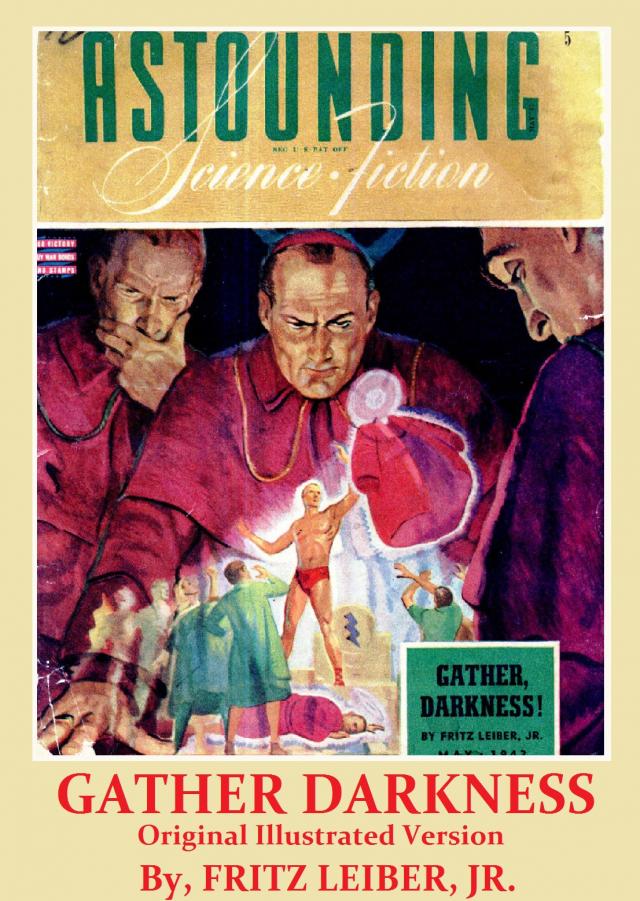
Gather Darkness - Illustrated, page 1


17-12-2023
conversion from the original illustrated story from Astounding
Contents:-
Gather, Darkness! - Part One
II.
III.
IV.
V.
VI
VII.
Gather, Darkness! - Part Two
SYNOPSIS
VIII.
IX
X
XI.
XII.
XIII.
XIV.
XV
Gather, Darkness! - Part Three
SYNOPSIS
XVI.
XVII.
XVIII.
XIX.
XX.
Gather, Darkness!
by Fritz Leiber, Jr.
Gather, Darkness! - From the original serialized story
in Astounding, May, June, and July 1943 –
This version is taken from the original three-part serial published in Astounding Science Fiction magazine over three months in 1943.
A dystopian, satirical depiction of a future theocracy and the revolution that brings it down.
-oOo-
GATHER, DARKNESS! is a science-fiction classic. It tells the story of Armon Jarles, a man on the edge, living amidst the disputes of two rival powers at large in the world. 360 years after a nuclear holocaust ravaged mankind, throwing society back into the dark ages, the world is fraught with chaos and superstition. The new rulers over the masses of humanity are the techno-priests of the Great God, endowed with scientific knowledge lost to the rest of humanity. Jarles, originally of peasant descent, rises to become a priest of the Great God. He knows the gospel propagated by the priests to be a fraud, based on illusion and trickery. Even more offensive to him is the paucity of true believers among the priesthood. One day he rebels against his priestly training and attempts to incite the peasants to rise up and demand freedom, but they are not ready. Jarles is not the only dissenter trying to sabotage and expose the false theocracy of the priesthood witchcraft is slowly gaining strength and support among the populace. about to throw him headlong into the middle of the greatest holy war the world has ever seen.
Gather, Darkness!
by Fritz Leiber, Jr.
Part One of a three-part novel of revolt—revolt against a phony religion founded on scientific miracles. But this revolt was different—it was founded on super-scientific witchcraft! A mad and lovely blend of witchcraft, science, a wry sense of humor—and grim, sudden death.
Illustrated by Kramer
Brother Jarles, priest of the First and Outermost Circle, novice in the Hierarchy, swallowed hard against his churning anger; bent every effort to make his face a mask—not only to the Commoners, for that was something every member of the Hierarchy was taught to do—but to his brother priests as well.
Any priest who hated the Hierarchy as he did during these frightening spasms of rage, must be mad.
But priests could not go mad—at least, not without the Hierarchy knowing, as it knew of everything else.
A misfit then? But a priest was fitted to his job with infinite precision and foresight, the very outlines of his personality measured as if with an atomic probe. A priest could not hate his work.
No, he must be mad. And the Hierarchy must be concealing the fact from him, for its own inscrutable purposes.
Or else—everything to the contrary —he was right.
At the touch of that sickening thought, the Great Square of Megatheopolis seemed to haze and bloat before his eyes, like a moving solidograph out of focus. The Commoners became drab blurs. The priests here and there, scarlet ones, touched with the healthy pink of well-fed faces.
“Hamser Cholm, Commoner of the Fifth Ward! Stand forward, my son.”
Brother Jarles winced. In moods like this, that reedy piping voice grated un-endurably on him—as did every other characteristic and mannerism of Brother Chulian. Why had he been paired with Brother Chulian! Why, for that matter, must priests always work together —never alone, always by twos!
But he knew the reason. It was so they might watch each other, spy on each other, make detailed reports on each other. So that not the slightest action could be hidden. So that the Hierarchy would know of everything.
Fighting every instant to maintain the mask, he turned back. His eyes automatically dodged the fourth face in the queue of Commoners lined up before himself and Brother Chulian.
That fat, blue-eyed, soft-cheeked, shaven priest was consulting the Work Lists, which were printed in primitive style for the benefit of the Commoners, who did not know—and were not supposed to know—anything of reading tapes. Really, there was no reason to hate Brother Chulian especially. Just a rank-and-file priest of the Second Circle. Just a bloated baby.
But you could hate a bloated baby when he exercised over adult Commoners the powers of schoolmaster, minister, and parent.
Only one good thing—this particular job, so distasteful to Jarles, tickled Brother Chulian’s sense of self-importance so much that he was willing to do it all by himself.
The little fat priest looked up from the Work Lists at the stalwart young Commoner nervously twisting a shapeless hat in big, horny hands, pausing every second to wipe one of them against a home-woven smock.
“My son,” he piped benignly, “you are to work for the next three months in the mines. That will reduce your contribution to the Hierarchy to a mere half of your private earnings. You will report here to the appropriate deacon at dawn tomorrow. Hamser Dom!”
The young Commoner gulped, nodded twice, and quickly stepped aside.
Jarles’ anger flared anew. The mines! Worse than the fields, or even the roads! Surely the man must know. And yet, when he had heard, he had looked grateful—that same fawning look the old books were always attributing to a faithful domestic animal of the genus Canis, now extinct.
Jarles wrenched his gaze away, again skipping the same face, now third in line. It was that of a woman.
And this time the Great Square of Megatheopolis, richly shadowed by the sinking sun, did not blur. But it did seem to waver and jerk with his anger, like a moving solidograph when the tapes are feeding unevenly. To master that anger and maintain the mask, to shut out what was happening beside him, he concentrated painfully on each detail. The crowd was thinning. Only the tail-ends of a few wards were still waiting to hear what the Work Lists held in store. Here and there smocked or bloused Commoners—the men in clumsy leggings, the women in heavy skirts—were gathering up the left-overs of homemade goods they had brought to barter or sell, loading them onto their own backs or those of small, burly mules, then trailing off across the Great Square into the narrow, cobbled streets of the Commoners’ Section. Some wore broad-brimmed hats of a coarse felt. Others had already pulled up their hoods, although the chill of evening had not yet arrived.
Looking toward the Commoners’ Section of Megatheopolis, Jarles was reminded of pictures he had seen of the cities of the Black Ages, or Middle Ages—or whatever that period Dawn Civilization had been called. Except that the houses here were mostly one-story and windowless, and everything was very neat and clean. Although he was only a priest of the First Circle, he knew that the resemblance was no coincidence. The Hierarchy did not tolerate coincidence. It had a reason for everything.
An old crone in ragged garments and a peaked hat hobbled past. The other Commoners drew away from her, with suspicious, apprehensive glances. A small boy yelled, “Mother Jujy! Witch! Witch!” shied a stone at her and raced off. But Jarles smiled at her faintly and raised his hand in greeting. And she smiled back—an unpleasant grimacing of wrinkled lips over toothless gums during which her hooked nose and jutting chin seemed about to meet. Then she was on her way again, feeling with her cane for secure places between the cobbles.
In the other direction, Megatheopolis was magically different. For there rose the gleaming buildings of the Sanctuary, topped by the incredible structure of the Cathedral, which fronted the Great Square.
Jarles looked up at the Great God, and for a moment felt fingering through his anger a touch of the same awe and reverence and pious fear that vast idol had used to awaken in him when he was only a Commoner’s child—long before he had passed the tests and begun to learn the Secrets of the Priests. Could the Great God see his blasphemous rage, with those huge, searching, slightly frowning eyes? But such a superstitious fancy was unworthy even of a novice in the Hierarchy.
Without the Great God, the Cathedral was still a mighty structure of soaring columns and peaked windows tall as pine trees. But where one might expect a steeple or a pair of towers, began the figure of the Great God—the upper half of a gigantic human form, terrible in its dignity and serenity. It did not clash with the structure below, but was an integral and indisseverable part of it. The heavy folds of its drapery became the columns of the Cathedral, and it was built of the same smooth plastic.
From where it stood, it dominated all Megatheopolis, like some vast sphinx or unbelievable centaur. There was hardly an alley from which one could not glimpse the stem yet benignant face with the glowing nimbus of blue light.
And as for the Great Square immediately below, one felt that the Great God was minutely studying every pygmy creature that crossed it, as if he could at any moment reach down and pick one up for a closer scrutiny.
As if? Every Commoner knew there was no “as if” about it!
But that massive figure did not rouse in Jarles one atom of pride at the glory an d grandeur of the Hierarchy and his great good fortune in having been chosen to become part of it. Instead, his anger thickened and tightened, becoming an intolerable shell about his emotions—as red and oppressive as the scarlet robe he wore.
“Sharlson Naurya!”
Jarles flinched at the name, chirruped by Brother Chulian. But now the moment had arrive^, he realized he would have to look at her. Not to, would be cowardly. Every novice priest experienced great difficulties before he finally succeeded in breaking all emotional tie3 that linked him to the Commoners—7 to family and friends, and more than friends. Face the fact. Naurya could never mean anything to him.
Nor he to her, he realized with something of a shock as he quickly slewed his head around so that he was looking up into her face. For she did not seem to recognize him or take note of , him, although, save for her robe and shaven pate, he was the same as ever. She stood there quietly, showing none of the cringing nervousness of the men who had gone before. Her hands, calloused by the loom, were folded at her waist. Her face, paler for the masses of dark hair, was without emotion—or else a better mask than his own.
Something—the way she threw her shoulders back—the air of hidden purpose sunk deep, deep in her green eyes —thrust through the” shell of his anger and caught at his heart.
“My little daughter, Naurya,0 Chulian cooed importantly, “I have good news for you. A great honor is yours. For the next six months you are to serve in the Sanctuary.”
There was no change in her expression, no outward indication of her reaction, but it was a few seconds before she replied.
“It is too great an honor. I am unworthy. Such holy work is not for the likes of a simple weaver.”
“That is true,”, said Chulian, judiciously, bobbing his chubby hairless head up and down within the stiff, funnel-like scarlet collar of his robe. “But the Hierarchy may lift up whom it will, even from the ranks of the most humble. They have deemed you worthy for the holy work. Rejoice, my daughter. Rejoice.”
Her voice was as quiet and grave as when she first replied. “But I am still unworthy. I know it in my heart. I cannot do it.”
“Cannot, my daughter?” Abruptly Chulian’s voice became querulously stern. “Do you mean ‘will not’?”
Almost imperceptibly, Naurya nodded. The eyes of the Commoners behind her grew wide, and they stopped their nervous fumblings.
Brother Chulian’s soft little mouth set in an implacable pouting frown. The Work Lists crackled loudly as he clenched them in his red-gloved hand.
“You understand what you are doing, daughter? You understand that you are disobeying a command of the Hierarchy, and of the Great God the Hierarchy serves ?”
“I know in my heart that I am unworthy. I cannot.*’
But this time the nod was very definite. Again Jarles felt something catch inside his ribs.
Chulian bounced up from the bench he shared with Jarles. “No Commoner may question the judgments of the Hierarchy, for they are right! I sense more here than simple stubbornness, more even than sinful obstinancy. There is only one sort of Commoner who would fear to enter the Sanctuary when bidden. “I sense—Witchcraft.” he announced dramatically, and struck his chest with the flat of his hand. Instantly his scarlet robe ballooned out tautly, until it stood a hand’s breath away from his body at every point. The effect was frighteningly grotesque, like some incredible scarlet pouter pigeon. And above his shaven head a violet halo glowed.
There was a sibilant hiss of terror, and the faces of the Commoners grew more pale. But Naurya only smiled very faintly, and her green eyes seemed to bore into Chulian.
“And that, once sensed, is easily discovered !” the swollen little priest continued triumphantly.
He stepped quickly forward. His puffy scarlet glove clutched at her shoulder without seeming quite to touch it, yet Jarles saw her bite her lips against sudden hurt. Then the scarlet glove flirted downward, ripping the heavy smock, so that the shoulder was uncovered.
There were three circular marks on the white skin. Two burned angry red. The other was rapidly becoming so.
Jarles thought that Chulian hesitated a moment and stared puzzlingly at them, before gathering himself and shrilling out, “Witchmarks! Witchmarks! Proof!”
Unsteadily Jarles got to his feet. His anger made him retch, a nauseating pressure. He slapped his own chest, felt the uniform inward pressure of the field at every point of his body, like a bath of warm wax; saw from the corner of his eye the gleam of his halo. Then he launched his fist at Chulian’s neck.
The slow-looking blow did not seem to reach its mark, but Chulian tumbled down and rolled over twice. Even as he rolled, his robe stood out between him and the ground, as if he were inside a rubber ball.
Again Jarles slapped his own chest. His robe went limp and his halo vanished. And in that instant his anger exploded hotly, seeming almost to burn the mask of hypocrisy from his face.
Let them blast him! Let them blind and deafen him with excommunication! Let them drag him screaming to the crypts below the Sanctuary! The Hierarchy had seen fit to let him go mad without interfering. Very well, then! They would have a taste of his own madness!
Jarles sprang onto the bench and held up his hands for attention.
His voice was loud and hoarsely vibrant with anger at last unleashed.
“Commoners of Megatheopolis!”
That checked the beginnings of a panicky flight. Eyes turned to stare at him stupidly. They had not yet begun to comprehend what had just happened. But when a priest spoke, one listened.
“You have been taught that ignorance is good. I tell you it is evil!
“You have been taught that to think is evil. I tell you it is good!
“You have been told that it is your destiny to toil night and day, until your backs ache to breaking and your hands blister under the calluses. I tell you it is the destiny of all men to look for easier ways!
“You have let the priests rule your lives. I tell you that you must rule yourselves!
“You believe that the priests have supernatural powers. I tell you they have no powers you could not wield yourselves!
“You believe that the priests are chosen to serve the Great God and transmit his commands. But—if there is a god anywhere—each one of you, in his ignorant heart, knows more of him than the mightiest archpriest.
“You have been told that the Great God rules the universe—earth and sky. I tell you the Great God is a fake!”
Like whiplashes, the short, sharp sentences flicked into the corners of the Great Square, turned all eyes toward him. The words were not understood, except that they were very different from what the priests ever said. They frightened. They almost hurt. But they tugged irresistibly. Everywhere— even in the work queues—Commoners looked at the nearest priest, and getting no contradictory order, trotted over toward Jarles.
And Jarles now looked around him in bewilderment. He had expected to be silenced at once. His sole object had been to say as much as he could, or rather to let his anger say whatever it wanted to in its brief moment of freedom.
But the blow did not fall. No priest made a move toward him, or acted as if anything out of the ordinary were happening. Like some crazy dream, in which one transgresses all laws and conventions without rebuff or rebuke.
But even as he thought of that, his unquenched anger continued to speak for him.
“Commoners of Megatheopolis, what I am going to ask you to do is harder than you can ever imagine. Harder than work in the mines, though I won’t ask you to lift a finger. I want you to listen to what I say, to weigh my words for the truth in them, to make a judgment as to the worth of what I tell you, and then to act on that judgment. You hardly know what all that means, but you must try to do it, nevertheless! To weigh my words for truth? That’s to see how they square with what you’ve seen happen in your private lives—not what you’ve been told. To make a judgment? That’s to decide whether you want something or not, after you’ve learned what it is. I know the priests have told you all that is wrong. Forget the priests! Forget I wear the scarlet robe. Think of me just as someone talking to you man to man. man to woman. And listen, listen!”


