

The Mutant's Brother (ss), page 1


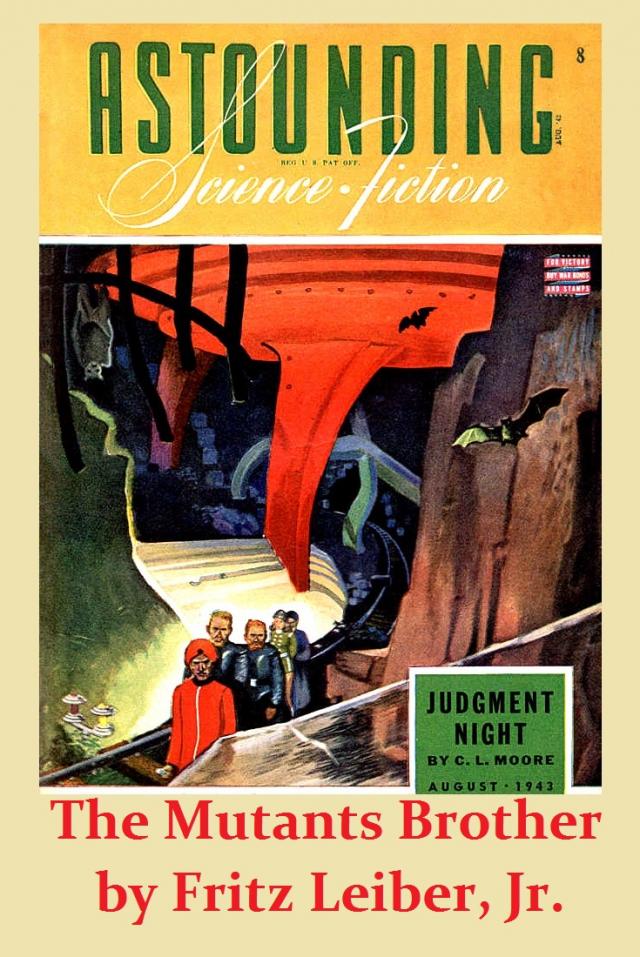
The Mutant’s Brother
by Fritz Leiber, Jr.
Science hasn’t worked on supermen—but with men, environment
can make a lot of difference even between a pair at twins.
If one were “brought up wrong”—the error might be costly!.
Illustrated by Kramer
From : Astounding Science-Fiction, August 1943 – Short Story
Illustrated – Frank Kramer
Twins raised apart from birth have very different, characters—
environment counts a lot. And if the twins are mutants,
with unhuman powers, the application of those powers may
be vastly different.
The cabin of the Steelton airjet was like a long satiny box, hurled miraculously through the night. Inside it, the thunder of the jets was nutted to a soothing rumble. Passengers dozed in the soft gloom, or chatted together in low, desultory voices.
There was comfort in the cabin, and the warmth of human security.
But Greer Canarvon turned away from his fellow passengers and peered out at the wild rack of wind-torn clouds, silvered by a demon moon. Like shadowy monsters they loomed and writhed, now bending close around the airjet, now opening their ranks so that he caught moonlit glimpses of the ragged Dakota Bad Lands.
Out there, he knew, lay his real kinship—with all that is alien and terrible and lonely. With the wild forces of darkness and the unknown. With all that is abnormal and inhuman, though it wear the mask of humanity.
Hunger to be with one of his own kind—a hunger which had never been satisfied—rose to a new pitch of poignancy. He fumbled in his pocket for the radiogram, which already looked creased and old, although it had popped out of the radioprinter only yesterday.
CONSOL SKYGRAMS
EXPRESS BEAM No. 3A-3077-B89
9/17/1973
GREER CARNARVON
209 BUNA TERRACE
COMPTON, OHIO
DEAR BROTHER.
IT IS TIME WE GOT IN CONTACT. IF YOU ARK WHAT I THINK YOU ARE. YOU WILL KNOW WE HAVE MUCH TO TALK ABOUT THAT ONLY YOU AND I CAN UNDERSTAND. THE ADDRESS IS 1532 DAMON PLACE. STEELTON. IF YOU COME, HURRY.
JOHN HALLIDANE
Greer’s heart pounded—that heart whose beating always brought a momentary frown of perplexity to doctor’s faces as they listened to it through their stethoscopes. He felt for’ a cigarette, hut the package was empty. He glanced at his conventional radioactive-driven wrist watch. Half an hour yet to Steelton. An hour perhaps before he got to Damon Place.
His only brother. His twin brother. And, if orphanage records of their striking similarity could be trusted, his identical twin. The only person in the whole world whose chromosomes and genes could carry the pattern of that frightening mutation.
For it must be a mutation. It was unthinkable that his parents could have possessed his powers and still lived such cramped and mediocre lives as the brief records showed. Almost equally unthinkable that such characteristics could have lain dormant in the germ plasm for generations, submerged by dominant factors, to brought to life by one chance mating.
“I’m coming home a clay early to please the wife.” one of the men in the seat ahead was explaining jocularly. “This Carstairs business has made her jumpy.”
“A regular city-wide scare.” agreed his air jet acquaintance. “Glad to be back with the family myself.”
Home, thought Greer bitterly. The familiar, the cozy, the safe, the tried-and-true—all he was now cut off from. Should he lean forward and whisper confidentially, “Speaking of scares, gentlemen, I have certain knowledge that there is a monster on this airjet/’
Though for that matter his own home life had been of the most pleasantly conventional sort. His foster parents were grand people—apparently he’d been luckier than John in that regard. During childhood and adolescence there had l)cen only the most shadowy intimations of what would some day set him so utterly apart. Doctors had frowned at his heartbeat, had puzzled over something in his eyes and an odd tinge in the color of his skin. They had caught fleeting, almost intangible impressions of otherness. But being practical physicians, they had assured themselves that his health was sound, and had gone no further. Or perhaps something—some kind of intuition that shields men from contact with the unnatural—had made them sheer off.
At times he had wondered, with a touch of fear, if there weren’t something different about him. But all children do that.
Otherwise, he had grown up as a healthy, normal child in a favorable environment. His ideals and aims and standards of behavior had been those of the children around him—a little better, perhaps, for his foster father was a very upright man.
And all the while that thing—that power—had been silently breeding in his flesh.
The cabin lurched gently, and the rumble of the jets went a tone deeper, as if some vast organ in space were sounding the opening notes of an awesome prelude. The silvery-smoky cloud monsters swooped close.
Awareness of his power had come with the suddenness of a .thunderclap. Afterward he remembered the splitting headaches he’d had for weeks, and realized that something might have been growing in his brain. Some new organ for which his skull hardly provided space.
Not all characteristics of an individual, whether normal or mutant, need be present at birth. Some, like sexuality, mature late. His power was like that.
He stared at the ragged cloud monsters. They seemed for a moment to be reeling in a wild dance, perhaps in invocation of the spirit of the grotesque and barren landscape the airjet was traversing. A terror of the abnormality lurking in the cosmos possessed him. Evolution was such a coldly and frighteningly inhuman process. Mutation worked by chance. It had no pattern or plan. Usually it only botched the normal organism. Sometimes, though rarely, it brought a slight improvement
But it could, conceivably, give rise to— anything.
He realized he was trembling slightly. His face was a tight mask. He automatically fingered for a cigarette, then remembered that the package was empty and crumpled it. He was frightened of his own power, terrified. It was such a darkly inhuman thing, like a survival from myth or primitive sorcery. That was one of the reasons he had not been able to tell anyone about it. It had such immense potentialities. It made a man a king—much more than a king. It clamored to be used. It tempted him, and he wondered if he would be strong enough to resist temptation.
He must talk to someone about it! In less than an hour, he would be with his brother. It would be easier then. Together they could work out some course of action. If only they could have gone together sooner!
Greer had not always known that he had a brother. When his foster parents took him from the orphanage, his twin had already been adopted by the Hallidanes. Later on his foster parents had tried to bring the two boys together, for a visit at least, but the Hallidanes had rebuffed this friendly suggestion.
There were things which his foster parents had not told him about the Hallidanes—unpleasant things, which he had not only discovered through his recent inquiries at the orphanage. How the Hallidanes had been accused of neglect and cruelty with regard to their adopted son, but had successfully fought a legal action. How—final action of
what must have been a sordid domestic tragedy—the father had murdered the mother and then killed himself.
That had happened a little less than a year ago. Thereafter the orphanage had lost track of John Hallidane.
For a brief moment the soft lights of the cabin winked out. Chilly moonlight, flooding through a gap in the turbulent clouds, transformed his fellow passengers into a company of ghosts, bound on some ominous mission.
Since Greer had first learned that he had a twin, he had indulged in endless speculations about him. lie imagined his twin doing the same things, thinking the same thoughts. Realization that he yas a mutant had changed those speculations into a frantic desire for contact. During the past months he had made every conceivable attempt to pick up his brother’s trail. All had failed. In the end it was his brother who had gotten in touch with him.
Evidently John Hallidane had been kept completely ignorant of the fact that he had a twin, and had only discovered it by chance. Perhaps he had recently recontacted the orphanage.
Again Greer scanned the terse radiogram. He could read something like his own anxiety between the guarded lines. The same hunger for a kindred being. The same fear of being found out by strangers. “If you are what I think you are—”
Anticipation made Greer’s mind almost painfully alive. Speculations about his brother and his brother’s life flashed through it more quickly than he could grasp them. There were a thousand things he wanted to know.
“Well, we should be there in a couple of minutes,” observed one of the men on the seat ahead, reaching for his hat. “Then we’ll be able to get the real dope on this Carstairs business,” he added.
“No doubt of that,” his companion replied with a faint, nervous chuckle. “Everybody in Steelton must be talking about it.”
Only half an hour now—maybe less! As Greer folded the radiogram, he realized that his hands were shaking. His body throbbed—a suffocating feeling.
The muffled thunder of the jets changed to a different key. He pressed his face against the cold transparency of the window. The airjet was slanting down toward a hole in the thinning clouds. Through it, as through a vast reducing glass, he could glimpse the streets and towers of Steelton. A general glow, and the absence of bright points of glaring light, ma de it seem like a spectral city.
For a moment the emotion he felt was not so much eagerness as fear.
“Package of Camdens,” Greer told the girl at the tobacco counter, a tiny bower of garish plastics in the vaulted immensity of the Steelton Terminals.
“Self-lighters?”
He shook his head. While she was getting them, he jerkily tried to analyze what it was that struck him as so peculiar in the behavior of the people around him. There was something set about their expressions, something tense about their movements. They were a little like the robot mannequins parading shimmering garments in the display front opposite. The hum of conversation wasn’t as loud as it should be. The amplified voice of the newscaster rang out too clearly. From the moment he’d landed, the atmosphere of apprehension had been as palpable as fog. Steelton was like a city awaiting attack.
Probably just a reflection of his own nervousness.
Impatiently he turned back toward the counter and caught the girl staring at him fixedly. He took the package from her hand. She smiled, nervously this time. As she was getting his change, she still watched him guardedly.
He lit a cigarette. He heard the newscaster say: “Tonight Police Director Marly assured a committee of Steel-ton citizens that it will only be a matter of time before Robert Carstairs is apprehended. Every police officer is on the alert, said Marly. We have sworn in two hundred deputies. Our nets are closing in. Robert Carstairs’ hours of liberty are numbered.”
Suddenly Greer realized that the hum of conversation and the echoing tramp of footsteps had ceased almost altogether. The girl at the counter turned away to look at the huge telescreen. That was what the rest of them were doing.
“We take this opportunity to repeat a previous statement of Police Director Marly,” continued the newscaster. “It is the duty of every citizen to aid in ridding Steelton of this menace. Robert Carstairs is dangerous. As the terrible tragedy at the Carstairs residence proved only too well, he displays a fiendish talent for ingratiating himself with his victims and subjecting them to his will power. If you sec this man, instantly inform the police.”
Then Greer saw flashed on the telescreen what was. in every detail and particular, a gigantic picture of himself.
What happened next seemed to Greer to happen slow-motion. The girl turned around. Her mouth sucked in air for a scream.
But the scream never came. He exerted his power. He did not see her thoughts—he seldom could see thoughts. He merely exerted his power. She stood there, staring woodenly.
Ducking his head so that half his face was masked by hat brim, he walked away rapidly. He could hold her for perhaps a hundred feet. By that time—
A big man carrying a black suitcase looked at him sharply, then looked again. He dropped the suitcase. He turned on Greer, his hands coming up to grab.
But they never grabbed. Under Greer’s control, he picked up the suitcase and walked on.
Several people noticed the incident. They peered at Greer curiously. First two of them, then three, he had to bring under his control, as he saw that they recognized him as the man they had seen on the telescreen. He didn’t know how many he could dominate, because he had never tried. Not more than four or five, he had the feeling.
From behind came a piercing scream, as the girl at the tobacco counter escaped from his influence.
The way everyone jumped at that scream gave him an idea. Distraction. There was a young man approaching in a gray coat and hat not unlike his own. Just as the number of people who recognized him was getting beyond his control. he caused the young man to break into a run. and sent three people after him yelling. “There he goes! There lie goes!” Then he continued toward the exit.
He felt a profound thrill of satisfaction. It was good to have to use his power without having time to be afraid of it. to think, to weigh the consequences. He walked purposefully, eyes searching the crowd ahead for the telltale signs of recognization, exerting control when he saw them.
Here and there behind him men and women awoke with a jerk—to fear and to the disquieting realization that four or five seconds had vanished unaccountably. They had seen the archcriminal Robert Carstairs. They had been about to do something. Then he had suddenly vanished—as if life were a film and the film had jumped a couple of feet ahead. Had it been an hallucination? Or—what sort of being was this Robert Carstairs. There were stories—stories which the newscasters played down. Around their hearts twined the tendrils of an icy terror.
A surging agitation followed Greer through the crowd, like a wave that lapped at his heels but never quite caught up. He was constantly shifting control from one group of persons to another.
The young man in the gray coat and hat came to himself and began to make profuse, bewildered apologies to an elderly woman he had careened into. His pursuers stopped and stared around, as baffled as he. Individual communicators clicked an alert to the police and detectives stationed in the terminals, as an observer in the gallery sought to fathom the nature of the commotion.
Greer was nearing the exit. But the agitation was increasing, and more and more it was centering around him, casing in. Too many people were staring at him. The situation was getting beyond his control. If he had to hold off a dozen at once, he was done for. Five or six was the limit.
He changed his tactics—caused four men to form a cordon around him, shielding him from view. He had them walk briskly and assume important, official-looking expressions, so that people got out of their way.
There were two policemen at the exit, trim in blue and silver, suspicious-eyed. But as they came within range of Greer’s power, their expressions became first blank, then different. They opened the doors for him. He slipped away from his cordon. He kept control of the policemen, causing them to stand at the exit and block off any possible pursuit.
There was a sleek black monocab cruising past the Terminals. He summoned it to the curb. It gave to bis weight as he sprang aboard. The gyro brought it smoothly back to even keel as it lunged ahead.
Under his control, the driver turned several corners at random, then headed for the rendezvous at Damon Place.
Since Steelton was a young metropolis, indirect street lighting was the rule. The result was ghostly, unreal— a shadowless city half materialized from the night. It seemed to Greer that there were unusually few people abroad. None of them loitered. Their taut apprehensiveness was more marked even than that of the crowd at the Terminals.
The monocab purred like a satiny cat. Greer felt himself slipping into a mood of black reaction. There was something fundamentally loathsome about using people like puppets. You didn’t know where to stop.
Was that what had happened to his twin ? Had he yielded to the temptation to use his mutant power to his own aggrandizement, make people his pawns ?
Greer’s mind veered away from the possibility. Much more likely, he told himself, that his twin had gotten into trouble by unwisely revealing his power. That was enough to make people hate you, fear you, fabricate hysterical accusations, lay all manner of crimes at your door. How else could you expect people to behave toward a mutant with the power of direct hypnotic control?
Yet why the change of name from Hallidane to Carstairs? Why— He fought the ugly suspicions that crowded up into his mind. Partly from unreasoning loyalty. Partly because he so ached for contact with his own kind, that he could not bear to think of anything standing between them. His brother’s attitudes must be like his own!
A police monocar droned past. Greet; ducked his head, acutely aware that, whatever predicament his brother was in, he was in it, too. For the present, there were two Robert Carstairs in Steelton.
Of course, if he had to, he could prove his identity. Or could he? Steelton’s panic was of the hysterical, shoot-on-sight sort. And suppose he did prove that he was Robert Carstairs’ identical twin. Wouldn’t that only mean two monsters to be exterminated instead of one?


