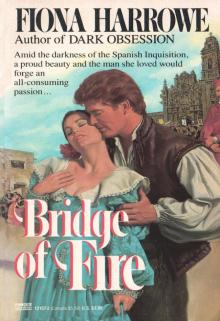
Bridge of Fire, page 28


He and Francisca were careful about the subject of religion, stepping around it with caution. Neither had realized that the events of the past year had changed them. They had become less narrow, less zealous in their beliefs and more willing to compromise. Then one afternoon as they were standing on deck discussing New Amsterdam, Miguel said, “We’ll start a fresh life, Francisca. I still hope to get an annulment from my wife. We’ll marry, have children, half-Jew, half-Christian. Let them decide when they are grown which or both.”
From Miguel this was a concession Francisca had always hoped for. For a few moments she could only stare at him, her lips parting in a slow smile. Then she flung herself at him, kissing him again and again, overcome with joyful gratitude—the bridge had been crossed, and the last obstacle between them had vanished.
“Well!” he exclaimed, holding her at arm’s length. “What is this all about?”
“Come, let me show you,” she said.
The cot was narrow and lumpy, but the lovers hardly noticed. Naked, hip to thigh, they rediscovered all the places that thrilled to touch and kiss, their mutual passion lighting old fires that burned with a new flame. Had they been separated a day or a thousand years, it would have been the same, her black hair tumbling on his breast, the pink lips parted in gasps of ecstasy, the baritone murmurs of delight, the fierce, generous, all-consuming, passionate taking and giving of love. Together they soared into a world that was their own, a man and a woman whose love had been forged through pain and tragedy, losing themselves in each other for a handful of precious time. Later, lying spent in each other’s arms, Francisca, looking up into her lover’s face, saw a sudden shadow cross it.
“What is it, sweet?”
“I was thinking how like you Jorge looks.”
Always that memory, always that shadow.
Ten years had gone by.
In New Amsterdam the del Castillos prospered. They were married now. (News of Miguel’s wife Ana’s death had reached them just as Miguel was about to set sail for Spain.) They had been blessed with three children: a boy, Pablo; his brother, Pedro; and a girl, Mariana, named after Francisca’s mother.
It was after the arrival of the second boy that Miguel had taken passage to Tampico. Traveling the overland route on muleback to Zacatecas, he had gone in search of Jorge again, only to find that there had been a massacre of the Chichimecs in that area, and that Jorge was counted among the dead. Narrowly escaping a trap set by an agent of the Inquisition who had been informed that Miguel was in Mexico, he returned home, sadly resigned to never seeing his son again.
Through luck, skill, and a series of wise investments in profitable cargoes, Miguel had become master of his own ship, the Doña Francisca. He and his family lived in a large brick house with a tiled roof and true glass windows curtained in linen. The furnishings, from the Russian leather chairs and French nutwood cupboards (or hastens) to the paintings by Jan Steen (one of Francisca hung over the foreroom’s fireplace), were similar to those to be seen in other well-to-do households.
When Francisca and Miguel, in his infrequent stops at home, entertained, or were entertained, Francisca wore gowns of silk, sarcenet, velvet, or satin, the detachable wrist-length sleeves made of lacy Holland ruffles. Her wardrobe held dresses in colors that were fashionable for the day-scarlet, purple, fawn, and ash gray. She wore gold bodkins in her black, glossy hair, diamonds on her fingers and in her earlobes, and around her neck a gold chain with a chased locket bearing Miguel’s coat of arms.
Meanwhile, New Amsterdam had become New York, with the English taking over the colony from Peter Stuyvesant on orders from James I in a brash, bloodless move. The colony became even more heterogeneous, although there were still few Jews and Catholics. But Miguel managed to find a priest who conducted mass in a private home, and Francisca attended services—also in a private home—during the High Holidays, finding to her astonishment that the celebration in Mexico City had been only a faint echo of prescribed ritual.
They were a happy family. Miguel and Francisca were still very much in love. Because Miguel was out at sea for such long stretches, his homecomings were all the dearer, their lovemaking a turbulent, passionate reunion as if they were again bedding for the first time.
Only Jorge’s death remained in their memories, the one small cloud in their sky.
One day Miguel arrived home from a voyage where he had taken on cargo from Bermuda. With him was a young boy of about sixteen. Miguel had found him working as a bound servant in Hamilton for a surgeon.
Francisca did not have to be told who the boy was.
Though he stood straight and tall, his expression was shy, a little bewildered. And Francisca, overcome with emotion, her eyes filling with tears, suddenly felt shy, too. Her baby, her little boy, grown almost to manhood! She looked at Miguel, whose eyes were also suspiciously moist, then back to Jorge, whose lips twitched as if he did not know whether to smile or to cry.
“Jorge,” Francisca whispered. And with the sound of his spoken name, the awkward silence was broken. Through a veil of tears the mother reached out and embraced the son she had thought she had lost forever, taking him to her heart, holding and cradling him. “Jorge, oh, Jorge.”
Did he remember her? “Oh, yes.” His Spanish was halting. “And Papá, too.”
It seemed that Jorge’s Indian abductors had been killed in a Spanish raid when the boy was ten. The leader of the raid, having taken Jorge prisoner, had sold him to the captain of a ship, who in turn had bound him over to the surgeon on Hamilton.
“That is the bare bones of the story,” Miguel said to a tearful Francisca and the other children who had gathered around to stare at their long lost brother. “There is more, much more.”
“Ah, but loves,” Francisca said, kissing each of her children and lastly Miguel, whose strong arm circled her waist, “we have a lifetime ahead for the telling.”
Fiona Harrowe, Bridge of Fire