

J. A. Taylor, page 1


The Project Gutenberg EBook of Far from Home, by J.A. Taylor This eBook is for the use of anyone anywhere at no cost and with almost no restrictions whatsoever. You may copy it, give it away or re-use it under the terms of the Project Gutenberg License included with this eBook or online at www.gutenberg.org Title: Far from Home Author: J.A. Taylor Release Date: November 8, 2007 [EBook #23408] Language: English Character set encoding: ISO-8859-1 *** START OF THIS PROJECT GUTENBERG EBOOK FAR FROM HOME *** Produced by Greg Weeks, LN Yaddanapudi and the Online Distributed Proofreading Team at http://www.pgdp.net
[64]
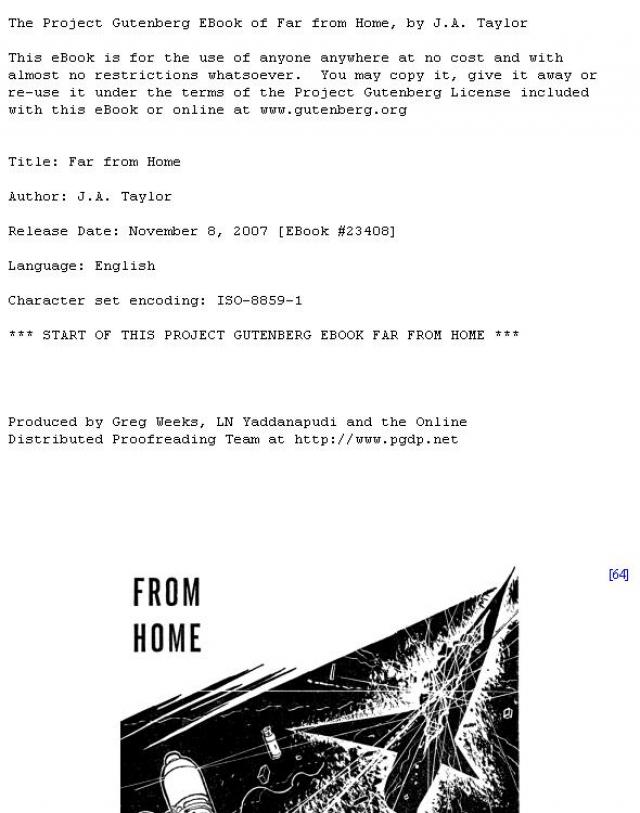
FAR FROM HOME
BY J. A. TAYLOR
Illustrated by Emsh
“Far” is strictly a relative term. Half a world away from home is, sometimes, no distance at all!
* * *
[65]
Someone must have talked over the fence because the newshounds were clamoring on the trail within an hour after it happened.
The harassed Controller had lived in an aura of “Restricteds,” “Classifieds” and “Top Secrets” for so long it had become a mental conditioning and automatically hedged over information that had been public property for years via the popular technical mags; but in time they pried from him an admittance that the Station Service Lift rocket A. J. “Able Jake” Four had indeed failed to rendezvous with Space Station One, due at 9:16 Greenwich that morning.
The initial take-off and ascent had gone to flight plan and the pilot, in the routine check-back after entering free flight had reported no motor or control faults. At this point, unfortunately, a fault in the tracking radar transmitter had resulted in it losing contact with the target. The Controller did not, however, mention the defection of the hungover operator in fouling up the signal to the standby unit, or the consequent general confusion in the tracking network with no contact at all thereafter, and fervently hoped that gentlemen of the press were not too familiar with the organization of the tracking system.
At least one of the more shrewd looking reporters appeared as though he were mentally baiting a large trap so the Controller, throwing caution to the winds, plunged headlong into a violent refutal of various erroneous reports already common in the streets.
Able Jake did not carry explosives or highly corrosive chemicals, only some Waste Disposal cylinders, dry foodstuffs and sundry Station Household supplies.
Furthermore there was no truth in the oft-revived rumors of weaknesses in the so-called “spine-and-rib” construction of the Baur and Hammond Type Three vessel under acceleration strain. The type had been discontinued solely because the rather complicated structure raised certain stowage difficulties in service with overlong turnabout times resulting.
There may have been a collision with a meteor he conceded, but, it was thought, highly unlikely. And now, the urgent business of the search called, the Controller escaped, perspiring gently.
Able Jake was sighted a few minutes later but it was another three hours before a service ship could be readied and got away without load to allow it as much operating margin as possible. Getting a man aboard was yet another matter. At this stage of space travel no maneuver of this nature had ever been accomplished outside of theory. Fuel-thrust-mass ratios were still a thing of pretty close reckoning, and the service lift ships were simply not built for it.
The ship was in an elliptical orbit and a full degree off its normal course. A large part of the control room was demolished and there was a lengthy split in the hull. There was no sign of the pilot and some [66] of the cargo was missing also. The investigating crew assumed the obvious and gave it as their opinion that the pilot had been literally disintegrated by the intense heat of the collision.
The larger part of the world’s population made it a point to listen in on the first space burial service in history over the absent remains of Johnny Melland.
* * *
Such a small thing to cause such a fury. A mere twenty Earth pounds of an indifferent grade of rock and a little iron, an irregular, ungraceful lump, spawned somewhere a billion years before as a star died. But it still had most of the awesome velocity and inertia of its birth.
Able Jake, with the controlling influence of the jets cut, had yawed slightly and was now traveling crabwise. The meteor on its own course, a trifle oblique to that of the ship, struck almost directly the slender spring steel spine, the frightful energy of the impact transmuted on the instant into a heat that vaporized several feet of the nose and spine before the dying shock caused an anguished flexing of the ship’s backbone; thrust violently outward along the radial members and so against the ribs and hull sheathing on that side. Able Jake’s hull split open like a pea pod for fully half its length and several items of its cargo burst from their lashings, erupted from the wound.
Johnny was not inboard at the time, but floating, spacesuited alongside, freeing a fouled lead to the radar bowl, swearing occasionally but without any real passion at the stupidity of the unknown maintenance man who failed to secure it properly. For some odd reason he had never quite lost the thrill of his first trip “outside,” and, donning pressure suit with the speed of long practice, sneaked as many “inspections” as possible, with or without due cause.
The second’s fury that reduced the third stage of a $5,000,000 rocket to junk was evident to him only as a brilliant blue-white flash, a hammer-like shock through the antennae support that left his wrist and forearm numb. Then a violent wrench as a long cylinder, expelled from the split hull, caught the loop of his life line and dragged him in till he clashed hard against it, the suddenly increased tension or a sharp edge parting the line close to the anchored end. He clawed blindly for a hold, found something he could not at that moment identify and hung on.
For a short time his vision seemed dulled and that part of his mind, trained to the quick analysis of sudden situations groped but feebly through a haze of shock to understand what had happened. Orienting himself he found he was gripping a brace of the open-mounted motor on one of the Waste Disposal Cylinders. About him he could see other odd items of the cargo, some clustering fairly closely, others just perceptibly drifting farther away. To one side, or “downwards” the Earth rolling vastly, pole over pole, and with her [67] own natural rotation giving an odd illusion of slipping sideways from under him.
Only a sudden sun glint on the stubby swept-back wings showed him where Able Jake was. Far away—too far, spinning slowly end over end. His sideways expulsion from the ship then had been enough to give him and his companion debris a divergent course.
Spacemen accept without question the fact of a ship or a station always at hand with a safety man on watch at all times over those outside and a “bug” within signaling distance constantly. They do not conceive of any other state of affairs.
Now Johnny had to face the fact that he was in such a position—entirely and utterly alone, except for the useless flotsam that came with him. He might have flung himself into a mad chase after the ship on his suit jets except that the thought of leaving his little island, cold comfort though it was, to plunge into those totally empty depths was suddenly horrible.
The tide of panic rose within him. He knew the sickening bodily revolt of blind unreasoning terror—the terror of the lost, the terror of certain untimely death, but mostly of death so dreadfully alone.
He might have gone insane. In the face of the insoluble problem his mind might have retreated into a shadow world of its own, perhaps to prattle happily the last few hours away. But there was something else there. The pre-flight school psychiatrist had recognized it, Johnny himself probably wouldn’t have and it wasn’t their policy to tell him. It saved him. The labored heart pounding and the long shuddering gasps slowed in time and with the easing of his physical distress he found enough heart to muster a wry little smile at the thought that of the castaways of history he at least stood fair to be named the most unique.
* * *
And after a while, shaking himself mentally, a little ashamed of his temporary fall from grace, he followed the example of the more intelligent of his predecessors and settled down to itemize his assets, analyze his position and conjecture the chances of survival.
Item: He was encased in a Denby Bros. spacesuit, Mark III, open space usage, meant for no gravity use. Therefore it had no legs as such, the lower half being a rigid cylinder allowing considerable movement within and having a swivel mounted rocket motor at its base controlled by toe pedals inside.
The upper half, semiflexible with jointed arms ending in gloves from which by contorting the shoulders the hands could be withdrawn into the sleeves when not in use.
A metal and tinted plastic helmet with earphones, mike and chin switch. An oxy air-conditioning and reprocessing unit with its spare pure oxygen tank; on this he could possibly depend for twelve hours given no undue exertion and with the most rigid economy all the time.
[68] The power pack for suit operation and radio had a safety margin of one hour over the maximum air supply, if the radio wasn’t used. At this time Johnny couldn’t see much use for it.
Item: One Waste Disposal Cylinder, expendable, complete with motor and full fuel tanks, packed, according to his loading manifest with sundry supplies to avoid dead stowage space. Seldom used, since most station waste was ferried down in the otherwise empty service ships, they occasionally handled certain laboratory refuse it was considered best to destroy in space. The cylinders were decelerated and allowed to fall into atmosphere where the friction of the unchecked plunge burned up what the magnesium charge inside had not already. The re st of the shipwrecked material had by now drifted beyond easy reach and Johnny did not feel like wasting fuel rounding it up.
Position? A matter of memory and some guesswork by now. Some ten minutes out of powered flight at the time of collision, coasting up to station orbit where a quick boost from the jets would have made up his lost velocity to orbit standard. But there would be no boost now. So he’d just fall off around the other side, falling around and into Mother Earth, to skim atmosphere and climb on past and up to touch orbit altitude—and down again. A nice elliptical orbit, apogee a thousand odd miles, perigee, sixty-seventy—perhaps. How much speed had he left? How long would it be before he brushed the fringe of atmosphere once too often and too deep? Just another meteor.
And survival. A comparatively simple problem since the mechanics of it were restricted by a simple formula in which his role would seem to be a passive one. To survive he must be rescued by his own kind in twelve hours or less. To be rescued he must be seen or heard. Since his radio was a simple short-range intercom it followed that he must be seen first and heard later. Being seen meant making a sufficiently distinguishable blip on somebody’s radar screen to arouse comment over a blip where, according to schedule no orbiting blip should be.
* * *
Johnny was painfully aware that the human body is very small in space. The cylinder would be a help but he doubted it would be enough. Then he thought of the material inside the cylinder. He pried back the lugs holding the cover in place with the screwdriver from his belt kit. He started pulling out packages, bags, boxes, thrusting them behind him, above him, downwards; cereals, ready mixed pastries, bundles of disposable paper overalls—toilet paper! He worked furiously, now stuck halfway down the cylinder, kicking the bundles behind him. He emerged finally in a flurry of articles clutching a large plastic bag that had filled the entire lower end of the tank.
About him drifted a sizable cloud of station supplies, stirring sluggishly after his emergence. He pushed them a bit more, distributing them as much[69] as possible without losing them altogether.
Johnny tore open the big bag and was instantly enveloped in clinging folds of ribbon released from the pressure of its packing. He knew what it was now, the big string of ribbon chutes for the Venus Expedition, intended for dropping a remote controlled mobile observer to the as yet unseen and unknown surface. Johnny had ferried parts of the crab-like mechanical monster on the last run, and illogically found himself worrying momentarily over the set-back to the Probe his mischance would cause.
But in the next minute he was making fast the lower end of the string to the WD cylinder, then, finding the top chute he toed his pedals and jetted himself out, trailing the string out to its full extent.
Now the period of action was over and he had done all he could, Johnny found himself dreading the time of waiting to follow. He would have time for thinking, and thinking wasn’t profitable under the circumstances unless it were something definitely constructive and applicable to his present and future well-being. Waiting was always bad.
Surely they would find him soon. Surely they would press the search farther even when they found Able Jake as they couldn’t fail to in time.
A tightness started in his throat. Johnny quickly drowned the thought in a flood of inconsequential nonsense, a trick he had learned as a green pilot. He might sleep though, if sleep were a possible thing in this cold emptiness. No one, to his recollection, had ever done so outside a ship or station—the space psychology types would be interested doubtless.
* * *
Johnny tied his life line to the WD cylinder and then jetted clear of his artificial cloud, positioning himself so that it formed a partial screen between himself and the sun. He turned his oxygen down to the bare minimum and the thermostat as low as he dared. He commenced a relaxation exercise and was pleased when it worked after a fashion—a mental note for Beaufort at the station. A drowsiness crept over him, dulling a little the thin edge of fear that probed his consciousness.
Face down towards the earth he hung. The slow noise of his breathing only intensified the complete silence outside. The well padded suit encompassed him so gently there was no sense of pressure on his body to make up for the weightlessness. Johnny felt as though he were bodiless, a naked brain with eyes only hanging in nothingness.
Beneath, Earth rolled over with slow majesty, once every two hours. His altered course was evident now, passing almost directly over the geographic poles proper instead of paralleling the twilight zone where night and day met. Sometimes he caught the faint glow of a big city on the night side but the sight only stirred the worm of anxiety and he closed his eyes.
Johnny was beginning to feel very [70] comfortable. He supposed sleepily that this was the way you were assumed to feel while freezing to death in a snowbank, or so he’d heard. Air and heat too low perhaps. He should really turn it up a notch.
On the other hand it was perhaps a solution to the problem of dying—a gentle sleep while the stomach was still full enough from the last meal to be reasonably comfortable and the throat yet unparched. Would it be the act of an unbalanced mind or one of the most supreme sanity?
He dozed and dreamed a bit in fragments and snatches but it was not a good sleep—there was no peace in it. At one time he seemed to be standing outside the old fretworked boarding house he lived in—looking in at the window of the “sitting room” where the ancient, wispy landlady sat among her antimacassared chairs and the ridiculous tiny seashell ashtrays that overflowed after two butts. He wanted desperately to get in and sprawl in the huge bat-winged chair by the fire and stroke the enormous old gray cat that would leap up and trample and paw his stomach before settling down to grumble to itself asthmatically for hours.
It was cold and dark out here and he wanted to get in to the friendliness and the warmth and the peaceful, familiar security, but he didn’t dare go around to the door because he knew if he did the vision would vanish and he’d never find it again.
He scratched and beat at the window but his fingers made no sound, he tried to shout but his cries were only strangled whispers and the old lady sat and rocked and talked to the big gray cat and never turned her head.
The fire seemed to be flaring up suddenly, it was filling the whole room—a monstrous furnace; it shouldn’t do that he knew, but the old lady didn’t seem to mind sitting there rocking amid the flames—and it was so nice and warm. The fire kept growing and swelling though—soon it burst through the window and engulfed him. Too hot. Too hot.
* * *
Johnny swam hazily back to consciousness with an aching head and thick mouth. He saw that he had drifted clear of his protective screen somehow and the sun beat full on him. With clumsy, fumbling hands that seemed to belong to somebody else he managed the air valve; the increased oxygen reviving him enough to find the pedals and jet erratically about till he gained the shadow once more.
Now he was entering upon the worst phase of the living nightmare. Awake, the doubts and fears of his position tormented him; wearied, he feared to sleep, yet continually he found himself nodding only to jerk awake with that suddenness that is like a physical blow. Each one of these awakenings took away a little more of his self-control till he was reduced to near hysteria, muttering abstractly, sometimes whimpering like a lost child; now seized with a feverish concern for his air supply. He would at one instant cut it down [71] to a dangerous minimum, then, remembering the near disaster of his first attempt at economy, frantically turn it up till he was in danger of an oxygen jag. In a moment he would forget and start all over again.
In addition, he was now realizing bitterly what he had subconsciously denied to himself for so long, that they had found Able Jake and drawn the obvious conclusion. That he had been obliterated or blown out through the hull by the collision without warning or preparation. That he was undoubtedly dead if not vaporized altogether and, as they must, considering the expense of a probably fruitless search, abandon him.
There came the moment when Johnny accepted this in full. This was directly after the time when, sliding down the long hill to the perigee of his orbit, he turned on his radio and cried for help. It was a bare hundred miles or less to that wonderful world below, but there was the Heaviside layer, and the weak signals beat but feebly against it. All that seeped through by some instant’s freak of transmission was a fragment of incoherent babble to reach the uncomprehending ear of an Arkansas ham and give that gentleman uneasy sleep for some time to come.


