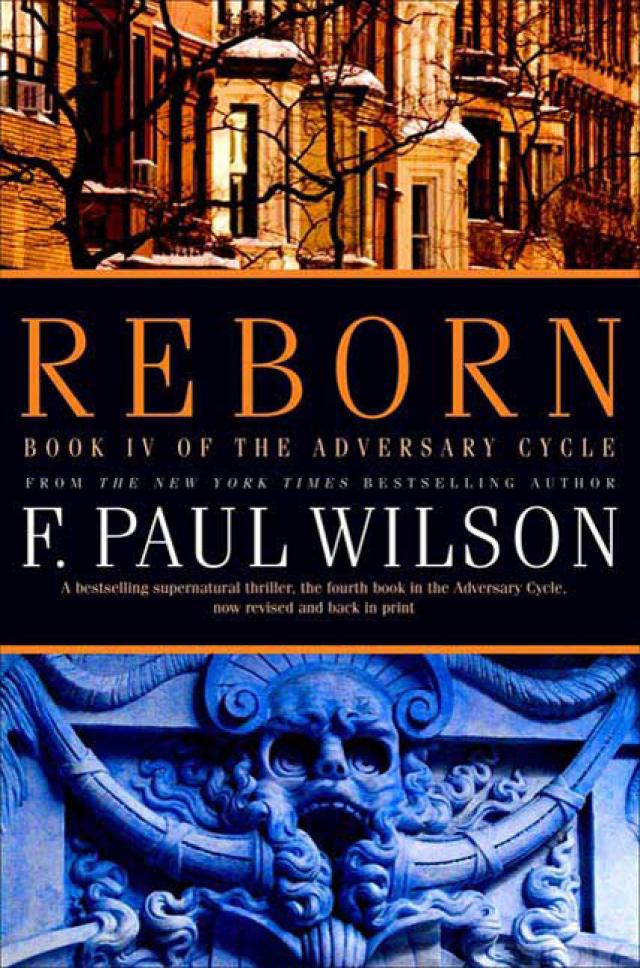
Reborn, page 1


PRAISE FOR THE ADVERSARY CYCLE
The Keep
“Spellbinding, chilling, bloodcurdling.”
—Seattle Post-Intelligencer
“One of the few really satisfying horror novels of the year…it has true fear in it.”
—Peter Straub
The Tomb
“A riveting combination of detective story and horror fiction…This thriller is fast-action fun!”
—Publishers Weekly
“F. Paul Wilson weaves spells with words.”
—Dean Koontz
The Touch
“A superior supernatural excursion from the author of The Keep and The Tomb…Hair-raisingly plausible ideas, winningly developed, set in a well-paced, gripping narrative. His best so far.”
—Kirkus Reviews
“[Not] a horror novel in the usual sense, and variations on this idea have been used before, but rarely with the skill and entertainment value of this fine novel.”
—San Francisco Chronicle
Reprisal
“First-class…Wilson’s most gripping yet, with his strongest characterizations.”
—Kirkus Reviews
“Very unsettling…scary…one of Wilson’s best.”
—San Francisco Chronicle
ALSO BY F. PAUL WILSON
The Adversary Cycle*
The Keep
The Tomb
The Touch
Reprisal
Nightworld
Repairman Jack Novels*
The Tomb
Legacies
Conspiracies
All the Rage
Hosts
The Haunted Air
Gateways
Crisscross
Infernal
Harbingers
Bloodline
By the Sword
Ground Zero
Young Adult*
Jack: Secret Histories
Jack: Secret Circles
Other Novels
Healer
Wheels Within Wheels
An Enemy of the State
Black Wind*
Dydeetown World
The Tery
Sibs
The Select
Implant
Deep as the Marrow
Mirage (with Matthew J. Costello)
Nightkill (with Steven Spruill)
Masque (with Matthew J. Costello)
The Christmas Thingy
The Fifth Harmonic
Sims
Midnight Mass
Short Fiction
Soft and Others
The Barrens and Others*
Aftershock & Others*
Editor
Freak Show
Diagnosis: Terminal
*See “The Secret History of the World”
REBORN
F. Paul Wilson
A TOM DOHERTY ASSOCIATES BOOK
New York
For William Sloane,
the early brewer of science with the supernatural
REBORN
CONTENTS
PROLOGUE
CHAPTER ONE
CHAPTER TWO
INTERLUDE ON CENTRAL PARK WEST I
CHAPTER THREE
INTERLUDE ON CENTRAL PARK WEST II
CHAPTER FOUR
CHAPTER FIVE
CHAPTER SIX
CHAPTER SEVEN
CHAPTER EIGHT
CHAPTER NINE
CHAPTER TEN
CHAPTER ELEVEN
CHAPTER TWELVE
CHAPTER THIRTEEN
CHAPTER FOURTEEN
CHAPTER FIFTEEN
CHAPTER SIXTEEN
CHAPTER SEVENTEEN
CHAPTER EIGHTEEN
CHAPTER NINETEEN
CHAPTER TWENTY
CHAPTER TWENTY-ONE
CHAPTER TWENTY-TWO
CHAPTER TWENTY-THREE
CHAPTER TWENTY-FOUR
INTERLUDE ON CENTRAL PARK WEST III
EPILOGUE
THE SECRET HISTORY OF THE WORLD
PROLOGUE
Sunday
February 11, 1968
1
He was calling himself Mr. Veilleur these days—Gaston Veilleur—and tonight he found it difficult to sleep. A remote uneasiness made him restless, a vague malaise nettled his mind, stirring up old memories and ancient nightmares. But he refused to give up the chase. He measured his breathing and soon found the elusive prey within his grasp. But just as he was slipping off, something dragged him back to full wakefulness.
Light. From somewhere down the hall. He lifted his head to see. The glow came from the linen closet. Blue-white radiance was streaming out along the edges of the closed door.
Moving carefully so as not to awaken his wife, Mr. Veilleur slipped out of bed and padded down the hall. His joints creaked in protest at the change in position. Old injuries, old wounds, reminders of each hung on, sounding little echoes from the past. He knew he was developing arthritis. No surprise there. His body looked sixty years old and had decided to begin acting accordingly.
He hesitated a moment with his hand on the knob of the closet door, then yanked it open. The very air within seemed to glow; it flowed and swirled and eddied, like burning liquid. But cold. He felt a chill as it splashed over him.
The source—what was causing this? The light seemed most intense in the rear corner of the bottom shelf, under the blankets. He reached down and pulled them away.
Mr. Veilleur bit back a cry of pain and threw an arm across his eyes as the naked brilliance lanced into his brain.
Then the glow began to fade.
When his eyes could see again, when he dared to look again, he found the source of the glow. Tucked back among the towels and sheets and blankets was what appeared to be a huge iron cross. He smiled. She’d saved it. After all these years, she still hung on to it.
The cross still pulsed with a cold blue radiance as he lifted it. He gripped the lower section of the upright with two hands and hefted it with an easy familiarity. Not a cross—a sword hilt. Once it had been gold and silver. After serving its purpose, it had changed. Now it was iron. Glowing iron.
Why? What did this mean?
Suddenly the glow faded away, leaving him staring at the dull gray surface of the metal. And then the metal itself began to change. He felt its surface grow coarse, saw tiny cracks appear, and then it began to crumble. Within seconds it was reduced to a coarse powder that sifted and ran through his fingers like grains of sand.
Something has happened. Something has gone wrong! But what?
Slightly unnerved, Mr. Veilleur stood empty-handed in the dark and realized how quiet the world had become. All except for the sound of a jet passing high overhead.
2
Roderick Hanley twisted in his seat as he tried to stretch his cramped muscles and aching back. It had been a long flight from L.A., and even the extra width in first class cramped his big frame.
“We’ll be landing shortly, Dr. Hanley,” the stewardess said, leaning close to him. “Can I get you anything before we close the bar?”
Hanley winked at her. “You could, but it’s not stocked in the bar.”
Her laugh seemed genuine. “Seriously, though…”
“How about another gimlet?”
“Let’s see.” She touched a fingertip to her chin. “‘Four-to-one vodka to lime with a dash of Cointreau,’ right?”
“Perfect.”
She touched his shoulder. “Be right back.”
Pushing seventy and I can still charm them.
He smoothed back his silvery hair and squared his shoulders inside the custom-made British tweed shooting jacket. He often wondered if it was the aura of money he exuded or the burly, weathered good looks that belied his years. He was proud of both, never underestimating the power of the former and long since giving up any false modesty about the latter.
Being a Nobel Prize winner had never hurt either.
He accepted the drink from her and took a healthy gulp, hoping the ethanol would calm his jangled nerves. The flight had seemed interminable. But at last they were approaching Idlewilde. No, it was called Kennedy Airport now, wasn’t it. He hadn’t been able to get used to the name change. But no matter what the place was called, they’d be safely down on terra firma shortly.
And not a moment too soon.
Commercial flights were a pain. Like being trapped at a cocktail party in your own house. If you didn’t like the company you couldn’t just up and leave. He much preferred the comfort and convenience of his private Learjet where he could call all the shots. But yesterday morning he’d learned that the plane would be grounded for three days, possibly five, waiting for a part. Another five days in California among those Los Angeleans who were all starting to look like hippies or Hindus or both was more than he could tolerate. So he’d bitten the bullet and bought a ticket on this Boeing behemoth.
For once—just this once—he and Ed were traveling together.
He glanced at his traveling companion, dozing peacefully beside him. Edward Derr, M.D., two years younger but looking older, was used to this sort of travel. Hanley nudged him once, then again. Derr’s eyes fluttered open.
“Wh-what’s wrong?” he said, straightening up in his seat.
“Landing soon. Want something before we touch down?”
Derr rubbed a hand over his craggy face. “No.” He closed his eyes again. “Just wake me when it’s over.”
“How the hell can you sleep in these seats?”
“Practice.”
Thirty years o f regular attendance together at biological and genetic research conferences all over the world, and never once had they traveled on the same plane. Until today.
It would not do to have the pair of them die together.
Certain records and journals in the Monroe house were not yet ready for the light of day. He couldn’t imagine any time in the near future when the world would be ready for them. Sometimes he wondered why he didn’t simply burn them and have done with the whole affair. Sentimental reasons, he guessed. Or ego. Or both. What ever the reason, he couldn’t seem to bring himself to part with them.
A shame, really. He and Derr had made biological history and they couldn’t tell anybody. That had been part of the pact they’d made that day in the first week of 1942. That and the promise that when one of them died, the other would immediately destroy the sensitive records.
After more than a quarter century of living with that pact, he should have been accustomed to it. But no. He’d been in a state of constant anxiety since takeoff. But at last, the trip was over. All they had to do was land. They’d made it.
Suddenly came a violent jolt, a scream of agonized metal, and the 707 tilted to a crazy angle. Someone behind them in the tourist section screamed something about a wing tearing off, and then the plane plummeted, spinning wildly.
The thought of his own death was no more than a fleeting presence. The knowledge that there would be no one left to destroy the records crowded out everything else.
“The boy!” he cried, clutching Derr’s arm. “They’ll find out about the boy! He’ll find out about himself!”
And then the plane came apart around him.
ONE
Tuesday
February 20, 1968
Monroe, Long Island
1
A form took shape out of the darkness, shadows merged, coalescing into an unholy shape. And it moved. In utter silence, the night became flesh and glided toward her.
Jim Stevens leaned back in his chair and stared at the paper in the typewriter. This wasn’t going the way he wanted. He knew what he wanted to say but the words weren’t capturing it. Almost as if he needed new words, a new language, to express himself.
He was tempted to pull one of those Hollywood scenes. Rip the paper out of the platen, ball it up, and toss it at the wastebasket. But in four straight years of writing every day, Jim had learned never to throw anything away. Somewhere in the mishmash of all the unpublished words he’d committed to paper might lurk a scene, an image, a turn of phrase that could prove valuable later on.
No shortage of unpublished material, unfortunately. Hundreds of pages. Two novels’ worth neatly stacked in their cardboard boxes on the top shelf of the closet. He’d submitted them everywhere, to every publishing house in New York that did fiction, but no one was interested.
Not that he was completely unpublished. He glanced over to where The Tree, a modern ghost story, sat alone on the otherwise bare ego shelf in the bookcase. Doubleday had acquired that two years ago and published it last summer with the publicity bud get accorded most first novels: zero. What few reviews it received had been as indifferent as its sales and it sank without a trace. None of the paperback houses had picked it up.
The manuscript of a fourth novel sat in the far left corner of his desk, the Doubleday rejection letter resting atop it. He’d hoped the astonishing success of Rosemary’s Baby would open doors for this one, but no dice.
Jim reached over and picked up the letter. It was from Tim Bradford, his editor on The Tree. Although he knew it by heart, he read it again.
Dear Jim—
Sorry, but I’m going to have to pass on Angelica. I like its style and I like the characters. But there’s no market for the subject matter. No one will be interested in a modern day succubus. I’ll repeat what I said over lunch last year: You’ve got talent, and you’ve got a good, maybe great future ahead of you as a novelist if you’ll just drop this horror stuff. There’s no future in horror fiction. If you’ve got to do weird stuff, try sci-fi. I know you’re thinking of how Rosemary’s Baby is still on the bestseller list, but it doesn’t matter. The Levin book is an aberration. Horror is a dead end, killed by the A-bomb and Sputnik and other realities that are scary enough.
Maybe he’s right, Jim thought, flipping the letter onto the desk and shaking off echoes of the crushing disappointment that had accompanied its arrival.
But what was he to do? This “weird stuff” was all he wanted to write. He’d read science fiction as a kid and had liked it, but he didn’t want to write it. Hell, he wanted to scare people! He remembered the ripples of fear and jolts of shock he’d received from writers like Bloch and Bradbury and Matheson and Lovecraft when he’d read them in the fifties and early sixties. He wanted to leave his own readers gasping, to do to them what the masters had done to him.
He was determined to keep at it. There was an audience for his writing, he was sure of it. All it took was a publisher with the guts to go find it. Until then, he’d live with the rejection. He’d known it was an integral part of a writer’s life when he started; what he hadn’t known was how much it could hurt.
He closed his research books on Satanism and witchcraft and got up from the desk. Time for a break. Maybe a shave and a shower would help. He got some of his best ideas in the shower.
As he rose he heard the mail slot clank and detoured toward the front door. He turned on the hifi on his way through the living room. The Rolling Stones Now! spun on the turntable and “Down the Road Apiece” began to cook through the room. The furniture was all leftovers from when Carol’s folks had owned the place, austere sofas, slimlegged chairs, asymmetrical tables, lots of plastic—the “modern look” from the fifties. When they got some money he promised to buy furniture designed for human beings. Or maybe a stereo instead. But all his records were mono. So maybe the furniture would be first.
He scooped the mail off the floor. Not much there except for his paycheck from the Monroe Express—a fair sum this week because the paper had finally paid him for his series of feature articles on the “God Is Dead” controversy.
Great. He could buy Carol dinner tonight.
Finally to the bathroom. “Hello, Wolfman,” he said to the mirror.
With his dark brown hair hanging over his thick eyebrows, his bushy porkchop sideburns reaching almost to his jawline, and tufts of wiry hair springing from the collar of his undershirt, all framing a stubble that would have taken the average guy three days to grow, his old nickname from the Monroe High football team seemed as apt as ever. Of course, the hair on his palms had been the real clincher. Wolfman Stevens—the team’s beast of burden, viciously ramming through the opponent’s defensive line in play after play. Except for a few unfortunate accidents—to others—his football years had been good ones. Great ones.
He was adopting the new longhaired look. It hid his ears, which had always stuck out a little farther than he liked.
As he lathered up the heavy stubble on his face, he wished someone would invent a cream or something that would stop beard growth for a week or more. He’d pay just about anything for a product like that. Anything so he wouldn’t have to go through this torturous ritual every day, sometimes twice a day.
He scraped the Gillette Blue Blade in various directions along his face and neck until they were reasonably smooth, then gave his palms a quick once-over. As he was reaching for the hot water knob in the shower, he heard a familiar voice from the direction of the living room.
“Jimmy? Are you here, Jimmy?”
The thick Georgia accent made it sound like, Jimmeh? Are you heah, Jimmeh?
“Yeah, Ma. I’m here.”
“Just stopped by to make a delivery.”
Jim met her in the kitchen where he found her placing a fresh apple pie on the counter.