

Fenrir, page 1


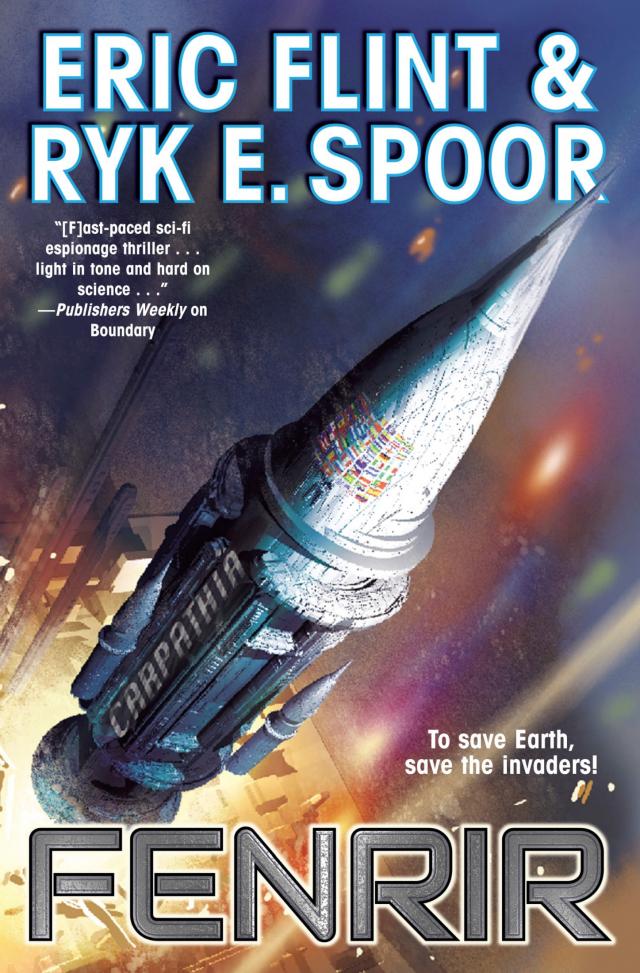
Table of Contents
PART I: DISCOVERY Chapter 1: Anomaly
Chapter 2: Impossibility
Chapter 3: First Responses
Chapter 4: Announcement
Chapter 5: Preparations for a Visit
Chapter 6: Fame Has its Rewards
Chapter 7: An Uncomfortable Silence
Chapter 8: Explosive Solution?
Chapter 9: Challenges and Speculation
Chapter 10: Publicity Good, Radiation Bad
Chapter 11: Anomalous Event
Chapter 12: Call to Action
PART II: WELCOME WAGON Chapter 13: Politics as Usual
Chapter 14: Explosive Situations
Chapter 15: Project Management 1O1
Chapter 16: Making Choices
Chapter 17: A Point of Agreement
PART III: CARPATHIA Chapter 18: Big Job
Chapter 19: Drones and Detonations
Chapter 20: Rescue Options
Chapter 21: The Group
Chapter 22: Challenges and Concerns
Chapter 23: Two Decisions
Chapter 24: Contingencies in Motion
Chapter 25: A Traditional Timetable
Chapter 26: A Worrisome Success
Chapter 27: You Spin Me Round and Round
Chapter 28: Unpleasant Possibilities
Chapter 29: Plots and Plotters
Chapter 30: Upgrading
Chapter 31: Safety, Security, and Spaceships
Chapter 32: Contingencies of Failure
Chapter 33: Interrupted Triumph
Chapter 34: Recovery and Purpose
Chapter 35: Unexpected Awakening
Chapter 36: After-Action Reports
Chapter 37: Resetting the Clock
Chapter 38: Launch
PART IV: JOURNEY Chapter 39: One Final Option
Chapter 40: Mirrors of Determination
Chapter 41: Optimist and Pessimists
Chapter 42: A Distant Boom
Chapter 43: WorsT-Case Scenario
Chapter 44: Preparations and Conversations
PART V: ARRIVAL Chapter 45: On the Edge of Contact
Chapter 46: Extinction On Demand
Chapter 47: Calls for Help
Chapter 48: Conversations
Chapter 49: Understanding the Alien
Chapter 50: Off-the-Record Hope
Chapter 51: Confronting the Dilemma
PART VI: ILLIKAI AND HUMAN Chapter 52: A Heated Deadline
Chapter 53: Branches of Choice
Chapter 54: An Understanding Between Saboteurs
Chapter 55: Conference Tightrope Walk
Chapter 56: Choices of the Zalak
Chapter 57: Hatred From the Past
Chapter 58: Problem, Solution, Problem
PART VII: TIME BOMB Chapter 59: Negotiations and Promises
Chapter 60: Playing the Cards You’re Dealt
Chapter 61: Planning a Delivery
Chapter 62: Escape
Chapter 63: An Unexpected Subject
Chapter 64: Death of Worlds
Chapter 65: Logic of Murder and Sacrifice
Chapter 66: Working Toward a New Home
Chapter 67: Set Me Up the Bomb
Chapter 68: Countdown to Cataclysm
Chapter 69: The Final Backup
PART VIII: HOMECOMING Chapter 70: Detonation
Chapter 71: Aftershocks on Earth
Chapter 72: What Goes Up . . .
Chapter 73: . . . Must Come Down
Chapter 74: Welcome to Earth
Chapter 75: Adirondack Wonder
Epilogue: Caught in the Flash
Fenrir
by Eric Flint & Ryk E. Spoor
When astronomer Stephanie Bronson uncovers a massive alien vessel named Fenrir racing toward the Sun, she must lead a desperate mission to rescue its crew before a catastrophic failure dooms them both to fiery destruction.
It was just a dot of light . . .
. . . a dot of light that appeared out of nowhere. Stephanie Bronson thought she might have found a distant supernova. Instead, what she’d found was something more than a thousand miles across, moving towards the Sun at almost a third the speed of light from the constellation of Lupus, the Wolf. Even more frightening, the object—called Fenrir, after the Norse Wolf of the World’s End—was slowing down. It was not a comet or even a rogue planet.
It was an alien vessel.
And despite the increasingly detailed and insistent messages of greeting from Earth, it showed no sign of responding. As the world braced itself for the arrival of the immense, frighteningly silent alien visitor, Stephanie held hope that they still might communicate with Fenrir—until something happened that no one had imagined: Fenrir flared and its drive died, leaving the huge ship careening out of control to a fiery death inside the orbit of Venus.
There was—just possibly—a chance for Earth to act—to rescue the now-shipwrecked “Fens.” But even Stephanie—or those trying to stop her and the rescue ship Carpathia—could not imagine that not merely the fate of the aliens, but that of Earth itself, would be decided by Fenrir.
BAEN BOOKS by ERIC FLINT AND RYK E. SPOOR
Fenrir
the boundary series
Boundary
Threshold
Portal
Castaway Planet
Castaway Odyssey
Castaway Resolution
BAEN BOOKS by ERIC FLINT
ring of fire series
1632
1635: The Eastern Front
1636: The Saxon Uprising
1636: The Ottoman Onslaught
1637: The Polish Maelstrom
1812: The Rivers of War
1824: The Arkansas War
Mother of Demons
Worlds
Worlds 2
BAEN BOOKS by RYK E. SPOOR
Princess Holy Aura
Mountain Magic with Henry Kuttner, David Drake, and Eric Flint
Fenrir
This is a work of fiction. All the characters and events portrayed in this book are fictional, and any resemblance to real people or incidents is purely coincidental.
Copyright © 2025 by Eric Flint and Ryk E. Spoor
All rights reserved, including the right to reproduce this book or portions thereof in any form.
A Baen Books Original
Baen Publishing Enterprises
P.O. Box 1403
Riverdale, NY 10471
www.baen.com
ISBN: 978-1-6680-7266-0
eISBN: 978-1-964856-24-7
Cover art by Dominic Harman
First printing, June 2025
Distributed by Simon & Schuster
1230 Avenue of the Americas
New York, NY 10020
Library of Congress Cataloging-in-Publication Data
Names: Flint, Eric, author. | Spoor, Ryk E., author.
Title: Fenrir / Eric Flint, Ryk E. Spoor.
Description: Riverdale, NY : Baen Books, 2025.
Identifiers: LCCN 2025001283 (print) | LCCN 2025001284 (ebook) | ISBN 9781668072660 (hardcover) | ISBN 9781964856247 (ebook)
Subjects: LCGFT: Science fiction. | Novels.
Classification: LCC PS3556.L548 F46 2025 (print) | LCC PS3556.L548 (ebook) | DDC 813/.54—dc23/eng/20250224
LC record available at https://lccn.loc.gov/2025001283
LC ebook record available at https://lccn.loc.gov/2025001284
Printed in the United States of America
10 9 8 7 6 5 4 3 2 1
Electronic version by Baen Books
www.baen.com
Acknowledgments:
To Toni, for nigh-infinite patience.
To Dr. Suman Chakrabarti, for long discussions that led to Carpathia’s drive system.
To my Beta Readers, for their invaluable feedback, which saved me from a number of embarrassments.
To all my readers, and especially my Patrons, who’ve kept me going in this sometimes challenging business.
And as always to my wife, Kathleen, for giving me the time and putting up with my often-frustrating quirks. Love you!
Dedications:
This book is dedicated to the memory of two men who helped make me who I am, and neither of whom remain among us:
To Ryk Peter Spoor, my father, who was always the symbol of what a scientist should be—and whose collection of SF novels was an endless inspiration. Thanks, Dad.
And to Eric Flint, my coauthor, “The Butcher of Baen,” without whom I might never have been published, and certainly would never have dared the dangerous and demanding waters of hard-SF . . . and thus would never have written Boundary or any of its sequels, let alone Fenrir. I wish he could have been here to read this last collaboration—and tell me if it met his standards.
PART I:
DISCOVERY
Chapter 1:
Anomaly
Stephanie Bronson settled back into her seat and began working on the current draft of her thesis, glancing occasionally at the screens nearby. The Smyth-Nichols Infrared Telescope, irreverently referred to by everyone as “SNIT,” had provided a glut of new images over the last month, and Stephanie had the dubious honor of sitting by and observing as they were processed for anomaly detection.
It wasn’t all boring, of course; she’d been present when the computer announced it had found something that turned out to be a major flare from a previously unremarkable red dwarf, and had managed to catch most of the transition between a peaceful star and one several magnitudes brighter. Even small anomali es could be interesting, and if your field was infrared astronomy it was all potentially input for your work.
And in this case, it allowed her to do schoolwork while she was babysitting the computers. Win-win!
She settled back into her chair, wrapped in a long sweater and a knit scarf against the office chill; as seemed to be always the case, the thermostat was about five degrees too cold for her, and mere grad students were in no way allowed to change the settings. There were, fortunately, no restrictions in how heavily you dressed, so with a cup of the indifferent-but-still-hot coffee from the break room and her heavier clothing, she could still be comfortable.
Stephanie opened up the spreadsheet and started trying to pretty up the graphs for the main portion of her thesis. Established Ph.D.s doing their papers could use the simplest, automatic presentation from Excel or whatever program they were using, but if you wanted to get there, you’d better make sure everything was presented clearly, unambiguously, and—preferably—attractively. Thesis committees were notoriously picky about pretty much everything.
A muted ping made her look up. An anomaly there . . . new star in the field. She flicked back and forth between the newest image and the preceding ones, then grinned. Stupid machine. Asteroid moved from one field to the other.
There were a lot of cases like that. In theory the system knew where things like mapped asteroids and variable stars were, but whoever had programmed it had either missed edge cases or made some kind of unwarranted assumptions, because there were quite a few objects that it commonly failed to match properly.
Sure enough, her studies were interrupted a few times each hour by “anomalies” that were nothing of the sort. Still, it did keep her awake, even if it did throw off her groove sometimes.
Another ping, and she sighed and closed the laptop again. Where’s this one? she thought, seeing yet another star field with a faint dot circled. A quick check of the references and she at least knew what part of the sky it was in. About in the middle of constellation Lupus, near Gamma Lupi. There was another, slightly brighter star near the apparent anomaly, but a quick check didn’t give her a catalog number for it—interesting in and of itself, but not to the extent of the anomalous star. The dimmer star looked to have an infrared magnitude of about ten, which was still pretty bright compared to the limit of detection of the system.
She checked the prior images; there was nothing visible there, at least down to the sensitivity of SNIT, which went down at least seven magnitudes below the anomalous point.
The next check was to see if there was more than one image with this anomalous point; electronic imaging systems could easily produce spurious points of light from various types of glitches. But, no, the dot was present on all images after a certain point, so it was a real something.
This was already more interesting than a lot of the false alarms. Stephanie hitched her chair forward. This change was also near the center of the image, and the location of the new dot seemed steady, so it wasn’t an asteroid or something like that crossing into the field of view.
A nova? That would be exciting. Certainly a nova—or a supernova—could vary in magnitude sufficiently to make a previously invisible object visible. Feeling more excited, she composed a quick email to the SNIT team:
FROM: sbronson@SNIT.org
TO: SNIT Team
Subject: We might have something!
Guys,
SNIT found what really looks like a new object at about RA 15h 33m 13s, Declination -41° 06' 22". Checked and it’s definitely an object, not a transient glitch, no relative motion obvious yet so it’s not one of our asteroid or comet crossing false alarms. Anyone have a prior at that location? I’m thinking nova!
Steph
She appended links to some of the key images in the database, then—after another glance at the mysterious dot on her screen—went back to working on her graphs. Discovering a nova was exciting, but she wouldn’t let herself get excited unless and until she was sure that was what it was. She had work to do, and in all likelihood someone would call or message back and tell her what obvious thing she’d missed.
But half an hour later, her phone buzzed. It was a text from Shin Mouri, one of her teammates from Japan:
Can confirm nothing at the site of your putative nova previously, down to limit of about mag 28.
That was interesting, exciting even; depending on just how much the mystery object was radiating in the visible versus the infrared, that implied it had increased by something over fifteen to eighteen magnitudes—a million to twenty million times brighter. That put it out of ordinary nova range, straight into supernova or even into superluminous supernova range.
But exciting as that might be, she still had work to do. She returned, somewhat regretfully, to her thesis work.
There were a couple more false alarms before she packed up to go home and left to get some sleep.
She unlocked the side door that led to her apartment stairway and tried to go up as quietly as possible.
It wasn’t quiet enough to fool a cat, though, and something soft brushed its way around one leg. “Hello, Luna,” she said, and bent down to pat the snow-white animal.
Luna’s yellow-green eyes met hers, then closed to slits as Stephanie scratched her gently just behind the ears—Luna’s favorite spot. A faint buzz-rumble of approval came from the cat. “Yes, you like that, don’t you? But I can’t spend an hour doing this, I have to get to bed. You should be in bed too, silly cat.”
Luna looked at her with exasperation as she stood, as if to say What? Your sleep is more important than properly attending to my needs?
“You are a spoiled little cat, Luna, and Joel spoils you entirely too much.” Nonetheless, she bent back down and spent another thirty seconds on properly greeting her unofficial landlord (her official landlord was Luna’s owner . . . or Luna’s pet, probably, from the cat’s point of view).
Joel Landon lived in the downstairs part of the house, which she’d never quite understood, since Landon owned probably a dozen different properties or more and could certainly afford to live pretty much anywhere; it might have had to do with his being widowed a few years ago and not wanting to stay in a place with too many memories. Why he’d rent his top floor as an apartment for college students she didn’t know, but she sure wasn’t going to complain.
Luna permitted her to move onward and get into her own apartment. Stephanie put her backpack down with relief and headed for the bathroom . . . and then went to bed.
An insistent brrr-brrr-brrr! sound dragged her out of the depths of sleep. She groped around to find the clock, then realized with a dull surprise that the sound was coming from her cell phone. She half fell out of bed and managed to yank it out of her jacket pocket, where she’d left it last night. “Hello?”
“Steph? That you?” That was the deep voice of David Amitay, head of the SNIT team and currently also one of her thesis advisors.
“Barely.” Her eyes focused on the clock. “Why the hell are you calling me at nine-thirty in the morning . . . sir? You know I had a late, late night and it’s Saturday!”
“Oh . . . yes, I suppose you did, but never mind that, you’re awake now.” Dave’s tone was only mildly apologetic. “That object you found last night? It’s already proving to be very interesting.”


