The Arctic Incident (Disney), page 22
part #2 of Artemis Fowl Series
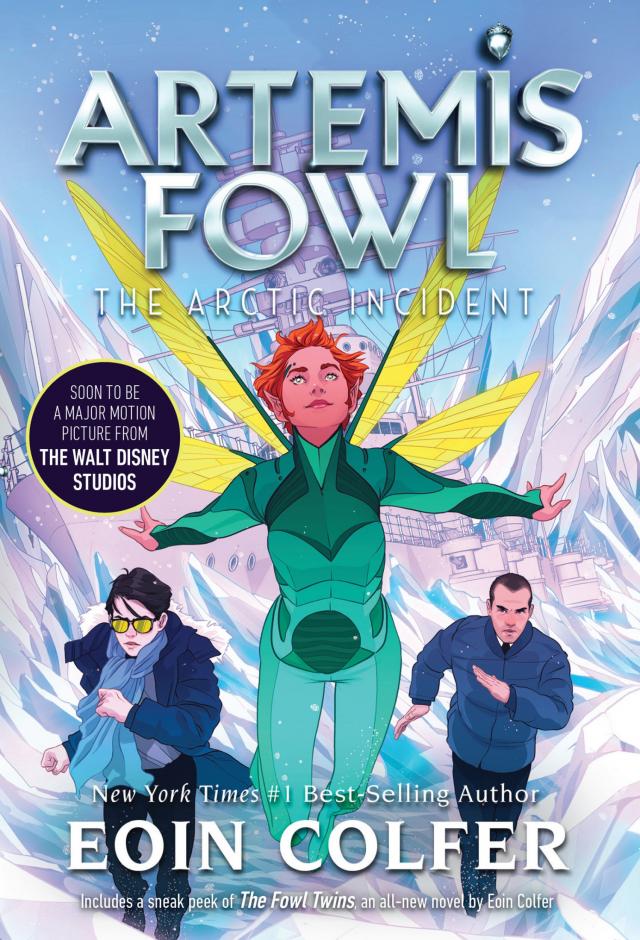


For here begins the second documented cycle of Fowl adventures.
The Baddie: Lord Teddy Bleedham-Drye.
The Duke of Scilly.
If a person wants to murder the head of a family, then it is very important that the entire family also be done away with, or the distraught survivors might very well decide to take bloody revenge, or at least make a detailed report at the local police station. There is, in fact, an entire chapter on this exact subject in The Criminal Mastermind’s Almanac, an infamous guidebook for aspiring ruthless criminals by Professor Wulf Bane, which was turned down by every reputable publisher but is available on demand from the author. The actual chapter name is “Kill Them All. Even the Pets.” A gruesome title that would put most normal people off from reading it, but Lord Teddy Bleedham-Drye, Duke of Scilly, was not a normal person, and the juiciest phrases in his copy of The Criminal Mastermind’s Almanac were marked in pink highlighter, and the book itself was dedicated as follows:
To Teddy
From one criminal mastermind to another
Don’t be a stranger
Wulfy
Lord Bleedham-Drye had dedicated most of his one hundred and fifty years on this green earth to staying on this green earth as long as possible—as opposed to being buried beneath it. In television interviews he credited his youthful appearance to yoga and fish oil, but in actual fact, Lord Teddy had spent much of his inherited fortune traveling the globe in search of any potions and pills, legal or not, that would extend his life span. As a roving ambassador for the Crown, Lord Teddy could easily find an excuse to visit the most far-flung corners of the planet in the name of culture, when in fact he was keeping his eyes open for anything that grew, swam, waddled, or crawled that would help him stay alive for even a minute longer than his allotted four score and ten.
So far in his quest, Lord Teddy had tried every so-called eternal youth therapy for which there was even the flimsiest of supporting evidence. He had, among other things, ingested tons of willow-bark extract, swallowed millions of antioxidant tablets, slurped gallons of therapeutic arsenic, injected the cerebrospinal fluid of the endangered Madagascan lemur, devoured countless helpings of Southeast Asian liver-fluke spaghetti, and spent almost a month suspended over an active volcanic rift in Iceland, funneling the restorative volcanic gas up the leg holes of his linen shorts. These and other extreme practices—never ever to be tried at home—had indeed kept Bleedham-Drye breathing and vital thus far, but there had been side effects. The lemur fluid had caused his forearms to elongate so that his hands dangled below his knees. The arsenic had paralyzed the left corner of his mouth so that it was forever curled in a sardonic-looking sneer, and the volcanic embers had scalded his bottom, forcing Teddy to walk in a slightly bowlegged manner as though trying to keep his balance in rough seas. Bleedham-Drye considered these secondary effects a small price to pay for his wrinkle-free complexion, luxuriant mane of hair, and spade of black beard, and of course the vigor that helped him endure lengthy treks and safaris in the hunt for any more rumored life-extenders.
But Lord Teddy was all too aware that he had yet to hit the jackpot, therapeutically speaking, in regards to his quest for an unreasonably extended life. It was true that he had eked out a few extra decades, but what was that in the face of eternity? There were jellyfish that, as a matter of course, lived longer than he had. Jellyfish! They didn’t even have brains, for heaven’s sake.
Teddy found himself frustrated, which he hated, because stress gave a fellow wrinkles.
A new direction was called for.
No more penny-ante half measures, cribbing a year here and a season there.
I must find the fountain of youth, he resolved one evening while lying in his brass tub full of electric eels, which he had heard did wonders for a chap’s circulation.
As it turned out, Lord Bleedham-Drye did find the fountain of youth, but it was not a fountain in the traditional sense of the word, as the life-giving liquid was contained in the venom of a mythological creature. And the family he would possibly have to murder to access it was none other than the Fowls of Dublin, Ireland, who were not overly fond of being murdered.
This is how the entire regrettable episode kicked off.
Lord Teddy Bleedham-Drye reasoned that the time-honored way of doing a thing was to ask the fellows who had already done the thing how they had managed to do it, and so he set out to interview the oldest people on earth. This was not as easy as it might sound, even in the era of worldwide-webbery and marvelous miniature communication devices, for many aged folks do not advertise the fact that they have passed the century mark lest they be plagued by health-magazine journalists or telegrams from various queens. But nevertheless, over the course of five years, Lord Teddy managed to track down several of these elusive oldsters, finding them all to be either tediously virtuous, which was of little use to him, or lucky, which could neither be counted on nor stolen. And such was the way of it until he located an Irish monk who was working in an elephant sanctuary in California, of all places, having long since given up on helping humans. Brother Colman looked not a day over fifty, and was, in fact, in remarkable shape for a man who claimed to be almost five hundred years old.
Once Lord Teddy had slipped a liberal dose of sodium Pentothal into the Irishman’s tea, Brother Colman told a very interesting story of how the holy well on Dalkey Island had come by its healing waters when he was a monk there in the fifteenth century.
Teddy did not believe a word of it, but the name Dalkey did sound an alarm bell somewhere in the back of his mind. A bell he muted for the present.
The fool is raving, he thought. I gave him too much truth serum.
With the so-called monk in a chemical daze, Bleedham-Drye performed a couple of simple verification checks, not really expecting anything exciting.
First he unbuttoned the man’s shirt, and found to his surprise that Brother Colman’s chest was latticed with ugly scars, which would be consistent with the man’s story but was not exactly proof.
The idiot might have been gored by one of his own elephants, Teddy realized. But Lord Bleedham-Drye had seen many wounds in his time and never anything this dreadful on a living body.
There ain’t no fooling my second test, thought Teddy, and with a flash of his pruning shears he snipped off Brother Colman’s left pinky. After all, radiocarbon dating never lied.
It would be several weeks before the results came back from the Advanced Accelerator Mass Spectrometer Laboratory, and by that time Teddy was back in England once again, lounging dejectedly in his bath of electric eels in the family seat: Childerblaine House, on the island of St. George in the Scilly Isles. Interestingly enough, the island had been so named because in one of the various versions of the St. George legend, the beheaded dragon’s body had been dumped into Cornish waters and drifted out to the Scilly Isles, where it settled on a submerged rock and fossilized, which provided a romantic explanation for the small island’s curved spine of ridges.
When Lord Teddy came upon the envelope from AAMSL in his pile of mail, he sliced it open listlessly, fully expecting that the Brother Colman excursion had been a big waste of precious time and shrinking fortune.
But the results on that single page made Teddy sit up so quickly that several eels were slopped from the tub.
“Good heavens!” he exclaimed, his halo of dark hair curled and vibrating from the eel charge. “I’m off to Dalkey Island, begorra.”
The laboratory report was brief and cursory in the way of scientific reports:
The supplied specimen, it read, is in the four-hundred- to five-hundred-year-old age range.
Lord Teddy outfitted himself in his standard apparel of high boots, riding breeches, and a tweed hunting jacket, all topped off with his old commando beret. And he loaded up his wooden speedboat for what the police these days like to call a stakeout. It was only when he was halfway across the Irish Sea in the Juventas that Lord Teddy realized why the name Dalkey sounded so familiar. The Fowl fellow hung his hat there.
Artemis Fowl.
A force to be reckoned with. Teddy had heard a few stories about Artemis Fowl, and even more about his son Artemis II.
Rumors, he told himself. Rumors, hearsay, and balderdash.
And even if the stories were true, the Duke of Scilly’s determination never wavered.
I shall have that troll’s venom, he thought, opening the V-12 throttles wide. And I shall live forever.
The Goodies (relatively speaking)
Dalkey Island, Dublin, Ireland.
Three Weeks Later.
Behold Myles and Beckett Fowl, passing a late summer evening on the family’s private beach. If you look past the superficial differences—wardrobe, spectacles, hairstyles, and so on—you notice that the boys’ facial features are very similar but not absolutely identical. This is because they are dizygotic twins, and were, in fact, the first recorded nonidentical twins to be born conjoined, albeit only from wrist to little finger. The attending surgeon separated them with a flash of her scalpel, and neither twin suffered any ill effects, apart from matching pink scars that ran along the outside of their palms. Myles and Beckett often touched scars to comfort each other. It was their version of a high five, which they called a wrist bump. This habit was both touching and slightly gross.
Apart from their features, the fraternal twins were, as one tutor noted, “very different animals.” Myles had an IQ of 170 and was fanatically neat, while Beckett’s IQ was a mystery, because he chewed the test into pulpy blobs from which he made a sculpture of a hamster in a bad mood, which he titled Angry Hamster.
Also, Beckett was far from neat. In fact, his parents were forced to take up Mindfulness just to calm themselves down whenever they attempted to put some order on his catastrophically untidy side of the bedroom.
It was obvious from their early days in a double cradle that the twins did not share similar personalities. When they were teething, Beckett would chew pacifiers ragged, while Myles chose to nibble thoughtfully on the eraser end of a pencil. As a toddler, Myles liked to emulate his big brother, Artemis, by wearing tiny black suits that had to be custom-made. Beckett preferred to run free as nature intended, and when he finally did agree to wear something, it was plastic training pants, which he used to store his pet goldfish, Gloop (named for the sound it made—or at least the sound the goldfish was blamed for).
As the brothers grew older, the differences between them became more obvious. Myles became ever more fastidious, 3-D–printing a fresh suit every day and taming his wild jet-black Fowl hair with a seaweed-based gel that both moisturized the scalp and nourished the brain, while Beckett made zero attempt to tame the wild blond curls that he had inherited from his mother’s side of the family, and continued to sulk when he was forced to wear any clothes, with the exception of the only article he never removed—a golden necktie that had once been Gloop. Myles had cured and laminated the goldfish when it passed away, and Beckett wore it always as a keepsake. This habit was both touching and extremely gross.
Perhaps you have heard of the Fowl family of Ireland? They are quite notorious in certain shadowy circles. The twins’ father was once the world’s preeminent crime lord, but he had a change of heart and reinvented himself as a champion of the environment. Myles and Beckett’s older brother, Artemis II, had also been quite the criminal virtuoso, hatching schemes involving massive amounts of gold bullion, fairy police forces, and time travel, to name but a few. Fortunately for more or less everyone except aliens, Artemis had recently turned his attention to outer space, and was currently six months into a five-year mission to Mars in a revolutionary self-winding rocket ship that he had built in the family barn. By the time the world’s various authorities, including NASA, ASCO, ALR, CSNA, and UKSA, had caught wind of the project and begun to marshal their objections, Artemis had already passed the moon.
The twins themselves were to have many adventures, some of which would kill them (though not permanently), but this particular episode began a week after their eleventh birthday. Myles and Beckett were walking along the stony beach of Dalkey Island, where the Fowl family had recently moved to Villa Éco, a newly built, state-of-the art, environmentally friendly house attached to a renovated Martello tower. The twins’ father had donated Fowl Manor, their rambling ancestral home, to a cooperative of organic farmers, declaring, “It is time for the Fowls to embrace planet Earth.”
On this summer evening, the twins’ mother was delivering a lecture in Dublin’s National Library with her husband in attendance. Some years previously, Angeline had suffered from what Shakespeare called “the grief that does not speak,” and, in an effort to understand her depression, had completed a mental health doctorate at Trinity College and now spoke at conferences around the world. The twins were being watched over by the house itself, which had an Artemis-designed Nano Artificial Neural Network Intelligence system, or NANNI, to keep an electronic eye on them.
Myles was collecting seaweed for his homemade hair gel, and Beckett was trying to learn seal language from a dolphin just off-shore.
“We must be away, brother,” Myles said. “Bedtime. Our young bodies require ten hours of sleep to ensure proper brain development.”
Beckett lay on a rock and clapped his hands. “Arf,” he said. “Arf.”
Myles tugged at his suit jacket and frowned behind the frames of his thick-rimmed glasses. “Beck, are you attempting to speak in seal language?”
“Arf,” said Beckett, who was wearing knee-length cargo shorts and his gold necktie.
“That is not even a seal. That is a dolphin.”
“Dolphins are smart,” said Beckett. “They know things.”
“That is true, brother, but a dolphin’s vocal cords make it impossible for it to speak in the language of a seal. Why don’t you simply learn the dolphin’s language?”
Beckett beamed. “Yes! You are a genius, brother. Step one, swap barks for whistles.”
Myles sighed. Now his twin was whistling at a dolphin, and they would once again fail to get to bed on time.
Myles stuffed a handful of seaweed into his bucket. “Please, brother. My brain will never reach optimum productivity if we don’t leave now.” He tapped an earpiece in his right ear. “NANNI, help me out. Please send a drobot to carry my brother home.”
“Negative,” said the house system in a strangely accented female voice, which Beckett instinctively trusted for some reason. “No flying Beckett home. Mother’s orders.”
Myles could not understand why his mother refused to authorize short-range flights for Beckett. In tests, the drone/robots had only dropped the dummy Becketts twice, but his mother insisted the drobots were for emergencies only.
“Beckett!” he called. “If you agree to come back to the house, I will tell you a story before bed.”
Beckett flipped over on the rock. “Which story?” he asked.
“How about the thrilling discovery of the Schwarzschild radius, which led directly to the identification of black holes?” suggested Myles.
Beckett was not impressed. “How about the adventures of Gloop and Angry Hamster in the Dimension of Fire?”
Now it was Myles’s turn to be unimpressed. “Beck, that’s preposterous. Fish and hamsters do not even share the same environment. And neither could survive in a dimension of fire.”
“You’re preposterous,” said Beckett and went back to his whistling.
The crown of Beck’s head will be burned by the evening UV rays, thought Myles.
“Very well,” he said. “Gloop and Angry Hamster it is.”
“And Dolphin,” said Beckett. “He wants to be in the story, too.”
Myles sighed. “Dolphin, too.”
“Hooray!” said Beckett, skipping across the rocks. “Story time. Wrist bump?”
Myles raised his palm for a bump and wondered, If I’m the smart one, why do we always do exactly what Beck wants us to?
Myles asked himself this question a lot.
“Now, brother,” he said, “please say good night to your friend, and let us be off.”
Beckett turned to do as he was told, but only because it suited him.
If Beckett had not turned to bid the dolphin farewell, then perhaps the entire series of increasingly bizarre events that followed might have been avoided. There would have been no nefarious villain, no ridiculously named trolls, no shadowy organizations, no interrogations by a nun (which are known in the intelligence community as nunterrogations, believe it or not), and a definite lack of imaginary head lice. But Myles did turn, precisely two seconds after a troll had surged upward through the loose shale at the water’s edge and collapsed onto the beach.
Fairies are defined as being “small, humanoid, supernatural creatures possessed of magical powers,” a description that applies neatly to elves, gnomes, sprites, and pixies. It is, however, a human definition, and therefore as incomplete as human knowledge on the subject. The fairies’ definition of themselves is more concise and can be found in the Fairy Book, which is their constitution, so to speak, the original of which is behind crystal in the Hey Hey Temple in Haven City, the subterranean fairy capital. It states:
Fairy, faerie, or faery: A creature of the earth. Often magical. Never willfully destructive.
No mention of small or humanoid. It may surprise humans to know that they themselves were once considered fairies and did indeed possess some magic, until many of them stepped off the path and became extremely willfully destructive, and so magic was bred out of humans over the centuries, until there was nothing left but an empath here and there, and the occasional telekinetic.
Trolls are classed as fairies by fairies themselves, but would not be so categorized according to the human definition, as they are not magical—unless their longevity can be considered supernatural. They are, however, quite feral and only slightly more sentient than the average hound. Fairy scientists have discovered that trolls are highly susceptible to chemical-induced psychosis while also tending to nest in chemically polluted sites, in much the same way as humans are attracted to the sugar that poisons them. The toxins ingested by trolls often result in uncharacteristically aggressive behavior and uncontrollable rage. Again, similar to how humans behave when experiencing sugar deprivation.