

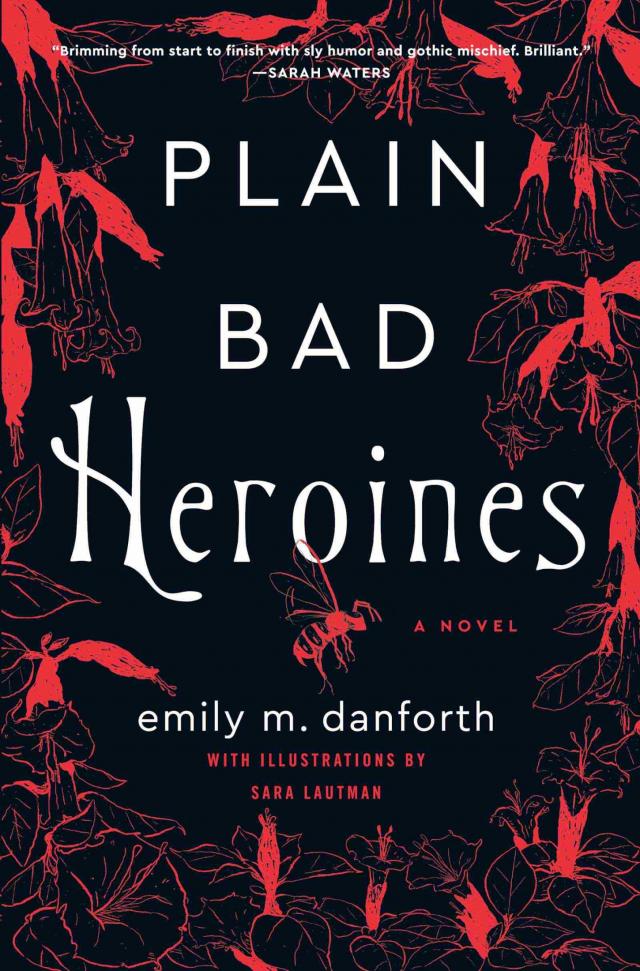
Plain Bad Heroines, page 58


“What the hell?” she says to Esther, her very pink lips sliding over her teeth in a real smile.
Esther swats again. “Sorry. There’s, like, a bee chasing you.”
Even before she sees it, Harper knows that it is not a bee. But to Esther she says, “That’s how sweet I am.”
“You’re corny and you’re about to get stung,” Esther says, swatting again. Harper likes that Esther does not go in for any of her bullshit. Esther has a wife who’s a lawyer for a climate change nonprofit. They have a kid and another one coming and a house in Silver Lake.
Esther represents a kind of adult ideal to Harper, who feels in need of ideal adults.
“I think it’s buzzed off for the moment,” Esther says. She returns to the sidelines.
Harper keeps moving forward. She answers a few questions from the microphone wielders before she notices that the yellow jacket is still following her. In fact, Harper’s pretty sure there are now a few of them following her—or one of them that sure gets around: her left shoulder, her right hip, up against her temple.
There’s so much noise and chaos around her, the glint of camera lenses, the blood red of the carpet, which is weirdly squishy (it rained hard that morning and the carpet is still soggy with it), the Cannes handler scooting in to tell her where to look and what outlet this person represents, but she can still feel the flick of the yellow jacket: the pulse close to her skin, the vibration in the air about her.
It’s like winding the dial on the dread inside her.
She looks back along the carpet from where she’s just come. Audrey is now working the rope line as well—and Bo is out, too. The plan is for them to meet up soon, here toward the middle, and pose together for some shots, answer questions as a trio. People will like that, so they’ll be sure to be extra about it. Of course people would like it even better if Merritt was here too, but Merritt isn’t coming.
Until fifteen minutes ago, when they were together in the staging area, Harper had seen Audrey only a few times (twice to do soundstage stuff in LA) since their last day shooting at Brookhants. And those last days at Brookhants—those last weeks, really, everything that came after Elaine’s fall on the Spite Tower stairs, and her death—had been so strained between the three of them. In the immediate aftermath, with production shut down, it had seemed like maybe they wouldn’t finish the film at all. While estate lawyers sorted the details and press reported endlessly, Audrey had moved out of her tiny house and into an offsite hotel and Merritt had disappeared. Basically, she had. I mean, they saw her at the funeral, but . . .
It had seemed, then, like that might be that. The press was everywhere, saying nothing good. Nobody knew if they could finish the film. Or should finish it. Harper had another movie to get to, one starting in Montreal the following month, and she’d been hoping for some time off in between. Plus, she didn’t want the stink of this one to land on that one. She’d been ready to call it and head back to Los Angeles for a while. Or maybe Montana, to check in on things.
But then Bo had texted that it was all sorted. They could reassemble at Brookhants to finish telling the story of Flo and Clara, and what had happened to them all those years before. The story from the past, that is. That’s the story they could finish. So they had.
There were no more strange occurrences, no more delays. They were now as rigidly on schedule as they’d once been off it. Audrey, Harper had noticed, thrived under these conditions. Actually, everyone on set had noticed this. It was like she had finally given herself permission to be as good as she could be, and then she was. But they never discussed this fact among the three of them because, for those last weeks of shooting, there was no longer a three of them. (And some of the things they’d said to each other the night of Noel’s concert made it seem like maybe there never had been to begin with.)
But now, for the next few weeks anyway, Audrey and Harper will be together a lot, doing press for this film, selling their story to the people in practically any way the people would want to receive it.
Truth be told, Harper had been really glad to see Audrey come into the staging tent with Caroline at her side. They didn’t have much time to talk, and there were too many people around them to do it properly, anyway, but when they hugged—carefully, because of their makeup and hair (well, Audrey’s hair) and couture—Harper said, “Oh my God I’m glad you’re here. I’m so fucking happy to see you.” And that was true, Readers.
“I’m happy to see you, too,” Audrey said. Harper didn’t know if that was true or not. She hoped it was.*
Harper has wanted to talk and talk about the things they’ve not said to each other, or to anyone, about what really happened to them at Brookhants. She especially wants to talk about the things that have happened—happened to her, at least—since they all left Brookhants. Harper wants to talk to Merritt about these things too, but since the splashy announcement of her bidding-war book deal (which necessarily lit up Harper’s own Google Alerts), Merritt has dropped off all social media and appears to have changed her phone number.
At first Harper’s texts and congratulatory calls weren’t returned, but the last two times she tried they wouldn’t even go through. And she’s too embarrassed to ask anyone who might have Merritt’s new number, the working number, to give it to her. Harper doesn’t even know if Merritt’s seen the movie yet. She didn’t come to any of the cast and crew screenings in LA.
“Harper! Do you like the film?” This from a rope liner with mirrored sunglasses and a pink-stemmed microphone.
Harper looks in the general direction of that microphone. The swarm of camera faces look back. “Yes! I think it’s terrifying.”*
“But is it the film you thought you were making? Were you in on it?”
She pauses. She’s practiced for these questions, has some lines memorized. “Yes and no,” she says as if she’s thinking. “Movies are always something else, something different, when they’re finished than when you’re making them. I had a sense of Bo’s vision for this film, but not the specifics of how he would piece the timelines together.”
“Isn’t it a bit of a cheat for him to cast himself as the villain, though?”
“Why is that a cheat?” Harper asks. She hadn’t known, before she saw the first cut, how much Bo Dhillon would appear in his own film, how willing he was to show himself unflatteringly pulling the strings. (Though she’s pretty sure Bo knew that’s what he would be doing the whole time.)
“Isn’t that choice meant to absolve him of any objections about how he made the film—if he’s portraying himself as the villain within its story? Now he can call it all a performance?”
“I don’t think he’s doing that,” she says. “I think he used the film to interrogate his own acts of manipulation, to question the nature of narrative film, of horror as entertainment.” (This is one of the answers she’s memorized.)
Another reporter: “Audiences are supposed to believe that you were really frightened to be on location there. Were you?”
“Definitely,” she says, feeling the flick of the yellow jacket at her ear. “The whole time.”
She does not say: I still am. (But she thinks it, Readers, and sometimes that means more, the things you think and don’t say—especially when you’re on a red carpet.)
She feels the tap of the yellow jacket against her scalp. It is not possible, but she now smells lilac, too. It’s a waft of fresh scent—not a perfume, not a spray—descending like a draped sheet over the whole area. The microphones are buzzing, buzzing. The glint off the hundreds of glass lenses around her might actually be the flick of advancing yellow jackets, more and more, or maybe the first flakes of falling snow, here in the May sun on the French Riviera.
She feels a touch dizzy, her steps still sinking in the red sog of the carpet. Its springiness reminds her of something. Moss? Like the thick scabs of moss that grew between the stones near the fountain at Brookhants. Or the sand there on its strip of beach? These thoughts make bile rise in her throat. Her next step sinks weirdly into the moss carpet. The sand carpet. And the next. She should have eaten more of that yogurt parfait they’d brought her while she was getting her makeup done. She needs to get water or—
“Sorridi, bella!” a camera face from an Italian magazine yells. The glint, the flick, the lilac—Harper cannot tell who’s yelled this. Can she even lift her foot for the next—
“Sorridi!”
And now someone shouts from down the carpet, “Don’t fucking bark at her to smile, asshole.”
Harper turns. It can’t be, but it is: Merritt. Merritt, who wasn’t supposed to be coming, who maybe hasn’t even seen the movie, but who is now here on the carpet looking hot as fuck in her own suit with a satin stripe down the leg. Only paired with hers, beneath her jacket, is a T-shirt with Warped Predilection on it.
Now she’s got Audrey by the hand and together they’re walking toward Harper. They’re not working their angles. They’re not stopping for the camera faces or answering questions or doing it at all like they’re supposed to. Hovering people with earpieces and tablets, the Cannes handlers, seem perturbed by this traffic violation, but Merritt is not stopping for even a one of them and Audrey seems content to let herself be pulled along.
They are hand in hand and they’re coming for her and Harper is glad.
When they reach her the three of them pull into a group hug that is not at all like the one Harper shared with Audrey in the staging tent fifteen minutes before—as grateful as Harper was to have that hug then. This is something else entirely: it’s a coming together. It’s being able to arrange and rearrange themselves however they choose to allow someone to always be in the middle, flanked on either side.
From a microphone wielder: “Should you even be here screening this film? Promoting it? When a woman died.”
Harper, as she pulls out of the hug, runs over scripted lines, but before she can offer any of them Merritt steps forward and answers: “The woman’s name was Elaine Brookhants. You didn’t know her, I did, and nobody wanted this movie to be made more than she did.”
“Is that enough of a justification?”
“You tell me,” Merritt says. “I haven’t seen it yet.”
“The camera loves her in it,” Harper says quickly. She doesn’t know quite why she’s said this. It’s a little desperate and she doesn’t do desperate.
“Oh fuck off,” Merritt says to her while Audrey takes a question.
“I can’t believe you stole Audrey’s shirt idea,” Harper says.
“I didn’t steal it,” Merritt says. “I had one made for her, too.”
This news hits Harper funny.
“Look at me, ladies!” another camera face yells. The three of them wrap their arms around each other until they’re a locked chain—and then they do look, and they smile.
“I heard you owe your publisher two more books,” Harper says to Merritt while they continue to smile, and turn, and pose—still bound together in their line. “Is that true?”
“That’s what I heard,” Audrey singsongs.
“It is a very ill-advised thing they offered me,” Merritt says. “So I accepted. I mean, if they’re going to offer it . . .”
“Who you gonna write those books about?” Harper asks.
“I’m waiting to see what happens on this press tour.”
“So you’re doing it?” Harper asks. “The whole tour and not just tonight?”
Merritt shrugs.
“That’s really why you came? So we can be your content farm?” Merritt shrugs again.
“I don’t believe that,” Harper says. But she isn’t sure. Maybe she does believe it.
They unchain themselves to pose in different ways, move down the line a little, answer more questions.
Harper tries one final question and delivers it as lightly, as casually, as she can: “So are you gonna let me read it early or what?”
“I wasn’t planning to,” Merritt says. “I saw what they’re paying you for Ripe Planet—you can afford to buy your own copy. That title, though? Shudder.”
Harper ignores that last bit. “You don’t think Capote Capote is a little on the nose for your heroine?”
“I told her that,” Audrey says, grinning. She looks at Merritt. “I did tell you that.”
“Who told you Capote Capote is the protagonist?” Merritt asks Harper. “Alluring but enigmatic love interest, yes. A very bad heroine to be sure—but the heroine? You’ve been misinformed.”
“Have you read it?” Harper asks Audrey, thinking there’s no way this could be, but she’s sensing a certain new camaraderie between them—the T-shirt thing, their winking comments.
“Months ago,” Audrey says, turning so that a photographer can capture her cream gown—one not unlike an angel’s trumpet—from the side. “While she was still editing. I had to help her get a certain character’s motivation right.” Audrey smiles.
“Those were early days,” Merritt says. “You’ve read it more recently than that.”
Harper is bothered by this news and she does not do a particularly good job hiding this fact on her face. “Really?” she says, again feeling a little like she’s sinking into the carpet. “What’s the secret to getting inside the locked vault?”
“She was over,” Merritt says, tilting her head toward Audrey, casual as a trip to the grocery store. “She drove herself over—in her own car.”
“Good for you,” Harper says, still so confused.
“And the galleys had come in the mail like the day before, so they were sitting out and she kept whining about reading it until I gave her one.”
“I’m sure they just happened to be sitting out,” Audrey says. “You couldn’t have possibly found two minutes to put them in a closet before I came.”
“Certainly not,” Merritt says.
The smile they share in this moment bothers Harper even more. “You just happened to be in Connecticut?” she asks Audrey.
“Merritt’s in LA now,” Audrey says like it’s common knowledge. “She’s gonna get taken out by an earthquake-mudslide-brushfire with the rest of us.”
“Since when are you in LA?” Harper asks. She is disoriented by all these true facts that have been unknown to her before these moments. She also feels like she’s now up to her ankles in red carpet, her feet buried in it like they’re in silt.
Glint, glint, pose, smile, step, buzz. “Here, please!” Smile again.
“January,” Merritt says. “Basically February—I moved in at the end of the month.”
Harper aligns this chronology with all of the press about Merritt’s book deal, the change in her phone number: everything happened around then, the end of January.
“I wish I’d known,” Harper says.
“Why?” Merritt asks.
“So I could’ve brought you a cactus,” Harper says. “As a housewarming gift.” She’s proud of herself for being this quick, especially since she still feels dizzy and hears the buzzing, and especially because it’s Merritt she’s saying it to.
But Merritt doesn’t want to do the thing with her, the flirting thing that they’ve always done before. “Better that you didn’t. I’m sure it would be dead by now.”
This is not the place for intimate moments, but Harper cannot stop herself from saying, “I’ve really missed you. I keep wanting to talk to you. Both of you, I mean. We left it in such a weird place.”
“Left what?” Merritt says.
“I think you know what,” Harper says.
Audrey had pulled away from them. She’s been answering a question at the rope line and only catches the end of this statement, but as she turns back, she says, “I know what. I have things to say to you both. And I want to ask you about . . . things—” She does not finish this.
“Me too,” Harper says fast. She will not let embarrassment or shame stop her from admitting this. She won’t let the cameras or the microphones or the red carpet stop her, either. She knows Audrey’s talking about the months since they were last together—the things that feel like innocuous loose threads, until you go to pull one and find that it’s not loose at all—it’s attached, and if you follow it, it reaches back and back to Brookhants.
“I keep calling it all coincidental,” Audrey says. “But I don’t really think it is.”
“It’s not,” Harper says. “Not the stuff that’s been happening to me—it’s still happening. I can’t turn it off.”
“It’s more like a love letter to Answered Prayers than it is a true completion of Capote’s novel,” Merritt’s saying to a reporter who has asked about her book.
“And they’re both in it?” the reporter asks, gesturing at Harper and Audrey.
“Oh no—it’s a work of fiction,” Merritt says. “Any resemblances to persons living or dead are incidental.” And then she winks—which is a textbook Harper Harper move, Readers.
Harper can’t tell if it’s the sand dune red carpet that’s to blame for how seasick she’s feeling. But she doesn’t think so.
They pose again, the three of them with their arms about each other.
The buzzing has swelled and deepened without Harper’s registering of it. Its volume has simply turned up and now emanates from the crowd, the air. She feels it vibrating through the soles of her shoes, up and up through her body.
Now Audrey pulls away to be shot alone.
Harper thinks she might pass out. When she’s near swoon, she catches Merritt’s eye. The buzzing is thick around her, inside her.
“I can hear it, too,” Merritt says, taking Harper’s hand. Harper looks at her, unsure. Merritt nods, she’s calm. “Stay here with me. We’re OK. Anchor yourself to me.”
Harper does, gripping Merritt’s arm as she steadies herself, tries to slide back into her body.
“Get Audrey’s hand, too,” Merritt says.
Harper doesn’t hesitate, she reaches out for Audrey’s hand—and even though she’s still in midpose, Audrey gives it. They’re almost at the end of the carpet anyway. All they have to do now is climb the wide red stairs—which, I mean, is itself a thing. There are a lot of them to get up, but they’ve made it this far. Although the Cannes people around them with earpieces seem less than thrilled with how they’ve performed on this latter portion of their walk.


