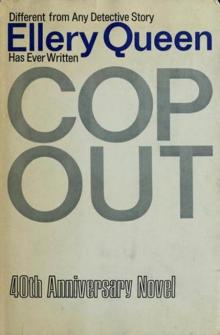
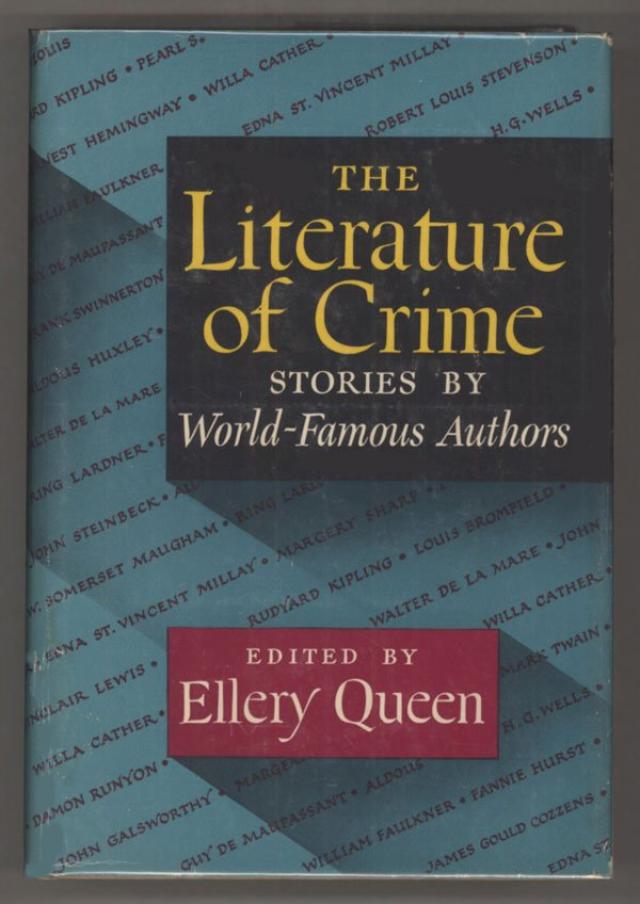
The Literature of Crime, page 1


COPYRIGHT 1950, BY LITTLE, BROWN AND COMPANY
ALL RIGHTS RESERVED. NO PART OF THIS BOOK IN EXCESS OF FIVE HUNDRED WORDS MAY BE REPRODUCED IN ANY FORM WITHOUT PERMISSION IN WRITING FROM THE PUBLISHER ACKNOWLEDGMENTS
ACKNOWLEDGMENTS
Grateful acknowledgment is made to the following who have granted permission to reprint herein the copyrighted material listed below:
Brandt & Brandt for Clerical Error by James Gould Cozzens; copyright, 1935, by McCall Corporation. Also for The Murder in the Fishing Cat by Edna St. Vincent Millay; copyright, 1923, by Edna St. Vincent Millay.
Curtis Brown, Ltd., for The Post-Mortem Murder by Sinclair Lewis; copyright, 1921, by The Century Co.; copyright, 1949, by Appleton-Century-Crofts, Inc.; reprinted by permission of the author. Also for Mr. Brisher’s Treasure by H. G. Wells; copyright, 1899, by H. G. Wells; reprinted by permission of the author’s estate.
Jacques Chambrun, Inc., for Tabloid News by Louis Bromfield; copyright, 1930, by Louis Bromfield. Also for Guilty by Fannie Hurst; copyright, 1922, by Harper & Brothers.
Chatto & Windus and Clarke, Irwin & Company Limited for Canadian permission on The Gioconda Smile by Aldous Huxley. Walter de la Mare and Faber & Faber for Canadian permission on An Ideal Craftsman by Walter de la Mare.
Doubleday & Company, Inc., for Before the Party from the casuarina tree by W. Somerset Maugham; copyright, 1926, by W. Somerset Maugham, reprinted by permission of Doubleday & Company, Inc.
Gregory, Fitch and Hendricks for London Night’s Entertainment by Margery Sharp; copyright, 1941, by Margery Sharp.
Harper & Brothers for The Gioconda Smile from MORTAL COILS by Aldous Huxley; copyright, 1921, 1949, by Aldous Huxley. Also for The Verdict by Frank Swinnerton from LONDON CALLING edited by Storm Jameson; copyright, 1942, by Harper & Brothers. And for The Stolen White Elephant from TOM SAWYER ABROAD by Mark Twain.
Alfred A. Knopf, Inc., for An Ideal Craftsman by Walter de la Mare; copyright 1931, 1950 by Walter de la Mare. Also for Paul’s Case by Willa Cather; copyright 1905, 1932 by Willa Cather.
J. B. Lippincott Company for Sense of Humor from MONEY FROM HOME by Damon Runyon; copyright, 1931, 1932, 1933, 1934, 1935, by Damon Runyon, published by J. B. Lippincott Company.
David Lloyd for Ransom by Pearl S. Buck; copyright, 1938, by Pearl S. Buck; reprinted by permission of the author’s agent.
Harold Matson for The Letters in Evidence by C. S. Forester; copyright 1937, by C. S. Forester.
Random House for Monk from KNIGHT’S GAMBIT by William Faulkner; reprinted by permission of Random House; copyright, 1939, 1940, by Curtis Publishing Co.; copyright, 1932, 1937, 1946, 1949, by William Faulkner.
Charles Scribner’s Sons for The Juryman reprinted from CARAVAN by John Galsworthy; copyright, 1925, by Charles Scribner’s Sons; used by permission of the publishers. Also for The Killers reprinted from MEN WITHOUT WOMEN by Ernest Hemingway; copyright, 1926, 1927, by Charles Scribner’s Sons; used by permission of the publishers. And for Haircut reprinted from THE LOVE NEST & OTHER STORIES by Ring Lardner; copyright, 1926, by Charles Scribner’s Sons; used by permission of the publishers.
James Thurber for The Catbird Seat; reprinted from The New Yorker by permission of the author. Copyright, 1942, by James Thurber.
The Viking Press, Inc., for The Murder from THE LONG VALLEY by John Steinbeck; copyright, 1938, by John Steinbeck; reprinted by permission of The Viking Press, Inc., New York.
A. P. Watt & Son, W. Somerset Maugham, and Messrs. William Heinemann, Ltd. for Canadian permission on Before the Party by W. Somerset Maugham.
PRINTED IN THE UNITED STATES OF AMERICA
CONTENTS
Cover
Title Page
Copyright
Introduction
THE POST-MORTEM MURDER
Sinclair Lewis
RANSOM
Pearl S. Buck
BEFORE THE PARTY
W. Somerset Maugham
THE MURDER IN THE FISHING CAT
Edna St. Vincent Millay
THE JURYMAN
John Galsworthy
THE MURDER
John Steinbeck
MONK
William Faulkner
THE LIMITATIONS OF PAMBÉ SERANG
Rudyard Kipling
TABLOID NEWS
Louis Bromfield
THE KILLERS
Ernest Hemingway
HUNTED DOWN
Charles Dickens
PAUL’S CASE
Willa Cather
THE STOLEN WHITE ELEPHANT
Mark Twain
THE GIOCONDA SMILE
Aldous Huxley
THE HAND
Guy de Maupassant
THE LETTERS IN EVIDENCE
C. S. Forester
HAIRCUT
Ring Lardner
AN IDEAL CRAFTSMAN
Walter de la Mare
THE CATBIRD SEAT
James Thurber
MARKHEIM
Robert Louis Stevenson
MR. BRISHER’S TREASURE
H. G. Wells
LONDON NIGHT’S ENTERTAINMENT
Margery Sharp
SENSE OF HUMOR
Damon Runyon
THE VERDICT
Frank Swinnerton
CLERICAL ERROR
James Gould Cozzens
GUILTY
Fannie Hurst
A Letter from the Editor
DEAR READER:
If you stood at the corner of Fifth Avenue and 42nd Street, in New York City, in front of the world’s sixth largest library, and tapped the shoulders of the first fifty people to pass by, asking the question: “Can you name a detective-story writer?”—if you did this on any day of any week, what answers do you think you would get?
Among English writers of crime stories, you might hear the names of Agatha Christie, Dorothy L. Sayers, Edgar Wallace, and perhaps even that of Conan Doyle.
Among American writers of mystery stories, you would probably hear the names of Dashiell Hammett, Erie Stanley Gardner, Rex Stout, S. S. Van Dine, and perhaps an occasional mention of a certain Gentleman from Boston (and Baltimore, New York, and Philadelphia), one Edgar A. Poe, who started it all.
But the odds would be astronomically against your hearing the names of Sinclair Lewis, Pearl S. Buck, W. Somerset Maugham, Edna St. Vincent Millay, John Galsworthy, John Steinbeck, William Faulkner, Rudyard Kipling, Louis Bromfield, and Ernest Hemingway. Yet every single one of these celebrated literary figures has written detective or crime stories—indeed, they are the authors of the first ten stories in this book.
Few people realize—few critics, too—that nearly every world-famous author, throughout the entire history of literature, has tried his hand at writing the detective or crime story. Some, it is true, have merely “stooped to conquer.” In these instances, the results have invariably borne the mark of the greatest of literary sins—insincerity. Most of them, however, have attempted in all good faith to conquer the technical difficulties of the form. In these instances, the results have seldom been so-so: great writers usually produce either solid successes or hollow failures, and many of them have made important contributions, creatively and critically, to the crime genre.
Take, for example, Mark Twain, whom the Encyclopedia Britannica ranks as “the most characteristic American writer of his epoch. . .whose Huckleberry Finn is a veritable epic, poetic in feeling, strictly veracious in detail, abounding in colour, and with a grasp of life that can only be described as classical.” The extent and versatility of Mark Twain’s writings in the detective-crime field are almost wholly unappreciated, not only by the general reader but by the so-called aficionado. Even in his masterpiece, The Adventures of Huckleberry Finn, acknowledged to be one of the 100 best books ever written, one of the 100 books containing, in the opinion of the editors of “The Golden Book,” the “greatest human wisdom, the deepest understanding, the highest and bravest flights of man’s imagination”—even in this masterwork Mark Twain did not scorn the use of pure ratiocination. Do you recall the battle of wits between Huck Finn, dressed as a girl, and the little old lady detective, Mrs. Judith Loftus? That sharp old she-sleuth penetrated Huck Finn’s disguise as easily as Sherlock Holmes would have done, although her reasoning was expressed in language that was folk-American to the core:
“You do a girl tolerable poor, but you might fool men, maybe. Bless you, child, when you set out to thread a needle don’t hold the thread still and fetch the needle up to it; hold the needle still and poke the thread at it; that’s the way a woman most always does, but a man always does t’other way. And when you throw at a rat or anything, hitch yourself up a tiptoe and fetch your hand up over your head as awkward as you can, and miss your rat about six or seven foot. Throw stiff-armed from the shoulder, like there was a pivot there for it to turn on, like a girl; not from the wrist and elbow, with your arm out to one side, like a boy. And, mind you, when a girl tries to catch anything in her lap she throws her knees apart; she don’t clap them together, the way you did when you catched the lump of lead. Why, I spotted you for a boy when you was threading the needle; and I contrived the other things just to make certain.”
And did you know that Mark Twain was the first writer in history to see the plot possibilities of fingerprints? Yes, both in the short story and in the novel. In Chapter XXXI of Life on the Mississippi (1883), which is a complete short story by itself, and in his novel, The Tragedy of Pudd’nhead Wilson (1894), Mark Twain inaugurated the literary use of fingerprints as a means of criminal identification.
And did you know what book Mark Twain was writing at the time of his death? It was a mystery novel titled Jim Wheeler, Detective. The holograph manuscript is now part of the Berg Collection in the New York Public Library, at Fifth Avenue and 42nd Street. Mark Twain’s last work was only about half-finished, and therefore never published. But, then, who ever heard of publishing an unfinished detective story?—excepting, of course, Charles Dickens’s The Mystery of Edwin Drood.
Yes, nearly every world-famous author has contributed to the literature of crime, and the purpose of this anthology is to bring you the finest tales of mystery and murder, of crime and detection, written by those authors who have distinguished themselves in the more “serious” fields of writing—by such gifted storytellers and expert craftsmen as the ones already mentioned, as well as Willa Cather, Robert Louis Stevenson, Ring Lardner, Aldous Huxley, Walter de la Mare, H. G. Wells, Fannie Hurst, Guy de Maupassant. . .
Yes, name an illustrious author, name any of “the choice and master spirits of this age,” and you name a mystery writer. And for proof, twenty-six times over, we offer you this treasure house of tales. For here is the creme du crime—caviare to the general public.
Your Obliged and Humble Servants,
in research and ratiocination,
ELLERY QUEEN
THE LITERATURE OF CRIME
THE POST-MORTEM MURDER
by SINCLAIR LEWIS
Sinclair Lewis, author of MAIN STREET, BABBITT, and ARROWSMITH, is the first American to have been awarded the Nobel Prize for literature. He is also the “stormy petrel” who, in the opinion of sixty-five literary editors and book reviewers polled recently by the University of Florida Libraries, “made the greatest contribution to American literature in the first half of the Twentieth Century.” With a remarkable gift for native speech and epigrammatic catchwords, Sinclair Lewis has succeeded in enriching the vocabulary of “the American language” as only an enthusiast and specialist like H. L. Mencken can fully appreciate. “The Post-Mortem Murder” which first appeared in the Century Magazine in 1921, one year after the publication of MAIN STREET, and has not been reprinted since, springs from Mr. Lewis’s inner compulsion to satirize American customs and shibboleths—“he has studied American society,” said T. K. Whipple, “like a Red Indian stalling through the land of his enemies.” But you will find the narrator in this unusual story an authentic detective, in a literary way, and the crime an authentic murder, in an equally literary way. . .
I WENT to Kennuit to be quiet through the summer vacation. I was tired after my first year as associate professor, and I had to finish my Life of Ben Jonson. Certainly the last thing I desired was that dying man in the hot room and the pile of scrawled booklets.
I boarded with Mrs. Nickerson in a cottage of silver-gray shingles under silver-gray poplars, heard only the harsh fiddling of locusts and the distant rage of the surf, looked out on a yard of bright wild grass and a jolly windmill weather vane, and made notes about Ben Jonson. I was as secluded and happy as old Thoreau raising beans and feeling superior at Walden.
My fiancée—Quinta Gates, sister of Professor Gates, and lovelier than ever in the delicate culture she had attained at thirty-seven—Quinta urged me to join them at Fleet Harbor. It is agreeable to be with Quinta. While I cannot say that we are stirred to such absurd manifestations as kissing and hand-holding—why any sensible person should care to hold a damp female hand is beyond me—we do find each other inspiriting. But Fleet Harbor would be full of “summerites,” dreadful young people in white flannels, singing their jazz ballads.
No, at thought of my spacious, leafy freedom I wriggled with luxury and settled down to an absorbed period when night and day glided into one ecstasy of dreaming study. Naturally, then, I was angry when I heard a puckery voice outside in the tiny hallway:
“Well, if he’s a professor, I got to see him.”
A knock. I affected to ignore it. It was irritatingly repeated until I roared, “Well, well, well?” I am normally, I trust, a gentle person, but I desired to give them the impression of annoyance.
Mrs. Nickerson billowed in, squeaking:
“Mis’ White from Lobster Pot Neck wants to see you.”
Past her wriggled a pinch-faced, humorless-looking woman. She glared at Mrs. Nickerson, thrust her out, and shut the door. I could hear Mrs. Nickerson protesting, “Well, upon my word!”
I believe I rose and did the usual civilities. I remember this woman, Miss or Mrs. White, immediately asking me, with extraordinary earnestness:
“Are you a professor?”
“I teach English.”
“You write books?”
I pointed to a box of manuscript.
“Then, please, you got to help us. Byron Sanders is dying. He says he’s got to see a learned man to give him some important papers.” Doubtless I betrayed hesitation, for I can remember her voice rising in creepy ululation: “Please! He’s dying—that good old man that never hurt nobody!”
I fluttered about the room to find my cap. I fretted that her silly phrase of “important papers” sounded like a melodrama, with maps of buried treasure, or with long-lost proofs that the chore boy is really the kidnaped son of royalty. But these unconscious defenses against the compulsion expressed in her face, with its taut and terrified oval of open mouth, were in vain. She mooned at me, she impatiently waited. I dabbled at my collar and lapels with my fingers, instead of decently brushing of! the stains of smoking and scribbling. I came stumbling and breathless after her.
She walked rapidly, unspeaking, intense, and I followed six inches behind, bespelled by her red-and-black gingham waist and her chip of a brown hat. We slipped among the gray houses of the town, stumped into country stilly and shimmering with late afternoon. By a trail among long salty grasses we passed an inlet where sandpipers sprinted and horseshoe crabs bobbed on the crisping ripples. We crossed a moorland to a glorious point of blowing grasses and sharp salt odor, with the waves of the harbor flickering beyond. In that resolute place my embarrassed awe was diluted, and I almost laughed as I wondered:
“What is this story-book errand? Ho, for the buried treasure! I’ll fit up a fleet, out of the six hundred dollars I have in the savings bank, and find the pirates’ skellingtons. Important papers!’ I’ll comfort the poor dying gentleman, and be back in time for another page before supper. The harbor is enchanting. I really must have a sail this summer or go swimming.”
My liveliness, uneasy at best in the presence of that frightened, fleeing woman, wavered when we dipped down through a cranberry bog and entered a still, hot woods of dying pines. They were dying, I tell you, as that old man in there was dying. The leaves were of a dry color of brick dust; they had fallen in heaps that crunched beneath my feet; the trunks were lean and black, with an irritation of branches; and all the dim alleys were choking with a dusty odor of decay. It was hot and hushed, and my throat tickled, my limbs dragged in a hopeless languor.
Through ugly trunks and red needles we came to a restrained dooryard and an ancient, irregular house, a dark house, very sullen.
No one had laughed there these many years. The windows were draped. The low porch between the main structure and a sagging ell was drifted with the pine needles. My companion’s tread was startling and indecent on the flapping planks. She held open the door. I hesitated. I was not annoyed now; I was afraid, and I knew not of what I was afraid.
Prickly with unknown disquietude, I entered. We traversed a hall choked with relics of the old shipping days of Kennuit: a whale’s vertebra, a cribbage board carved in a walrus-tusk, a Chinese screen of washed-out gold pagodas on faded, weary black. We climbed a narrow stair over which jutted, like a secret trap door, the corner of a mysterious chamber above. My companion opened a door on the upper hall and croaked, “In there.”
I went in slowly. I am not sure now, after two years, but I think I planned to run out again, to flee downstairs, to defend myself with that ivory tusk if I should be attacked by—whatever was lurking in that shadowy, silent place. As I edged in, about me crept an odor of stale air and vile medicines and ancient linen. The shutters were fast; the light was grudging. I was actually relieved when I saw in the four-poster bed a pitiful, vellum-faced old man, and the worst monster I had to face was normal illness.