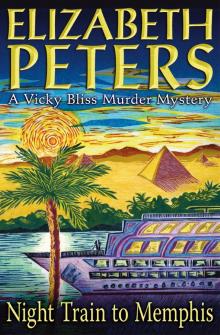
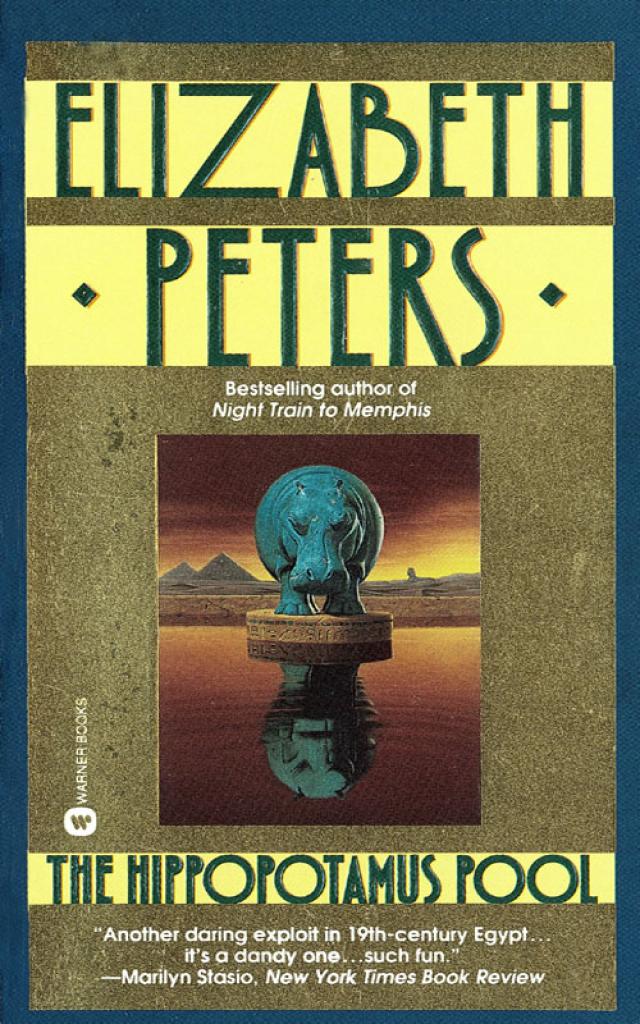
The Hippopotamus Pool, page 1
part #8 of An Amelia Peabody Mystery Series


The Critics Praise
THE HIPPOPOTAMUS POOL
“FASCINATING … HER BEST IN YEARS, primarily because … super-bright Ramses hilariously dominated much of the action.”
—Chicago Sun-Times
“FUN … HER CHARACTERS ARE DELIGHTS… PETERS’S GREATEST STRENGTH IS DIALOGUE—always witty, often risque and totally non-Victorian, which somehow makes it work.”
—San Francisco Examiner
“A DELIGHT FROM START TO FINISH … presents the author and her detecting heroine in fine form.”
—Mostly Murder
“JUMP INTO THE ‘POOL.’ THE WATER’S FINE…. continues the mix of feminism, archaeological insights and humor that has made the series a success with readers.”
—Charleston Post & Courier
“READ THIS ONE—JUST FOR FUN.”
—Louisville Courier-Journal
“A DELICIOUSLY WITTY, COMPULSIVELY READABLE ROMP … sure to enchant both first-time readers and passionate Peters fans.”
—Book Page
“FANS WILL LOVE THE WAY OUR HEROES OUTWIT THEIR ENEMIES AND SOLVE THE MYSTERY.”
—Abilene Reporter News
READERS LOVE ELIZABETH PETERS!*
“Your books contain all the things I love the most: humor, adventure, mystery, romance, and intelligent, capable heroines.”
—J.C., British Columbia, Canada
“One of your most ardent fans is a seventeen-year-old student in SC. She is enthralled with all of your characters and writings. She even wants a pair of Turkish trousers.”
—C.S. Jr., Gastonia, NC
“I thought it was about time I should write to thank you for the laughter, entertainment, and even the broadening of my mind your books have given me.”
—M.S., Fish Hoek, South Africa
“Life without the comfort of a new ‘Elizabeth’ would be insupportable. I ration them. They got me through menopause—and you make me giggle like a teenager.”
—N.W. (no address)
“They are such intelligent books. I think I have read each book at least 10 times.”
—J.C.D., Rocky Point, NY
“I have just finished reading The Hippopotamus Pool. I laughed harder than ever. Hooray for Amelia, long may she wave! And Ramses too.”
—D.G., Middletown, NY
“So you have done it again! You have made Peabody, Emerson, and the others in your newest book live again for us readers who welcome old and new friends into our lives.”
—V.T.M., Tenafly, NJ
AND THE EXPERTS AGREE!
“Elizabeth Peters/Barbara Michaels has once again brilliantly evoked the mystery, excitement, and, yes, passion of a Golden Age of Egyptology, with generous doses of wit and suspense thrown in for good measure. This Egyptologist gives The Hippopotamus Pool three thumbs up!”
—Dr. W. R. Johnson, field director of The Epigraphic Survey, Oriental Institute (Chicago House, Luxor, Egypt)
“The queen of Egyptological fiction.”
—William J. Murname, Ph.D., University of Memphis
“ ‘The best Amelia yet’ is always the assessment of the latest installment of Elizabeth Peters’s suspense-cum-parody Amelia Peabody Emerson series, and this is certainly true of The Hippopotamus Pool.”
—Dennis Forbes, editor, KMT: A Modern Journal of Ancient Egypt
Books by Elizabeth Peters
NIGHT TRAIN TO MEMPHIS
THE SNAKE, THE CROCODILE AND THE DOG*
THE LAST CAMEL DIED AT NOON*
NAKED ONCE MORE
THE DEEDS OF THE DISTURBER*
TROJAN GOLD
LION IN THE VALLEY*
THE MUMMY CASE*
DIE FOR LOVE
SILHOUETTE IN SCARLET
THE COPENHAGEN CONNECTION
THE CURSE OF THE PHARAOHS*
THE LOVE TALKER
SUMMER OF THE DRAGON
STREET OF THE FIVE MOONS
DEVIL-MAY-CARE
LEGEND IN GREEN VELVET
CROCODILE ON THE SANDBANK*
THE MURDERS OF RICHARD III
BORROWER OF THE NIGHT
THE SEVENTH SINNER
THE NIGHT OF FOUR HUNDRED RABBITS
THE DEAD SEA CIPHER
THE CAMELOT CAPER
THE JACKAL’S HEAD
* Amelia Peabody mysteries
To George and Dennis
Copyright
Copyright © 1996 by MPM Manor, Inc.
All rights reserved.
Warner Books, Inc.
Hachette Book Group
237 Park Avenue
New York, NY 10017
Visit our website at www.HachetteBookGroup.com
First eBook Edition: December 2009
ISBN 978-0-4465-7127-2
Contents
The Critics Praise THE HIPPOPOTAMUS POOL
Books by Elizabeth Peters
Copyright
Acknowledgments
Characters Appearing or Referred to in The Hippopotamus Pool
Introduction
CHAPTER ONE: The Trouble with Unknown Enemies Is That They Are So Difficult to Identify
CHAPTER TWO: A Lady Cannot Be Blamed If a Master Criminal Takes a Fancy to Her
CHAPTER THREE: Abstinence, As I Have Often Observed, Has a Deleterious Effect on the Disposition
CHAPTER FOUR: Candor Is Not a Conspicuous Characteristic of Criminals
CHAPTER FIVE: The Fatal Fall of a Fellah
CHAPTER SIX: Another Shirt Ruined!
CHAPTER SEVEN: The Soft Voice of the Father of Curses Is Like the Growl of an Angry Lion
CHAPTER EIGHT: No Innocent Person Can Lead a Life So Free of Harmless Vice
CHAPTER NINE: Buried Alive!
CHAPTER TEN: Men May Be Violently Attracted by Attributes That Are Not Immediately Apparent
CHAPTER ELEVEN: I Have Known Several Villains Who Were Perfect Gentlemen
CHAPTER TWELVE: It Is Better to Have a Demon As a Friend Than an Enemy
CHAPTER THIRTEEN: Humor Is an Excellent Method of Keeping a Tight Rein on Unproductive Displays of Emotion
CHAPTER FOURTEEN: Most People Obey the Orders of an Individual Who Is Pointing a Gun at Them
CHAPTER FIFTEEN: No Mystery Is Insoluble—It Is Simply a Matter of How Much Time and Energy One Is Willing to Expend
A Preview of SEEING A LARGE CAT
Acknowledgments
I have badgered and bored almost all my Egyptological friends about this book. I am particularly indebted to the following for supplying offprints, photographs, suggestions and encouragement:
Dennis Forbes, editor of KMT (who also suggested the title); George B. Johnson, his skilled colleague and photographer extraordinaire; The Wilbour Library of Egyptology of the Brooklyn Museum; Dr. Donald Ryan, who passed on Tetisheri’s good wishes; the entire staff of the Epigraphic Survey at Chicago House, Luxor, especially the Mudir, Peter Dorman, who dragged me, kicking and screaming, up to the top of Drah Abu’l Naga; Dr. Daniel Polz, who has politely refrained from finding Tetisheri’s tomb before I could do so; The Oriental Institute, its library and its director, Dr. William Sumner; Dr. Peter Der Manuelian, who designed the map and the tomb plan. He followed my (often confusing) instructions, so any errors and/or anomalies are my responsibility.
And Dr. Edna Russman, who was the first to mention to me the possibility that the statuette of Tetisheri might be a copy of an ancient original rather than an out-and-out forgery. She graciously admits that Emerson may have hit on the idea earlier.
Characters Appearing or Referred to in The Hippopotamus Pool
Abd el Hamed—antiquities dealer and forger, living in Gurneh
Abdullah ibn Hassan al Wahhab—reis (foreman) of Emerson’s Egyptian workmen
Ali—a suffragi (room steward) at Shepheard’s Hotel
Ali, Mohammed, Selim, et cetera et cetera—Abdullah’s sons, who also work for the Emersons
Ali Murad—antiquities dealer and American consular agent in Luxor
Amherst, William—Cyrus Vandergelt’s assistant, a young Egyptologist, who has very little to do with the story
Bertha—a woman of mystery, one of the Emersons’ former enemies
Brugsch, Emile—assistant to Maspero, first archaeologist to enter the cache of royal mummies at Deir el Bahri
Budge, Wallis—Keeper of Egyptian and Assyrian Antiquities at the British Museum; notorious for his questionable methods of acquiring objects for the museum
Carter, Howard—newly appointed Inspector of Antiquities for Upper Egypt
Daoud—Abdullah’s nephew
Emerson, Amelia Peabody—Victorian gentlewoman, archaeologist, and expert in crime
Emerson, Evelyn—Walter’s wife, granddaughter of the late Earl of Chalfont
Emerson, Radcliffe—Amelia’s husband, “the most eminent Egyptologist of this or any other era,” known to Egyptians as the Father of Curses and to his wife as Emerson
Emerson, Walter—Radcliffe’s brother, a specialist in the languages of ancient Egypt
Emerson, Walter Peabody—son of Amelia and Emerson, called Ramses by his friends and an afreet (demon) by almost everybody else
Forth, Nefret—ward of Amelia and Emerson, granddaughter of the late Lord Blacktower
Layla—Abd el Hamed’s third and most interesting wife
Mahmud—steward of the Emersons’ dahabeeyah
Marmaduke, Gertrude—hired by the Emersons to tutor their children
Maspero, Gaston—reappointed in 1899 to his former position as Director of Antiquities
Murch, Chauncey—American missionary and dealer in antiquities in Luxor
Newberry, Percy—English Egyptologist
O’Connell, Kevin—star reporter of The Daily Yell
Petrie, William Flinders—Emerson’s chief rival as the founder of scientific archaeology
Quibell, J. F.—newly appointed Inspector of Antiquities for Lower Egypt
Riccetti, Giovanni—formerly in control of the illegal antiquities trade in Luxor, he intends to regain that position by any means necessary
Sethos, aka the Master Criminal—formerly in control of the illegal antiquities network in Egypt, the chief adversary of Amelia and Emerson (and Ramses)
Shelmadine, Leopold Abdullah, aka Mr. Saleh—is he the reincarnation of the High Priest Heriamon or a member of a gang of tomb robbers? Or both?
Todros, David—Abdullah’s grandson
Vandergelt, Cyrus—American millionaire excavator and enthusiastic amateur of Egyptology
Washington, Sir Edward—a younger son with a talent for archaeological photography and a questionable reputation with the ladies
Willoughby, Dr.—English physician residing in Luxor
Introduction
For the convenience of readers who may be encountering Mrs. Emerson’s journals for the first time, we have obtained permission to reprint this excerpt from The National Autobiographical Dictionary, 45th edition.
The date of my birth is irrelevant. I did not truly exist until 1884, when I was in my late twenties.1 It was in that year that I set out for Egypt with a young lady companion, Evelyn Forbes, and found the three things that were to give meaning and purpose to my life: crime, Egyptology and Radcliffe Emerson!
Emerson (who was beginning that remarkable career in archaeology which is described elsewhere in this dictionary) and his brother Walter were digging at the remote site of Amarna in Middle Egypt. Shortly after Evelyn and I joined them, the work was interrupted by a series of extraordinary events featuring what appeared to be an animated mummy. The unmasking of the villain who had inspired this apparition did not interfere unduly with a successful season of excavation.2
My marriage to Emerson took place soon thereafter, as did the union of Evelyn to Emerson’s brother. The birth of our only child, Walter Peabody Emerson, familiarly known as Ramses, necessitated a brief hiatus in our annual expeditions to Egypt. It was not until the autumn of 1889 that an appeal from the widow of Sir Henry Baskerville, whose death under mysterious circumstances had interrupted his excavation of a royal tomb at Thebes, took us back (with what delight the Reader may imagine) to Egypt. We were of course able to finish Sir Henry’s work and solve the mystery of his death.3
We had left our son with his aunt and uncle in England that season, since his extreme youth (and certain of his habits) would have imperiled him (and everyone around him). However, he had from an early age demonstrated a keen aptitude for Egyptology, so (at the insistence of his doting father) he accompanied us to Egypt the following year. We had hoped to work at the great pyramid field of Dahshûr that season, but the spite and jealousy4 of the then Director of Antiquities relegated to us the nearby site of Mazghunah—probably the dullest and least important archaeological site in Egypt. Fortunately our work was enlivened by our first encounter with the enigmatic genius of crime known as Sethos, or, as I preferred to call him, the Master Criminal.
The details of this amazing man’s career are shrouded in mystery, but it must have begun in the late 1880s, in the Luxor area. A few years later he had disposed of all rivals and ruled supreme over the illegal antiquities trade. All the objects looted from tombs and temples by unauthorized diggers, Egyptian and European, passed through his hands. Superior intelligence, a poetic imagination, utter ruthlessness, and an incomparable talent for disguise contributed to his success; only his most trusted lieutenants were aware of his true identity.
We were able that year to foil Sethos’s attempt to rob the princesses’ tombs at Dahshûr and to escape his attempts on our lives.5 He got away from us, though, and we found him on our trail again the following season. However, certain developments of a private nature (which are not within the scope of this article) gave us reason to believe we had seen the last of him.6
In the autumn of 1897 we set out for the Sudan, which was being reconquered by British-led Egyptian troops after a long period of occupation by the Dervishes. We had planned to excavate in the ruins of the ancient Cushite capital of Napata, but a message from Willy Forth, an old friend of Emerson’s who had been missing for over ten years, sent us out into the wastes of the Western Desert in search of him and his family. The details of that astonishing adventure (perhaps the most remarkable of our lives) have been recorded elsewhere;7 it resulted in the rescue of Forth’s daughter Nefret from the remote oasis where she had dwelt since her birth.
The winter of 1898-99 saw Emerson and me again at the site of Amarna. We had left Ramses and Nefret (now our ward) in England, and I looked forward to reliving the fond memories of my first meeting with my admirable spouse. The startling events that interrupted our excavations that year involve private personal matters that are inappropriate in an official biography;8 suffice it to say that we encountered for the third time our great and terrible adversary, the Master Criminal, and several of his henchmen, as well as a mysterious female known to us only as Bertha. The thrilling denouement of this adventure saw Sethos felled by an assassin’s bullet, the dispatch of the assassin by Emerson and the disappearance of Bertha and the henchmen….
I have often been asked to account for the frequency of our encounters with criminals of various varieties, but in my considered opinion it resulted inevitably from two causes: first, the uncontrolled state of excavation during the period in question, and second, the character of my husband. From the first, and at first almost single-handedly, Emerson fought tomb robbers, inept inspectors of antiquities and unprincipled collectors in his crusade to preserve the historic treasures of Egypt. Needless to say, I was ever at his side in the pursuit of knowledge and of villains.
1. Sic? This is not consistent with other sources. However, the editors were of the opinion that it would be discourteous to question a lady’s word.
2. Crocodile on the Sandbank
3. Curse of the Pharaohs
4. Mrs. Emerson refused to alter this statement, despite the editors’ objections to its prejudicial nature.
5. The Mummy Case
6. Mrs. Emerson’s reticence on this subject is difficult to understand, since she has described these events in the fifth volume of her Memoirs, Lion in the Valley.
7. The Last Camel Died at Noon
8. For the details of these private personal matters, cf. The Snake, the Crocodile and the Dog
CHAPTER ONE
The Trouble with Unknown Enemies Is That They Are So Difficult to Identify
Through the open windows of the ballroom the soft night breeze of Egypt cooled the flushed faces of the dancers. Silk and satin glowed; jewels sparkled; gold braid glittered; the strains of sweet music filled the air. The New Year’s Eve Ball at Shepheard’s Hotel was always an outstanding event in Cairo’s social season, but the dying of this December day marked an ending of greater than usual import. In little more than an hour the chimes would herald the start of a new century: January the first, nineteen hundred.
Having just completed a vigorous schottische in the company of Captain Carter, I sought a quiet corner behind a potted palm and gave myself up to speculation of the sort in which any serious-minded individual would engage on such an occasion. What would the next one hundred years bring to a world that yet suffered all the ancient ills of mankind—poverty, ignorance, war, the oppression of the female sex? Optimist though I am, and blessed with an excellent imagination (excessively blessed, according to my husband), I could not suppose a single century would see those problems solved. I was confident, however, that my gender would finally achieve the justice so long denied it, and that I myself would live to see that glorious day. Careers for women! Votes for women! Women solicitors and women surgeons! Women judges, legislators, leaders of enlightened nations in which females stood shoulder-to-shoulder and back-to-back with men!