Love and Scandal, page 8


Collette noticed the knave had not denied being the writer of her book, and her fury grew. She remembered the first moment she had seen the article. She read every paper she could obtain in Listerwood-on-Sea, and that usually included Wilson’s Gazette, as Professor Stiltson dropped off his copies for her perusal. The Professor was one of the few people aware of her literary secret identity, and she suspected that he had deliberately kept that particular issue out of her sight so as not to upset her. He seemed to believe she was much more fragile than she really was, perhaps because of her short stature.
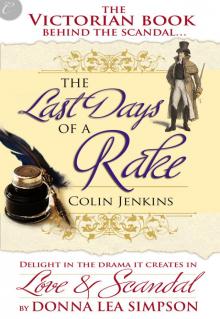
It was not until two weeks after the story ran that she came across the article. The paper was wrapped around some vegetables delivered from the manor house to her aunt’s cottage. She wouldn’t even have noticed, but that the title of her book had leaped out at her. She had read all of the reviews, hugging her secret delight to herself except in front of her aunt and the Professor, and she eagerly seized the paper to read it.
To her dismay, after the headline she read:
Man about town and legendary rake Charles Stonehampton Jameson, an eminently well-connected gentleman, has been heard loudly acclaiming as brilliant the daring new novel The Last Days of a Rake. The novel is brilliant, a tour de force, an inimitable piece of perfection, he has been heard to exclaim. When this reporter approached Mr. Jameson and taxed him with being, perhaps, the secretive author, he would only say, “I suppose if I deny being Jenkins you will not believe me, so I will not bother denying it.” This equivocation is proof that the man is the brilliant new author and that the work is to some extent autobiographical, relating his journey from rake to man of letters. We congratulate Mr. Jameson, heretofore a collector of manuscripts, for stepping into the role of author, and acquitting himself with such brilliance on his first time out.
She glared up at the object of the paper’s fawning article. Blackguard, she fumed to herself. Base scoundrel. Thief.
What a fortuitous night this was, Jameson thought, rubbing his hands together. He had not been going to come to this literary party at all, having begun to find the sly innuendo and outright badgering he was subject to since that damned article, a nuisance. But he had come, and as a reward here was his sweet little Collette, his secret flirtation, the most intriguing young lady he had met in quite a while.
Collette Jardiniere. He rolled her name around in his mind, listening to the sound of it, liking the rich French tones, even as he relished how her indigo dress, as unfashionable as it was, clung to her modest curves. He smiled down at her, only to find her glaring up at him as if he emitted a particularly foul odor or had said a nasty word. What was wrong that she glowered at him like that?
“Well, my dear Mrs. Gaskell, if you say we must speak, you shall be obeyed at once.” More anxious than he ever found himself, he took her arm and guided her away, saying, as Mrs. Gaskell and Philoxia Bertrand looked on with indulgent smiles, “Miss Jardiniere, have you noticed that you and I have the same initials? Would your middle name happen to start with an S?”
When they were far enough from the others, he offered her a seat on a small fainting couch in a dim corner of the room and sat beside her, ignoring other ladies who were looking at him in reproach for not making his customary gallant rounds. She sat carefully, keeping a distance between them.
He thought for a moment. Had he done aught to offend her? She seemed angry. He must bend all his effort to charming her back into the open smile he remembered from the train. That expression had been so unguarded, so unpracticed. He had never experienced anything like it since. “Now that we are alone,” he murmured close to her ear, “I shall call you simply ‘Collette’ again. I do so like that name.”
She bent away from him and glared into his eyes, candlelight glinting on her spectacles. “I did not give you permission this time, sir!”
“Ah, but once permission is given, it can never be rescinded.”
“Is that some kind of rake’s code?” she said, her tone tart. “Does that carry through for your amorous conquests as well? May they never say ‘no’ to you once they have said ‘yes’? A dangerous philosophy, sir.”
He began to understand. Sighing, he shook his head. “Did Elizabeth and Philoxia fill your head with some nonsense about me being a rake? Is that what is behind this change in attitude toward me?” He lowered his tone, making it tender as he laid a hand on her slender bare arm above her glove. “You were not always so cold, my dear.” He caressed her soft, smooth skin. It had the feel he remembered, that satiny texture of finest chamois.
“I am not your dear,” she said fiercely, pulling her arm away.
Her green eyes, behind glass, were the color of jade and just as mysterious as that oriental stone, with sparks of topaz. She had hardened toward him. Had his liberties in the train given her a disgust of him? Was that why she ran away from him in the station? Or was she afraid of her own feelings? That was much more likely. Women were often frightened of their own sexual responses and repulsed by the physical aspect of human life. With their weaker understanding, they could not reason that life relied on just such physicality.
Whatever had happened, it appeared all she felt toward him was revulsion. But it could not stay that way, not if he bent all his efforts to the task at hand. He would charm her against her own conscience—he had done so before.
Sincerity. That was perhaps the weapon to charm her. But she was bright and perspicacious; any falsity would be sensed. And so he would tell the truth.
He clasped his hands in front of him and scanned the room. Philoxia and Elizabeth were standing together by a mahogany table looking in his direction and talking and smiling. He didn’t even want to think what they were making of him drawing Collette away like this. It had been rash, for he would not wish their conversation to become the subject of gossip. As odd as it seemed even to himself, his relationship with this slender lady was precious to him and private. He should have been more circumspect. Jameson looked down at the Turkish carpet and sighed.
“I know you are not ‘my’ dear,” he said to Collette, looking back up into her eyes. He didn’t smile. He simply examined her expression, the flashing green of her eyes, the dour scowl on her pretty mouth. He deeply wanted to kiss that scowl away but would have to talk her out of her sour mood. “Do you know, I have done nothing but think of you every minute since you ran away from me in the train station?” Damn it, that was the truth. Against every determined effort of his own, he had not been able to forget the little country wren. “Why did you do that, Collette…Miss Jardiniere, if I must call you that? Why did you run away from me?”
He saw indecision on her gamine face. She really was an adorable creature, with a pointed, dimpled chin and perfect mouth. He was not sure why she had affected him. Perhaps she represented a challenge or a change or something like that. But he had enjoyed their conversation almost as much as their kisses, and that was puzzling. She had done nothing but disagree with him. He was not accustomed to women who disagreed with him.
“I did not run away from you.” She gazed across the room but then turned and met his eyes again. “I merely found the man who had come to meet me at the station,” she continued. “I’m not familiar with London, and he was departing in the other direction. I was afraid to lose sight of him. He had my bag, and I didn’t even know where I was going, as he had, to my surprise, already rented a room for me. It is reasonable, I think, to not want to lose sight of the only person in a great metropolis who knows where one is going, and who, furthermore, has one’s valise.”
He frowned. “Who is this man who met you at the station? And what have you come to London for?”
“I told you,” she replied tartly. “Business.”
“Business. Yes, you did say that, but you never did explain what business a young lady like you could possibly have in London.”
“But Mr. Jameson, you have some explaining to do.” She stared at him, her lips pinched in a firm line, her expression still dour. “Why did you not tell me, when you saw what I was reading, that you are the author of that book?”
Damn. He had forgotten what she was reading on the train. And Philoxia had had to bring that up as she introduced them. Damn and damn again!
“That is merely a rumor, Miss Jardiniere. Surely you do not trade in rumor and innuendo?”
“No, I generally go to the source and ask them the truth straight out. I am a great believer in the truth.”
That sounded very much like a challenge.
“Shall we say that some of the novel reads like the story of my life?”
“No, we shall not say that,” she said, a stubborn note in her melodious voice. “What is so difficult about a simple question? Did you write The Last Days of a Rake or not?”
“What if I was the author and wrote under a pseudonym because I wanted my privacy? What then should I say to intrusive questions like that?”
He was pleased to see her flinch. She gazed off over his shoulder with glazed and unseeing eyes for a moment, and then seemed to come to a decision.
“I would say,” she said, meeting his eyes again, “that you are entitled to your privacy, but once someone speculates on your identity, I think that if it is your work, you should acknowledge it. You should not lie, and evasions are merely lies in vague dressing. Is it your work or not? Make a statement.”
Her words were harrying. He could not abide a nag, and this harpy would certainly be one of those. He was becoming intensely irritated without quite knowing why. She was the most demanding, infuriating girl—woman, lady?—he had ever met. He longed to give her a set down, to tell her it was none of her business after all, but some part of him admitted the justice of her remark. The confusion over his supposed authorship had become tedious and mocked his inadequacy.
He sighed deeply and folded his arms over his chest. “I am not the author of The Last Days of a Rake. Are you satisfied?” He caught a look of some gratification on her face. What was it to her? Why was this an important issue?
“Not wholly.” She sat up straight and primly folded her hands together on her lap over her reticule. “What are you going to do about that journal, Wilson’s Gazette? Should you not tell them the truth so they can print a retraction of some sort?”
“Why would I do that?” he exclaimed. “Do you take me for a bloody fool? Tell them I am not the author whom I never claimed to be?”
“They wrote that you were the author, and you should correct them!” she said, shaking her finger in his face. “For the real author’s sake, if for nothing else.”
He stared at her if she were mad. It occurred to him that she had read the Gazette story; she must have to be so familiar with it. Was she disappointed he was not the author? Did she fancy herself enamored of this elusive Colin Jenkins, as half the silly women in London claimed to be, to judge by foolish conversations he had overheard at tea tables and evening parties, the opera and theatre? One woman claimed she had written the author, at the publisher’s address, offering to marry him, sight unseen. But that just did not fit with what he had surmised about her. He did not judge her to be one of those women seeking some tenuous connection with celebrity, even if it was only in their own fevered imagination.
“In the first place, it is not my business to correct erroneous stories about me by young men with more imagination than intelligence. In the second place, I have learned the least said, soonest mended, and in the third place, are you quite mad?”
She bridled and lifted her chin. He wanted nothing more at that moment than to shut her mouth in the most delectable way he could think of, and that was to kiss it. But if it was highly irregular on the train, it was scandalous in a salon crowded with people. Not that half of these people would mind. They were of an artistic bent, or of a mind to appreciate the artistic temperament, and would be shocked but titillated. If it were any other woman he might do it just to garner a reaction, even if it ended in his being slapped on the cheek. It would not be the first time. He still remembered her resounding slap with a great deal of pleasure and wished he had taken the opportunity to return the salute with a vigorous smack on her bottom as he followed her off the train.
However, he did not wish to subject a lady whom he could only characterize as innocent, and for whom furthermore, he had a peculiar—absolutely mad, considering the way she treated him—affection, to gossip and innuendo. He was inured to it, but she would not know what to do. Of course there was that maddening strain of tenacity; perhaps he was being too easy on her.
“I am not mad, but I believe in honesty,” she was saying in reply. “What do you think the real author is thinking this very moment? Do you feel quite comfortable being such a fraud?”
Jameson shifted uncomfortably. He had not really thought of what the author would think about him. It had not seemed important at the time, but perhaps she had a point, especially in light of the fact that he was trying to find him. It was what his trip down to Kent was about. He had gleaned from the pages of the novel an inkling that since a promontory along the Kentish shoreline was the setting for one memorable and very poignant scene in the book—one close to the end when the hero was considering his imminent death—it had, perhaps, some deep meaning to the author. So he had hared off to Kent to try to track down the exact location, thinking the novelist might actually live close by, but no one had known any Colin Jenkins. Meeting Collette on the train was the only thing that had salvaged his memory of that otherwise disappointing jaunt.
“If the author wishes me to retract,” Jameson said carefully, “he need only come forth and tell me. I have been longing to meet the fellow to congratulate him on a work I would not feel ashamed to name my own. That was half the reason I equivocated to the damned Gazette lad. I thought the real author might come forth to straighten out the record.”
She gazed at him steadily, her eyes narrowed in suspicion. “You mean, this is not some kind of conspiracy between you and the publisher to gain more publicity for the book?”
“Don’t be absurd! I tried to get the author’s real name out of the publisher, a chap by the name of Bellringer, and he would not tell me, nor even if Colin Jenkins is a nom de plume or the fellow’s actual name. I have had a man harassing every Colin Jenkins in London. I was set to send him about the countryside smoking out other Colin Jenkinses, but I am on the verge of giving up.”
Her expression cleared and she actually smiled. “The publisher would not tell you the author’s real name? Do you think he was being protective of the author’s identity?” Her voice lifted with a lighter tone.
“Yes. He told me the fellow lived in retirement and did not wish to be bothered. He would not confirm the name as a pen name, so I still don’t know the truth.”
“And you truly only want to talk to the writer?”
“What do you think, that I want to marry the fellow? Of course I only want to talk to him. I would respect his anonymity,” Jameson said with all honesty. It would be a great pity in his thinking, but if the fellow truly wanted to remain anonymous, then so be it. “I would gladly tell the public I am not the author if that is what the fellow wanted. I just want to congratulate him on a fine achievement, possibly the best novel of this decade. I would like to be his patron but would respect his desire for anonymity if it came from his lips.”
Collette looked pensive, staring down at her gloved hands, stroking the indigo fabric of her dress and picking at a loose thread. He watched her. She was teetering on the edge of some decision. What was it?
“I don’t know what any of this has to do with you,” Jameson said. He edged toward her. “Why don’t we talk about something more entertaining,” he said urgently, “like a kiss on a dark train by the light of a single candle? I have thought of you so often. I don’t even know why, but you left me bereft when you fled the station.” He felt naked and helpless, unable to explain even to himself the effect she had upon him. All he knew was he wished to explore it further.
She reddened but did not respond. She looked up into his eyes, and he had the oddest feeling she was searching his soul, diving into depths he did not even think he possessed.
“There is something we can talk about,” she said. “You can talk to me about my book if you like. I am the author of The Last Days of a Rake. I am Colin Jenkins.”
Seven
Oh, Lord, Collette thought. I have done it. I have told him. Her heart thudded wildly with the knowledge that in some way, reading a writer’s book was to glimpse into her soul. She was afraid to look up into his eyes, fearful that she would see a dawning understanding there, and so was not prepared for the sharp bark of laughter, followed by quickly stifled snorts.
“You are Colin Jenkins? Ha! Very good, my dear. I have been hoisted, I believe, on my own petard.” He relaxed back on the fainting couch, resting against the wall and crossing one long leg over the other.
“You don’t believe me?” Now was her chance. She could retract now and let him think she joked.
He uncrossed his legs and sat up straight again, tilting his head, his slate gray eyes challenging her with his direct stare. “Believe you? I didn’t think you were serious. My dear, you do not mean to tell me that you, a young lady, wrote a book that explores the darker side of a rake’s consciousness?” His voice had a caustic edge to it, as sharp and burning as acid.
Fury at his patronizing tone filled her. How dare he question not only her abilities, which she admitted he had no reason to know about or believe in, but her veracity? She, who had taxed him with lying! She was driven now to respond to his insult. “Do you think I lie?”
He bent toward her and said, “You’re serious? You mean me to believe you wrote that book?”
“I mean you to believe I do not lie,” she said.
He smiled, but the expression was cold and humorless for all his lips twisted upward in the corners. “For argument’s sake, let us say I believe you. Where on earth did you, a spinster from a tiny seaside village, come about knowledge of the soul of a rake like Lankin?” he asked, about the central character of the novel. “How would you understand how he thinks, how he feels, what he wants? Impossible. Outrageous.”