Mr Ape, page 2


‘Hell’s bells!’ said Ape. ‘Of course, she must have sacked the gardeners as well.’
The grounds of Penny Royal were extensive, and had needed the attentions of two gardeners and a garden boy, but now, as Ape found when he went out to walk around, the place was like a jungle. Apart from the overgrown lawns, the flower-beds were choked with weeds, as was the kitchen garden, where many of the vegetables had gone to seed. Everything was in a terrible mess.
Ape went back indoors, stopping outside the French windows of the drawing room to admire his hens within, and made himself a large cup of cocoa. He sat dunking biscuits in it.
Over the years he had made a secret study of the art of dunking – secret because Mrs Spring-Russell strongly objected to the practice. He knew the exact length of time for which a particular variety of biscuit might be immersed before becoming too soggy and thus disintegrating into the cup. Digestives were a two-second dunk, Marie three, Royal Scots four, Rich Tea six, and so on.
Today, as he ate his shortbreads (five seconds), Ape discussed, with himself, the problem of the overgrown grounds. ‘I can’t possibly manage it all,’ he said. ‘That’s for sure. All that mowing, weeding, sowing, hoeing, that sort of stuff. I suppose I’ll have to get the gardeners back. If they haven’t found other jobs.
‘On the other hand,’ he went on, ‘I don’t really want to do that. Does it matter if it’s all a bit jungly? There’s no-one else to see it but me. Though I must say, it looks a frightful mess.’
When he had finished his cocoa, he went back out into the kitchen garden and pulled some bolted lettuces for his hens. Fetching a stepladder and a length of string, he suspended the green stuff from the great glass chandelier that hung from the centre of the drawing room ceiling.
It was while he was watching the birds pecking happily away at the lettuces that Ape suddenly became aware that someone else was watching him. He turned towards the French windows and saw, staring in at him, the mournful face of a donkey. Round its neck, Ape could see, was a length of old rope with a frayed end to it. The creature, it was plain, had been tethered to a post or peg, and the worn rope had snapped, setting it free.
At that moment Ape heard a loud knocking, and he made his way out of the drawing room, shutting the door carefully behind him, and crossed the hall to the great double front doors of Penny Royal.
‘Must be the postman,’ he said (for the milkman and the coalman and the man who came to read the meter always used the tradesmen’s entrance), but when he opened the doors, he saw, standing at the top of the broad flight of stone steps that led up from the forecourt, a boy, wearing rather ragged clothes and a worried look.
‘’Scuse me, mister,’ said the boy. ‘You haven’t seen a donkey, have you?’
‘Yes,’ said Ape. ‘On my front lawn. The other side of the house.’
The worried look vanished from the boy’s brown face, to be replaced by a broad grin. ‘Oh thanks, mister!’ he cried. ‘She’s my donkey, you see. Dada bought her specially for me. She’s called Columbine, and she broke her tether, and we searched all over the common where our caravan is and we couldn’t find her, so I came on up here.’
‘Where’s your father then?’ said Ape.
‘He’s looking in the fields on either side of your drive,’ said the boy. ‘I’ll call him,’ and he put two fingers in the sides of his mouth and let out the loudest, most piercing whistle imaginable.
‘Gosh!’ said Ape admiringly. ‘I’ve always wanted to be able to do that.’
‘I’ll teach you,’ said the boy.
‘Thanks,’ said Ape. ‘What’s your name, by the way?’
‘Jake.’
‘Come on then, Jake. Let’s go and catch your Columbine,’ said Ape, and he shambled down the steps, the boy following.
As they set off, Jake pointed down the drive. ‘Here’s Dada coming now,’ he said.
Ape saw a tall dark-skinned man, with longish black hair like the boy, striding towards him. He looked angry.
‘Here, you,’ he said loudly. ‘Where d’you think you’re taking my boy?’
A gypsy, thought Ape, and a bad-tempered gypsy at that.
He looked the tall man in the eye – they were much of a height. ‘I’m taking your boy to show him where his donkey is,’ he said, ‘and I’ll tell you something – he’s a sight politer than his father,’ and he turned his back on the gypsy and walked on.
But when they reached the lawn-turned-hayfield, there was no sign of the donkey.
‘Funny,’ said Ape. ‘She was standing just out here’, and he pointed to the French windows, behind which stood several of his hens looking out from the drawing room, while others still pulled at the lettuces hanging from the chandelier. From the wall behind, Mrs Spring-Russell seemed positively to glower at the sight of the strangers looking in.
They found Columbine in the overgrown kitchen garden, eating a very large cabbage. The man took hold of her rope, while the boy Jake scrambled up on to the donkey’s grey back. He leaned forward, pulling gently at her long ears, and crooning some sort of song to her in a language Ape could not understand.
‘Thank you, mister, thank you very much,’ he said, smiling at Ape. Ape smiled back. He’d never had a lot to do with his own children, perhaps because they were, in looks and character, very like his wife. Like her, they had actively disliked animals of all sorts. Whereas this boy obviously loved them.
‘Sorry,’ said Jake’s father abruptly. ‘I shouldn’t have spoken to you like that, sir. I was worried. I didn’t know where Jake had got to.’ He put out a hand.
Ape shook it. ‘Forget it,’ he said. ‘What’s your name?’
‘Hart. Joe Hart.’
‘You’re gypsies, aren’t you?’
‘We call ourselves Romanies.’
‘You’re in a caravan, up on the common, Jake was telling me,’ Ape said. ‘I’ve always fancied life in a gypsy caravan, moving around the countryside wherever you like, here today, gone tomorrow, always the open road stretching away before you.’
‘I dare say you’re more comfortable in a great house like this,’ said Joe Hart.
‘I’m as snug as a bug in a rug,’ said Ape. ‘It’s the outside that’s worrying me – this kitchen garden, the lawns and all the rest of it. It’s one big mess.’
There was a short silence, broken only by the noise of the donkey champing cabbage. A look passed between father and son, and then Joe said, ‘I could lend a hand for a bit, if you like, sir.’
It’s a good strong hand too, thought Ape, and the boy could be useful if I should get some more livestock, which I might. Anyway, he’s going to teach me to whistle with two fingers.
‘All right,’ he said. ‘Thanks. We’ll try it. I’ll pay you a fair hourly rate, and you can bring Columbine with you and she can eat her way through this jungle. Does she pull the caravan?’
‘Oh no, sir,’ said Joe. ‘I’ve got a horse.’
‘A skewbald, he is,’ said Jake, ‘called Billy.’ ‘Well, bring him too,’ said Ape, ‘and look here, Joe, there’s no need to call me “sir”. My name’s Spring-Russell, but I’m always known by my initials, you see. A-P-E. Call me Ape.’
‘Couldn’t do that,’ said Joe. ‘Wouldn’t seem right.’
‘But we could call him Mr Ape, couldn’t we, Dada?’ said Jake.
‘No, no,’ said Joe.
‘Yes, yes,’ said Ape.
CHAPTER 4
Ape Gets Some Pets
A week later, the view from the French windows of the drawing room was rather different.
Ape stood, his hens clucking contentedly around him, and looked out once again at the broad lawns of Penny Royal.
Joe had spent hours mowing them, and had at last made them look a lot more respectable. Each day Jake and he had brought Columbine the donkey and Billy the horse and turned them into the walled kitchen garden, where they feasted.
‘Good job you can’t see them in there,’ Ape said to his wife’s portrait. ‘You’d have forty fits.’
Jake came into the drawing room. ‘Mr Ape?’ he said.
‘Yes?’
‘Do you like rabbits?’
‘To eat, d’you mean?’
‘No, to keep as pets.’
‘Haven’t kept any since I was your age.’
‘You could now,’ said Jake. ‘In the dining room. They’d have lots of space to run about.’
Before Ape could comment on this, they heard a noise somewhere up inside the drawing room chimney. It was a scrabbling noise, as of something falling down. First came a shower of soot with some bits of stick mixed in it, and then into the wide empty grate fell a bird.
‘What on earth …?’ began Ape.
‘It’s a jackdaw, Mr Ape,’ said Jake. ‘A young jackdaw. There must be a nest of them in the top of the chimney and this one’s come tumbling all the way down.’
‘Catch him,’ said Ape, but before the boy could lay hands on the bird, it began to flutter around the floor, much to the surprise and annoyance of Ape’s hens, who ganged up and began to set upon this black intruder.
The fledgling jackdaw had not yet properly mastered the art of flying, and things would have gone hard with it had not Jake now been able to grab it. It squawked and pecked at him, but he talked to it and soothed it, and soon it ceased to struggle, regarding them both with bright black eyes.
‘What shall I do with him, Mr Ape?’ Jake asked.
‘Well,’ said Ape, ‘we can’t put him back up the chimney, and we can’t let him loose in the world – he can’t fly well enough yet. So we’ll have to keep him, Jake, if he is a he, which we don’t know. He can live in the kitchen with me.’
‘He’ll make messes everywhere, Mr Ape,’ said Jake. ‘But you could keep him in the dining room. The rabbits wouldn’t mind.’
‘Rabbits?’ said Ape. ‘Oh yes, rabbits … I remember, you were saying. Tell you what, Jake. We’d better go shopping.’
The following morning Ape made himself one of his favourite breakfasts, a breakfast quite unlike most people’s.
First, he opened a tin of creamed rice, poured it into a bowl, added two big spoonfuls of strawberry jam, crumbled some digestive biscuits into the mixture, and stirred it all up together with a spoon.
Then he hard-boiled three brown eggs from his brown hens, squished them up with a fork, added salt, pepper and a large lump of butter, and stirred that up.
Then he got back into bed and sat up against his pillows, happily eating these strange messes and chewing over the idea of buying himself some rabbits. He clearly remembered a particular pet rabbit he had had as a small boy, seventy years ago, and how fond of it he had been. He could picture it still, looking out through the wire of its little hutch.
Ape swallowed his last mouthful. ‘I suppose,’ he said as he got out of bed to put the dishes in the sink, ‘that that rabbit would have been happier if he’d had room to stretch his legs. Not much space in a hutch. Still, there’ll be masses in the dining room. In fact I’d better get several rabbits – for company, you know.’
Ape continued talking to himself as he dressed. ‘I’ll drive into town today,’ he said, ‘and have a look round the pet shop and see what they’ve got. Perhaps Jake would like to come with me. I’ll ask Joe if he can.’
He found Joe in the stable yard, cleaning the Rolls-Royce. ‘Where’s Jake?’ he asked.
‘Looking at Columbine, I expect,’ said Joe. ‘He fusses about her like nobody’s business.’
‘Why?’ said Ape. ‘She’s not ill, is she?’
‘No,’ said Joe. ‘She’s in foal. Six months gone, so only another three to wait.’
‘Gosh!’ said Ape. ‘Going to have a baby, eh? How wizard! I’d love to see a baby donkey born here at Penny Royal. I do hope you won’t have gone before then – I know you people are always on the move. How long do you plan to stay on the common?’
‘We shan’t go yet awhile, I hope, Mr Ape,’ said Joe. ‘Jake here has got a place at the village school, and the term starts soon.’
Ape looked round to see Jake approaching. ‘I suppose you’ve had to go to quite a few different schools, eh?’ he said to the boy.
Jake nodded. ‘I wish I could stay at the same one like other children do,’ he said. ‘But as soon as I’ve made some friends, we move on again.’
‘The trouble is the same it’s always been,’ said Joe Hart. ‘People don’t feel comfortable with Romany folk. To them we’re foreigners at best, selling clothes-pegs and sprigs of lucky heather, eating hedgehogs baked in a clay oven. At worst they think of us as a pack of dirty thieves and try their best to get us shifted somewhere else. We ought to be all right where we are now – it is common land – but sooner or later someone will find a way to get rid of us. It isn’t so much that we want to keep moving on – it’s that we have to.’
‘Couldn’t you buy a piece of land?’ said Ape. ‘They couldn’t put you off it then.’
‘Land costs money,’ said Joe. ‘Which I haven’t got.’
I have, thought Ape. More than I know what to do with.
Joe gave the windscreen of the Rolls a final going-over with a chamois-leather and stood back to admire his handiwork.
‘She hasn’t been so clean for donkey’s years,’ said Ape. ‘Which reminds me – I’m going into town this morning. I’m thinking of buying some rabbits.’
‘Rabbits?’ said Joe. ‘To eat, you mean?’
‘No, I don’t want to eat them,’ said Ape. He laughed. ‘Though I am going to keep them in the dining room,’ he added. ‘Now, would it be all right if Jake came with me? He might like a ride in the Rolls, and I’m sure he’d be a help to me in choosing these rabbits. He’s good with animals.’
‘That’s fine by me, Mr Ape,’ said Joe. ‘I know you’ll take good care of him.’
The road to town crossed the common, and as they drove over it the Harts’ caravan came into sight, a big old fashioned horse-drawn caravan, brightly painted in red and blue.
Ape slowed and stopped. ‘Jake,’ he said, ‘d’you think I could have a look inside your home? It looks so nice.’
‘’Course you can, Mr Ape,’ said Jake, and they got out of the Rolls and walked across the grass towards the caravan.
‘Aren’t you afraid someone might steal from it?’ Ape asked. ‘Now that you and your father are down at Penny Royal all day?’
‘No,’ said Jake. ‘Swift wouldn’t let them.’
‘Who’s Swift?’ Ape asked.
For answer Jake put his fingers in the corners of his mouth and out came that piercing whistle. Out too, from under the steps that led up to the back door of the caravan, came a long-legged snake-headed, biscuit-brindled dog, a typical gypsy’s lurcher, and ran to Jake and licked his hand, whip tail wagging.
‘She’s going to have puppies, Mr Ape,’ Jake said.
‘Wow!’ said Ape. ‘Your donkey’s in foal and your dog’s in whelp. Aren’t you lucky!’
Inside the caravan, Ape noted immediately how neat and colourful it was, with bright paint and burnished brasswork and lots of gleaming ornaments. There wasn’t a speck of dust to be seen, and anyone else would have thought this the home of a very house-proud woman – or, rather, caravan-proud.
But Ape knew, because Joe had told him, that no woman lived here. Joe’s wife had died when Jake was small, and the gypsy had brought up his son alone.
As though he had read Ape’s thoughts, Jake pointed to a large coloured photograph in a gilded frame that hung upon the wall. It was of a raven-haired woman – not much more than a girl, Ape thought – who stared unsmilingly at the camera. Her face, with its high cheekbones and large dark eyes, was beautiful.
‘That’s my mum,’ Jake said. ‘She died.’
Ape nodded. ‘Your father told me,’ he said. He thought of adding, ‘How very sad’ or ‘I’m so sorry’ or ‘You must miss her’, but something decided him to say no more. Poor little chap, he thought.
Once again Jake seemed to know what he was thinking. ‘It’s all right,’ he said, as though Ape was the one who needed comforting. ‘She died when I was very young. I can’t really remember her.’
When they arrived in town, Ape and Jake went first to the bank, where Ape drew out some money, and then on to the pet shop. They made a strangely assorted pair: Ape in his hairy tweed suit, brown boots and brown bowler hat, Jake in old jeans and a T-shirt and trainers, the tall old man lumbering along in his usual way, the boy positively skipping in his excitement.
‘How many rabbits are you going to buy, Mr Ape?’ he asked as they walked along the high street.
‘Depends what they’ve got,’ said Ape.
In fact there were four rabbits for sale in the pet shop, a black one, a grey one, a spotty one and a white one with pink eyes.
‘What d’you think, Jake?’ said Ape.
‘They’re all lovely, aren’t they?’
‘Well, we’ll have the lot then.’
‘But, Mr Ape,’ said Jake, ‘hadn’t you better ask whether they’re bucks or does? Bucks might fight when they’re put together.’
‘You’re right,’ said Ape, and he asked the shopkeeper.
‘The white one’s a buck,’ the man said. ‘The other three are females.’
‘Well,’ said Ape again, ‘we’ll have the lot then.’
‘But, Mr Ape,’ said Jake again, ‘you’ll have to keep the buck separate or else you’ll have dozens of rabbits before long.’
‘Good,’ said Ape.
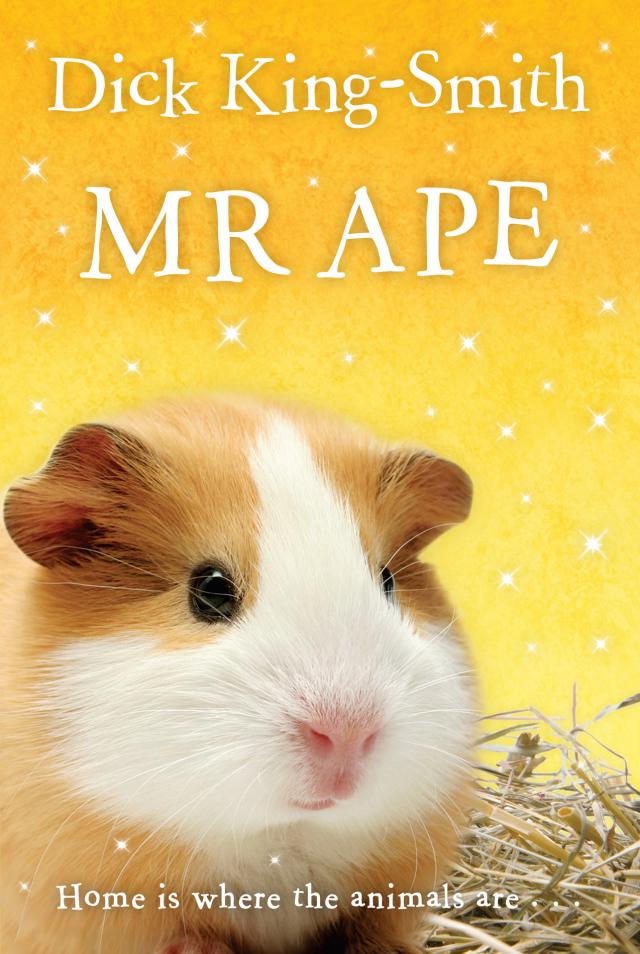
His eye fell upon two large cages full of guinea-pigs. ‘Look at those, Jake,’ he said. ‘I used to keep some when I was your age. I like guinea-pigs – they make nice noises, talking to you all the time,’ and to the shopkeeper he said, ‘All right to keep rabbits and guinea-pigs together, is it?’
‘If you’ve got plenty of space.’
‘I have,’ said Ape.
‘How many did you want?’
‘How many have you got?’
The shopkeeper counted the guinea-pigs. They were of many different colours, some with smooth coats, some with rough, some long-haired. ‘There are twelve here altogether to choose from,’ he said. ‘Was it boars or sows you wanted?’