In Odd We Trust, page 1


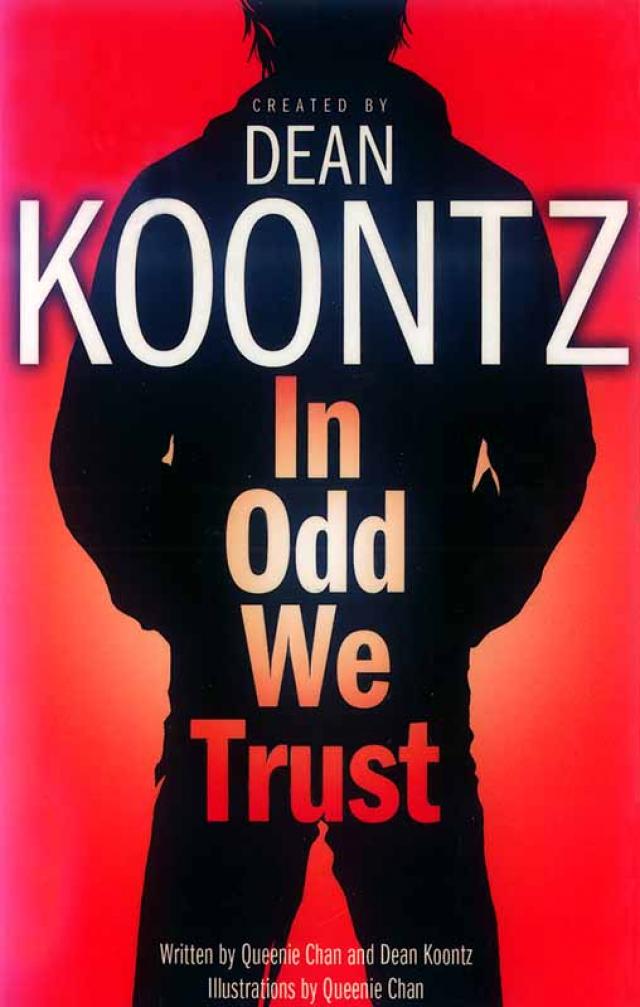
In Odd We Trust is a work of fiction. Names, characters, places, and incidents are the products of the author’s imagination or are used fictitiously. Any resemblance to actual events, locales, or persons, living or dead, is entirely coincidental.
A Del Rey Trade Paperback Original
Text copyright © 2008 by Dean Koontz
Illustrations copyright © 2008 by Queenie Chan
All rights reserved.
Published in the United States by Del Rey Books, an imprint of The Random House Publishing Group, a division of Random House, Inc., New York.
Del Rey is a registered trademark and the Del Rey colophon is a trademark of Random House, Inc.
Grateful acknowledgment is made to Hal Leonard corporation for permission to reprint an excerpt from “You’re the Devil in Disguise” Words and Music by Bill Grant, Bernie Baum and Florence Kaye Copyright © 1963; Renewed 1991 Elvis Presley Music (BMI) Worldrights Rights for Elvis Presley Music Administered by Cherry River Music Co. International Copyright Secured All Rights Reserved Reprinted by permission.
ISBN: 978-0-345-49966-0
Cover Design by David Stevenson
Toning Assistant—Dee DuPuy
6 8 9 7
Also by Dean Koontz
Odd Hours • The Darkest Evening of the Year • The Good Guy • Brother Odd • The Husband • Forever Odd • Velocity • Life Expectancy • The Taking • Odd Thomas • The Face • By the Light of the Moon • One Door Away From Heaven • From the Corner of His Eye • False Memory • Seize the Night • Fear Nothing • Mr. Murder • Dragon Tears • Hideaway • Cold Fire • The Bad Place • Midnight • Lightning • Watchers • Strangers • Twilight Eyes • Darkfall • Phantoms • Whispers • The Mask • The Vision • The Face of Fear • Night Chills • Shattered • The Voice of the Night • The Servants of Twilight • The House of Thunder • The Key to Midnight • The Eyes of Darkness • Shadowfires • Winter Moon • The Door to December • Dark Rivers of the Heart • Icebound • Strange Highways • Intensity • Sole Survivor • Ticktock • The Funhouse • Demon Seed
DEAN KOONTZ’S FRANKENSTEIN
Book One: Prodigal Son • with Kevin J. Anderson
Book Two: City of Night • with Ed Gorman
Also by Queenie Chan
The Dreaming, volumes 1—3
CONTENTS
IN ODD WE TRUST
ABOUT THE CREATORS
THE ODD FACE IN THE MIRROR
An Excerpt from ODD THOMAS
ARTIST’S SKETCHBOOK
ABOUT THE CREATORS
DEAN KOONTZ is the author of many #1 New York Times bestsellers. He lives with his wife, Gerda, in Southern California.
QUEENIE CHAN was born in 1980 in Hong Kong and emigrated to Australia when she was six years old. She began drawing at the age of 18 and graduated in 2002 with a degree in Information Systems. In 2004, she began drawing a mystery-horror series called The Dreaming for Los Angeles-based manga publisher Tokyopop, the three volumes of which are now available. It has been translated into four languages. Apart from her professional work, Queenie Chan also draws a number of online manga strips on her personal site:
http://www.queeniechan.com/
THE ODD FACE IN THE MIRROR
Dean Koontz
DURING MY CAREER, I have written a townful of characters, maybe enough of them to populate Pico Mundo, California, in which Odd Thomas lived his first twenty years. I have provided physical descriptions of those people, some in more detail than others. In all but one case, during the writing of the books in which those people appeared, I had vivid images of their faces in my mind.
The exception was Odd Thomas. By page two, I knew Oddie more intimately than I had ever known another character after writing so few words about him. What I knew of Odd, however, was his heart, every chamber of it, all its secrets, all the hopes and dreams that he sheltered there, all his losses. I knew his goodness, his self-doubt, his capacity for friendship and for love, his extraordinary humility. I did not know what his face looked like.
Because the book employed a first-person point of view, I could not describe him from the eyes of another character, and I did not want to engage in any hokum like having him look in a mirror and describe himself. Rather than stop writing and brood about his face, I let the narrative flow, certain that the details would accumulate until I could see him clearly in my mind's eye.
By the time I finished Odd Thomas, the first novel in the series, I not only knew Odd's heart but also the singular workings of his mind, and not least of all the architecture of his soul. I knew him as well as—perhaps better than—I knew myself. I knew his body type. His physical qualities were clear: real strength without Schwarzeneggerian muscularity; masculinity without bravado; natural athleticism; the agility of a dancer; confidence in every pose and position, but never arrogance; self-effacement that expressed even in his physicality, so that he seemed unremarkable though he was in fact exceptional.
After three books—and a fourth in the works—I do not know his face. The actor to whom readers most often refer is Tobey Maguire, and I think Mr. Maguire—although soon too old for the part—would be terrific because he can project innocence without naivete and can portray genuine goodness rather than the cloying kind. Yet Oddie's face is not Tobey Maguire's. It is nothing like the face of any actor anyone has named.
When we developed an avatar of Oddie for the website, we came up with one that I liked. But it's not his face. I thought at first that the limitations of avatar design would not allow us the detail necessary to capture the real Odd Thomas.
When the wonderful Queenie Chan presented her engaging sketches for the book you hold in your hands, I liked her Odd very much, and felt he worked perfectly for a manga. But this was not Odd's face any more than Tobey Maguire's face is Odd's.
As I write this, I am at work on Odd Hours, and I have begun to understand why Oddie's face will not materialize in my mind when I strive to envision it. The reason for this arises from Odd's destiny and from his fundamental nature, which have become apparent to me as I work on this book. Because he is an archetypal character in a way I did not fully understand until he revealed it to me during this fourth novel, no face is right for him; every face is his face, in one sense, and in another sense, he is not to be understood whatsoever by his appearance but only by what will prove to be his fundamental nature, which is why his face eludes me.
I now believe that, God willing, there will be six Odd Thomas novels. His end will prove to be there in his beginning, and his beginning in his end. When I get to the last page of the sixth book, I believe it will be apparent to me that everything in the series was to be foreseen in the first book, perhaps in the first chapter of the first book. And yet where I find this going is a great surprise to me and extremely exciting. Pulling off books five and six with the grace they require will be an epic challenge, and all I can do is follow my fry cook and hope that, when it's over, I will feel that the whole series was as much a gift to me as was the first book.
Odd's adventures continue in several full-length novels by Dean Koontz. Read on for a sample chapter from Odd Thomas, in which a stranger comes to Pico Mundo accompanied by a horde of hyena-like shades who herald an imminent catastrophe. Odd, Stormy, Chief Porter, and others must race against time to thwart the gathering evil. Odd Thomas is published by Bantam Books and © 2003 by Dean Koontz.
ONE
MY NAME IS ODD THOMAS, though in this age when fame is the altar at which most people worship, I am not sure why you should care who I am or that I exist.
I am not a celebrity. I am not the child of a celebrity. I have never been married to, never been abused by, and never provided a kidney for transplantation into any celebrity. Furthermore, I have no desire to be a celebrity.
In fact I am such a nonentity by the standards of our culture that People magazine not only will never feature a piece about me but might also reject my attempts to subscribe to their publication on the grounds that the black-hole gravity of my noncelebrity is powerful enough to suck their entire enterprise into oblivion.
I am twenty years old. To a world-wise adult, I am little more than a child. To any child, however, I’m old enough to be distrusted, to be excluded forever from the magical community of the short and beardless.
Consequently, a demographics expert might conclude that my sole audience is other young men and women currently adrift between their twentieth and twenty-first birthdays.
In truth, I have nothing to say to that narrow audience. In my experience, I don’t care about most of the things that other twenty-year-old Americans care about. Except survival, of course.
I lead an unusual life.
By this I do not mean that my life is better than yours. I’m sure that your life is filled with as much happiness, charm, wonder, and abiding fear as anyone could wish. Like me, you are human, after all, and we know what a joy and terror that is.
I mean only that my life is not typical. Peculiar things happen to me that don’t happen to other people with regularity, if ever.
For example, I would never have written this memoir if I had not been commanded to do so by a four-hundred-pound man with six fingers on his left hand.
His name is P. Oswald Boone. Everyone calls him Little Ozzie because his father, Big Ozzie, is still alive.
Little Ozzie has a cat named Terrible Chester. He loves that cat. In fact, if Terrible Chester were to use up his ninth life under the wheels of a Peterbilt, I am afraid that Little Ozzie’s big heart would not sur vive the loss.
Personally, I do not have great affection for Terrible Chester because, for one thing, he has on several occasions peed on my shoes.
His reason for doing so, as explained by Ozzie, seems credible, but I am not convinced of his truthfulness. I mean to say that I am suspicious of Terrible Chester’s veracity, not Ozzie’s.
Besides, I simply cannot fully trust a cat who claims to be fifty-eight years old. Although photographic evidence exists to support this claim, I persist in believing that it’s bogus.
For reasons that will become obvious, this manuscript cannot be published during my lifetime, and my effort will not be repaid with royalties while I’m alive. Little Ozzie suggests that I should leave my literary estate to the loving maintenance of Terrible Chester, who, according to him, will outlive all of us.
I will choose another charity. One that has not peed on me.
Anyway, I’m not writing this for money. I am writing it to save my sanity and to discover if I can convince myself that my life has purpose and meaning enough to justify continued existence.
Don’t worry: These ramblings will not be insufferably gloomy. P. Oswald Boone has sternly instructed me to keep the tone light.
“If you don’t keep it light,” Ozzie said, “I’ll sit my four-hundred-pound ass on you, and that’s not the way you want to die.”
Ozzie is bragging. His ass, while grand enough, probably weighs no more than a hundred and fifty pounds. The other two hundred fifty are distributed across the rest of his suffering skeleton.
When at first I proved unable to keep the tone light, Ozzie suggested that I be an unreliable narrator. “It worked for Agatha Christie in The Murder of Roger Ackroyd,” he said.
In that first-person mystery novel, the nice-guy narrator turns out to be the murderer of Roger Ackroyd, a fact he conceals from the reader until the end.
Understand, I am not a murderer. I have done nothing evil that I am concealing from you. My unreliability as a narrator has to do largely with the tense of certain verbs.
Don’t worry about it. You’ll know the truth soon enough.
Anyway, I’m getting ahead of my story. Little Ozzie and Terrible Chester do not enter the picture until after the cow explodes.
This story began on a Tuesday.
For you, that is the day after Monday. For me, it is a day that, like the other six, brims with the potential for mystery, adventure, and terror.
You should not take this to mean that my life is romantic and magical. Too much mystery is merely an annoyance. Too much adventure is exhausting. And a little terror goes a long way.
Without the help of an alarm clock, I woke that Tuesday morning at five, from a dream about dead bowling-alley employees.
I never set the alarm because my internal clock is so reliable. If I wish to wake promptly at five, then before going to bed I tell myself three times that I must be awake sharply at 4:45.
While reliable, my internal alarm clock for some reason runs fifteen minutes slow. I learned this years ago and have adjusted to the problem.
The dream about the dead bowling-alley employees has troubled my sleep once or twice a month for three years. The details are not yet specific enough to act upon. I will have to wait and hope that clarification doesn’t come to me too late.
So I woke at five, sat up in bed, and said, “Spare me that I may serve,” which is the morning prayer that my Granny Sugars taught me to say when I was little.
Pearl Sugars was my mother’s mother. If she had been my father’s mother, my name would be Odd Sugars, further complicating my life.
Granny Sugars believed in bargaining with God. She called Him “that old rug merchant.”
Before every poker game, she promised God to spread His holy word or to share her good fortune with orphans in return for a few unbeatable hands. Throughout her life, winnings from card games remained a significant source of income.
Being a hard-drinking woman with numerous interests in addition to poker, Granny Sugars didn’t always spend as much time spreading God’s word as she promised Him that she would. She believed that God expected to be conned more often than not and that He would be a good sport about it.
You can con God and get away with it, Granny said, if you do so with charm and wit. If you live your life with imagination and verve, God will play along just to see what outrageously entertaining thing you’ll do next.
He’ll also cut you some slack if you’re astonishingly stupid in an amusing fashion. Granny claimed that this explains why uncountable millions of breathtakingly stupid people get along just fine in life.
Of course, in the process, you must never do harm to others in any serious way, or you’ll cease to amuse Him. Then payment comes due for the promises you didn’t keep.
In spite of drinking lumberjacks under the table, regularly winning at poker with stone-hearted psychopaths who didn’t like to lose, driving fast cars with utter contempt for the laws of physics (but never while intoxicated), and eating a diet rich in pork fat, Granny Sugars died peacefully in her sleep at the age of seventy-two. They found her with a nearly empty snifter of brandy on the nightstand, a book by her favorite novelist turned to the last page, and a smile on her face.
Judging by all available evidence, Granny and God understood each other pretty well.
Pleased to be alive that Tuesday morning, on the dark side of the dawn, I switched on my nightstand lamp and surveyed the chamber that served as my bedroom, living room, kitchen, and dining room. I never get out of bed until I know who, if anyone, is waiting for me.
If visitors either benign or malevolent had spent part of the night watching me sleep, they had not lingered for a breakfast chat. Sometimes simply getting from bed to bathroom can take the charm out of a new day.
Only Elvis was there, wearing the lei of orchids, smiling, and pointing one finger at me as if it were a cocked gun.
Although I enjoy living above this particular two-car garage, and though I find my quarters cozy, Architectural Digest will not be seeking an exclusive photo layout. If one of their glamour scouts saw my place, he’d probably note, with disdain, that the second word in the magazine’s name is not, after all, Indigestion.
The life-size cardboard figure of Elvis, part of a theater-lobby display promoting Blue Hawaii, was where I’d left it. Occasionally, it moves—or is moved—during the night.
I showered with peach-scented soap and peach shampoo, which were given to me by Stormy Llewellyn. Her real first name is Bronwen, but she thinks that makes her sound like an elf.
My real name actually is Odd.
According to my mother, this is an uncorrected birth-certificate error. Sometimes she says they intended to name me Todd. Other times she says it was Dobb, after a Czechoslovakian uncle.
My father insists that they always intended to name me Odd, although he won’t tell me why. He notes that I don’t have a Czechoslovakian uncle.
My mother vigorously asserts the existence of the uncle, though she refuses to explain why I’ve never met either him or her sister, Cymry, to whom he is supposedly married.
Although my father acknowledges the existence of Cymry, he is adamant that she has never married. He says that she is a freak, but what he means by this I don’t know, for he will say no more.
My mother becomes infuriated at the suggestion that her sister is any kind of freak. She calls Cymry a gift from God but otherwise remains uncommunicative on the subject.
I find it easier to live with the name Odd than to contest it. By the time I was old enough to realize that it was an unusual name, I had grown comfortable with it.
Stormy Llewellyn and I are more than friends. We believe that we are soul mates.
For one thing, we have a card from a carnival fortune-telling machine that says we’re destined to be together forever.
We also have matching birthmarks.
Cards and birthmarks aside, I love her intensely. I would throw myself off a high cliff for her if she asked me to jump. I would, of course, need to understand the reasoning behind her request.