

The Five Things We Cannot Change, page 1


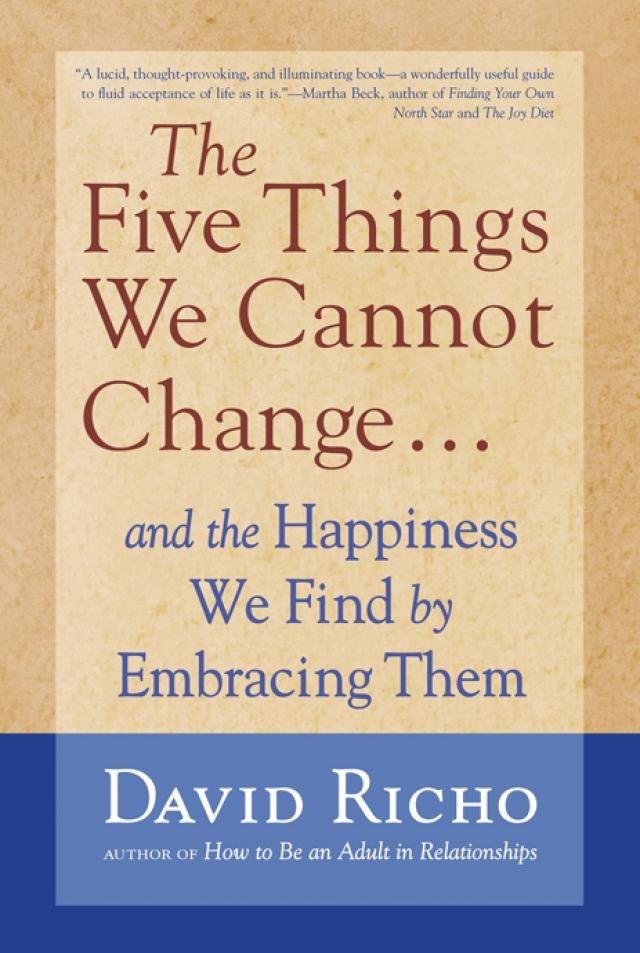
“A lucid, thought-provoking, and illuminating book about the realities of human existence—a wonderfully useful guide to fluid acceptance of life as it is.”
—Martha Beck, author of Finding Your Own North Star and The Joy Diet
“I started highlighting splendid passages in this book and my highlighter ran dry. The whole book is splendid.”
—Brother David Steindl-Rast
ABOUT THE BOOK
Why is it that despite our best efforts, many of us remain fundamentally unhappy and unfulfilled in our lives? In this provocative and inspiring book, David Richo distills thirty years of experience as a therapist to explain the underlying roots of unhappiness—and the surprising secret to finding freedom and fulfillment.
There are certain facts of life that we cannot change—the unavoidable “givens” of human existence: (1) everything changes and ends, (2) things do not always go according to plan, (3) life is not always fair, (4) pain is a part of life, and (5) people are not loving and loyal all the time. Richo shows us that by dropping our deep-seated resistance to these givens, we can find liberation and discover the true richness that life has to offer. Blending Western psychology and Eastern spirituality, including practical exercises, Richo shows us how to open up to our lives—including to what is frightening, painful, or disappointing—and discover our greatest gifts.
DAVID RICHO, PhD, is a psychotherapist, teacher, writer, and workshop leader whose work emphasizes the benefits of mindfulness and loving-kindness in personal growth and emotional well-being. He is the author of numerous books, including How to Be an Adult in Relationships and The Five Things We Cannot Change. He lives in Santa Barbara and San Francisco, California.
Sign up to learn more about our books and receive special offers from Shambhala Publications.
Or visit us online to sign up at shambhala.com/eshambhala.
THE
FIVE THINGS
WE CANNOT CHANGE
And the Happiness
We Find by
Embracing Them
DAVID RICHO
SHAMBHALA
Boston & London
2010
SHAMBHALA PUBLICATIONS, INC.
Horticultural Hall
300 Massachusetts Avenue
Boston, Massachusetts 02115
www.shambhala.com
© 2005 by David Richo
All rights reserved. No part of this book may be reproduced in any form or by any means, electronic or mechanical, including photocopying, recording, or by any information storage and retrieval system, without permission in writing from the publisher.
Library of Congress Cataloging-in-Publication Data
Richo, David, 1940–
The five things we cannot change: and the happiness we find by embracing them / David Richo.—1st ed.
p. cm.
eISBN 978-0-8348-2226-9
ISBN 1-59030-209-5
1. Conduct of life. I. Title.
BF637.C5R535 2005
158—dc22
2004016055
For my wonderfully
lovable nephews and niece,
Christian, Damien, and Thea
And in tender loving
memory of my sisters
Gail and Linda
CONTENTS
INTRODUCTION
PART ONE
THE GIVENS OF LIFE
1. Everything Changes and Ends
How We Avoid or Accept
Attracted or Repelled
Growing Older: A Changing Image in the Mirror
What Makes Us So Controlling
Nothing Separate
A Two-Handed Practice
Death and Renewal
2. Things Do Not Always Go According to Plan
Nature’s Design
Our Calling
The Larger Life
It All Balances in Love
3. Life Is Not Always Fair
Revenge or Reconcile?
Why Does Harm Come to the Innocent?
The Art of Taming Ego
Commitments beyond Ego
A Mindful Reply to Unfairness
4. Pain Is Part of Life
Are We Victims?
A Yes to the Pain Nature Brings
Being with the Suffering of Others
When Cheer Doesn’t Work
The Fertile Void
5. People Are Not Loving and Loyal All the Time
The Lifelong Influence of Childhood
Taking Care of Yourself As You Open to Others
Givens of Adult Relating
A Checklist on Boundaries in Our Relationships
Egoless Love
6. Refuges from the Givens
Religion as a Refuge
Religion and Refuge in Nature
Three Refuges
Distraction or Resource?
Magical Thinking
Backstreet Refuges
Safety in No Refuge
Wisdom within Us
PART TWO
AN UNCONDITIONAL YES
TO OUR CONDITIONED EXISTENCE
7. How to Become Yes
Loving-Kindness
Tonglen Practice
No Outside
Nature Practices Yes
8. Yes to Feelings
Our Gifts from Nature
How Feelings Become SAFE
Love Liberates
How Fear Holds Us Back
The Life Span of a Feeling
How Do We Receive the Feelings of Others?
Tracking Our Feelings
What Feelings Are Not
Feelings Are Three-Dimensional
9. A Yes to Who I Am
Psychologically
Spiritually
Mystically
Self or No-Self?
A Stable Sense of Myself
EPILOGUE
ABOUT THE AUTHOR
E-MAIL SIGN-UP
INTRODUCTION
THERE ARE some things in life over which we have no control, probably most things. We discover in the course of our lives that reality refuses to bow to our commands. Another force, sometimes with a sense of humor, usually comes into play with different plans. We are forced to let go when we want so much to hold on, and to hold on when we want so much to let go. Our lives—all our lives—include unexpected twists, unwanted endings, and challenges of every puzzling kind.
Reinhold Niebuhr, an American Protestant theologian, composed a prayer that has become the cornerstone of the recovery movement: “God grant me the serenity to accept the things I cannot change, the courage to change the things I can, and the wisdom to know the difference.” This is a profound aspiration. But what are the things we cannot change? Are they unique to each of us, or are there some things that all of us must acknowledge and accept in order to find peace in our lives?
As a psychotherapist working with clients—and in my own life—I have seen the same questions and struggles arise again and again. There are five unavoidable givens, five immutable facts that come to visit all of us many times over:
1. Everything changes and ends.
2. Things do not always go according to plan.
3. Life is not always fair.
4. Pain is part of life.
5. People are not loving and loyal all the time.
These are the core challenges that we all face. But too often we live in denial of these facts. We behave as if somehow these givens aren’t always in effect, or not applicable to all of us. But when we oppose these five basic truths we resist reality, and life then becomes an endless series of disappointments, frustrations, and sorrows.
In this book, I propose the somewhat radical idea that the five givens are not actually the bad news that they appear to be. In reality, our fear of and struggle against the givens are the real sources of our troubles. Once we learn to accept and embrace these fundamental, down-to-earth facts, we come to realize that they are exactly what we need to gain courage, compassion, and wisdom—in short, to find real happiness.
A given is a fact of life over which we are powerless. It is something we cannot change, something built into the very nature of things. From one point of view, there are many givens. In addition to the five disturbing givens stated above, there are also delightful givens: we experience bliss, our hopes are sometimes exceeded, we discover unique inner gifts, things have a way of working out, luck comes our way, miracles of healing happen.
There are also givens that apply only to us as individuals: our body shape and personality, our unique psychological and spiritual gifts or limitations, our temperament, our genetic makeup, our IQ, our conventional or unconventional lifestyle, whether we are introverted or extraverted, and so forth.
There are in fact, givens in every thing we do and in every place we enter. A given of having a job is that we might advance or we might be fired—as well as any number of possibilities between. A given of a relationship is that it may last a lifetime or it may end with the next phone call.
I have found that anything that crosses swords with our entitled ego is a powerful source of transformation and inner evolution. The five simple facts of life defy and terrorize the mighty ego that insists on full control. Life happens to us in its own way, no matter how much we may protest or seek to dodge it. No one is or has ever been exempt from life’s uncompromising givens. If we cannot tolerate them, we add stress to our lives by fighting a losing game.
In this book I will explain why we need not feel despair in
The story of Buddha’s enlightenment illustrates that the givens of life are the basis of our growth and transformation. The Buddha was born Siddhartha Gautama, an Indian prince. His father tried to protect him from encountering pain or displeasure. The king created a life of utter perfection for Siddhartha, providing him every possible satisfaction and shielding him from all unpleasantness. But one day the young prince wanted to see what lay beyond the palace walls. When he ventured out, he soon encountered sickness, old age, and death—the natural conditions of every life—for the first time. These sights moved him deeply and set him on a spiritual journey that ultimately led to his enlightenment. His legendary transformation began by facing the laws of life with curiosity and courage.
From ancient times, the five givens have puzzled and chagrined humanity. Religions offer responses to mysteries like these. Throughout this book I will draw on teachings from Buddhism and other world religions. Spiritual traditions offer us valuable resources, models, and inspiration for facing the givens of life openly and with equanimity. I rely most heavily on the Buddhist tradition because that spiritual tradition emphasizes the importance of seeing through our illusions and facing up to life’s givens in order to become more fully who we are meant to be.
THE UNCONDITIONAL YES
Each of the givens or conditions of existence evokes a question about our destiny. Are we here to get our way or to dance with the flow of life? Are we here to make sure everything goes according to our plans or to trust the surprises and synchronicities that lead us to new vistas? Are we here to make sure we get a fair deal or are we here to be upright and loving? Are we here to avoid pain or to deal with it, grow from it, and learn to be compassionate through it? Are we here to be loyally loved by everyone or to love with all our might?
The ancient Romans spoke of amor fati, the virtue of loving one’s fate. Some of us find it hard to handle the anxiety aroused by the conditions of our existence; we fight against our human situation. The method for handling the givens and gearing them to our destiny is stated most clearly by Carl Jung: “Givens can be embraced with an unconditional yes to that which is, without subjective protests, an acceptance of the conditions of existence . . . an acceptance of my own nature as I happen to be.” Such a yes is a willingness to land on concrete reality without a pillow to buffer us. Such a yes makes us flexible, attuning us to a shifting world, opening us to whatever life brings. Such a yes is not a stoic surrender to the status quo but a courageous one—an alignment to reality. Once we trust reality more than our hopes and expectations, our yes becomes an “open sesame” to spiritual surprises. In this book, I will suggest how to discover the spiritual riches that lie within our most challenging experiences.
Yes is the brave ally of serenity; no is the scared accomplice of anxiety. We find help in saying yes and in facing the givens through mindfulness—that is, through fearless and patient attention of the present moment. We also gain support from nature, from psychology, from religious traditions, and from spiritual practices. These are the resources and tools presented in the pages that follow.
Hamlet speaks of “the thousand natural shocks that flesh is heir to,” a poetic definition of the givens of life. When something happens to us that echoes with the painful thud of any of the unalterable conditions of existence, we can ask, “What can I learn here? How does this serve?” We can learn to trust the givens of life as having transformative or evolutionary potential. We can trust that the laws of existence somehow help us to achieve our destiny.
The givens of life may seem like cruel jokes perpetrated upon us by a vindictive universe. They could seem like penalties for a waywardness we inherited but did not cause. They may even seem like spiteful tricks to make our lives miserable. In an antiquated theological view, they are considered the punishments enacted by a vengeful God upon us exiles from Eden for an original sin. The unconditional yes, with its implicit trust of the givens’ usefulness to our growth, cuts through that fear-based view of life. Saying yes to reality—to the things we cannot change—is like choosing to turn around and sit in the saddle in the direction the horse is going. Sitting that way is mindfulness, an honoring of the here and now without the distractions of fear or desire. Mindfulness is an unconditional yes to what is as it is. We face our issues in the here and now without protest or blame. Such a yes is unconditional because it is free of conditioning by the neurotic ego: fear, desire, control, judgment, complaint, expectation. When we are mindful, we meet each moment with openness, curiosity, and kindness. Mindfulness is both a state of being and a daily spiritual practice, a form of meditation.
WHY ME?
When faced with one of life’s givens, we might ask: “Why did such a terrible thing happen to a good person like me? I deserve better.” The mindful version of that question is: “Yes this happened. Now what?” We will notice we are happier when we accept what we do not like about life as a given of life. Our mindful yes is an entry into this sheltering paradox.
When we make an unreserved consent to the things we cannot change, we are saying yes to ourselves, as we are, in our ever-unfolding autobiography. The conditions of existence are our personal experiences, not alien forces or hurdles to avoid. They are also the universal experiences of all people. Every human who ever lived faced the five major givens. This makes them part of being human, so they must be a necessary part. When we finally embrace the givens as extensions of our human selves, we say yes to them not in resignation or acquiescence. We say yes to the ingredients of our own humanity.
All the givens of life are based on one underlying fact: Anything can happen to anyone. This is the given of givens. Most of us have a hard time really believing this applies to us. We imagine that very good luck or very bad luck is supposed to happen to other people but never to us. To believe, finally and fully, that anything can happen to us is an enormously adult accomplishment, and it grants us two wonderful gifts. First, we let go of our ego’s privileged view of itself as entitled to special treatment; we let go of the childlike belief that a rescuer, otherworldly or this-worldly, will come through just for us and grant us an exemption from life’s hard knocks. Second, believing that anything can happen to us helps us become humble and helps us feel our comradeship with our fellow humans. “Nothing human is alien from me,” the Roman poet Terence wrote in the second century B.C.E. There is something so consoling about a sense of belonging, of being in it with everyone else, no matter how difficult life may become.
The givens of life are a code to our personal evolution. An unconditional yes to the givens is how the code is broken or, rather, opened. In the traditional Buddhist view, birth as a human is a great boon. In the human realm there is said to be just the right mix of suffering and joy for us to awaken, to become enlightened. In other words, the givens of life help provide us with the perfect, awakening blend of experiences.
All things have a natural, irrepressible tendency to evolve, that is, to reach their full potential within the changing conditions of the environment. Therefore the hope we often feel so comforted by is not a foolish pipe dream. Hope is an authentic response to life’s inherent, irrepressible inclination toward fulfillment. An unconditional—that is, mindful—yes to the givens, without debate or complaint, is all it takes.
GIVENS AS GIFTS
The word given has two meanings. It is a condition that cannot be changed, but it is also something that has been granted to us. Once we say yes, the givens of life are suddenly revealed as gifts, the skillful means to evolution. The givens are relentless but also rich with wisdom. Only amid such exacting and challenging conditions could we evolve. The givens of life are gifts because they are the ingredients of character, depth, and compassion.
What does it take to find the gift dimension in life’s many challenges? First and foremost, we must cease our attempts to control or head them off. Then life’s puzzling givens turn into doors to liberation. But we humans have a long tradition of reacting with defensiveness and resistance in the face of life’s challenges. Indeed, our resistance to discomfort is part of our human inheritance. How ironic that we try so desperately to fend off what is unalterably our human condition and the conditions that can ultimately promote our growth.


