Xstabeth, page 1


ALSO BY
DAVID KEENAN
England’s Hidden Reverse
This Is Memorial Device
For the Good Times
Europa Editions
1 Penn Plaza, Suite 6282
New York, N.Y. 10019
info@europaeditions.com
www.europaeditions.com
Copyright © David Keenan 2020
First published in Great Britain in 2020 by White Rabbit
First U.S. and Canada publication 2022 by Europa Editions
The moral right of David Keenan to be identified as the author of this work has been asserted in accordance with the Copyright, Designs and Patents Act of 1988.
All rights reserved, including the right of reproduction in whole or in part in any form.
Lyrics to ‘It’s Too Late’ by Bob Desper © 1974
reproduced with kind permission of Bob Desper
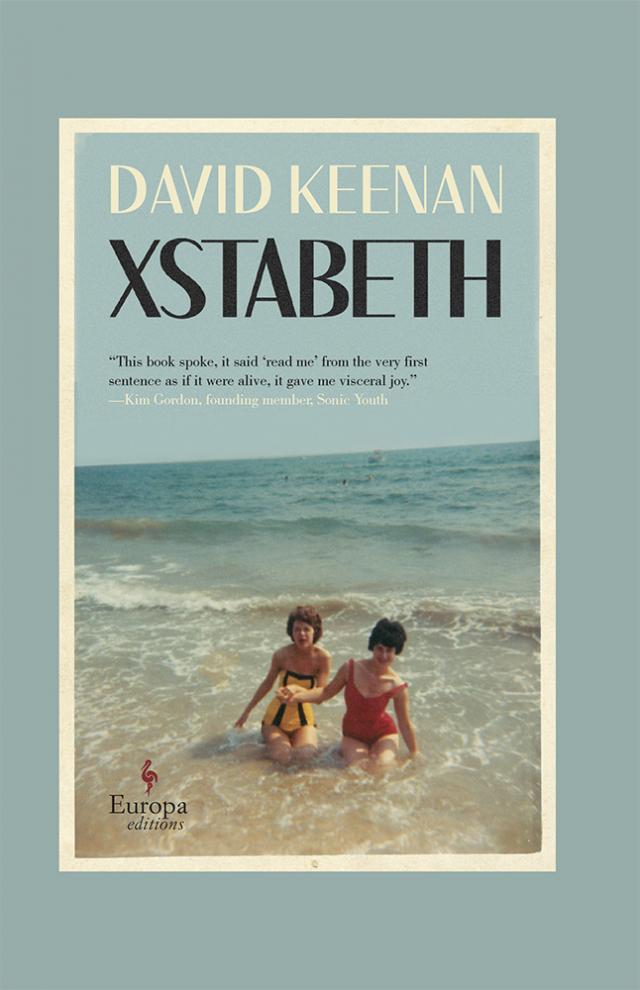
Cover Art by Emanuele Ragnisco
www.mekkanografici.com
Cover photo: Used with kind concession of the author
ISBN 9781609457358
David Keenan
XSTABETH
For Xstabeth
David W. Keenan was a (non-political) writer, teacher and local historian (whose “great passion in life [was] literature and music, as well as the researching and publishing of the local history of his home town, St. Andrews, in Scotland”), who committed suicide by throwing himself from the top of the tower of St. Rule in the autumn of 1995.
In the early 1990s he ran a correspondence course that taught magick, tarot and bibliomancy via ethno-poetics and avant-garde literature, which was known as St. Rule’s School for Immaculate Fools, or SR|SIF for short. It also had an inner order: Dx(e).
His articles for the St. Andrews Oracle were collected in a series of self-published pamphlets in the late 1980s entitled St. Andrews Oracle Articles by David W. Keenan as well as A Book of Shadows by David W. Keenan. They can often be found cheap in the little bookshop near the top of Market Street in the town.
Some of his most interesting articles include: “Xstabeth Isappearing,” a revisiting of the tale of a ghost said to take the form of a “grey lady” who walked The Scores and plied her trade by the castle; “Wilson’s Brewery,” a self-explanatory rags-to-riches success story involving Aitcheson’s (of Edinburgh) pale, export and strong ales; “Tobacconists of St. Andrews,” a lament for the “general trend away from pipe smoking that occurred in the 1960s”; “Churches of Old St. Andrews,” a lament; “The Heyday of Craigtoun Park,” a lament; “Octogenarian Golfer Recalls Old St. Andrews,” a lament; and “The Dutch Village,” sadly, a lament.
He self-published one novel in his lifetime, 1992’s Xstabeth, reissued here and updated with commentary, newly discovered, by students of SR|SIF, alongside assorted addenda.
David W. Keenan
XSTABETH
(ILLUMINATED EDITION WITH COMMENTARY)
INTRODUCTIONS IN XSTABETH
by Ruth White (Sr|Sif)
An introduction is quite the simplest thing. It is a moving from silence into speech, and shortly, back again. Introductions are made, daily. They can be advantageous, or, just as often, detrimental. Whether you read an introduction is one thing, whether you make one is another. I would say that the purpose of an introduction is to ease one in, which is why I often leave it to the last, so that I may, as I say, ease myself in all over again. The best introductions, then, in my view, or according to my view, which, as I have already stated, is backwards, would be a summation or, rather, an elaboration, of mood. Which is why I prefer to save them for last, through fear of the depths, I admit, through fear of getting too deep already, or too soon, because I prefer the gentle arc of a beach in the evening to a perilous drop from a clifftop in full sun.
When I was small and the trees were very high. This was in Russia. My dad was a musician. A famous musician. But he was friends with a musician who was even famouser. I went to his lecture. The famouser musician. He did a lecture. His speciality was moral philosophy. But in this lecture it was different. In this lecture he spoke against morals. I couldn’t believe it. My teenage mind was like that. What. He said it was okay to be immoral. That’s what he said. In so many words. Words like “permission,” “authority,” “refusal.” “Autonomy.” I remember that one. “Belief.” That was still key. Funnily enough. Afterwards we went with him. My father and I. And we drank vodka. I know it’s typical. But we also drank stout. Russian imperial stout 12 per cent. That’s also typical. I asked him a question. I said to him you mentioned permission but who is asking permission and who is giving it. If you know what I mean. I just came right out with it. He said it was a good question. That’s a good question. He said. He was from Moscow. Originally. Typical. Typical of intellectuals to come from Moscow. Or the Urals. I knew a few from the Urals but I was too nervous to approach them on the whole. This was different. He was a musician. Somehow that made it different. Softer. I pushed my point. I pursued my question. But at first he just kept looking into thin air. How can you just be bad. I wanted to say. But of course that was illiterate to a Russian. So I phrased it a different way. How can you give yourself permission. I said. I used one of his words strategically. How can you give yourself permission to perform acts that go against yourself otherwise why do you need to give yourself permission to do something if it comes naturally anyway. I said. That’s a good question. He said. He said it again. I began to realise that a good question was something that would stop you in your tracks. Well. He said. There are all sorts of things that have given you permission that weren’t you and that you never knew you wanted to do anyway. I know in a way that’s elementary philosophy but at the time it really struck me. Like what. I said. Well. He said. Do you think it is beautiful to be on the beach at night beneath the stars. This guy was from Moscow where a beach with stars is more than a dream. Yes. I said. It’s romantic. Who doesn’t. Especially in Moscow. All the time my father was just observing me. He was seeing how I was doing up against an intellectual who was famouser than him. What if it’s freezing cold at night. The intellectual musician asked me. What if you are standing there shivering and in the distance you can smell sewage. This is a Russian beach. I said. For sure. It’s still a beach under the stars. I said. Nothing can change that. What if I told you someone was murdered there. He said. I didn’t see that coming. It’s a beach in the dark. He said. You know nothing.
* * *
I had an affair with the immoral musician. Who was famouser than my father. I say it was an affair. But I wasn’t cheating on anyone. Neither was he. At first. But it was an affair because I had to hide it from my father. Who would have been jealous of the famouser musician who was having an affair though not really with his daughter. It started when he slipped his hand onto my leg on the first night. Which was the night after his talk. Which was the night of the beach in the dark. He slipped his hand onto my thigh. Which was bare and had goosebumps from the cold and from his touch. Which was sudden and exciting. But which didn’t linger. Honey. He said. He called me honey. It’s a big bad world out there. He said. Then he said something else. He said one never knows. I thought to myself what kind of a Russian speaks like Shakespeare. Like Dostoevsky. Surely. Like Tolstoy. Perhaps. Like Solzhenitsyn. No doubt. Plus. The famouser musician had a beard like old Solzhenitsyn too. Or was that Gogol. A beard where it just grew down from beneath the chin. I thought to myself. This could be an education. It was confusing how he said it though. I thought does he mean one never knows but two might know. Or that two together had a chance of finding out. Moscow intellectuals are as cryptic as ever. Even if they don’t survive on black bread and water in a garret anymore. Then I thought. Does he mean that one never knows ever. And that it was even impossible to read his own intentions. For good or for worse. That gave me a thrill and scared me at the same time. A beach in the dark. I thought to myself. Who knows what has taken place. I was starting to come round to his way of thinking. It had only taken me half an hour. Then my father came back to the table and they began to talk about old times together. I felt excluded. Especially when they got really drunk and the famouser musician took out a penknife. He wanted to play the game that Russians love. Which despite what everyone says isn’t Russian roulette. Most people in Russia can’t afford a gun with bullets missing. Even though the black market is everywhere. No. It’s five-finger fillet that the Russians love the best. Because everyone has a penknife. You spread your hand out on a table and then stab a knife quickly back and forth between your fingers. There’s a reason why Russia has the least fingers. But the famouser musician had perfect hands. That’s what I noticed. I thought we really don’t know what is going on here. Either he was the best player of the game Russia has ever seen. Or he was bluffing and had never played it before. Which was unlikely with him being a famous musician and a moral philosopher and a drinker too. But when he asked my father to go first. When he asked my father to go first I got a terrible feeling. Like he wanted my father to stab himself right through the back of his palm and attach himself to the table. So that he could make off with his daughter. He looked at me for a second. Then he said. Let’s see what the old man is made of. That only made things worse. Of course my father had his own penknife. A blue Swiss Army number. But he was so drunk that he opened it up at the corkscrew and not at the blade. The famouser musician laughed at my father. You old fool. He said. We’re trying to open your hand not a bottle. That gave the game away right there. He did plan to have my father stab h
* * *
We had our own codes that we used. We had a system. On a Sunday morning the famouser musician would call and let the phone ring three times. My father would play golf on a Sunday morning. Of course they play golf in Russia. What do you mean. Lee Trevino and Seve Ballesteros are like heroes there. And they all dream of one day travelling to St. Andrews and playing drunk on the Old Course.
He would call three times and then hang up. If the coast was clear I would call him back. What would we talk about? Philosophy mostly. He said I was an agnostic. Then a pessimist. Then a nihilist. I told him that really I was a romantic. He was trying to get to the bottom of me. I thought I was quite shallow. I hadn’t read much philosophy. So I didn’t really know what I was talking about. But then I realised that attractive young people are endlessly deep to older people. They are literally unfathomable. You’re unfathomable Aneliya. The famouser musician would say to me. That’s just the word he used. And then I thought no. It’s just because I echo. It’s just because I’m empty enough to echo. Sometimes it was awkward. Sometimes I had nothing to say and I would just hang on the line in silence. But then I learned that if I did that. If I did that he would fill the gap with compliments and echoes. He compared me to certain months. To the beauty of a wild mountain. I thought all mountains were wild. I thought that was normal. No. He said. Some mountains cannot be tamed. But most of them in the end can be conquered. It all went to my head. As you can imagine. I started seeing less of my friends. My good friends that were my own age. For instance Marja. Tiny Marja with the so cute buck teeth. I shunned her company. She would turn up at our door looking to go out and hunt for birds’ eggs. But I would instruct my father to say that I wasn’t in. Then I would watch her through the curtains from upstairs. She would turn and look up towards me. Towards my room. Where I was hidden behind the curtains. And her buck teeth would implore me not to give up on all of the fun we could have as young girls. She was like a poor little rabbit. But I told myself. I have the love of a man. I told myself. An immoral philosopher. Who needs little frightened rabbits. And my father downstairs. My father downstairs would be playing a Leonard Cohen song on the guitar. My mother had been taken from us long ago and he would play “Famous Blue Raincoat.” And he would sing that line about taking the trouble from her eyes. And I would think to myself yes. Yes. I understand. An affair can do all of that. I felt so grown up and doomed and romantic and sad. I stared out of the window and saw Tiny Marja disappear like a speck of dust.
* * *
St. Peters is cold but it’s nice where I’m living. That was a line that I could relate to. Your bitterest foe is dead now. My dad would sing. His voice would rise up from downstairs. I would imagine the famouser musician in his apartment. Alone or maybe even with a naked woman sitting on the edge of the bed. Maybe she was upset and sobbing quietly while the famouser musician slept. Or maybe they had just made love and she was going to the bathroom. Did you ever isappear. My dad would sing. His voice echoing up the stairs and right now echoing out of the past. And I never understood that line. I never knew what it meant to isappear. Later on I found out for myself. But then I imagined it to do with opening yourself up to the light. Leonard Cohen struck me as a very honest musician. That’s what my father would say. Leonard Cohen has lived it. He would say. Then he would play another one. “Bird on the Wire.” A song about trying to be free. This is raw emotion. My father would say. This is authentic. That was always the word he used. Do you understand that little one. He would call me little one when he was drunk but before he tipped over. Even though I was nineteen years old.
My father tried to make money as a musician. Even though he was past his prime. He put out some records that were a mix of cover versions and originals. But he was naive. That’s why I still loved him. If you were to ask me for my single favourite quality. I would say naivety. He always had big plans. For instance. The tall trees that grew outside our window and that made me feel so small. He took four photographs of them. One in spring. One in summer. One in autumn. One in winter. Then he had them printed as a calendar. One photograph for every three months. One photograph for each of the seasons. He called it The Changing Forest and he tried to sell the idea. Of course no one was interested. It wasn’t even a forest. But my father couldn’t see that. He thought it was a great idea. He was excited about it. It made me cry every time I looked at the calendar. Which was quite a lot because it hung at the end of my bed for several years. And the pictures on the calendar matched the view outside my window. And of course made it more like a forest. A forest on an endless loop. Which of course is what all forests are. And what childhoods are too. When you’re right in the middle of them. Or when you’re looking back at them from way yonder. From afar.
My father was on TV. It was a comedy sketch show where they had guest slots. He sang one of his own songs. Everyone thought it was his big break. Then a comedian came on dressed like a bohemian and played a song that mocked men like my father and Leonard Cohen. He had a name that was an awful pun. He smoked a cigarette and his hair was all in his eyes. He almost bent double over his guitar. Like he was using his own belly button as a microphone. He sang words like “destitution” and “despair” and “it’s so hard.” Then he started singing things about Mama’s money and about Papa’s money. About how it ain’t no good. Then he began howling about how he was fixing to die. And who shot out the lights. Who shot out the lights. Mama. He sang. Who turned down the sound. And of course the joke was that they faded him out and turned his sound off. My father stood up. On live television. And he applauded. He applauded the joke. Who is that man. He asked the presenter. Does he have any records out. My father launched into an impassioned rant on live TV. We need more of this kind. He said. This is the new man. He announced. Run a guitar string into a vein. He said. Play your songs washed in blood. That was when the comedy protest singer came back onstage. He pulled his wig off and revealed that he had been the co-presenter dressed up all the time. My father froze. He was furious and embarrassed. He had been made to look like a fool. But he was too naive even to pretend that he had just been playing along with the sketch. It was all too real. He stormed off the set. Everybody thought he was a joke from then on. Not me. Naivety gets me every time. Knowledge can be cynical. It just gets used to undermine things. Sarcasm and irony are horrible. But naivety is the deepest form of belief. It’s closer to reality. To wonder. Plus it has more love in it.
* * *
On the phone to the famouser musician. I said to him. You need to practise a bit of naivety. Who have you been reading. He asked me. Nietzsche. I might have been. I said. I was too embarrassed to admit that I’d just come up with it out of my own head. Creative naivety. He said. Or was that Schopenhauer. It was one of those comedians. He said. I just sat there silent until I started echoing again. Listen. He said. Let me take you to the movies. My father would never let me out of his sight in the evenings. I told him. There’s not much chance of that. But secretly I was dying to go. I had never been to the movies with a man on my own yet. Here. He said. I have an idea. He had an idea to get my dad a gig. To pull some strings and get him a show. My dad hadn’t played since the TV comedy incident. No one would take him seriously. But the famouser musician could get him a gig. Everybody listened to him. Okay. I said. It’s a deal. That way my father could resurrect his career. Plus. I could get to see what a date at the movies was all about. The famouser musician called my father the next day. I could hear him on the phone downstairs. At first he played it cool. I heard him using the words “bastards” and “reprobates” and “philistines” and “ironists.” They don’t deserve me. He said. He was talking to himself really. Eventually he agreed to do it. But there were conditions. No interviews. He said. As if there would be any interviews. No support act. He said. As if anyone was willing to support him. No photographs. He said. As if anyone wanted to take his picture. Plus. I play two sets of one hour each. As if anyone would sit through one set. It broke my heart. I knew my father had talent. I knew he had a special belief. But I also knew that no one else cared. And of course. I knew that he was only getting the gig so that his famouser friend could sneak me away and have sex with me let’s face it in the back row of the cinema. Two sets. He insisted. One originals. And one all Leonard Cohen covers. Whatever you say. The famouser musician must have said. Because my father hung up happy. He called me from the bottom of the stairs. Little one. He said. Little one they want me. He lifted me up. And I hugged him. And I wrapped my legs around him. I imagined him passing me over to the famouser musician in exactly the same position. Me clinging to him like a limpet. My father picking up his guitar and walking out of the door like a cowboy. But maybe that’s just because of what happened next.