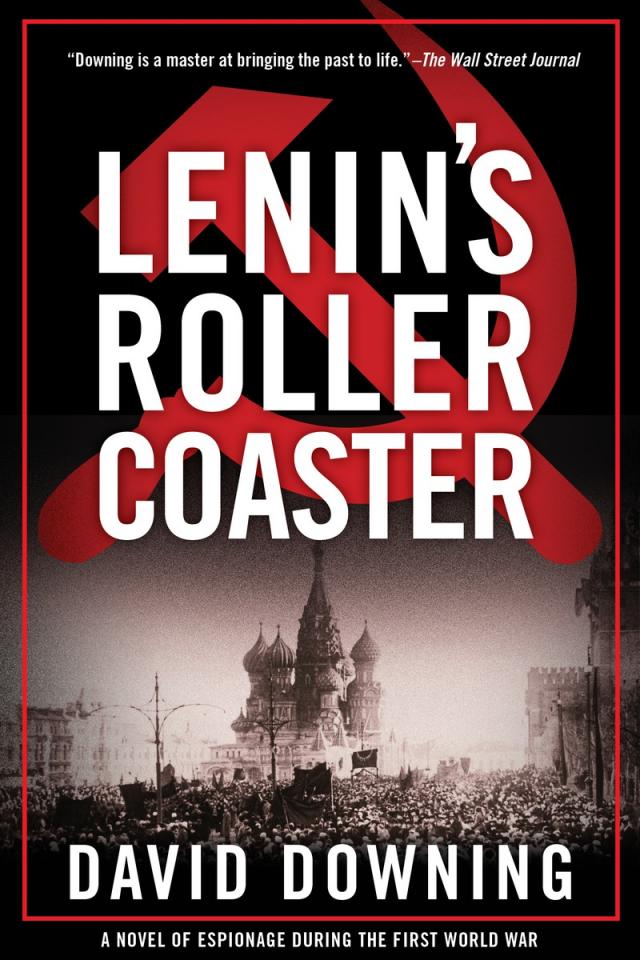
Lenin's Roller Coaster, page 11


On the other side of the room, the pages of an unfinished letter to Soph were scattered across the mattress.
“Good-bye, Aud,” he murmured.
What to do? It seemed certain that Cheselden’s killers would come back for him once they knew he was there. And now they had his gun. He had to get away from the hotel.
There was nothing he could do for the boy. Except take the letters he had written to Soph.
He gathered those up and placed them in his own bag, then rummaged through Cheselden’s valise for anything that might prove useful. There was nothing.
One last look around the room—still nothing. He grabbed his bag and half crouched his way across the room, rising to his full height when he knew that he couldn’t be seen from outside. Pressing his ear to the door, he heard only his own thumping heart.
The corridor was lit by just a sliver of moonlight, the stairs so dark that he twice almost lost his footing, but memory guided him down to the kitchen and through to the hotel’s back door. As he stepped outside, it occurred to him that the other German might be covering this exit, but no blade or bullet leaped out of the shadows.
He hadn’t yet decided where to go, but he started walking anyway, intent on putting some distance between himself and the men who had killed his partner. German-paid assassins. Who else could it be?
He didn’t pause for breath until he’d crossed three streets. The town was almost wholly asleep, with only an occasional window revealing a candlelit glow. The streetlights were out, a thin veneer of moonlight glinting on the edges of the box-shaped buildings and turning the scene into a life-size cubist painting. Struck by the beauty of it all, McColl reminded himself that the moon would still be around tomorrow, whereas he might not be.
Where should he go? He wasn’t far from Lutovinov’s house—would the cotton wholesaler help him, if only with advice? He didn’t believe that the man would shop him, so there seemed no risk in asking.
He located the house without too much difficulty and was surprised to find a light burning behind the downstairs curtains.
His rap on the door was answered in a heartbeat, the same amount of time it took for the young girl’s face to switch from hope to accusation. “What do you want?” she almost shouted at him. Her eyes looked red from crying.
“To see your father—”
“My father has been arrested! Only hours after talking to you!”
The door slammed shut in his face. He stood there for a moment, stunned by the suddenness of the exchange. He thought about knocking again and decided there wouldn’t be much point.
So now what? The only way out of Ashkhabad was by one of the four daily trains—what time did they run? He seemed to remember that one of the Tashkent trains left at three in the morning, about three hours from now. If no alarm had been raised and no one stopped him boarding the train, then the horses were waiting at Kaakhka, and by noon tomorrow he could be back in Persia.
Their mission would have ended in abject failure, but he would be alive.
He owed Cheselden more than that. He probably owed his country more than that.
He needed to go west. To Krasnovodsk, where he knew there were stockpiles of cotton ready for shipment across the Caspian. Where he knew of two possible helpers.
But how?
Volkhov, he thought. A slender hope, but the only one remaining. McColl didn’t doubt the man’s hatred of the Germans, and only a railwayman could smuggle him out of Ashkhabad.
He started walking again, hugging the sides of the empty streets now that the moon was brighter. A wind had risen in the last half hour, chilling his skin and coating the back of his throat with dust.
He rehearsed what he wanted to say.
This time the house was in darkness. He banged on the door and waited, banged again and heard movement inside. A few moments later, Volkhov appeared, his ample form wrapped in a blanket.
McColl was getting used to frosty welcomes. “I need your help,” he said without preamble.
Volkhov laughed. “You have nerve, I . . .”
“My partner is dead. When I got back to the hotel, I found that someone had cut his throat. The Germans—it had to be. Who else had a motive?”
Volkhov actually looked shocked. He stepped out onto the veranda and shut the door behind him.
“I assume they also want to cut mine,” McColl went on. “I could run back to Persia, but that would mean they had won. I don’t want that, and I don’t think you do either.”
“No,” Volkhov conceded, “but I don’t see what I can do. You can’t stay here.”
“You can get me on a train to Krasnovodsk. There are stockpiles of cotton there already, and all the rest will be shipped there sooner or later. I can destroy at least some of it, especially if I get some help. You must know people there who still believe in fighting the Germans.”
Volkhov shivered and pulled the blanket tighter around his shoulders. “You ask a lot,” he said at last.
“I know.”
The Russian nodded. “Wait here.”
He returned fully dressed a few minutes later. “We are going to visit a friend,” he announced, leading the way out onto the empty street. “Your Russian is good enough,” he said after they’d walked in silence for a while. “From this point on, you must cease to be an Englishman. Some kind of Russian, but we will talk with my friend about that.”
“He’s a railwayman?”
“Of course. And a comrade. He will get you to Krasnovodsk.”
It took them about fifteen minutes to reach the friend’s gate. “Wait here,” Volkhov said, and walked on up the path. McColl could only just hear his rap on the door, but it opened a few seconds later. Volkhov disappeared inside.
McColl watched and waited and told himself that Volkhov would not betray him. That this wasn’t Semashko’s house and he wasn’t about to be offered up as a sacrifice in some local power struggle.
If he were, there was nothing he could do.
He wasn’t. The door opened, and the man who walked up the path with Volkhov was a young, fair-haired Russian with a flat nose and a wide smile. “Leonid Kuskov,” he introduced himself.
“And you are Georgiy Kuskov,” Volkhov added. “Leonid’s uncle.”
“Who is interested in fighting Germans and Turks,” Kuskov said, looking him in the eye. “And only Germans and Turks?” The question mark was infinitesimal but impossible to ignore.
McColl took the point. “Your revolution is your business,” he said flatly.
Kuskov seemed happy with the answer. “I will get you to Krasnovodsk. Do you know Moscow at all?”
“I’ve been there.”
“Well, you are my uncle now, and that is where our family comes from. From south of the river, in Serpukhovskaya district. Later I will give you some details to remember. You are here because you have been visiting your brother Gennady—my father—here in Ashkhabad, and you are now returning to Moscow. Understood?”
“Yes.”
“Good,” Volkhov said. “I must go. You asked about possible allies in Krasnovodsk. The leader of my party there is Grigori Tsvetkov, and he has long argued against making peace with the Germans. I cannot say for certain that he still believes this, but I would be surprised if he did not. And he has never been one to keep his opinions to himself, so you need not fear approaching him.”
And you need not fear my betraying him, McColl thought. Which was fair enough.
“I wish you good luck,” Volkhov said in farewell.
“Thank you,” McColl said.
Kuskov led the way into the house, offered him an armchair for the rest of the night, and disappeared into the bedroom, where murmuring Russian voices soon gave way to creaking bedsprings. McColl struggled to get comfortable in his armchair and wondered whether Caitlin was still in Russia.
He was awakened by the sound of an infant howling and soon greeted by a young woman with long dark hair and striking green eyes, holding the quieted child in her arms. “I am Vara,” she told him. “And this is Demyan Leonidovich.”
She told McColl that he should stay in the house, that her husband would return before nightfall. After serving up tea and bread, she got on with the family laundry and left him to his own devices.
With nothing for McColl to do but wonder what was happening elsewhere, the hours limped slowly by. Surely someone would have found Cheselden’s body by this time and the hunt would be on for the other Englishman. McColl realized he had no idea what had happened to the Russian police over the last few months. Were the same men still in uniform, or had the soviets recruited their own law enforcers? If they had, he only hoped the Keystone Cops were their main inspiration.
There was more black bread for lunch, along with a strange but not unpleasant-tasting soup. Vara’s Russian sounded worse than his own, but she smiled a lot and didn’t seem the slightest bit unnerved by his presence.
It was just after four when Kuskov returned. “There’s a train tonight,” he told McColl. “Mostly empty wagons, so we’ll have no trouble finding you a spot. If anyone challenges you, then refer them to the guard. His name is Rozhnin, and he thinks you’re my uncle, so he’ll vouch for you.”
“Wonderful. When does the train leave?”
“Not before nine. It will pick up more wagons in Kyzyl-Arvat, but you should be in Krasnovodsk about this time tomorrow. Here,” he added, reaching into his bag, “I’ve bought you bread and two bottles of Narzan water. Make the water last, because tomorrow might be hot.”
He wouldn’t accept any payment. “When the war is over and our revolution has put down its roots, then come and visit us,” Kuskov said. “Bring Vara something pretty from London.”
The train left the Ashkhabad goods yard around one, after what seemed an interminable wait. McColl was riding in one of many American-style boxcars, somewhere near the center of the train. It had sliding doors and a straw-covered floor, and it smelled vaguely of horses. Army transport was his best guess.
Once the train had been in motion for a couple of minutes, he eased one of the sliding doors open and sat himself against the jamb to scan the line for bridges. But as the night grew colder, his resolve began to weaken. Telling himself he would hear a bridge beneath the train, he slid the door shut and sat there in the darkness, thinking about Audley Cheselden. Just one of millions who’d been killed in the war, but what a difference it made when you knew the man in question, when you’d listened to his hopes and dreams, when you’d known him in life before seeing him dead. If McColl got back to England, he would take the letters to Soph and hopefully find her in thrall to some dashing swine in uniform and not have to break her heart.
The train reached Kyzyl-Arvat as the day was dawning. This, Kuskov had told him, was where the Transcaspian Railway had its main workshops, and here they were, plunked down on the empty steppe like factories on the moon. The train shunted this way and that with many a jolt and jerk, but no one slid back the door of his boxcar, and an hour or so after arriving, the train was headed west once more. Soon it was warm enough to sit by an open doorway, and as McColl watched the desert roll past, he wondered how Strakhov and company were doing. Were they still questioning Lutovinov, eliciting the names of the business contacts that the Russian had promised to pass on? Had Lutovinov implicated Volkhov and raised the suspicions of the latter’s Bolshevik partners? All that really mattered to McColl was whether they knew he had left Ashkhabad. The lack of a search at Kyzyl-Arvat suggested they probably didn’t.
The train rumbled on, pumping sparks and smoke out across the desert. Every hour or so, it would pass through another small settlement, another genuine contender in a middle-of-nowhere contest. McColl tried to put himself in the minds of the ragged children who noisily ran alongside it—did they know of different worlds farther down the line, or were they just chasing an iron dragon?
It was late afternoon when a wide bay came into view, and what looked like the open sea beyond. The train hugged the shoreline for a few miles before pulling up in a fan of sidings, most of which were occupied. With the door just cracked ajar, McColl could see cranes in the distance and a line of roofs beneath a rocky backdrop. Krasnovodsk.
He was wondering whether to wait there for darkness when he heard the sound of voices. It was too late to push the door shut, so he just stood behind it, holding his breath.
Boots crunched in cinders, then stopped right outside. “Georgiy Kuskov,” a voice said hopefully.
McColl slid back the door. Two men looked up at him, one in uniform, the other not. Neither appeared armed.
“There he is,” the former said to the latter, as if the matter had been in doubt. Without further word he turned and walked back up the train.
The guard, McColl realized. He lowered himself gingerly to the ground and reached back for his suitcase.
“My name is Karelin,” the other man said. “Anatoly Davidovich. I have been asked to take care of you here in Krasnovodsk.”
He was a studious-looking young man with longish fair hair, glasses, and a neat mustache. About twenty-five, McColl guessed. “You are a Socialist Revolutionary?”
“Of course.”
“My friend in Ashkhabad told me I should talk to your leader, Grigori Tsvetkov.”
Karelin nodded. “I know. I am one of his deputies. But he has had to visit Kyzyl-Arvat. He may be back tomorrow—we shall see. In the meantime I will look after you. Tonight you will stay in my house.”
“That’s very kind of you,” McColl said automatically. He was disappointed not to be dealing with the top man, but Karelin seemed intelligent enough. “Do you work on the railway?” he asked.
“No, but my father and brother do. I am a teacher at the town school.”
It took them about fifteen minutes to reach Karelin’s home, a small, one-story house not far from the sea. Krasnovodsk was possibly the worst-lit town McColl had ever seen and seemed little bigger than a village.
“The population is around eight thousand,” Karelin told McColl, as if divining his thoughts.
The Russian lived alone, but apparently not for much longer. A plump young blonde was standing by the stove and stirring their supper—Alisa and he would be married in spring. She was friendly enough, but McColl detected a few uncertain looks, as if she didn’t quite trust him with her husband-to-be. After serving their supper, she went home to cook for her parents.
Karelin clearly wanted to talk, and the exhausted McColl did his best to oblige. They discussed the war, its causes, conduct, and consequences. Karelin believed that any peace deal with Germany would be a betrayal of the German working class and found it hard to believe that the Bolsheviks would sign one. “I used to think the story about their being German agents was ridiculous, but sometimes now I wonder.”
They talked about the revolution and where it might take Russia and the world. According to Karelin it was only a matter of time until other nations followed their example—”Why would the worker and the peasant continue working for the industrialist and the landlord when they saw they didn’t have to?”
Eventually McColl brought the young Russian back to the business of cotton. He told Karelin that he supported the revolution and that he had taken this job for the British government only because he truly believed that defeating the Germans in Transcaspia was in both their interests. And most of that was true. McColl didn’t see how a German or Turkish invasion of Central Asia would serve any local interest, and unlike his boss and most of his colleagues, he was still keeping an open mind as far as the Bolsheviks were concerned. Caitlin’s enthusiasm had rubbed off, at least to the extent that he was willing to give them a chance.
He told Karelin about Nikolai Ostrovsky, the cotton exporter here in Krasnovodsk, who one of his refugee contacts had thought would be willing to help.
The expression on Karelin’s face was not encouraging. “Who told you about Ostrovsky?” he asked.
McColl named the source, who by this time would be in Teheran. Recalling the man in question, he had to concede that his loathing of the Bolsheviks had more than matched his loathing of the Germans.
According to Karelin, Ostrovsky was less evenhanded. “The rumor here in Krasnovodsk is that he’s already made his deal with the Germans,” the Russian told McColl. “Rumors are only rumors, true, but this one I believe. I will check it out tomorrow just in case, but you shouldn’t approach this man until we know for certain. Agreed?”
McColl nodded. “I’m happy to wait. Just so long as you agree that we need to do something about the cotton.”
After consenting to that, the young Russian, with annoying but commendable precision, went on to list the difficulties they would face. How could they stop the transfer of cotton? By destroying the railway? Impossible. By destroying the ships? They would sail for Krasnovodsk only when the Germans seized a port on the Caspian’s western shore. By destroying the cotton? Well, that was stored in many locations, and burning the biggest heaps, here on the Krasnovodsk wharves, would hardly make much difference. And even they could not be destroyed without burning down the port and threatening the town with starvation. “But do not despair,” he concluded, seeing the look on McColl’s face. “Tomorrow I will talk to Tsvetkov, and we will find a way.”
“At some point I’d like to talk to him myself,” McColl said, hoping this wouldn’t offend Karelin. “I want to make it clear that my government is not expecting something for nothing. If it looks as though the Germans or the Turks are planning to cross the Caspian, then the Krasnovodsk soviet can ask for our help in resisting them, and we will do all we can.”
“And what if the Bolsheviks disagree?” Karelin wanted to know. “Would you fight with us against them?”