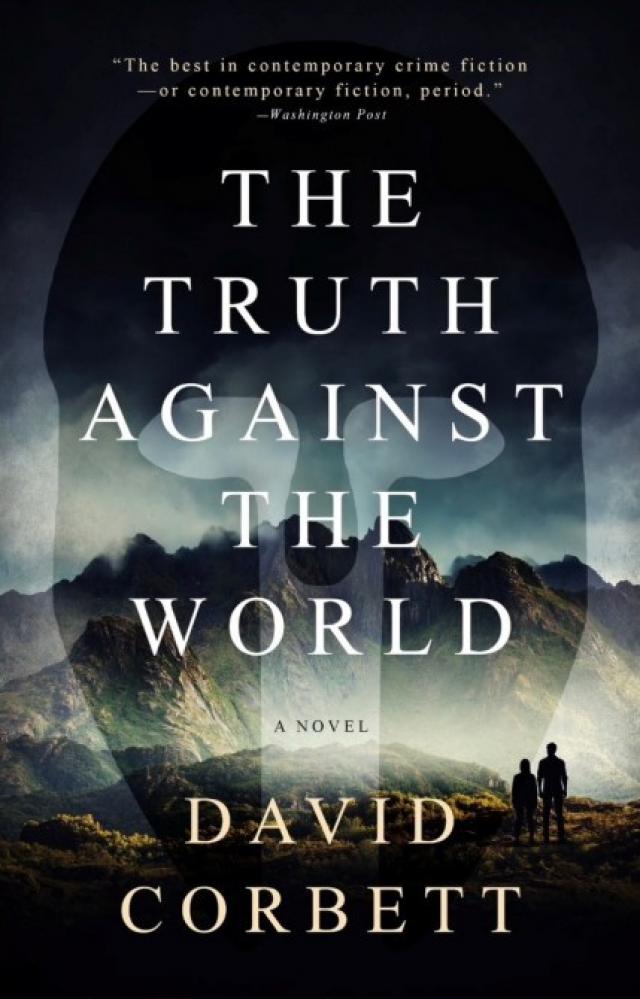
The Truth Against the World, page 1


Praise for The Truth Against the World
“The Truth Against the World is bloody amazing—a wild, enchanting ride across an apocalyptic America with characters who will steal your heart and surprises you won't see coming. The best novel yet from one of today's finest writers. I absolutely loved this book."
—Deborah Crombie, best-selling author of
A Killing of Innocents
“David Corbett's The Truth Against the World delivers terror, hope and redemption with incredibly-drawn characters, exquisitely-written cross-country settings, and sorrowful lessons in the history of the world. This book is reminiscent of King's masterpiece, The Stand, but with a very human—and very American—bogeyman. A fantastic read!”
—Rachel Howzell Hall, bestselling author of We Lie Here
“David Corbett weaves together myth and prophecy in a way that makes The Truth Against the World feel both timeless and frighteningly relevant. And it carries his hallmark of elegant writing and deeply considered, compelling character work. A fantastic read you’ll struggle to put down.”
—Rob Hart, critically acclaimed author of
The Warehouse and Paradox Hotel
“A sharply written thriller that gives readers a peek at a future that doesn’t seem all that far from reality, The Truth Against the World comes pre-baked with plot twists, suspense, and compelling characters. Corbett has outdone himself.”
—Alex Segura, bestselling author of Secret Identity
Praise for David Corbett
The Long-Lost Love Letters of Doc Holliday
“[J]ust terrific … Highly recommended.”
—New York Times bestselling author John Lescroart
“Fresh and inventive … exploring the territory where legend, lore, and fact collide.”
—BookPeople
The Mercy of the Night
"Tierney and company are so real they seem to step off the pages."
—Booklist (Starred Review)
“Corbett doesn’t stint on either narrative or psychological complexity.”
—Kirkus
Do They Know I’m Running
"Corbett delivers a rich, hard-hitting epic … an unforgettable journey.”
—Publishers Weekly (Starred Review)
“A major work of literary art that breaks all genre borders.”
—Bestselling Author Ken Bruen
Blood of Paradise
"Corbett, like Robert Stone and Graham Greene before him, is crafting important, immensely thrilling books."
—George Pelecanos, Producer, The Wire
“I would say of Blood of Paradise what I said of Done for a Dime: it’s an example of the best in contemporary crime fiction—or, if I may be so bold, in contemporary fiction, period.”
—Patrick Anderson, Washington Post
Done for a Dime
“Corbett’s fluid pace is enhanced by his elegant writing and his focus on characters.”
—South Florida Sun-Sentinel
“. . . one of the three or four best American crime novels I’ve ever read.”
—Patrick Anderson, Washington Post
The Devil’s Redhead
[A] compelling, shocking and beautifully written tour de force."
—The Irish Independent
The Truth Against the World by David Corbett
Copyright©2023 by David Corbett
All rights reserved.
This book or any portion thereof may not be reproduced, transmitted, or used in any manner without the express written permission of the author except for the use of brief quotations in book reviews or critical articles.
This is a work of fiction. Any historical figures and events referenced in this book are depicted in a fictitious manner. All other characters are products of the author’s imagination, and any similarity to real persons, living or dead, is coincidental.
ISBN: 9781960725004
LCCN: 2023903522
ebook ISBN: 9781960725011
Cover designed by Tim Barber, Dissect Designs
Interior designed by Ellie Searl, Publishista®
Square Tire Books
Austin, TX
For Mette, my Better Half, my Best Friend, my Bride
A stor mo chroí
Author’s Note
A glossary of pronunciation for the Irish names and terms that appear in the text can be found at the back of the book.
Consume my heart away; sick with desire
And fastened to a dying animal
It knows not what it is; and gather me
Into the artifice of eternity.
—William Butler Yeats, “Sailing to Byzantium”
“The truth against the world!—Yes. Certainly.
. . . the truth is a matter of the imagination.
—Ursula K. Le Guin, The Left Hand of Darkness
Solas Agus Dorchadas
With tens of thousands engaged online—Hong Kong to Tel Aviv, Manhattan to Berlin—Georgie reads from her scrawled notes, reciting the litany of names, linking them to their atrocities:
The plutocratic sociopaths who bankrolled the Capitol bombing.
The homegrown sicarios murdering governors, mayors, members of Congress.
The freelancers targeting journalists, bloggers, filmmakers, poets.
The paid provocateurs turning marches into riots, the arsonists torching courthouses—
Outside, a caravan of vehicles rumbles up the abandoned vineyard’s winding gravel drive, headlights piercing the fog of airborne ash in the darkness.
A sheriff’s squad car, followed by three pickups.
I switch off the overhead lights. The only illumination in the room now comes from the laptop. Its glow sharpens the angles of Georgie’s small, indomitable face. Her penumbral shadow hovers like a ghostly avatar in the giant mirror behind.
A bullhorn voice: “Whoever’s inside that building: Come out through the front door. Move slowly. Show your hands. There will not be a second warning.”
I signal to her: keep going. She leans in closer to the laptop’s camera and microphone.
“I’m going to be ending this broadcast shortly. They’ve discovered our location … If you’re hearing my voice, rise up. Take back your lives.”
Pickup doors slam shut. About a dozen men altogether, armed with long guns, inch forward up the shallow grade. I grip the pistol in each of my hands a bit more purposefully, breathing slowly in and out, emptying my mind, silencing what remains of my conscience.
The Prisoner in the Tower
Begin, be bold, and venture to be wise.
―Horace, The Odes
—1—
Seven Weeks Earlier
And so, there I am, secretly following the bastard home. What alternative did he leave me?
I’m speaking of Wilburn Kurth, senior VP at Merchants & Traders Trust of Philadelphia. Earlier in the day, I’m there at his bank, pleading my case. Georgie’s case, rather, for it’s her funds, essential to her care, that have inexplicably vanished.
Bulwarked behind his antique desk, hands folded before him on the blotter, our Mr. Kurth—bespectacled, portly, razor-straight part in his ash-brown hair—responds to my entreaties with the conscientious steeliness that commends a man who guards the money of others, especially in times such as these.
Meaning, of course, he gives me nothing, wandering around the barn about the sanctity of client privacy and such, ending with a cold, helpless smile.
I thank him for his time, spank the crease back into my slacks, show myself out.
Then wait, sitting in my car the remainder of the workday, while storm clouds the color of overripe plums gather overhead, a real pelter rolling in from the Atlantic.
Five on the dot, our Mr. Kurth scuttles out to his car, briefcase for an umbrella, rain lashing down in blinding sheets. I slip into gear as he pulls into traffic—headlights carving a path through the blur, wipers slogging back and forth. Maintaining a steady three-car distance all the way across the Schuylkill River, I end up in one of those staid and sleepy purlieus often mocked as hotbeds of social rest.
Puts me in mind of the Belfast suburbs, always so peaceful, even at the height of the bombings.
I make a mad dash from car to doorstep and stand there, damp as a rat, when the door finally opens.
It’s not the man of the house who greets me, however, but his wife. Even in flats she stands over six feet tall.
My banker married himself an amazon, a bohemian to boot: hair coiled behind in a thick dark braid, a paint-stained denim shirt knotted at the navel.
Her thin brown eyebrows slice like darts toward the wrinkled bridge of her nose. In return, I venture a smile in the porchlight.
“Might I possibly share a word with Wilburn?”
She glances past me toward the rainswept yard, practically vibrating with fright. Given the danger that stalks the land, who can blame her? I could be walking point for a murderous squad of brigands, a wandering strangler, a humble thug. There’s no relief in her eyes when her gaze snaps back.
“Does he know what this is regarding?”
“That he does. We spoke earlier, but I didn’t get the chance to—”
“If this concerns work, you need to meet with him there.” She shakes her wrist for a glance at her watch. “My God, I mean . . . With everything going on, seriously. And how on earth did you find—”
“Melissa, w ho is it?”
The banker himself at last appears, strolling up from behind, drying his hands on a dish towel. The necktie has fled, shirt collar open, sleeves rolled up from the wrist. It does little to redeem the steeliness of eye.
“No,” he says, seeing it’s me.
“Mr. Kurth, I’m sorry to disturb you at home—”
“Then leave.” This from Melissa, the wife. Arms crossed now, one of the darting eyebrows cocked.
“I don’t believe I had a chance to explain my purpose fully.”
The wife’s face tightens like a fist, but before she can comment, her husband says, “This is highly improper.” Ever so subtly, he eases himself in front of his bride. Protector. Defender. Two inches shorter. It’s only then I notice the apron: flower print, ruffled edges.
“I mean utterly, absolutely no harm. But I’m here on behalf of a young lady in dire need.”
“You told me at the—”
“Not enough so you’d rightly understand.”
I pull from my breast pocket the pictures I’ve brought, printed out on glossy stock.
“I’m calling the police.” The wife turns away brusquely. As she does, I spot the girl.
The first sight of a child, it invariably breaks my heart. Blame the sight of too many wandering war zones, starving, dressed in scraps.
This one seems fourteen or so, wearing a private school uniform, white blouse with Peter Pan collar, vest and pleated skirt of Marian blue. Catholic. I picture the classroom, crucifix high on the wall, the imperious nun. Little Sisters of the Rich.
Our eyes meet. I offer a timid wave, which she returns.
“Don’t make this difficult,” her father says. “I don’t want trouble any more than you do.”
The mother moves toward the girl, tries to collect her, turn her away from the door. From me. But the young one remains where she is, transfixed.
I cast no spell, I swear, conjure no magic. As if I could.
The girl eases forward. Lanky of build, legs like posts, she’ll grow tall like her mother. She possesses as well her mother’s chestnut hair, the same dark eyes, but the brows, not yet plucked and sculpted, possess a gentle shapelessness about them that renders perfectly the lonely bafflement of the precocious child.
She slips her hand casually into her father’s. “What’s your name?”
I offer a courteous glance to the father, a tacit request for permission to respond. “People tend to call me Shane.”
Her head lists to one side. “You’re . . . ”
“Irish, yeah. As wet grass.”
From behind, her mother utters a blistering, “Djuna, get away from the door.”
Speaking of names. I can’t help but grin. An arty appellation for the doomed-to-be-special daughter—from which I surmise there are no other sprogs about. Djuna is an only child.
The father interjects a bit of throat-clearing. “Mr. Redmond?”
“Riordan.”
“I’m sorry. Mr. Riordan, it really is improper, visiting me like this. At home.”
Behind them both, silhouetted in a rearward archway, the mother holds her phone aloft, a warning: Don’t make me finish the call. Be off.
“How old are you?” It’s the girl again.
Odd question. I keep my eyes trained on the mother. “Thirty-three. Thereabouts.”
“You seem much older.” She crinkles her nose. “It’s your eyes. They’re sad.”
From his eyes of flame,
Ruby tears there came
Good old Billy Blake.
“Djuna,” the mother barks, “I won’t say it again, get away from the door.”
The rain’s worsened, drops the size of apricots.
“Who’s that in the picture?” Djuna points to the topmost snapshot I’m holding.
“Her name’s Georgie. She’s a dear and precious friend, who’s sadly fallen on difficult times. That’s why I’ve come to speak with your father. I need his help.”
You can feel it, the melting of the man’s resistance, the girl’s long fingers twined in his. She glances up with wily fondness. “If that’s all he wants, Dad. I mean, it’s pouring.”
The stern banker answers with a sort of growling sigh, which seems a cue between them. The girl unlatches the screen door and nudges it open for me.
Oh, the mother’s truly going to hate me now. Inwardly, I’m laughing like a drain.
—2—
Using my handkerchief, I mop my face and hands as I stand in the entry, a quick brush across my hair, a flick here and there against the larger droplets clinging to my sport coat and slacks.
In the corner of my eye, I catch a glimpse of a wall-mounted monitor in a study off the main hall—a white cupola appears on the screen, shrouded in churning black smoke. Some sort of newscast—another government building attacked?
The mother rushes forward, slams shut the door, and points me toward the living room.
I lay out my photos on an antique painted chest, turning the pictures so they can be viewed from the roomy Chesterfield couch. Djuna sits in the middle, the parents looming to either side like watchful bookends. Paintings crowd the wall behind them, frenzied slashings of color that only an utter plank wouldn’t recognize as the mother’s.
I sense no lingering spirits about, no wandering ghosts. They tend to gather where there’s hope of something to learn from the living. I keep their absence in mind as I plead my case.
“I met Georgie at Liguorian College over in Lansdowne.”
The snapshots begin from the time when I first met Georgie, fresh as a field of bellflower, then advance over three years to the unfortunate present, where she stares back at the camera from the hollows of her haunted state.
“She’s very unusual looking,” the girl remarks.
“Djuna,” the father says, “don’t be rude.”
“I’m not. I just mean, well, her hair, it’s like ink, but her skin—”
“Black Irish,” the mother says.
“Actually,” I reply, “that’s not a term we use ourselves. It’s said about us, not by us.”
“And the eyes,” Djuna says, “they’re, like, Asian.”
“Seriously, Djuna!”
“That’s not at all uncommon,” I reply. “Squint-eyed, it’s called back home, not kindly. Truth be told, there’s as wide a variety of types in Ireland as anywhere, dark to fair. We’re not all ginger-haired, blue-eyed, and freckled. Regardless, her people left the old country long ago, banished to the Caribbean as indentured servants when Cromwell drove them off the land. Since then they’ve moved and mingled and intermarried like all the rest. She’s pure American mutt, though the Irish does shine through, not just in her name. Stubborn people, stubborn genes.”
The mother seems unperturbed at my having corrected her—no more agitated than before, at least—a good sign. As for the father, he just keeps his eyes locked upon me, as though any moment I might lunge.
“Georgie and me, we met in a class on Celtic myth given by a gent named Reginald Feely.”
The father stiffens at mention of the name. As well he should.
“Georgie—and here her Irish shone through—she was mad for the old stories, about Queen Maeve and Cú Chulainn, the Brown Bull of Cooley, the sad fate of the children of Lir. She practically sparkled when we read them out loud.”
My voice softens as I remember. A happier, more radiant time.
“But she’s a fragile thing, perhaps too fine a spirit for this world. And, as many young people do, she fell in love unwisely.”
“With you,” Melissa, the mother, presumes.
“No, no. Georgie and me, we’re friends—and not ‘merely.’ Friendship is my sacrament. ‘The immortal good that dances round the world,’ if you know your Epicurus. Fierce close we are, tight as twins, even in her current state.”