

The Eye of Strife, page 15


“Your Majesty is well informed.”
“If you think my spies are good, wait until you get to Syboarsh. Which is she?”
I confessed that Monal was my daughter.
“And what takes you to Syboarsh?”
“Business of the Holy Parents, which has not been fully revealed to us, sire. Our daughter in an Envoy of the Mother, and is confident that all will be made clear to her when the time is right.”
King Crippon eyed me suspiciously for a few breathless moments and then seemed to decide that whatever I might be hiding wasn’t worth shedding blood over.
“Then watch your backs in Syboarsh,” he said.
“I get the impression that the city is prosperous, peaceable, and law-abiding. Monarchy or republic?”
“Neither. Syboarsh is ruled by a secretive, self-perpetuating group known as the Seven. They speak through a single spokesman, who is replaced every ten years or so, but no-one knows whether that man is one of the Seven or just an underling. Even the name may be a lie: the Seven may in truth be one or eighty, for they appoint their own successors. They run the army, the city, the town watch, and the courts; their decisions cannot be appealed. Surprisingly few citizens complain, but those who do are liable to wash up on the banks of the Trium, face down and far downstream. Whoever they are, the Seven seem to rule fairly and wisely. There are no luxurious palaces in Syboarsh, or in the country around it.”
Iliana asked, “So why must we watch our backs?”
My cousin smiled and topped up our wine with his own hand. “Syboarsh is either the Gateway to the Plains or the Gateway to the Headwaters, depending on which way you are looking, and King Zaryqa of Vasque is definitely looking south.”
“War?” she said.
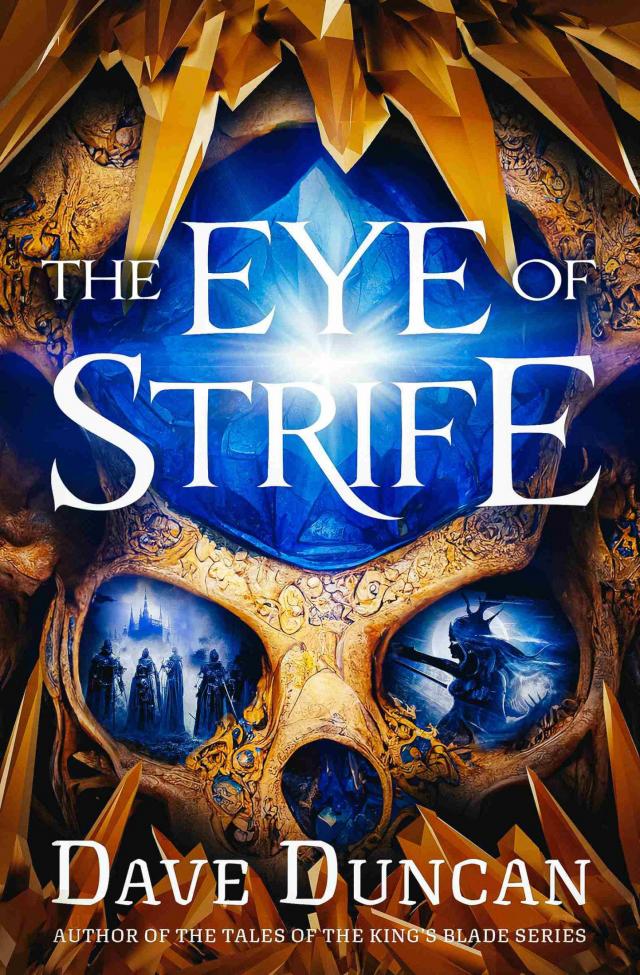
“There is a strong smell of war in the air. There usually is, in the Headwaters—Quistirians are a quarrelsome lot! Vasque is still the largest town, and the others used to gang up on it. Old King Aidyro kept the riffraff in line, even most of the hill tribes, too. When he died, they expected his son, Haluj, to be easier pickings, but he wasn’t. You’ve heard the old legend about Emperor Quarn and the Eye of Strife? According to the stories, Haluj dug up some of the old imperial tombs and found the original Eye of the god. He took to wearing it into battle. He’s won every time, so there must be some truth in the story.”
Of course we have been discussing this here all night, but it was staggering news to Iliana and me. How could the Eye have turned up twice, at opposite ends of the Plains?
“When was that, exactly?” I asked.
The king noted my interest. “Right after the old scoundrel died—Aidyro, I mean—and his son Haluj took over. 1350? No, it would have been 1349.”
That was the same year that Cuialfil and I had set off from Nisoim. This made no sense.
“What does it look like, this Eye?” I asked.
“You’ll have to go and ask King Zaryqa to show it to you. Zaryqa is Haluj’s son. He has it now, and he’s been using it a lot more often, from what I hear. He’s much more aggressive. He’s established his rule over the whole Headwaters, and he’s practically breathing on the gates of Syboarsh. So everyone will be very jumpy and on the lookout for spies.”
We thanked him, of course, and were invited to stay to dinner and meet the queen. It was dark by the time we were returned to Swift. I was grateful to my now-royal cousin, and promised to visit him again on my way home, wherever my home turned out to be. I also promised to tell him the end of the story.
Which we haven’t got to yet.
Before leaving Festant we agreed on what our answers would be if we were ever questioned: Iliana and Monal were on holy business for the Mother, which they were not at liberty to discuss; Cuialfil and I were their trusted guards; Juanian was in search of his long-lost sons and we had brought him along as an act of charity. It was close to the truth; it just didn’t sound very believable. It failed to explain why Juanian’s sons had never returned to look for him, or why the two guards from the Eastern Shores spoke with a Nisoimian lilt. I could speak Edness, but Cuialfil knew not a word of it. Weak.
In the next couple of weeks, sailing slowly upriver, we spent much time talking over the mystery of the Eye. How could both Eyes be genuine?
We had no way of comparing dates exactly. Both Cuialfil’s troubles and King Haluj’s transformation into a warlord had begun in the same year, but we could not be sure which happened first. Personally, I believed that my vision of Quarn in the House of the Mother proved that the mysterious packet had contained the genuine, one-and-only Eye, which had been hidden somewhere in the delta ever since Emperor Ythdel died. I wanted to believe that King Haluj’s version was a fraud and the opened grave had been invented as a cover story. But if the king’s version was a fake, why did his Eye win battles for him?
Iliana, on the other hand, pointed out that the Father must naturally be concerned about the whereabouts of his own Eye, and disinclined to let it be hidden in the house of his holy consort. According to Juanian, Skamp—who is Strife in his unpredictable aspect—had known where it was when Cuialfil visited the temple at Festant on his journey east. Why had he been allowed to carry it all the way to Ozopan Oasis, so that Poanir’s son Juanian would have to bring it all the way back again? True, the priests always describe the ways of Skamp as mysterious. He plays jokes on people and may well be capable of playing jokes on the Mother or even on other aspects of himself. We had heard Juanian describe what he saw in the package, and Iliana conceded that it must have been genuine, since it struck him blind, and no imitation Eye should do that. And where had the unknown Tapeworm taken the genuine Eye?
So even back then on the boat, we wondered if there might be two Eyes or, rather, one genuine Eye and a fake.
Tonight has made things no clearer for me. The one His Majesty showed us does not match what both Poanir’s son Juanian and I saw. Yet one Eye wins battles for the Vasquian kings; the other blinds a man and has attracted the attention of both the Holy Parents.
If there are two Eyes, and the mysterious Tapeworm delivered the package one to Syboarsh while Vasque has the other, what then? If war breaks out between those cities, will both sides claim to be wielding an Eye? We drew nearer to Syboarsh, but no nearer to solving the mystery. Nor have we done that tonight, that I can see.
On the last day of our journey on Swift, I was awakened by a periodic thump against the hull; I could sense that the boat was already underway, but not with its usual motion. Hearing the crew clumping about busily, I went up on deck, and saw at once that we were very close to Syboarsh. A great stone wall spanned the river, letting the water flow through three arches, and we were approaching the center one. But the sails were furled; the sailors were not manning the sweeps.
I headed aft, where Foamy sat, holding the tiller.
We exchanged morning blessings and I sat down. “That is a very impressive bridge, Captain.”
“It is. The Seven built it ’bout seventeen, eighteen years ago. It’s part of the new city wall.”
Built it because the Eye of Strife had reappeared in nearby Vasque? Allowing for planning and raising the necessary capital, the timing was about right.
“And what’s moving the boat?” I asked, for I could see that the piers of the bridge restricted the current, making it rush very fast through the arches.
“Water.” Teeth flashed momentarily in the silvery foam of his beard.
I stood up to see more clearly. Another boat, somewhat astern us, was approaching the western arch in the same magical fashion. But each vessel was preceded by a long line of floats, which must be attached to a rope or chain, and that was what was towing us in. A matching string of floats headed downstream in each case.
I sat down again. “Water wheels?”
Foamy nodded. “No one gets in unless the Seven want ’em in.”
Very clever! The current turned waterwheels, which pulled a loop of chain to drag boats in against that same current.
The arch was looming almost overhead, and the boat lurched and swayed in the rush of the current. Foamy was struggling to hold her steady, but that did not stop him talking.
“So where will you be staying in town?”
It was now my turn to spill secrets, and I had none to spill.
“I swear, Captain, that I do not know. It’s up to our priestesses to give the orders, and when I ask they just say they’ll start by finding a place to stay.”
“Must be a dozen temples in Syboarsh. Don’t temples offer hospitality to visiting priestesses?”
“But the Mother’s temples don’t like swordsmen. Can you recommend a guest house near the docks?”
He hesitated, then said that there were many, and all bad. I suspected that he wanted to be able to say he didn’t know, when the Seven asked him where we were staying.
So we came at last to Syboarsh. The sheer size of it impressed even Cuialfil and me, probably because it spreads up hillsides on either side of the river, so we could see all of it at once, whereas Nisoim is scattered over many islands, all of them flatter than puddles. Syboarsh is protected by high walls, so that it resembles two cities, one on either side of the river, with three high bridges connecting them. River traffic, both upstream and downstream, has to pass through massive gates to enter the city proper, and those gates can be closed against it.
Three major tributary streams from the hill country to the north come together just upstream from Syboarsh to form the Trium, so the city clearly marks the boundary between the Headwaters and the Plains. Major trading ships download their cargoes there, and send goods northward in much smaller boats. His Majesty will excuse me for believing that he cannot expand his realm southward without taking Syboarsh. In the empire’s time, it had been a much smaller town, but it had refused to open his gates to Emperor Iekoto, so he wiped it out.
With respect, sire, nowadays a siege would likely last a very long time while the city controls the river traffic, and if you try to starve it into submission, the city may starve Vasque by blocking its trade with the Plains.
Of course legend says that whoever owns the Eye will never lose a battle, and we had come in search of an eye, even if not perhaps the Eye.
We had to give an account of ourselves to a port official, and I was elected spokesman, as being more personable than either a scrawny blind Kogoluin or an ox with the face of a compulsive brawler—pardon me please, Cuialfil. The interview went very smoothly, thanks to my daughter standing at my side. The officious little man could barely take his eyes off Monal, because she looked as if she could barely keep her hands off him. I had seen her pass as a boy in Dsizlsirl; on Swift’s deck that morning she was the Maiden herself, every boy’s lust personified.
We were admitted, and marched down the gangplank onto the busy docks.
Then what? First we had to leave the river area through another gate into the city proper. As Foamy had told me, there were many rooming houses handy, so we chose one that claimed to be highly respectable. We rented two rooms, one for three men, the other for two women.
Monal’s verdict was scathing. “Respectable?” she said. “I don’t think it’s so respectable. Half the cockroaches in our room are male.”
Despite the great sprawl of the city, its market areas were concentrated around the docks, and we went shopping for clothes in the local style, so we would not stand out too obviously as strangers. Once that had been done, we had to start our hunt for someone who had called himself Tapeworm twenty years ago. The only real clue we had was that Poanir’s son Juanian remembered Wolma’s brother-in-law the jade trader being called something like Nupoguylde Wab.
He was sure about the Wab, not the rest of it.
Frankly, I was skeptical that anyone could make a living trading jade along the Desolation Road. Jade is so highly prized in the Eastern Shores that the rulers forbid it to be exported. Consequently all the jade that comes along the Desolation Road is contraband, and there is very little of it. Admittedly, scarcity does tend to make it even more valuable. In the next couple of days we asked all over town for jade traders. We began in the west town, then crossed over one of the high bridges into the east town, but we had no more luck there.
Monal, as usual, was smarter than the rest of us. “Valuable?” she said. “Valuable for what?”
Carving, of course. There was no market in raw jade.
So the next day we went out to speak with jewellers about jade carvings and carvers. We had discovered by then that the west town was the moneyed district and the east town the artisan area. A luxury trade like jade carving would be far more likely to be located on the west side. We split up; Cuialfil and Monal went upstream, Iliana and I downstream. By agreement we met back at a public fountain a couple of hours later, and before anyone spoke it was obvious that we had met with no success. No one had ever heard of a jade carver named anything like Nupoguylde Wab. No one, in fact, would admit to knowing any jade carvers anywhere, although several of the merchants we had spoken to were exhibiting carvings for sale.
Everyone in Syboarsh knew nothing about anything.
“Furthermore,” Monal said, “I am certain Cuialfil and I were being followed.”
The back of my neck prickled. Even without the ominous rule of the Seven, a city that builds gigantic walls because it suspects its neighbour of planning to make war on it is going to be leery of strangers. Syboarsh was probably swarming with government spies.
“So now what?” I asked. “Do we go back to the Eastern Shores and tell the Mother we failed?”
“I think we tell her right here,” Monal said, nodding to a chapel right there on the little plaza. The proposal seemed to make sense, so Cuialfil and I went in by the Father’s door, and my wife and daughter around to the far side and the Mother’s.
The interior was dim and quite cool. A man-sized depiction of the Father faced us as we entered, and there was a connecting door through to the Mother’s side in the far corner. The priest sitting just inside the doorway was a skinny adolescent, shaven-headed and red-robed, who looked both cold and ill-fed. He rose eagerly when we entered. We were the only worshippers there, perhaps the only ones he had seen that day.
“How may I help you, my children?” the lad inquired. The question went to Cuialfil, probably because of his alarming appearance.
“Have you eaten breakfast yet?”
The question took our juvenile pastor by surprise. “Um, no.”
“Then go and get some.” Cuialfil handed him a coin, one of the gold pieces the Home of the Mother had given Monal when she left on her mission. He could eat for a month on that. He flushed, hesitated, and then accepted the donation with a gesture of blessing, and vanished outside.
The image of the Father was a free-standing figure of marble, finely done, probably a donation from some wealthy trader. It did not wear Strife’s eyepatch or carry his sword, and looked more like Skamp, in an older version than I was accustomed to seeing. Cuialfil and I went over to the idol and knelt to pray. Neither of us spoke aloud, although I heard quiet murmurs from the Mother’s section. I thanked the Father for a safe journey completed and began to ask for guidance. I hadn’t quite finished when the light from the doorway dimmed. Cuialfil was on his feet in a flash, with me half a flash later.
Two men in the livery of the city watch had entered, and more were right behind them. Then a woman screamed in the Mother’s chapel. I was sure that it was neither Iliana nor Monal, but that did not matter. The mayhem began.
There is no law or edict against fighting in the Father’s temples—Nisoimian affairs of honour are often settled there, especially in rainy weather—but Kulf did not bother to draw. He just slammed the first man against the second so hard that they both crashed into the wall and fell over. The recoil slowed him so that he did not reach the doorway before one of his victims caught hold of his ankle and diverted him into the doorpost, face first. Then a third man jumped over the wounded, took hold of Kulf as he peeled his face off the doorpost, and slammed it back for a second helping.
That should have been the end of the matter, but it wasn’t. I kept out of it, because we were obviously hugely outnumbered and the moment I drew my sword the enemy would draw theirs. Besides, I was carrying my lute, which I had not cared to leave in the protection of a blind man, and did not wish to involve it in a free-for-all. I took shelter behind Strife’s statue and stayed non-combatant.
To my astonishment Kulf managed to straighten up and go for the third man with fists flying. A fourth man had arrived to make the temple very crowded, and the first two came up off the floor, flaming mad. All four of them piled on and systematically punched and began kicking him. They might have kicked him to death had Monal not arrived with a piercing scream and thrown herself on top of him. Kulf subsided into a motionless heap. The guards stopped kicking.
One of them licked blood off his knuckles and demanded that I hand over my sword, which I did.
They tied my hands behind me; put a bag over my head, and a halter around my neck; then led me off through the streets to jail. In most cities I would have been subjected to abuse, verbal or even physical, but in Syboarsh spectators do not draw attention to themselves. Cuialfil made the same journey after me, probably draped over the back of a horse. The women were taken in a closed carriage, as I learned much later.
We entered a building and I was told to stand for a minute. I tried to explain about Poanir’s son Juanian, whom we had left at the lodging house. I was told to keep quiet unless I wanted a very hard punch where I least fancied it. Eventually I realized that the watch would certainly check—and probably loot—our quarters, and they would find Juanian before he starved.
Obviously we had fallen afoul of the sinister Seven.


