Blade of Dream, page 1


This book is a work of fiction. Names, characters, places, and incidents are the product of the author’s imagination or are used fictitiously. Any resemblance to actual events, locales, or persons, living or dead, is coincidental.
Copyright © 2023 by Daniel Abraham
Cover design by Lauren Panepinto
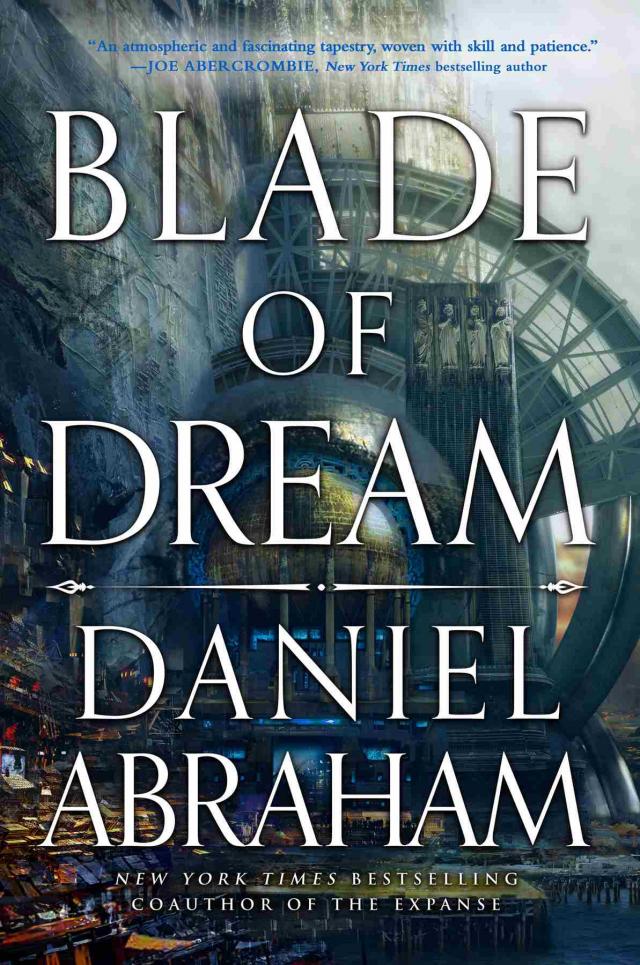
Cover illustration by Daniel Dociu
Cover copyright © 2023 by Hachette Book Group, Inc.
Map by Jayné Franck
Hachette Book Group supports the right to free expression and the value of copyright. The purpose of copyright is to encourage writers and artists to produce the creative works that enrich our culture.
The scanning, uploading, and distribution of this book without permission is a theft of the author’s intellectual property. If you would like permission to use material from the book (other than for review purposes), please contact permissions@hbgusa.com. Thank you for your support of the author’s rights.
Orbit
Hachette Book Group
1290 Avenue of the Americas
New York, NY 10104
orbitbooks.net
First Edition: July 2023
Simultaneously published in Great Britain by Orbit
Orbit is an imprint of Hachette Book Group.
The Orbit name and logo are trademarks of Little, Brown Book Group Limited.
The publisher is not responsible for websites (or their content) that are not owned by the publisher.
The Hachette Speakers Bureau provides a wide range of authors for speaking events. To find out more, go to hachettespeakersbureau.com or email HachetteSpeakers@hbgusa.com.
Orbit books may be purchased in bulk for business, educational, or promotional use. For information, please contact your local bookseller or the Hachette Book Group Special Markets Department at special.markets@hbgusa.com.
Library of Congress Cataloging-in-Publication Data
Names: Abraham, Daniel, author.
Title: Blade of dream / Daniel Abraham.
Description: First Edition. | New York, NY : Orbit, 2023. | Series: The Kithamar trilogy ; book 2
Identifiers: LCCN 2022042303 | ISBN 9780316421898 (hardback) | ISBN 9780316421881 (ebook)
Subjects: LCGFT: Novels.
Classification: LCC PS3601.B677 B53 2023 | DDC 813/.6—dc23/eng/20220909
LC record available at https://lccn.loc.gov/2022042303
ISBNs: 9780316421898 (hardcover), 9780316421881 (ebook)
E3-20230606-JV-NF-ORI
Contents
Cover
Title Page
Copyright
Dedication
Map
Part One: Midsummer
Part Two: Harvest
Part Three: Winter
Part Four: Spring Storms
Acknowledgments
Discover More
Also by Daniel Abraham
To the audience
and other unacknowledged collaborators
Explore book giveaways, sneak peeks, deals, and more.
Tap here to learn more.
In the course of a single life, a man can be many things: a beloved child in a brightly embroidered gown, a street tough with a band of knifemen walking at his side, lover to a beautiful girl, husband to an honest woman, father to a child, grain sweeper in a brewery, widower, musician, and mendicant coughing his lungs up outside the city walls. The only thing they have in common is that they are the same man.
These are the mysteries, and there is a beauty in them. In this way, Kithamar is a beautiful city.
All through its streets, Kithamar shows the signs and remnants of the cities that the city has been. Walls that defended the border of a younger town stand a dumbfounded, useless guard between the noble compounds of Green Hill and the fountain square at Stonemarket. The great battlements of Oldgate glower out over the river, the arrow-slits and murder holes used for candle niches now, and the enemy races who stormed or manned it sleep side by side in its armories because the rents are cheap. The six-bridged Khahon was the border between a great Hansch kingdom and savage near-nomad Inlisc to hear it one way, or the first place that the frightened, violent, sharp-faced Hansch had come from the west if you told the story from the other bank. Now the river is the heart of the city, dividing and uniting it.
The ancient races killed one another and swore eternal hatred, only to bury their enmity and pretend to be a single people, citizens of one city. Kithamar has declared itself the subject of the one true god. Or the three. Or the numberless. For three hundred years and longer, it has been a free city, independent and proud and ruled by princes of its own rather than any distant king.
Only today, its prince is dead.
The reign of Byrn a Sal had been brief.
Less than a year before, the streets had filled with revelers and wine, music and joy, and more than a little imprudent sex to celebrate the great man’s coronation. The months between then and now were turbulent, marked by ill omens and violence. A winter of troubled sleep.
Now, as the first light of the coming dawn touches the highest reaches of the palace towering at the top of its hill, the red gates open on his funeral procession. Two old women dressed in rags step out and strike drums. Black, blindered horses follow, their steps echoing against the stone. And all along the route, the men and women and children who are Kithamar wait.
They have been there since nightfall, some of them. They love the spectacle of death and the performance of grief. And, though few of them say the words aloud, they hope that the season of darkness will end and something new begin. Only a few of them ask their questions aloud: How did it happen? Was it illness or accident, murder or the vengeance of God?
How did Byrn a Sal die?
The black lacquered cart passes among the gardens and mansions of Green Hill. The heads of the high families stand at their entrances as if ready to make the dead man welcome if he should stand up. Servants and children and ill-dignified cousins gawk from the bushes and corners. Only the burned-out shell of the Daris Brotherhood ignores the funeral. And then the body passes into the city proper, heading first for Stonemarket and then south through the soot-dark streets of the Smoke.
Those lucky enough to have buildings along the route have rented space at their windows and on their roofs. As the death cart shifts and judders across the cobblestones, people jockey to look at the corpse: a little less than six feet of iron-stinking clay that had been a man. Behind the cart follow the highest dignified of the city.
The dead man’s daughter—soon prince herself—Elaine a Sal, rides behind her father in a dark litter. She wears rags, but also a silver torc. Her chin is lifted, and her face is expressionless. The eyes of the city drink her in, trying to find some sign in the angle of her spine or the dryness of her eyes to tell whether she’s a girl hardly old enough to be called woman drowning in shock and despair, or else a murderess and patricide struggling to contain her triumph.
Either way, she will rule the city tomorrow, and all these same people will dance at her coronation.
Behind her, the favored of the old prince walk. Mikah Ell, the palace historian in an ash-streaked robe. Old Karsen’s son, Halev, who had been Byrn a Sal’s confidant and advisor. Samal Kint, the head of the palace guard, carrying a blunted sword. Then more, all wearing grey, all with ashes on their hands. When they reach the bridge at the edge of the Smoke—yellow stone and black mortar—they stop. A priest walks out to meet them, chanting and shaking a censer of sweet incense. They perform the rites of protection to keep the river from washing away the dead man’s soul. Everyone knows that water is hungry.
The rite complete, the funeral procession passes through the wider streets of Seepwater, past the brewers’ houses and canals where the flatboats stand bow to stern, so thick that a girl could have walked from one side of the canal to the other and not gotten her hem wet. Midday comes, the early summer sun making its arc more slowly than it did a few weeks before, and the cart is only just turning northeast to make its way along the dividing line between Riverport and Newmarket. Flies as fat as thumbnails buzz around the cart, and the horses slap at them with their tails. Wherever the funeral procession is, the crowd thickens, only to evaporate when it has passed. Once the last of the honor guard rounds the corner, leaving Seepwater behind, the brewers’ houses reopen, the iron grates on their sides start accepting wagers again. Delivery men spin barrels down the streets on their edges with the practiced skill of jugglers.
It is almost sunset before the funeral procession reaches the Temple. The bloody western skyline is interrupted by the black hill of the palace. The colored windows of the Temple glow. Full dark takes the streets like spilling ink before the last song echoes in the heights above the great altar and the body of Byrn a Sal, purified by the mourning of his subjects and the prayers of his priesthood, comes out to the pyre. His daughter should light the oil-stinking wood, but she stays still until young Karsen, her father’s friend, comes and takes the torch from her hand.
The term for the night between the funeral of the old prince and the coronation of the new one is gautanna. It is an ancient Inlisc word that means, roughly, the pause at the top of a breath when the lungs are most full. Literally, it translates as the moment of hollowness.
For one night, Kithamar is a city between worlds and between ages. It falls out of its own history, at once the end of something and the beginning of something else. The skeptical among the citizens—and Kithamar has more than its share of the amiably godless—call it tradition and me rely a story that says something about the character of the city, its hopes and aspirations, the fears and uncertainties that come in moments of change. That may be true, but there is something profound and eerie about the streets. The rush of the river seems to have words in it. The small magics of Kithamar go as quiet as mice scenting a cat. The clatter of horseshoes against stone echoes differently. The city guard in their blue cloaks make their rounds quietly, or decide that for one night they might as well not make them at all.
Under the northernmost of Oldgate’s four bridges, a girl sits, listening to the water. She has a round face, gently curling hair, and a knife held in her fist. She is waiting for a meeting that she dreads as much as she longs for it.
Outside the city, the southern track where by daylight teams of oxen haul boats against the current is quiet and deserted apart from one lone, bearded man. He sits at the base of a white birch, his back against the bark. The small glass bead in his hand would be red if there were light enough to see it.
In a thin-walled bedroom above a tailor’s shop in Riverport, a young man lies alone on a mattress. His right hand is bandaged, and the wound beneath the cloth throbs. He watches the moon rise over the rooftops, listening with his heart in his throat for footsteps on the creaking floorboards outside his door.
His name is Garreth Left.
PART ONE
MIDSUMMER
The city of Kithamar is its divisions. The river divides the old Hansch stronghold from the Inlisc township that it conquered and consumed. The buildings on the north side of a particular street are in Stonemarket, the south, in the Smoke. Within a single quarter, divisions are everywhere: the wealthy merchant halls of Riverport against those that are struggling; the sun-warmed wall of a house where the family basks and the shadowed side where servants shiver. Division and division and division until there are as many Kithamars as there are people that sleep inside its walls. And even a heart has chambers.
—From the Sermon on Integrity by Avith Cerr, court philosopher to Prince Daos a Sal
Ivy grew up the courtyard’s northern wall, broad leaves a green so rich and dark they seemed almost black in lantern light. The day’s heat radiated up from the stones, and the thick breeze was what passed for coolness in midsummer. It smelled like the river.
“Then five more came out,” Kannish’s uncle Marsen continued, holding up his splayed hand. “So there we were, me and Frijjan Reed and Old Boar with a full dozen Longhill thugs around us, and no other patrol close enough to hear the whistle.”
Maur was leaning forward like a child, not a grown man with two full decades of life behind him. Garreth swallowed another mouthful of cider and tried not to lean forward too. Kannish, who had the blue cloak of the city guard for himself now even though he wasn’t wearing it, crossed his arms and sat back against the wall as if by joining the guard, he’d made all his uncle’s stories partly his own.
Marsen stretched his arms along the back of the metal bench, shaking his head at his own memories. He was halfway through his fifth decade, with grey at his temples and in his beard, and he wore the uniform with the ease of long familiarity. The uniform was so much a part of him that going shirtless like the boys never occurred to him, even in the heat.
“Did you get your ass split the other way, then?” Maur asked.
“No,” Marsen said. “We could have, no mistake. These were all Aunt Thorn’s knives, and she’s a bloodthirsty piece of Inlisc shit. Our badges of office make us targets for her. But we were in Longhill itself. You boys ever go to Longhill?”
“Just on the way to the university and the theater,” Garreth said.
“Well, don’t. If you’re going to Seepwater, stay by the river to get there. It’s a maze, Longhill. The way the Inlisc rot out their houses and throw up new ones, the streets shift from week to week, and the new places are built from the same wood that the old ones were. That was what saved us.” He nodded, and Kannish nodded with him like he knew what was coming next. “One of them had an oil lamp. Crap little tin-and-glass thing. So that’s what I went for. He dodged out of my way, but I wasn’t aiming for the meat of him. Oh no. I caught the glass and the tin. Shattered the fucking thing and got oil everywhere. Up and down my blade too. Looked like something out of a priest’s story for a little bit. Gods with flaming swords, but it was just me and a bit of cheap oil.” He held his right hand out, palm down, and pointed at his thumb. “You can see the burn scar from where it dripped right there.”
Maur whistled low. The knot of scar was pale and ugly, and the pain of getting it seemed like nothing to the man who wore it.
“Point was, Aunt Thorn’s boys saw the flame, and they panicked. Damn near forgot we were there. Started running for water. We had half of them dead or roped before they knew what was happening, and the rest scattered. They’re dangerous, but they spook easy when you stand up to them. That’s truth.”
“What about the fire?” Garreth asked.
“The locals had it out before we had to turn to it. Longhill knows that if it starts burning, it won’t stop. They’ve got hidden wells in some of those houses. There wasn’t any real danger. But distraction? That’s half of what fighting is.”
“Outthinking the enemy’s as deadly as speed or strength,” Kannish said. “More, likely. That’s what Captain Senit always says.”
His uncle’s eyes narrowed and he looked to his left. “He does say that.”
A woman’s voice called from inside. Kannish’s mother, the host of the night’s meal saying a wide, loud good night to some of the other guests. Garreth had spent time in Kannish’s home since he and Kannish and Maur were all pot-bellied, unsteady boys playing swordfight with loose sticks, and he knew a hint when he heard one. The others did too. He and Maur pulled their tunics back on over their heads, and Kannish shrugged his blue cloak back into place. Kannish wasn’t on patrol any more than his uncle was, but the uniform was a boast. A statement of who Kannish had become and his place in the city.
“Could head for the tap house,” Maur suggested.
“It’s a pretty thought,” Marsen said, “but it’s back to the barracks for us.”
“I have patrol in the morning,” Kannish said, “and Uncle’s pulling tolls at the Seepwater gate.”
Maur tried on a smile. “Another night, then.”
Together, the four of them passed under the stone archway and into the house proper. The servants had cleared away the remains of the meal, and Kannish’s mother and father were standing in the front hall along with their two eldest daughters. It was hard for Garreth to think of his friend’s older sisters as anything but the agents of torment and objects of adolescent curiosity that they had been for him when he was younger, but they were women now, full-grown and ready to take their places in the family and business. The elder had just announced her engagement to the son of a magistrate, and the night’s meal had been one of several meant to celebrate the coming union.
Garreth thanked Kannish’s father and mother for their hospitality, as form required, and they laughed and hugged him. The merchant houses of Kithamar were at constant war with each other, but it was a war fought with favors and alliances and a firm eye on how to wring advantage out of every situation without quite crossing the law. That it was usually bloodless made it no less intense. The decision, made almost all of Garreth’s lifetime ago, to have the three boys play together in the family courtyards had meant something, as did the choice to invite Kannish’s friends to the meal tonight. That was the way in Riverport. Everything was something more than it appeared.
Kannish and his uncle turned south, heading toward their barracks. Maur and Garreth made their way west. It was the height of summer, and the long, slow hours left a touch of indigo on the horizon. Palace Hill was off to the southwest from them, Oldgate glittering with lamps and lanterns all down the left side, like the hill was a head seen almost in profile with the palace of Prince Ausai atop it like a crown. Kannish had been in the guard for almost half a year already, but it still felt odd to be walking through the warm, fragrant night without him. Like someone was missing.