

Limo, page 1


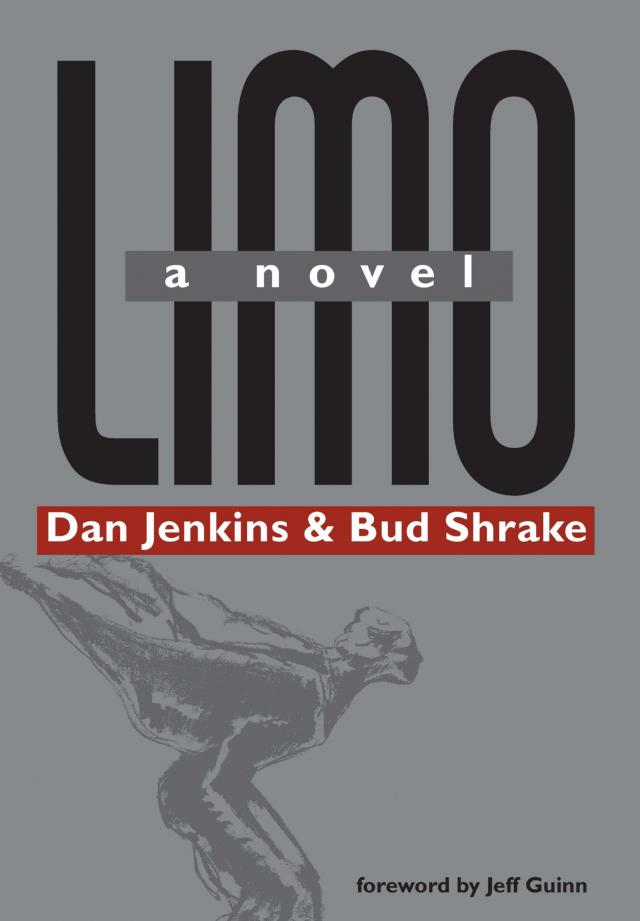
Limo
Limo
Dan Jenkins & Bud Shrake
A NOVEL
foreword by Jeff Guinn
Fort Worth,
Texas
Copyright © 1976 by Dan Jenkins and Edwin Shrake
Copyright © Renewed 2013 by Dan Jenkins and Ben Shrake
Library of Congress Cataloging-in-Publication Data
Jenkins, Dan.
Limo : a novel / by Dan Jenkins & Bud Shrake ; foreword by Jeff Guinn.
p. cm.
Reprint. Originally published by Atheneum in 1976.
ISBN 0-689-10734-X ((original)) -- ISBN 978-0-87565-550-5 ((tcu-new) : alk. paper)
1. Television broadcasting--Fiction. I. Shrake, Edwin. II. Title.
PS3560.E48L55 2013
813'.54--dc23
2013010080
TCU Press
P.O. Box 298300
Fort Worth, Texas 76129
817.257.7822
www.prs.tcu.edu
To order books: 800.826.8911
Designed by
Barbara Mathews Whitehead
ISBN 978-0-87565-551-2 (e-book)
Foreword
BACK IN 1976, when a new hardcover book still cost $8.95, Dan Jenkins and Bud Shrake published a very funny book and invented reality TV.
Limo was intended to satirize the then-modern state of television, which in real life consisted mostly of three networks (NBC, CBS, ABC) and, in the Jenkins/Shrake fictional world, a fourth, CBC, the acronym of Chambers Broadcasting Company. Compared to the Big Three, CBC was presented by the authors as the Little Fourth, dragging in prime time ratings and apparently destined to stay that way despite the best efforts of veteran news producer Frank Mallory, hired as the CBC vice president of entertainment and now responsible for luring audiences to his network with a variety of new programming. Unfortunately for Frank, there’s still the matter of sure-loser shows already purchased by his predecessor (Satan Takes a Bride, anyone?) and arch-enemy Herb Grant, a hall-of-fame quality suck-up who too often has the ear of Harley O. Chambers, CBC’s eccentric founder. Beyond this basic plot, Jenkins and Shrake tossed in acerbic social commentary on marriage, child rearing, jogging, dating, hedonistic celebrities at play, and swanky restaurants serving culinary artwork rather than edible food. As two of the best writers anywhere, and as old and dear friends who seamlessly traded off responsibility from one chapter to the next, they put together a novel that entertained on every page and was well worth nearly nine bucks in a time when ten dollars would fill up your gas tank twice.
But Jenkins and Shrake did more than that. Through a combination of writing excellence and keen insight into potential cultural lurchings, they predicted television’s future. Halfway through chapter three, Harley O. Chambers summons his top executives to a country club lunch and announces, “Little people need to see little people on television . . . just wonderful American people, doing whatever they do. We don’t want to interrupt them with interviews. We shall simply chronicle their adventures . . .”
Chambers dubs this mandated three-hour, live prime time special Just Up the Street; Frank Mallory is ordered to make it happen fast. And, over the next 270 or so pages, a new television genre is born, more than twenty years before Survivor or Big Brother were twinkles in any real-life TV producer’s eye.
The scary thing is how right Jenkins and Shrake get it, from the recruitment of “typical” families to the necessity of pushing their amateur stars into the kinds of situations that will inevitably result in hysteria, screaming, tears, and hopefully a little gratuitous near-nudity. The pages describing the live Just Up the Street broadcast are nothing short of magical. Even if you’ve been periodically savoring Limo since 1976, you’ll still hurt yourself laughing, because when they’re on (and here, are they ever!), nobody writes funnier than Dan Jenkins and Bud Shrake. But beyond that, you’ll marvel at how virtually every human frailty is collectively exposed onscreen courtesy of the Getzes in Rochester, the Perrys in Akron, the Skidmores in Washington, DC, and the Roccos in Tampa. This chunk of Limo proves that slapstick and intelligence really do exist in tandem beyond those old Marx Brothers movies. There’s never been better sustained comedic writing anywhere.
Which is why you need to read Limo and make all your friends do the same. It’s a classic in the best sense, a simultaneous time capsule and glimpse into the future. This new edition from TCU Press costs more than $8.95, but brilliance at almost any price is a bargain all the same. Bud Shrake is gone now, and Dan Jenkins sometimes feels a bit creaky, but the book they wrote in 1976 has a new, deserving literary life. Maybe you missed it the first time; don’t make the same mistake now.
Jeff Guinn
Fort Worth, Texas
PART ONE
1.
IT WAS A HOT STICKY NIGHT in Barcelona and all the good whores had the summer flu.
That’s how I always thought the memoirs would begin. And after a lot of splendid things had happened to me over the years, mostly in wars and journalism and fucking, the book would end with Claudine or Inga walking back into this bar on the rainy side of some desolate Pacific island and apologizing for the Bolivian smuggler she had lent her soul to, and saying, “It’s you, after all, Frank. It’s you, Cairo, Tangier, that little sidewalk cafe in Crans-sur-Sierre, and your crazy jeep careening down a dirt slope in another African border skirmish. Vodka tonic, darling. And just hold me for a moment.”
I could start that way now, of course, although I have managed to get involved in such things as television and families and analysts and love instead of real life. But maybe the only way I can begin to tell you about it—about all of those piercing, lurid months that changed prime-time TV into something a little bit wonderful, and changed the irritable but Christlike Frank Mallory into a more worthy human being—is to say that it all probably started when my wife gave me a lawyer for my birthday.
Most men find leaving home difficult, I think. Even though you may have discovered that your wife can throw a down-and-in from the bedroom to the fireplace with a jar of Elizabeth Arden’s moisturizer, you stay trapped in the slush of good memories.
When you visualize leaving it always comes out the same. The wife and kids will stand there crying in the entrance hall while you try to cram the loafers and cashmeres into the golf bag with three or four suede jackets draped around your shoulders at once.
Maybe you’ve got some of your favorite stereo albums under your arm, and you’re juggling the basketball autographed by the 1970 Knicks. Some guys give it up right there because of the tears. Or because they make the mistake of taking one last glance at the old leather chair in the den.
Others might get as far as the front lawn. And then they think about something vastly more sentimental: what the savings books will look like after the lawyers have folded them into party hats.
I did not, incidentally, unwrap a package on the morning of my forty-first birthday and find an actual person with a briefcase and a court order standing inside of it. What I found was a card from my wife Marcie. I found it on the butcher-block table in the kitchen of our warm and comforting home in Pelham Manor, New York.
I was alone that morning in October. The kids had done their poached eggs and gone off to their private schools to avoid the heroin addiction which Marcie felt was sweeping Westchester County.
Marcie was at the analyst’s again, trying to find out why I was ambitious.
I was stumbling around recovering from another Scotch-and-argument hangover, hoping to hit the coffee mug with a spoonful of instant Taster’s Choice, when I saw the envelope.
The card was yellow and pink with a picture of a bowl of flowers on it. The sentiment was printed in rhyming script. It was the kind of card you would mail to an aunt who had never been altogether civil to you. Marcie had rewritten the last two lines, so that it now read:
What a joy to know someone
Who’s always been the kind
To offer me a helping hand
Or hear what’s on my mind
For all of this, a birthday gift
It’s more than just a whim
I’ll pay for your half of our divorce
To Phillips Nizer Benjamin & Krim.
A total collapse of meter, I thought, sitting there at the table.
The fact is, I probably would not have left home that day if it hadn’t been for my friend D. Wayne Cooper.
Cooper had driven up from the city to Pelham Manor in the limousine the company provided for me. That wasn’t unusual; it was Cooper’s job. To look after me—the network biggie—and also to look after our silver Rolls limo.
D. Wayne Cooper was an old pal from Texas. He had done a bit of everything in his day, and a good deal of it in truck stops and honkytonks, I’d say. I hired Cooper during the summer, right after I accepted the new job, which made it possible for me to afford him. Cooper was my driver, my personal appointments secretary, and you could say my bodyguard, seeing as how I was in television. Mainly, he was my walk-around guy.
When Cooper came into the kitchen he didn’t ask for coffee or even a beer. He just looked at me for a second, turned, and went out. He started going through the rest of the house, gathering up things from the closets and drawers. My casual ensembles. My serious suits for the lunches at “21.” My handmade boots from Austin. And my wood-framed Wilson tennis racquet which put sting and mystery in my ground strokes.
Also, he sang.
“My front tracks are lookin’ for a cold-water well. . . . my back tracks are covered with snow. . . . Sometimes it’s heaven . . . Sometimes it’s hell . . . Sometimes I don’t even know.”
A country song could speak for D. Wayne Cooper almost anytime. Occasionally for me as well. Those Willie Nelson lyrics were Cooper’s idea of humor, given the circumstance.
Coming back to the kitchen, he said, “Getting’ your ass out of the house is my birthday present.”
I said something like I didn’t see how I could leave a cozy place like this, no matter how often I had threatened, or how worn out I was from hollering about the clouds that continually hovered over Pelham Manor.
“A poor man can,” Cooper said. “A man with a lot to lose stays on too long. Look at you, Frank. Did you wash your face with ketchup? You never been one to crave agony. 1 just saw Marcie down the road crying and looking terrible.”
Cooper picked up some pieces of bacon off a paper towel on a counter and wrapped them in a slice of white bread.
“You and Marcie don’t do nothing these days but try to destroy each other,” he said. “Who’d be the winner if that happened? You got one of them three-hundred-thousand-dollar-a-year jobs. At least you’ve got it until some sissy tricks you out of it. You can afford a di-vorce just like you don’t have nothing to lose but half interest in a refrigerator.”
I showed him the card but he didn’t laugh.
He said, “You got that Silver Goblet parked outside. It ain’t like you got nowhere to go. Like you’ve said yourself, you got too good of an apartment stashed in the city to let it sit there for nothing better than one or two nights a week of sneak-lovin’.”
D. Wayne Cooper had a way of getting it all down to where it belonged.
“Anyhow,” he said, “you ain’t been married to nobody but your work for twenty years. Shit. Give old Marcie a break.”
I left Marcie a note taped to her Panasonic blender, where she would be sure to see it. The note said:
Dear Marcie:
I’m moving into the city for a while so we can both try to think clearly about our lives. Explain it to Cindy and Frankie in whatever way you think is best. I’ll tell them my side of it later. I’m sure they not only will understand, but they might not even miss the sound of broken glass coming from our bedroom. Thanks for the lawyer. All I plan to tell him is that once you were a radiant light as you stood there on the dock, shining through the darkness that, in those days, was Lisbon. I love Jesus.
Frank.
About that job Cooper mentioned. I had the official title of Vice President, Entertainment, CBC-TV. I was in charge of prime-time programming for the Chambers Broadcasting Company, one of the four major networks.
Prime time is what they call those three hours of television entertainment—dramas, comedies, movies, specials—that come between the early evening local news, which tells you who’s winning what wars, and the late evening local news, which tells you how many firemen and cops were killed during the day.
Prime time is the hours of the evening—eight to eleven, to be general—during which the commercials cost the most money because the audiences are the biggest. Which is why prime time has so often been referred to as the “showcase” of a network.
It’s been said that the head of prime-time programming for a network doesn’t have any more power than the king of a medium-sized country. I, on the other hand, had always worked in TV news. So it was my opinion that most programmers in the quarter century of television’s existence had done little more than approve a pilot about a crippled orphan girl and her pet donkey.
The new job had brought with it a style of living that I thought was better and Marcie thought was gaudy. That I said was fun and she said was embarrassing. That I said was important and she said was irrelevant.
Not that Marcie ever refused to let the silver Rolls take her to Bendel’s and Bloomingdale’s. And not that she fought very hard to keep from taking advantage of the apartment in the city, which was big enough to put Richard III and the Coliseum Boat Show in at the same time. And not that she disapproved of what the salary boost did for her stature around the antique auctions.
It was just that I had stopped doing anything right a long time ago.
D. Wayne Cooper made sense as usual. It was time to move it on down the road, as he would say.
When the limo pulled away that day in the fall, I said to Cooper, “I know you’re right, D. Wayne, but it still hurts.”
“Yeah, I know,” he said. “Life’s a funny old dog, ain’t she?”
When a married man suddenly finds himself out on the street for one reason or another, he is obliged to fuck himself into a coma.
It is some kind of law they passed a while back.
My first few months full-time in the apartment on Park Avenue I obeyed the law. I don’t recall that it was all that much fun, especially with the fashion models. Cooper described my actions as purely human.
We did some remodeling in the apartment and created a suite for Cooper downstairs, but I don’t know that he did a very good job of body guarding, or why would I remember that some of the most joyous occasions were those days when I could wake up and not find a wine glass or a wig or a Wellesley graduate in the bed?
I have been leading up to a day in April, about six months after I left Pelham. I like to think back on it as the day God struck. I say God because I checked. Nobody else confessed.
It was a day when the career of Frank Mallory was going to get tossed up in the air so everybody at the network could run around with Hefty trash bags trying to catch pieces of it when it fluttered back into the music and laughter of Manhattan.
I speak of a fine spring morning, one of those days when the air quality would be acceptable to WCBC-TV, our local station.
The sunrays were shimmering white instead of filtered New Jersey green as they came through the sliding glass doors of my bedroom.
Without a headache, I would have wanted to go out on the terrace and look at the sights. At Central Park and the reservoir across to the west. To the city’s skyline posing for another Instamatic on my left. Or north and upstate past Harlem and Yankee Stadium toward the Marcies and station wagons of the world.
I was just crumpled up on the bed, trying to remember what last night was like, and maybe wondering if there might be another East Side contessa beside me, when I heard Cooper’s voice.
“Frank, you got to get with it. You got to meet the Big Guy up in Greenwich before noon,” Cooper said.
The Big Guy was Harley O. Chambers. Harley O. Chambers was the founder, chairman, monarch, and bat boy of the Chambers Corporation, which of course owned CBC-TV. The Big Guy owned most everything else you could think of on the financial pages.
I patted around on the sheets.
“You slept by yourself,” Cooper said. “Our last stop was Clarke’s. You went for a swim in the J&B. Sat with the usuals. And the mayor for a while.”
I opened one eye.
“After you solved all the problems of pollution and football, you did Cary Grant, Cagney, John Wayne. The mayor hadn’t heard you do ’em in months. Julia got pissed and split.”
I asked Cooper if there was any plausible reason why he hadn’t brought me straight home after dinner at Elaine’s, which was a restaurant where I went to watch heiresses eat fettuccini.
He said, “You fell in love with Julia, who you met at dinner.”
I said, “That girl I had a date with . . . Eloise? She didn’t want to go to Clarke’s?”
“Not with you and Julia,” Cooper said.
When he hit you with a sensible reply like that, Cooper had a way of grinning that barely parted his lips but caused dimples to appear on either side of his mouth like suck-holes in the sand. Cooper reached up with hands that had three silver-and-turquoise Navajo rings on them, and pushed back his hair to clear it away from his ears. His hair hung down a couple of inches past the collar of his Levi jacket.
The silver-and-turquoise rings were chipped and spotted with tooth marks, but not because Cooper chewed on them.
“As a matter of fact, Eloise compared you to some kind of turd that can only be found in Texas or Egypt,” Cooper said.
Cooper kept grinning and walked toward the bathroom in his pool hall slouch, with a hishi necklace bumping against his thin chest and bracelets sliding down his wrists. If you knew what to look for, you could see his right calf was thicker than his left. That was because he had what he called his Binniss, a .32 snubnose Smith & Wesson, stuffed into his right boot under the Levis. He carried his cash in the left boot.


