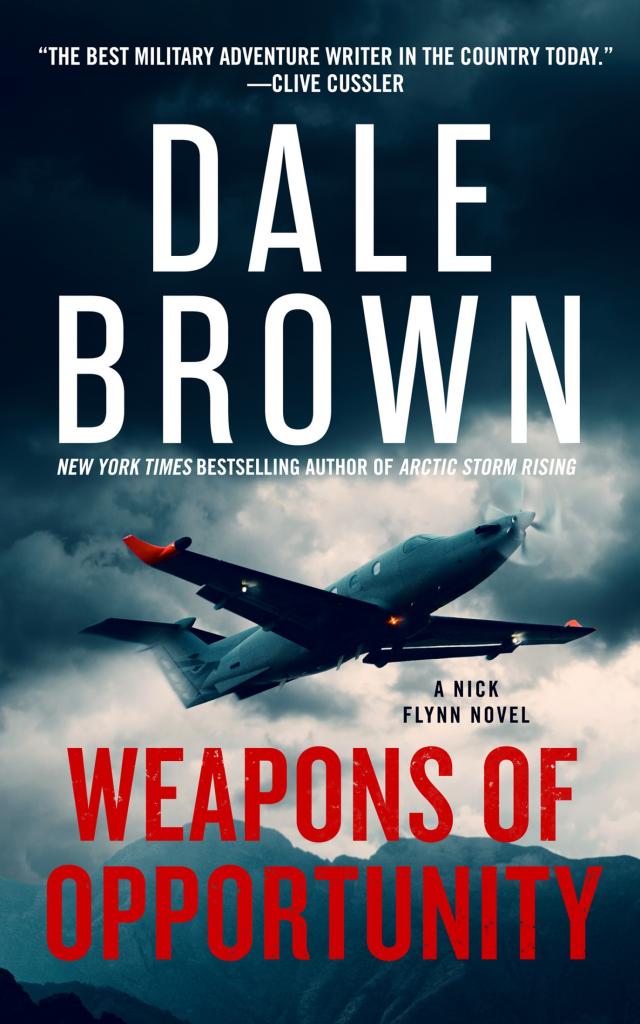
Weapons of Opportunity, page 1


Subscribe to our newsletter for title recommendations, giveaways and discounts reserved only for subscribers.
Join here.
PRAISE FOR WEAPONS OF OPPORTUNITY
“Dale Brown, the undisputed master of military adventure, is back with a relentless thrill ride . . . A spellbinding tale packed with unforgettable characters and plot twists . . . it is not to be missed.”
—JOSHUA HOOD,
bestselling author of The Guardian and Robert Ludlum’s Treadstone series
“As Flynn cuts through his enemies like an A-10 on a gun run, Flynn shows us that not all USAF intel officers live on the golf course or in cyberspace with PowerPoint for a weapon. A high-flying thriller of the type we’ve come to expect from Dale Brown. Not to be missed!”
—MATTHEW BETLEY,
bestselling author of The Neighborhood
“Scorchingly paced . . . Fans will be pleased.”
—PUBLISHERS WEEKLY
“For readers who like their action sequences bursting with badass tech and intense skirmishes in an almost nonstop pacing, Weapons of Opportunity is an immensely satisfying story with all the elements of an extraordinary thriller.”
—BEST THRILLER BOOKS
BOOKS BY DALE BROWN
Weapons of Opportunity
Countdown to Midnight
Arctic Storm Rising
Eagle Station
The Kremlin Strike
The Moscow Offensive
Price of Duty
Iron Wolf
Starfire
Tiger’s Claw
A Time for Patriots
Executive Intent
Rogue Forces
Shadow Command
Strike Force
Edge of Battle
Act of War
Plan of Attack
Air Battle Force
Wings of Fire
Warrior Class
Battle Born
The Tin Man
Fatal Terrain
Shadows of Steel
Storming Heaven
Chains of Command
Night of the Hawk
Sky Masters
Hammerheads
Day of the Cheetah
Silver Tower
Flight of the Old Dog
Copyright © 2023 by Creative Arts and Sciences, LLC
E-book published in 2023 by Blackstone Publishing
Cover design by Alenka Vdovič Linaschke
All rights reserved. This book or any portion
thereof may not be reproduced or used in any manner
whatsoever without the express written permission
of the publisher except for the use of brief quotations
in a book review.
The characters and events in this book are fictitious.
Any similarity to real persons, living or dead, is coincidental
and not intended by the author.
Trade e-book ISBN 979-8-212-18836-4
Library e-book ISBN 979-8-212-18835-7
Fiction / Thrillers / Military
Blackstone Publishing
31 Mistletoe Rd.
Ashland, OR 97520
www.BlackstonePublishing.com
This novel is dedicated
to the ones who keep watching to keep us safe . . .
around the corner or around the world.
“To surprise the enemy is to defeat him.”
—Alexander Suvorov, eighteenth-century Russian general
“Madness is however an affliction which in war carries with it the advantage of surprise.”
—Winston Churchill
PROLOGUE
Tambov Military Airfield, Russia
November
Winter had come early to this part of Russia, four hundred kilometers southeast of Moscow. Snow drifted down out of the cloudy night sky, becoming a swirling curtain of dazzling white where it fell into the beams of the powerful lights ringing the airfield. Along the base’s western perimeter, a stand of bare-limbed birch trees faded from sight—obscured by the steadily increasing snowfall.
Several narrow-body jets were parked out on a wide apron just off the concrete runway. Fitted with the needle-shaped nose of the much-larger Tupolev Tu-160 sweptwing supersonic bomber, they were Tu-134UBLs—models of a 1960s-vintage civilian passenger plane converted to train bomber crews rotating through Tambov’s 1,449th Air Base. But these specialized training aircraft were dwarfed by the single enormous, four-engine airliner sitting on a taxiway not far away. Comparable to America’s Air Force One, this Ilyushin-96-300PU was Russian president Piotr Zhdanov’s personal transport.
Outside near the flight line, a handful of stern-faced bodyguards surrounded Zhdanov. He took a long drag from his cigarette and then irritably pitched it away across the tarmac. Its lit end glowed orange in the darkness for a brief moment before vanishing, extinguished by the falling snow. Much like any man’s life, in the end, he thought dourly. One brief flash of light and warmth and then oblivion for all eternity. His hard mouth tightened in a grimace. Despite his thick black coat and fur hat, he could feel the cold gnawing at his bones. The glory days when he could strut bare chested through freezing temperatures for propaganda videos were long gone. More and more, age and ill health were catching up to him.
Impatiently, Zhdanov turned to the much younger, immaculately dressed man at his side. “Well, Voronin?” he demanded. “Now can you tell me what’s so important that you’ve dragged me out here to the ass end of nowhere?”
In answer, Pavel Voronin first checked his watch before looking back down at Russia’s autocratic ruler. His well-mannered smile never reached his pale-gray eyes. “I’ve invited you here for a demonstration, Mr. President,” he said evenly.
Zhdanov snorted. “A demonstration of what? Frostbite?”
“The future,” Voronin answered, ignoring the older man’s show of ill temper. Although it was not widely known outside Russia, his shadowy company—Sindikat Vorona, the Raven Syndicate—supplied military and intelligence services, equipment, and expertise to the highest bidders among Moscow’s allies around the world. Aided by enormous wealth and utter ruthlessness, Voronin himself had risen through the ruling elite to become the president’s closest strategic adviser. Although he was nominally still only a private citizen, his influence over Zhdanov effectively made him the second-most-powerful man in the Russian state.
Zhdanov frowned. “Pavel, I’m in no mood for riddles—”
Suddenly, one of his bodyguards broke in. “Sir, we have to get you into cover! Right now!” He tapped at his radio earpiece. “The Tambov control tower reports defense radars have just picked up an unidentified aircraft at close range!”
Voronin’s smile widened a bit. “Relax,” he said. “This new arrival is no threat. Not to us, at least.” He nodded toward the southern end of the runway. “You see?” And as if in response, a pale-gray shape materialized out of the darkness—gliding downward through a vortex of whirling snow. Batwing configured, the mystery aircraft was roughly seven meters long, with a similar wingspan. That made it significantly smaller than most modern combat planes, considerably less than half the size of Russia’s Su-35 air superiority fighter, as an example.
The wheels of its retractable landing gear were already lowered and locked in place. The aircraft touched down gently and rolled toward them along the runway, slowing fast until it came to a full stop only meters away. Its single wing-buried turbofan spooled down with a muted, remarkably quiet whine.
Zhdanov stared at the mystery plane for a moment. Then he swung back to Voronin. “Where the devil did that thing come from?” he snapped, not bothering to hide his irritation at being kept both literally and figuratively in the dark about this surprise landing.
“This prototype aircraft took off two thousand kilometers to the east,” the younger man told him. “At a small airfield near Omsk.”
Zhdanov raised an eyebrow. “Omsk? Our armed forces don’t have a base there.”
“They do not,” Voronin agreed with a shrug. “But I do.” He nodded at the gray, batwing-shaped plane. “This new aircraft is the product of an intense development effort funded by my Raven Syndicate.” He smiled again. “Aided, of course, by advanced scientific and engineering research data obtained through other . . . less conventional . . . means.”
“Through espionage,” Zhdanov realized.
“Why spend years and hundreds of billions of rubles to reinvent what our enemies already have in their possession?” Voronin asked.
The president matched his wry expression. “Why, indeed.” His eyes narrowed. “And the point of all this effort and expense? What’s so special about this new plane of yours?”
“Among other things, the fact that it flew all the way here without being detected by a single one of our vaunted air defense radar systems,” Voronin answered. “Not, in fact, until the moment it lowered its gear for landing.”
Zhdanov nodded his understanding. “You’ve built a new stealth aircraft,” he said appreciatively, eyeing the lines of the aircraft’s carefully designed configuration. “Introduce me to your test pilot, Pavel. I will congratulate him.”
“There is no pilot,” Voronin said.
The older man stared at him. “This is a drone?”
“What our military calls an un manned combat aerial vehicle,” Voronin agreed. “A UCAV.”
Zhdanov snorted. “Ah, where would our generals be without their bullshit jargon?” He jerked a thumb at the plane. “So, does this new robotic flying machine of yours have a name? Or only a number?”
“We call it a Mora,” Voronin told him.
Studying the aircraft now flecked here and there by clumps of accumulating snow, Russia’s leader bared his teeth in an icy, predatory smile of his own. The name the younger man had given to his new weapon was highly appropriate. In Slavic mythology, a Mora was a night demon. Transforming itself into the thin, almost invisible shape of a piece of hair or straw, the demon could flit unnoticed through locked doors—and then drain the blood of its chosen victims.
Later, during the flight back to Moscow on Zhdanov’s plane, Voronin allowed himself a moment to savor the remarkable success of his bit of theater with the Mora drone. The serious risks he’d taken by approving this prototype’s first long-range, cross-country flight had paid off handsomely, greatly strengthening his clout. It was, he admitted inwardly, a triumph he had very badly needed. Months before, the unexpected and still-unexplained failure of a Raven Syndicate operation code-named midnight had infuriated the president, leaving Voronin momentarily vulnerable. Among Zhdanov’s inner circle, there were many old military men and politicians—cautious and cowardly relics of an earlier age—who envied and resented Voronin’s swift rise to power. Only the president’s awareness that none of them had even a fraction of Voronin’s aggressiveness, imagination, or daring had saved him from being cast aside. At the time, he’d assured Zhdanov that he had other weapons to use against the Americans. Tonight, he had made good on that promise.
His smartphone vibrated softly, alerting him to an urgent message from his top deputy, Vasily Kondakov, a former colonel in the GRU, Russia’s military intelligence service. He checked the screen. Ferrets report small signs of prey, Kondakov had written. Possible Langley connection makes endeavor highly risky. Request authorization to pursue further.
Voronin sat back in his seat to consider his response. Within days of midnight’s disastrous end, he had set agents in motion with orders to identify those responsible. Now, at last, after months wasted prowling down blind alleys, it seemed that his operatives had a solid lead, however tentative. And high time, too, he thought coldly. With the planning for another covert large-scale attack against the United States already underway, the Raven Syndicate could not afford to give its unknown enemies free rein. They must be tracked down, pinned, and marked for destruction with all possible speed.
Still, he thought uneasily, there was no denying that the possibility of CIA involvement came as an unpleasant surprise. Early on, he had firmly ruled out any idea that the bloated, risk-averse American intelligence organization headquartered in Langley, Virginia, could have played an active part in thwarting his previous operation. His mouth curled into a slight frown. Taking direct action against anyone connected to the CIA would not be at all popular with Moscow’s own official spy services, the SVR and the GRU. In general, they preferred waging their clandestine war with the West through proxies . . . leaving most of the real dirty work to other, deniable hands. That would go double for any potential “wet work”—killing—within the precincts of the US capital region.
Voronin’s smile returned. So be it. If it proved necessary, he would show the hidebound men who ran the SVR and GRU the value of swift, decisive action—even right in the enemy’s backyard. Swiftly, he typed in a single-word reply to Kondakov: Proceed.
ONE
Southwestern Virginia
Some Weeks Later
Nick Flynn crouched low behind the thick trunk of an old oak. His breath steamed in the air, visible in the wan winter sunlight filtering down through the trees carpeting this steep Appalachian hillside. Quickly, he checked the fire-mode selector on the short-barreled HK417 carbine he carried, making doubly sure it was set on semiauto. His Quartet Directorate action team had chosen the German-designed weapon because its 7.62mm rounds had better stopping power and armor penetration than NATO-standard 5.56mm bullets. But those same rounds were also bigger and heavier, so each rifle’s standard magazine only held twenty rounds instead of thirty. Going full auto could empty a whole magazine in seconds. And running low on ammo is not exactly a great plan in a combat situation, he thought wryly. Unless, of course, he intended to try beating an enemy to death with the HK’s polymer stock.
Flynn glanced right and saw a short, compact man wearing a mottled white-and-brown winter camouflage smock settle into cover behind a boulder roughly twenty yards away. Shannon Cooke, a tough, forceful ex–US Special Forces operator, was in position. Flynn held out an open palm, signaling Cooke to hold in place for now.
With a tight grin, the other man flashed him the OK sign.
Looking left, Flynn spotted Wade Vucovich, the second member of his team, going prone behind a tree trunk of his own. Vucovich, a former US Army soldier, acknowledged the hand signal and then sighted through the optic fitted to his own HK carbine—scanning the snowy, tree-studded slope rising above them.
A final quick check backward showed Cole Hynes in his assigned slot about twenty yards downhill. The broad-shouldered ex-soldier was ready to maneuver to either flank if they ran into trouble.
That left only the action team’s fifth man, Tadeusz Kossak. The Pole, a veteran of his own country’s elite Special Troops Command, was not anywhere in sight—exactly as planned. Flynn nodded to himself. So far, so good. They’d cleared the wooded valley behind them without taking any casualties, but it was high time they got moving again. While rushing headlong into a possible enemy ambush would be dumb, there was no way to complete this mission without pushing deeper into hostile country. Their final objective lay at the very top of this next piece of high ground.
He shot a quick flurry of hand signals to the others, alerting them to what he intended. Then, cautiously, he climbed back to his feet and moved forward with his HK carbine at the ready. On the left and right, Vucovich and Cooke did the same, paralleling his steady advance up the slope.
Snow crunched softly under Flynn’s boots. He winced a little at the noise. It sounded much louder against the hushed, frozen silence of these wooded hills and valleys. Growing up in sunny Central Texas, where serious winter weather was a rare event, wasn’t exactly the best training for sneaking around on icy ground. Then again, before he’d joined the highly secret Quartet Directorate, his last assignment as a captain in the US Air Force had been to a remote radar outpost above the Arctic Circle. And compared to the howling winds and subzero perpetual dark he’d fought through up there, this brisk trek through southwestern Virginia’s rugged backcountry was practically a stroll on some idyllic Caribbean beach.
With the HK tucked firmly against his shoulder, he swiveled from side to side as he climbed steadily, hunting for the slightest sign of movement or anything that looked at all out of place among the trees and snow-covered rock ledges ahead of him. He controlled his breathing. He needed to be able to hear even the tiniest sounds.
Twang.
Flynn spun left toward the noise and saw a man-sized shape bounce upward from behind a ledge less than ten yards away. He squeezed off two quick shots. Crack-crack. Two holes appeared dead center in the plywood target. The suppressor threaded to the end of his carbine dropped the sound of his shots to a decibel level his ears could handle without damage. Off to either flank, he could hear more gunfire as Cooke and Vucovich engaged pop-up targets of their own.
Suddenly, something flickered at the very outside edge of his peripheral vision. Holy shit. A target had remotely triggered up in one of the tall trees to his right rear, mimicking an enemy sniper concealed high among the thick, bare branches. Desperately, he swung around—knowing he wasn’t going to make it in time. If this were real, he would be dead.
Whaaap. The target shuddered, hit straight on by a high-powered .338 Lapua Magnum rifle round. A fraction of a second later, the distant sound of the shot echoed across the surrounding hills.
“Hostile down,” Flynn heard Kossak report coolly through his headset. He breathed out.