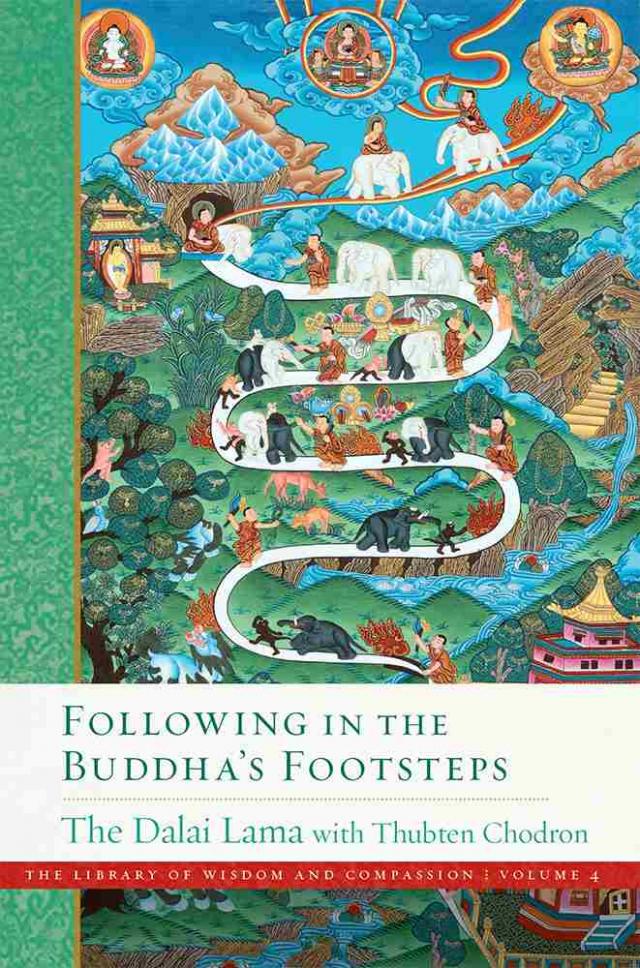
Following in the Buddha's Footsteps, page 1


THE LIBRARY OF WISDOM AND COMPASSION
The Library of Wisdom and Compassion is a special multivolume series in which His Holiness the Dalai Lama shares the Buddha’s teachings on the complete path to full awakening that he himself has practiced his entire life. The topics are arranged especially for people not born in Buddhist cultures and are peppered with the Dalai Lama’s unique outlook. Assisted by his long-term disciple, the American nun Thubten Chodron, the Dalai Lama sets the context for practicing the Buddha’s teachings in modern times and then unveils the path of wisdom and compassion that leads to a meaningful life, a sense of personal fulfillment, and full awakening. This series is an important bridge from introductory to profound topics for those seeking an in-depth explanation from a contemporary perspective.
Volumes:
1. Approaching the Buddhist Path
2. The Foundation of Buddhist Practice
3. Saṃsāra, Nirvāṇa, and Buddha Nature
4. Following in the Buddha’s Footsteps
More volumes to come!
“This authoritative volume serves as a rich source of information on two major themes — the bases of Buddhist faith and the framework of Buddhist training — each viewed from the two complementary perspectives of the Pali tradition and the Indo-Tibetan tradition.”
— BHIKKHU BODHI, scholar-monk and translator of Pali texts
Delve into the substance of spiritual practice in this fourth volume of the Dalai Lama’s definitive series on the path to awakening, Following in the Buddha’s Footsteps. You’ll first hear His Holiness’s explanation of the Buddha, Dharma, and Sangha, why they are reliable guides on the path, and how to relate to them. His Holiness then describes the three essential trainings common to all Buddhist traditions: the higher trainings in ethical conduct, concentration, and wisdom. These chapters show us how to live a life free of harm to self or others and give us detailed instructions on how to develop single-pointed concentration as well as the higher states of concentration available to an earnest practitioner. In addition, the chapters on wisdom contain in-depth teachings on the noble eightfold path and the four establishments of mindfulness for developing greater awareness and understanding of our body, feelings, mind, and other phenomena. Together, these topics form the core of Buddhist practice.
This is a book to treasure and refer to repeatedly as you begin the path, progress on it, and near the final goal of nirvāṇa.
“Following in the Buddha’s Footsteps clearly lays out how to take the journey to exploring and developing our mind’s highest potential, following the Buddha as the unmistaken qualified guide who discovered the unmistaken qualified path all the way up to the final destination: enlightenment. The chapters in this book are logical, historically accurate, in-depth instructions and directions on how to skillfully and diligently create a meaningful Dharma practice.”
— JETSUNMA TENZIN PALMO,
founding abbess of Dongyu Gatsal Ling Nunnery
PUBLISHER’S ACKNOWLEDGMENT
The publisher gratefully acknowledges the generous help of the Hershey Family Foundation in sponsoring the production of this book.
Contents
Preface by Bhikṣuṇī Thubten Chodron
Abbreviations
1. TRUSTWORTHY SPIRITUAL GUIDANCE
The Entrance to the Buddhist Path
Reasons for Taking Refuge in the Three Jewels
The Mind’s Potential and the Existence of the Three Jewels
The Three Jewels according to the Fundamental Vehicle
The Three Jewels according to the Perfection Vehicle
Eight Excellent Qualities of the Buddha Jewel
Eight Excellent Qualities of the Dharma Jewel
Eight Excellent Qualities of the Saṅgha Jewel
Final and Provisional Refuges
The Three Jewels according to the Vajra Vehicle
2. QUALITIES OF THE BUDDHA, DHARMA, AND SAṄGHA
The Four Kinds of Self-Confidence
The Ten Powers of the Tathāgata
The Eighteen Unique Qualities of a Buddha
Qualities of the Buddha’s Body, Speech, and Mind
The Buddha as a Reliable Guide
Recollection of the Buddha, Dharma, and Saṅgha
Distinguishing Features of the Three Jewels
Causal and Resultant Refuge
3. HEARTFELT CONNECTION TO THE THREE JEWELS
Formally Taking Refuge
Deepening Our Refuge
Maintaining Proper Refuge
Bodhisattvas’ Refuge
4. THE HIGHER TRAINING IN ETHICAL CONDUCT
The Three Higher Trainings
The Importance of Ethical Conduct
The Prātimokṣa Ethical Code
Vinaya Schools
The Benefits of Practicing the Prātimokṣa Ethical Conduct
Intoxicants
Why Celibacy?
Bodhisattva and Tantric Ethical Codes
Making Mistakes and Rectifying Them
5. SAṄGHA: THE MONASTIC COMMUNITY
The Value of the Monastic Community
The Flourishing of the Dharma and the Existence of the Dharma
The Intent and Purpose of Monastic Life
Maintaining the Purity of the Saṅgha
Tibetan Monastics and Monastic Institutions
Challenges for Western Monastics
Full Ordination for Women
Advice for Monastics
The Joy of Monastic Discipline
6. THE HIGHER TRAINING IN CONCENTRATION AND THE PERFECTION OF MEDITATIVE STABILITY
Concentration and Serenity
The Importance of Developing Serenity
Conditions Conducive to the Development of Serenity
Observed Objects
Choosing Our Meditation Object
Structuring the Meditation Session
Working with the Body
7. OBSTACLES AND ANTIDOTES
The Five Hindrances
Taming the Five Hindrances
Overcoming Hindrances
The Five Faults and Eight Antidotes
The Nine Stages of Sustained Attention
Mental and Physical Pliancy and the Bliss of Physical and Mental Pliancy
A Diagram Illustrating the Process of Attaining Serenity
8. THE MEDITATIVE ABSORPTIONS
Cultivating Mundane Insight
Meditative Absorptions of the Form Realm
Meditative Absorptions of the Formless Realm
Meditative Absorptions on the Four Truths
The Eight Liberations
The Nine Serial Absorptions
The Superknowledges
The Value of the Superknowledges for Bodhisattvas
Serenity in Buddhist Practice
Words of Advice
9. CONCENTRATION IN THE PĀLI TRADITION
Objects of Meditation
The Four Dhyānas
The Four Formless Absorptions
Four Kinds of Development of Samādhi
Samādhi and Insight
10. THE PRACTICE OF SERENITY IN CHINESE BUDDHISM
Meditation
Creating Balance at the Beginning and End of a Meditation Session
Cultivating Serenity and Insight in Sitting Meditation
Cultivating Serenity and Insight while Interacting with the Environment
Deviant Meditation and Correct Meditation
Counteracting the Work of Māra
11. HIGHER TRAINING IN WISDOM: THE ROLE OF MINDFULNESS AND INTROSPECTIVE AWARENESS
Introduction to the Thirty-Seven Harmonies with Awakening
The Importance of Mindfulness and Introspective Awareness
Mindfulness
Introspective Awareness
Mindfulness and Introspective Awareness Working in Tandem
Mindfulness in Modernity
The Thirty-Seven Harmonies with Awakening
12. THE FOUR ESTABLISHMENTS OF MINDFULNESS: BODY, FEELINGS, AND MIND
Introduction to the Four Establishments of Mindfulness
Shared and Specific Characteristics
Mindfulness of the Body (kāyasmṛti, kāyagatāsati)
Mindfulness of Feelings
Mindfulness of the Mind
13. THE FOUR ESTABLISHMENTS OF MINDFULNESS: PHENOMENA
Mindfulness of Phenomena
Mindfulness of the Five Hindrances
Mindfulness of the Five Aggregates
Mindfulness of the Six Sources
Mindfulness of the Seven Awakening Factors
Mindfulness of the Four Truths
Mindfulness in Vajrayāna
Bodhisattvas’ Practice of the Four Establishments of Mindfulness
The Selflessness of Phenomena and the Four Establishments of Mindfulness
The Benefits of the Four Establishments of Mindfulness
14. THE THIRTY-SEVEN HARMONIES WITH AWAKENING
The Four Supreme Strivings
The Four Bases of Spiritual Power
The Five Faculties and Five Powers
The Seven Awakening Factors
The Āryas’ Eightfold Path
Relationships among the Thirty-Seven Harmonies with Awakening
The Thirty-Seven Harmonies and the Five Paths
Conventional and Ultimate Thirty-Seven Harmonies
The Thirty-Seven Harmonies for Fundamental Vehicle and Mahāyāna Practitioners
The Thirty-Seven Harmonies in Tibetan Budd hism
Notes
Glossary
Further Reading
Index
About the Authors
Preface
ALTHOUGH EACH VOLUME of the Library of Wisdom and Compassion can be read separately, the topics in them are arranged in a particular sequence so that each subsequent volume builds on the preceding one. The first volume, Approaching the Buddhist Path, and part of the second volume, The Foundation of Buddhist Practice, contain introductory topics that are helpful to know before engaging in further study. Calling them introductory doesn’t mean they are elementary or easy; rather they are the basis of what will follow.
The second volume then continues, speaking about precious human life, its rarity and value, and urging us to take advantage of the opportunity it affords, since our lives are comparatively short and we will be reborn. Because effects arise from their causes, our future lives will depend on the causes we create now — our karma or actions. An extensive explanation of karma and its effects concludes this volume.
Volume 3, Saṃsāra, Nirvāṇa, and Buddha Nature, contains an in-depth discussion of the cycle of constantly recurring rebirth in which we are bound under the control of ignorance, afflictions, and polluted karma. It investigates buddha nature — the nature of our minds that provides the potential to become fully awakened buddhas.
That brings us to this fourth volume, Following in the Buddha’s Footsteps, which begins with the topic of turning to the Three Jewels — the Buddha, Dharma, and Saṅgha — for spiritual guidance. Taking refuge in the Three Jewels is the mark of becoming a Buddhist, and the guidance the Buddha gives us is to practice the three higher trainings in ethical conduct, concentration, and wisdom.
In most presentations of the lamrim (stages of the path), which were written for Tibetans who were already Buddhists, the topic of refuge comes earlier — after considering our possible future rebirths. This occurs for two reasons. First, refuge is the initial protective measure enabling us to avoid unfortunate rebirths. Second, increasing our faith and trust in the Buddha facilitates our understanding and practice of the law of karma and its effects. This is because we depend on the Buddha’s word to understand the subtle and obscure aspects of karma and its effects.
My observation — and that of many fellow Western Dharma students — is that people who did not grow up Buddhist are eager to learn about karma and its results but need more time to understand the meaning of taking refuge in the Three Jewels. We want to understand clearly what are the Three Jewels and what are the advantages and meaning of taking refuge in them. For this reason, the explanation of refuge in this volume is fuller than in most lamrim texts. It includes Dharmakīrti’s argument on why the Buddha is a reliable teacher and Maitreya’s explanation of how the Buddha, Dharma, and Saṅgha individually and together guide us on the path to liberation and full awakening.
In volume 3, we discussed the āryas’ four truths. The last two, true cessations and true paths, are the Dharma Jewel. The Dharma Jewel is the actual refuge, for when generated in our mindstream, awakening dawns. By actualizing a portion of true cessations and true paths, we become the Saṅgha Jewel, and by realizing them fully, we are transformed into the Buddha Jewel. This is possible because the buddha nature is an inalienable quality of our mind. Our actualizing the Three Jewels is the fulfillment of our buddha nature, which has been completely purified and brought to perfection.
With this background, the present volume elaborates on the true cessations and true paths spoken of in volume 3 by beginning with a more in-depth explanation of the Three Jewels of refuge. The Dharma Jewel of true paths includes the āryas’ three higher trainings in ethical conduct, concentration, and wisdom, which are also revealed in this volume. Ethical conduct as practiced by monastics and lay followers comes first. Here we hear His Holiness’s love and respect for the Vinaya — monastic discipline — and for the monastic community and its role in preserving the Dharma. This is followed by instructions on how to cultivate meditative concentration, explained from the perspective of both the Sanskrit and Pāli traditions. While the lamrim usually discusses this in the context of the perfection of meditative stability, it makes sense to include it in the higher training in concentration so practitioners can begin to improve their concentration now. The higher training in wisdom comes next. Here we delve into the thirty-seven harmonies with awakening, practices found in both the Sanskrit and Pāli traditions. This volume is rich in teachings to practice that will definitely transform our minds.
How This Volume Came About
The Library of Wisdom and Compassion came about when I requested His Holiness to write a brief root text for Tibetan geshes and khenpos to use when teaching in the West. His Holiness said we should write the elaborate explanation first and gave me transcripts of his teachings to work from. Several series of interviews happened over the years. In 2006 His Holiness said that this series must be unique — it should not be a rewording of previous lamrim texts — and insisted that material from the Pāli and Chinese Buddhist traditions be added.
Why would someone who has spent his life studying and practicing the Sanskrit tradition as presented in Tibet want to encourage his students and those interested in Buddhism to learn the Pāli tradition and Chinese Buddhism? His Holiness is open-minded and sees all these teachings as coming from the same Teacher, the Buddha. He knows a fair bit about other Buddhist traditions and is strongly opposed to sectarianism. His wish is for all Buddhist traditions to cooperate, have fruitful exchanges, and work together for the betterment of the world. Since all Buddhist traditions are present in the West, this is especially important. While not ignoring the differences in presentation and emphasis, His Holiness wants us to enhance our Dharma practices by learning from one another.
Charging me with adding teachings from the Pāli tradition and Chinese Buddhism, he also insisted, contrary to my wishes, that the book be coauthored and gave me permission to alter the usual order of the topics to suit this audience: people who were not brought up Buddhist, as well as Asians — especially young Tibetans — with a modern education.
Having received bhikṣuṇī ordination in Taiwan, lived with Chinese Buddhists in Singapore, and gone on pilgrimage in Tibet, Mainland China, and Taiwan, I was familiar with Chinese Buddhists and knew scholars and practitioners who could teach me more. Fortunately I also knew many Theravāda Buddhists from my time in Singapore and from the annual Western Buddhist Monastic Gatherings in the United States. I spent some time studying and meditating at a wat in Thailand and diligently studied Bhikkhu Bodhi’s talks on the Majjhima Nikāya, reading portions of the Vinaya and the other nikāyas in the Pāli canon as well as supplementary material.
The journey into other Buddhist traditions enriched my practice tremendously. I came to have a deep appreciation for the Buddha’s skill as a teacher and the many ways he made the Dharma available so that living beings with different inclinations and interests could find what they needed in his teachings.
In 2018 I had another series of interviews with His Holiness, and I’d like to share a touching story that illustrates His Holiness’s compassion in teaching us. We were completing a long discussion on how bodhisattvas generate the meditative absorptions of the form and formless realms, when His Holiness said, “I don’t give a lot of thought to the meditative absorptions, though I would like to develop the capable preparation and use that to enter the path of preparation. I’m not expecting to attain buddhahood soon. Does that seem lazy? However, there are numerous buddhas in the ten directions, but do they come to help? As long as I have a polluted body, my wish is to serve sentient beings, and practically speaking, I can do that. I often contemplate Śāntideva’s verses (BCA 3.21, 10:55):
Just like the earth and space itself,
and all the other mighty elements,
for boundless multitudes of beings,
may I always be the ground of life, the source of varied sustenance.
For as long as space endures
and as long as living beings remain,
until then may I too abide
to dispel the misery of the world.”
How to Approach These Teachings
His Holiness’s teaching style is unique: he weaves easy-to-understand advice that relates to our daily life together with complex teachings that pertain to practitioners who have studied and practiced for many years (and lifetimes). In addition, Buddhist teachers in general don’t expect us to remember and understand everything the first or even second time we hear or read it. Rather, each time we study the same material new understandings are revealed because our mind has matured. So if some of the material seems difficult to understand or too advanced for your present level, keep going. Remember that you are “planting seeds” in your mindstream that will yield deeper and more precise understanding in the future.