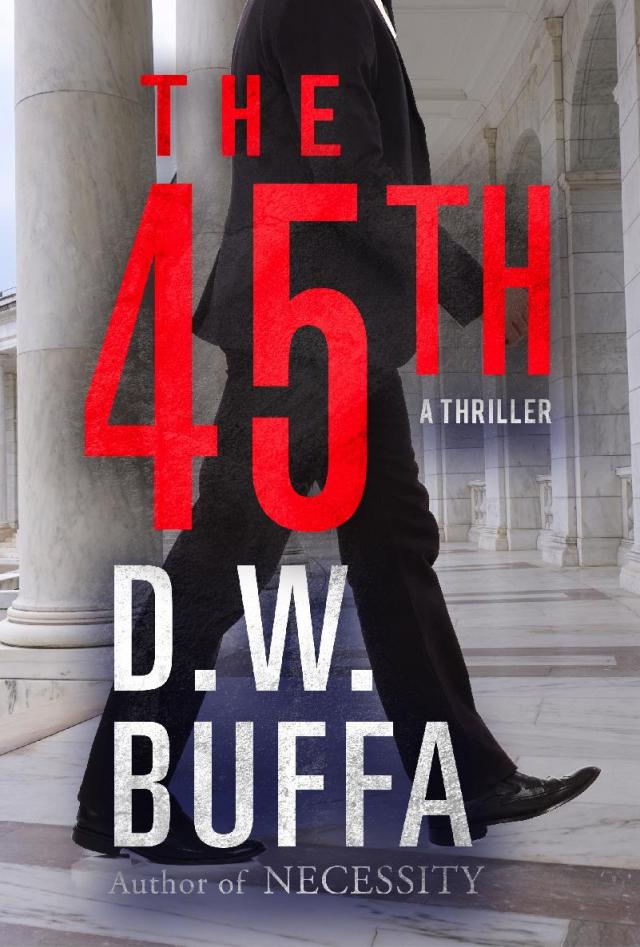
The 45th, page 7


“You said you had a way to reach Julian? Tell him I need him at the convention, but I want him here first – now, tomorrow… whenever he can get here. Tell him it’s important, and that I wouldn’t ask if it wasn’t.”
Chapter Six
Ismael Cooper was right. Julian Drake looked exactly as he had twelve years ago, only more so. It was almost uncanny. Everything Louis Matson had remembered about him seemed more vivid, every characteristic deeper and more pronounced.
“Julian!” he cried, as he jumped up from his chair and hurried across the long, rectangular room to greet him.
An inch or so shorter than Matson, and much slighter of build, Julian shook hands with surprising strength, and for just an instant Matson felt himself go cold. Julian Drake was a young man in vigorous good health, he was old man with little time left.
“The years…,” he started to say, but stopped himself with a laugh. “I should have followed your example and taken early retirement. But, what am I thinking! Come and tell me everything that’s happened.”
Matson sat on the far end of the leather sofa under the two windows that looked onto the street; Julian sat in an easy chair just next to it. Stretching his legs across the corner of the coffee table, Matson clasped his hands behind his head, and remarked, “If someone walked in here now, you in that gray pinstripe suit, white shirt and perfect striped tie, me in my tattered shoes and wrinkled shirt, they’d think you were the senator and I was some tired old press secretary listening to what you wanted me to put in some speech you wanted to give. Christ, Julian, you looked more like a senator your first day in the House than most of those clowns with their off-the-rack suits who had been here thirty years.”
Julian gazed at the carpets and the crystal chandelier, the ornate furnishings of the office that every majority leader for a hundred years had occupied. He got up and went over to the painting of the White House on fire in the War of 1812.
“We’ve been lucky,” he said, in a voice that to Matson’s ear had not changed at all, “lucky that it happened only once, foreign troops on our soil just that one time; lucky that, after that, the only battles fought here were those of our own Civil War.”
Matson sat up. “Lucky? – the Civil War?”
Julian Drake kept his eyes on the painting
“Not in all the lives lost, but in what happened. Without the Civil War we would have still had slavery; without the Civil War,” he continued, turning to Matson, “we would not have had Lincoln. And without Lincoln, without that example, I’m not sure we would have had anything.”
“Wouldn’t have had anything…? I’m not sure I understand.”
“That remarkable intelligence, the deep understanding - the nobility of his soul, to use an older expression – that made Lincoln the embodiment of the best of what freedom can mean. Lincoln gives everyone someone to look up to; he proves the possibility of greatness. He becomes the standard by which to judge everyone who claims the ability, much less the right, to lead.” A smile drifted across the fine, straight line of Julian’s mouth. “Without Lincoln, we might not know what fools we are.”
Sinking back into the soft folds of the sofa, Matson bent his head to side as if to study him from a different perspective.
“And bigger fools every year. This place has become an echo chamber for all the insanity in the world.” Matson reached for the speech he had left on the table. “Which brings me to this.”
Julian shoved his hands into his pockets and grinned proudly.
“Is that what I’ve done? – Put all the insanity in the world into ten pages! I had not known I could be so concise.”
“You know damn well it’s a great speech. The question isn’t what you have written; the question is what will happen if I give it, whether anyone will understand it; the question,” he added with a raised eyebrow, “is whether I won’t be thought crazier than all the rest of them.”
Julian nodded slowly, and Matson had the impression that Julian had wondered the same thing himself.
“You could give this speech,” said Matson, holding it up in the air. “At least you could have, twelve years ago, when you were still in Congress. No one else could do what you did; no one else would have even known how to try. It’s a great speech, but I’m not a great speaker.”
Matson set the speech down on the table and hunched forward, resting his elbows on his knees.
“A few years ago, I saw something on television. Winston Churchill’s grandson had edited a volume of Churchill’s most important speeches. He was doing a reading in New York. I thought about you – it was the reason I watched: what you used to tell me about Churchill, how he learned to speak, how he had to memorize everything, thousands of words, before he spoke in Parliament. His grandson read from several speeches. The words were all majestic, words that once you heard them you could never forget, Winston Churchill’s words, but it was not Winston Churchill’s voice.” With a self-conscious laugh, he jabbed his finger at the speech that lay just beyond his reach. “I know I can’t give this speech, but it’s such a great speech - it says everything I want to say, everything that needs to be said - that I’ll be damned if I won’t do it anyway. ‘What fools we are.’ We are that, all right, and I may be the biggest one of all, but it doesn’t matter anymore. At least I know I’m not Lincoln.”
“No one is, but you’re closer than any of the others. But, tell me,” said Julian, coming back to the chair. “Ismael explained your dilemma. No one has a majority going into the convention. You must have seen that coming, and so you arranged things so that you would have the Michigan delegation and with that the balance of power. What is it you want to do? You wouldn’t be doing what you are doing unless you wanted the nomination to go to someone other than one of the major candidates.”
“That question would be easy, if you had spent the last twelve years in the senate.”
“After twelve years,” replied Julian with a quick, self-deprecating laugh, “there wouldn’t be anyone left I had not offended.”
“Maybe,” said Matson, with a long, pensive gaze; “but there also wouldn’t be anyone who did not have more respect for you than for anyone else in this place. I told you – do you remember? – that if you ran for the senate, it would not be the last office you would ever run for.”
“I have no regrets.”
“It’s true, what Ismael told me – the girl is in medical school, the boy is at Harvard? Your sister would have been proud of what you’ve done – and grateful, too. You asked what I was trying to do. I haven’t yet quite figured that out,” he said, with a sly grin. “I knew I couldn’t just do nothing: I couldn’t just let the nomination go to someone who has no right to be president. It isn’t a question of whether one of them could win. That is a lie. That is precisely the question, but not the way everyone else seems to think I mean it. If I didn’t think there was a chance one of them might win, I wouldn’t be so damn worried,” he remarked, with a gruff laugh. “Hillary could lose. She’s old, and she’s been around forever. And there is this other thing – I don’t mean her husband, his character, the life he leads, that whole business. No, something else. I could not quite put my finger on it before, but when I read that speech of yours -”
“Your speech,” insisted Julian, with a sparkle in his eye.
“The speech you wrote. She could never give it. It isn’t – what is the word I’m looking for? – careful, or better yet, cautious. You’re dealing in fundamentals; she’s never done anything but talk about the small details, changes at the edges of things. This speech – it’s like FDR talking about the New Deal! Give a speech like this – she’d win in a landslide. But she won’t; she can’t. She won’t say anything that might offend anyone who has not decided how they are going to vote. What she doesn’t understand is that the country is looking for something totally different from all these feeble half-step policies and politicians they have been forced to deal with the last twenty, thirty years. And that means that unless I can do something, someone may get the nomination who might get elected precisely because, not knowing any better, he convinces everyone that what the country really needs is a government whose only claim to govern is the promise that it will never try to govern anything.
“Which isn’t anything like what you would have me say in this speech of yours. Hell, I may get shot before I am halfway through it,” he said with a huge grin, as he got to his feet. He walked over to his desk and from one of the drawers pulled out a bottle of Scotch. “Join me?” he asked, as he started looking for a glass. “No? I forget, you don’t drink at all, do you? Still? Probably would have been better if I never had either,” he muttered, as he found the glass he was looking for and filled it halfway to the top. He came back, glass in hand, but instead of sitting down, pointed to the speech stacked neatly on the dark lacquered coffee table. “Best goddamn speech I ever read. Wish I could have written it – written something even half as good. What a goddamn waste,” he remarked, shaking his head, a baffled expression rising in his tired eyes. “I don’t mean what you did – I’d never question that; but that you had to, that you could not stay, that you couldn’t do what – I swear to God – I never knew anyone more perfect for.”
His gaze still on Julian, he took a long, slow drink.
“You really think I should do this? It will cause holy hell – which would be a good enough reason by itself.” He stared at Julian through narrowed eyes, pondering the thought that had not left him since the first time he had read what Julian had written. “I know from what Ismael told me that you don’t watch television, that the only news you get is the Sunday Times every month or so, but you had to have known that some of what is in that speech isn’t anything I’ve ever been known to support.”
“ I did not think you sent Ismael all the way out to Big Sur to find me just to write something anyone in Washington could do as well or better. It’s the keynote speech at the Republican Convention, a national audience. I did not know what you wanted to say about specific things; what policies, if any, you wanted to emphasize or support. All I could do was write the speech that, if I were in your position, I would want to give.”
“I wish to hell you were giving it. The damn thing is diabolical!” exclaimed Matson, with a sharp, deep-throated laugh. “Diabolical. I’m reading the damn thing, hearing your voice, the way I remembered it from the speeches you used to give, and I suddenly realized – too late, in a sense you’ll understand – that I’d been so swept up in what you’re saying – in what that speech is saying – that I did not even notice that half of what it says about what the country needs to do are things I never would have voted for. Now how do you explain that? – And you really think I ought to give it?”
It was Julian’s turn to laugh.
“No, unless you think that if we don’t do something, something like what I tried to suggest, things will just keep getting worse. I knew that, whatever you might think about it, you would take it seriously; I knew you never believed that America is the exception to all the rules of history and experience, that what worked two hundred years ago will still work today because nothing has changed. Nothing has changed, but not the way everyone seems to think,” he added, eager to make a distinction Matson was not sure he quite grasped. “But it’s your speech. It’s just a draft. You can do whatever you like with it.”
“Damn it, Julian; I wanted to give a great speech, and you’ve written one. The question,” he said with an almost fierce intensity, “is whether a great speech can be given by someone who is not great himself.”
Julian gave him a very odd look, disturbing in its implications.
“When you read it, you said you were carried along by it. That only happens if, in a sense, you take the speech inside yourself and make it your own.”
“But everyone who hears a great speech does that.”
“Yes, precisely; so the only question is whether, when you give it, when instead of listening you speak the words yourself, the words come from deep inside.”
“Some might say that is a conjurer’s trick, an actor speaking a writer’s lines.”
“Yes, but there aren’t many great actors,” remarked Julian. His eyes danced with a paradox that had just occurred to him. Staring down at the floor, a slight smile on his mouth, he thought through the various possibilities. “I read somewhere that the speaker does not give the speech, the speech gives him. I think what that means is that, as he speaks, the words begin to define who he is You can read history to the end of time, read all about what famous figures did, the battles they fought, the victories they won, but we don’t really feel we know them until we read what they said. Whatever you say in this speech of yours, it is what people will think you are.”
Julian looked at Matson as if to study his reaction, whether he was now convinced that he could give the speech Julian had written. Matson moved his head from side to side, like a fighter’s bob and weave, or a politician’s indecision. Another analogy leaped to Julian’s mind, and though it might have been thought arrogance in someone else, Louis Matson would not think it of him.
“She’s the best looking girl you’ve ever seen, but you’re afraid she’ll only laugh at you if you ask her out?”
Matson’s shoulders heaved up and his chest began to rumble. He broke into a harsh, caustic laugh, a laugh that was directed less at Julian than at himself.
“That’s close, all right; you’re right about the fear, the fear of making myself look a fool. But, I have to tell you, it’s not a fear that ever stopped me before. I wish it had. It was just the way you described it: the best looking girl I had ever seen. I was sure she’d never say yes, and maybe that was why I did it, thought it better to be a fool than a coward. So I asked her out, and to my astonishment she said yes, and then, before I knew it, I was married, and learned what real misery could be.” His exuberance dwindled into a jaundiced grin. “I’m the majority leader. Making a fool of myself goes with the job. If I don’t give that goddamn speech it won’t be because I’m afraid of what anyone else might say or think; it will be because…because it’s like what you just said: the best looking girl anyone has ever seen. Look at me: I’m a wreck. Would you want to take a picture of a beautiful woman with someone like me standing next to her? But, never mind, I may do it anyway; but maybe with a few changes. We can talk about that later. Besides helping me with the speech, there is something else you can do – if you don’t mind, I mean. Someone is coming over.”
He checked his watch, nodded to himself, tossed down what was left of the Scotch in his glass, and went back to his desk.
“I had a conversation the other evening. Wish you had been there to hear it. I knew it was going to happen at some point.” His tangled reddish gray eyebrows shot up, a signal that something of more than ordinary interest was going on, and that what had happened earlier was in some way connected with what was about to happen now. He pressed a button on the console. “Is he here…? The hell you say. The son of a bitch is late?” A wily look marched through Matson’s eyes. He looked across at Julian as he finished. “Let me know when he gets here.”
Matson sat down on the heavily creased leather chair behind his desk, but he could barely keep still. His eyes darted one way, than another; he looked up at the ceiling, he looked again at Julian. He looked as if he wanted to laugh.
“He asks to see me. He heard – everyone hears everything in this town – that I had a private meeting after the big dinner the other night, a private meeting where certain matters were discussed and, I’m sure he believes, decided. He wants me to know he knows; then he wants me to explain, to give him assurances, and then, once he has them, he wants me to do something that will give him the same kind of advantage he considers it unfair for the other guy to have. He asks to see me, but to make sure I don’t think he’s worried, or concerned, or angry, or ready to kill, he makes sure to come late; not too late – he doesn’t want me to think he’s rude or disrespectful – just a little late to show there is nothing urgent about it.” Suddenly, Matson smiled. “I can’t tell you how glad I am you’re here. If you didn’t think we were in trouble before, wait till you see this!”
Five minutes later, Matson’s secretary called on the private line. A moment later, the door opened and Donald Trump walked into the majority leader’s office, but Matson, instead of greeting him, was too wrapped up in conversation to notice that he had even entered the room. Trump was used to attention; he was not used to waiting. He was not sure what to do. He cleared his throat and regretted immediately what he had done. Irritated as much with himself as with Matson, he turned and started to leave.
“Donald! Come in, come in,” said Matson at his jovial best, as he shot to his feet and came to greet him. “You’ll have to forgive me,” he said, as he put his arm around his shoulder and escorted him the few short steps to the sofa. “This is Julian Drake. He has been helping me on the speech I have to give at the convention.”
Julian stood up and offered his hand. Trump took it, but barely, and without exchanging a word. He sat down at the far end of the sofa and began to tell Matson why he was there, but then he remembered, as if he had not noticed before, that they were not alone.
“But perhaps we could discuss this…..”
The smile on Matson’s rumpled face grew brighter, larger, really quite immense. This was even better than he had imagined.
“Julian doesn’t work for me; he isn’t on my – isn’t on anyone’s staff. Julian was once my colleague. He was in the House for a number of years,” he said, deliberately exaggerating the length of time Julian had served. “He would have been elected to the senate if…if he had decided to run.”