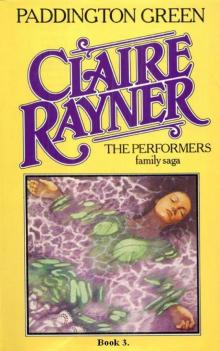
Paddington Green, page 14


Rupert sat still for a moment and then nodded, and William sat down, well content. He had done his part, and done it well; it was now up to Rupert to take over, as they had planned, to speak to these men in a way that would make them see, as clearly as he did, the necessity for changes to be made in the running of the hospital. And the necessity to deal with Abel Lackland.
Rupert remained very still for a moment longer, looking down at the table, and then he lifted his head and spoke in a very soft tone of voice, but one which carried a great deal of conviction.
‘Gentlemen, I will not hide from you the fact that this is a painful moment for me. And for my brother. We know our filial duty and would wish to discharge it as would any Christian gentleman. But we find, in all conscience, that we cannot go on as we are without apprising you of the facts.’
He stopped and looked round at them all, and they looked back. Damn him, William thought irritably. He has made them listen much better than I did. He looks so damned knowing—but he’s no better than I am! He shall discover that, for I’ll not let him ride me. Wait until my father’s dealt with and then I’ll show him—
‘—my experience of such matters is quite considerable,’ Rupert was saying. ‘Afflictions of the mind are many, and I have made it my business to develop an awareness of them. And I must tell you that it is my considered opinion as a medical man that my father is developing la folie de grandeur. He believes himself to be above all men’s touch. He believes that he knows better than any other how matters should be dealt with. He is convinced that none but he can choose what shall be done in this hospital. Despite, gentlemen, the fact that you are the persons meant to make the final decisions! You could put this behaviour down to mere—shall we say—self assurance. But I do not think it is this. I think he is moving into the condition of frank madness, when he will brook no opposition to his decisions. You have all, in your time, had your brushes with him, I believe, gentlemen—’
There was a silence. Cloudesly was sitting staring at the table, and William looked at him and wanted to grin. He remembered all too well the time his father had stood in this room and shouted at this tall thin man in such stentorian tones that he could be heard over half the hospital, about the need for spending more money on the beds and the linen; he remembered how his father had won that argument by the sheer weight of his personality, and he had no doubt that Cloudesly was remembering it too.
And on the other side of the table, Ross, who had been dismissed by Abel at one memorable Trustee’s meeting as a ‘narrow half-wit, not fit to run a brothel, never mind a hospital’; at Porteous, who Abel so despised that he never bothered to hide the fact and never addressed a word directly to him; at Buckle, who had been referred to by Abel in his hearing as ‘a bladder of lard, a glutton, and gormandizer who could not keep his mind, such as it was, above his belly’. Oh, they all had cause to treat Rupert’s account of Abel with seriousness. It would soothe many smarting wounds that Abel had inflicted over the years to regard him as not in full control of his wits.
‘Well? What would you have us do?’
William leaned forwards. ‘I would ask you to accept this money saved for you, and ask you to consider seriously whether we should not make every effort to save more in the self-same way—’
‘—and also to consider whether or not the time has come to send my father away from here, and with him his gutter patients,’ Rupert cut in, ‘and to look at Queen Eleanor’s in a new way, and plan to make it the sort of establishment I believe it could be. A more agreeable, successful and certainly financially rewarding one.’
It was Buckle who responded to that, staring at Rupert with his pale blue eyes narrowed. ‘How do you propose to do that?’ he wheezed huskily. ‘Make a hospital financially rewarding? Can’t be done!’
Rupert smiled that very sweet wide smile of his again and said softly, ‘Oh, Mr Buckle, I assure you it can! It should be a hospital for the better sort of person, you see. Not these poor useless hulks that fill the beds now, but decent citizens and householders.’
His smile widened even more. ‘People who will pay for their care and treatment, do you see. Who will be glad to have decent medical attention in a pleasant place, and will pay heavily for the privilege. It is an interesting idea, is it not? And only my father, I imagine, with his— peculiar passion for the most undeserving of the poor, will be stubborn enough and arrogant enough, in his incipient madness, to deny that fact.’
12
‘I cannot pretend I am entirely happy about it,’ Abby said. ‘No, do not look so put about, Henry. There are matters here of which you have no knowledge and you cannot understand my thinking. I am not complaining of your efforts to obtain this customer for us. Indeed, no, for I can quite see you would regard it as a most excellent piece of business—’
She looked across the room at Gideon, who was standing with his back to the glazed door, his coat held over his arm, and his glossy top hat in one hand, for he had arrived only moments after Henry had come bursting in with his news. ‘I am sure you understand, Gideon?’
‘I am not sure that I do,’ he said carefully, coming further into the room and setting his coat across the back of the armchair and his hat beside it before settling himself into his usual posture of legs-out-stretched comfort. ‘No—that is not fair. I understand, I believe. But do I sympathize? That is where I suspect we may disagree.’
‘I wish you’d tell me, Mrs Caspar, what this is all about,’ Henry said fretfully, and pushed his hair out of his eyes, and for the first time realized that he still had his hat on the back of his head, and snatched it off with his face reddening. It was difficult sometimes to remember that his employer was entitled to the courtesies that a gentleman usually paid to ladies, because he never really thought of her as a lady. But now, with this sudden exhibition of capriciousness, her sex was brought home to him with some force and for the first time in all the years he had worked for Caspar’s he found himself looking at her with a somewhat jaundiced gaze.
‘You must take pity on my foolishness, Mrs Caspar,’ he said now, and allowed an aggrieved note to creep into his voice. ‘For I must be foolish not to comprehend what the rub in our way might well be. I come in to tell you that I am well in the way of getting one of the biggest—indeed, positively the very biggest—order we have ever had, an order that could keep the whole manufactory going with no other customers at all unless I miss my bet, and instead of being hat over the moon, as I thought you would be, you tell me you are not happy! I must be foolish, indeed—’
‘Oh, Henry, of course you are not!’ she said, with a return of some of her usual crispness. ‘I told you, there are matters here you do not know of which colour my view of this order. And let us not get too excited, after all. You have not precisely brought in a definite order, have you? The man has only asked you for samples and a tariff.’
‘Only!’ Henry stared at her, and again pushed his hair out of his eyes. ‘Only, Mrs Caspar? How can you talk so? Don’t you know as we offer the most competitive prices of anyone? That there ain’t another apothecary anywhere that can compete with us? Indeed, you do me an injustice, ma’am, to imply I can’t get this order written firmly in my book before the week is out! Gettin’ Conran to ask me for the samples and prices was where the skill lay, if you’ll forgive my bumptiousness in saying as much! I’ve been angling for this contact this last three months! My old friend Matthew Hodgkin let drop to me that the hospital’s own manufactory was getting very expensive, and that Conran was getting notions about it all—reckoned the man that was running it was lining his pockets more than somewhat—and I’ve been nibbling away ever since. And now I come home with the bacon, and you say—’
‘Henry, do be quiet!’ Abby said wearily. ‘I have my own reasons for saying what I do and I do not think they concern you—’
‘I think you may be wrong there, Abby, if you will permit me to say so,’ Gideon said quietly. ‘You have made an arrangement to include Henry within the business on a commission basis. When you did but pay him a salary it was perhaps different. Now, when he enjoys a percentage of the goods he sells, he is entitled, I am sure you will agree, to know why you receive his best success with such scant pleasure.’
‘Thank you, Mr Henriques,’ Henry said, and turned to look for a chair, at last mollified enough to relax a little, and Abby too sat down behind her tall desk, and set her elbows on it and rested her chin on her hands and tried to think. There was a silence in the little room, broken only by the muffled rattle and thump from the machines outside and a faint hiss from the coals that burned in the little corner fireplace.
‘I will tell you the problem, Henry,’ she said abruptly, at last. ‘And I must ask you to keep your tongue between your teeth, because it is largely personal.’ She glanced up at Henry who was sitting very upright on the little wooden chair and looking at her with an expression of high expectancy on his round young face.
‘Do you know the name of the man who is in prime control of Queen Eleanor’s hospital?’
He looked mystified. ‘The man who runs it? Conran is the Bursar and controls the spending of money, and as I understand it he is answerable to Trustees—or—oh, do you mean the surgeon? Mr Lackland? Everyone knows Mr Lackland! Why, he founded the place— came over from Tavistock Street, so I’ve been told, when they rebuilt all round the Strand there—but know him—oh, no, Mrs Caspar, and glad I am to say that I don’t! No one in their right mind wants to know such a surgeon as him, except he can’t help himself. I deal with apothecaries—and the physicians sometimes—but not the surgeons. And that is how I like it. They’re a hard lot, surgeons. Let the instrument makers and the resurrectionists and their like deal with them and have joy of them, not honest apothecaries’ merchants, like us—’
‘He is also an apothecary,’ Abby said, almost absently, and then went on in an almost casual tone, ‘My name before I was wed was Abigail Lackland.’
Henry stared at her, frowning, and there was a short silence. Then he said uncertainly, ‘You, Mrs Caspar? A relation, then? Well, you don’t say so!’ He shook his head, grinned widely, and began to laugh. ‘D’you mean to tell me as I’ve been beating my head against that wall trying to get satisfaction out of that dried up Conran, when you could have gone and extracted the juice from the very top? Well, I’ll be—’
‘You find it amusing, Henry? Then you lack imagination,’ Abigail said crisply. ‘If I do not go to Mr Lackland, do you not think it is possibly because it would be—an—an embarrassment to do so?’
Henry sobered at once and stared at her, trying to rearrange his thoughts. As a much loved younger son in a large and very affectionate family of market gardeners (who took a great pride in Henry’s learning, for an apothecary’s assistant was a good cut above a mere radish grower) he had some difficulty in rearranging his view of family attachments and what was proper behaviour between relations; and his uncertainty returned. ‘He is a very distant connection, perhaps?’ he said carefully.
‘He is my father,’ Abby said quietly. Henry blinked and again shook his head in bewilderment, and then blurted out, ‘Your—father? Then why must you deal with business matters as you do? I understood you to be a helpless widow, with none to aid you, and this was why—I explained to my mother that was the reason when she was so—’ He suddenly flushed a deep crimson, the tide of colour rising in his face under his heavy yellow hair in a most ludicrous fashion, and Abby could not help but laugh.
‘Oh dear, Henry, did she worry and fret when you came to work for me? Fear you were in the hands of some wicked adventuress? Well, she was right to be so careful, for you are a charming young man of great gifts, and would indeed be interesting to such a one! I hope she is now more easy in her mind about you, after these past three years!’
‘Oh, indeed, yes, ma’am! I am sorry, ma’am—I meant no impertinence, none at all—’ Henry muttered, becoming more and more confused, and again Abby laughed softly and said, ‘I must explain a little more, I think. I hope you will understand. I was the oldest daughter of my parents, and grew up in—well, I was much in my father’s confidence. It was from him I learned what I know of the affairs of the apothecary’s trade, and it was in his shop in Piccadilly that I first learned the rudiments of working as I do on the book-keeping I now deal with here. He taught me much, in many ways, and gave me opportunities to use my own abilities for business that are usually denied to mere females. But my father and I parted bad friends when I was wed. It does happen, you must know, Henry, in many families. That it has not in yours, and that you have no experience of the bitterness and sadness that can ensue when parents and children lose affection for each other, is your good fortune—’
She stopped again and then went on painfully, ‘And I must say that we did not precisely lose affection for each other, my father and I. We—we were so very close through all my life for we have much in common in our characters, and understood each other well, and then James—and the pill-making machines, and—’
She was never to know quite what happened then. It was as though in some way her guard had been let down without her knowledge, that in talking to Henry and being so genuinely amused by his gauche yet charming confusion she had allowed her usually constant control over her deepest feelings to slip. For as she talked, she found the memories came seeping into her mind, first slowly, and then in a sudden great flood. She could see James in her mind’s eye, her James as he had been in those days of their strange and strained and yet so passionately happy courtship, could see his figure in all its dear detail in a way she had not been able to for many years. The reddish hair, the worried look that had always been on that pale face, the furrowed forehead bespeaking such concern and tenderness for her; all rose before her vision in knife-edged clarity, while behind him in that theatre of her mind stood Abel, his head bent and looking up at her from beneath his heavy dark brows with those narrow green eyes that she had known and loved so well, an expression of anger and pain and a curious yearning filling his face. And she closed her own eyes sharply, trying to banish those unasked-for visions, and shook her head and tried to speak again, but her voice was choked in her chest; to her own amazement and a curious helpless rage she felt the tears climb needle-sharp into her throat, come pushing against her clenched teeth, up and on, thrusting cruelly against her nose and tightly closed eyelids, until, for the first time, she was weeping, great sobs trying to escape her as she sat with her fists clenched on the desk before her, and tears forcing themselves through her lids to go coursing hot and salty down her cheeks.
It was as though a very small and coolly-collected Abby was sitting perched up in a corner of the room, looking down in unemotional curiosity at the figure sitting at the desk with sensible sleeves set over the cuffs of her grey gown, wrapped in her alpaca apron, her hair pulled into a neat soft knot at the nape of her neck and her face twisted into an ugly grimace as tears ran down the furrows in her soft flesh and her nose ran a little, like that of a child too miserable to know or care.
The little observing Abby high in the corner watched as Gideon stood up swiftly, opened the door and hustled out the bewildered Henry, thrusting his hat into his hand, then pulling across the door the little curtain of shabby sprigged cotton to close out the factory beyond the glazing.
He came back across the room then to where the real Abby sat still and tense, her fists clenched white-knuckled on the desk before her and making no attempt to dry her tears, for her arms were trembling so much it would not have been possible anyway.
He stood beside her for one brief moment, and then set his hand to the back of her chair and pulled it round, so that the desk no longer blockaded her away from him, and at this point the watching little Abby merged again with herself and she felt his hands, warm and very tender yet firm in their touch on both of her tightly-clenched fists and she heard his voice murmuring softly and very soothingly, although she could not recognize the words he used.
And then he was on his knees in front of her, had moved his hands so that he held each of her arms at the elbow, and gently he urged her forwards, until slowly and gently her rigidly-held back bent and then swayed and she let her neck relax too, until she was sitting there curled up in her chair but with his arms about her and her head resting on the rough fabric of his frock coat, weeping noisily and with the helpless misery of a heartbroken child.
How long they remained so she could not tell, for she abandoned herself to the luxury of her distress, letting the sounds of her crying pour from her to be muffled in his coat, but gradually the paroxysm passed its peak and then began to subside until she was sobbing gently against him, luxuriating, almost, in the feel of the cloth against her wet cheek, the smell of the damp serge and the sense of agreeable exhaustion that filled her chest and limbs.
He moved softly then, fumbling in his pocket with his right hand while still holding her close with his other arm, and then she felt his handkerchief, soft cambric smelling faintly of bay rum, against her face, and she sniffed, and obligingly he applied the handkerchief to her nose and said softly, ‘Blow!’ and she did and then, at last aware of herself, pulled away from him and sat up and scrubbed at her cheeks with the handkerchief and smoothed her hair with one still shaking hand.
‘I—please to forgive so shocking an exhibition, Gideon,’ she said huskily. ‘I cannot imagine—I do not know—perhaps I have been over-taken by some irritation of the nerves due to an impending disorder of some sort. A fever perhaps—I felt quite well this morning but—indeed, I cannot imagine—’ and she shook her head, and again blew her nose and looked very directly at him, difficult as it was to meet his eyes, for she was most ashamed of her outburst.