The Lonely Hour, page 1


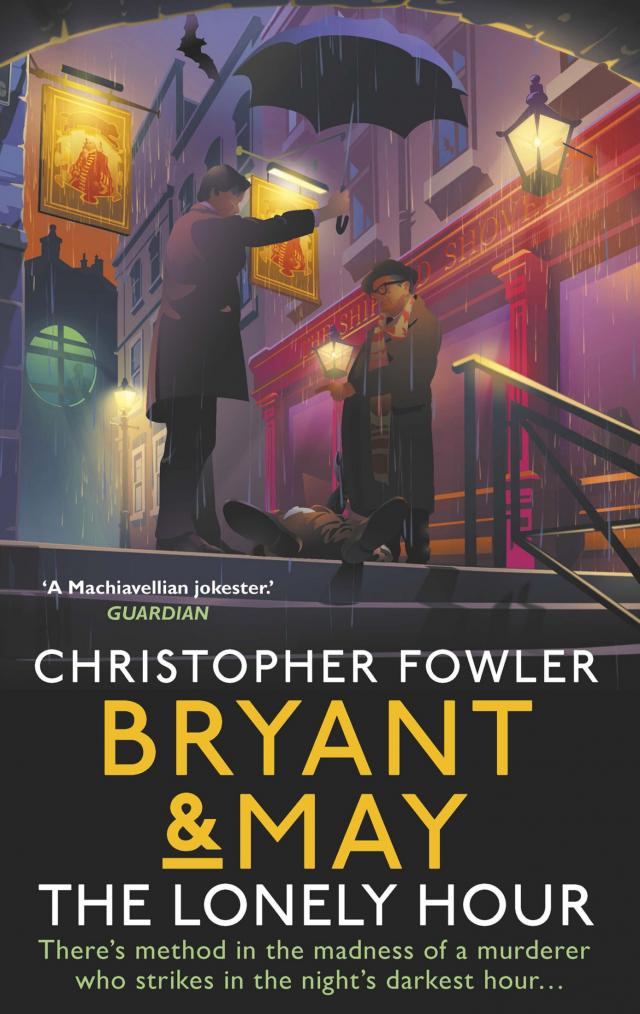
BRYANT & MAY
The Lonely Hour
* * *
CHRISTOPHER FOWLER
CONTENTS
1: BATS
2: REPORT
3: GUN
4: RITUAL
5: TEMPEST
6: COURT
7: RITE
8: HARUSPEX
9: RESCUE
10: WINDMILL
11: CORPSE
12: COFFEE
13: CONNECT
14: ALONE
15: BREAK
16: PURPOSE
17: HOME
18: PRIVACY
19: SHIFT
20: TEXT
21: NIGHT
22: PUNTER
23: SECRET
24: REMEMBERING
25: LATE
26: BLAZE
27: SCENARIO
28: BACKSTAGE
29: ADMISSION
30: CONTACT
31: WHITECHAPEL
32: WEALTHY
33: FLNEUR
34: CODICES
35: PAINTING
36: TANK
37: HOSPITAL
38: MISSING
39: SPY
40: SOLDIER
41: CLOSER
42: TOXIC
43: MEAT
44: BURGLARY
45: CORRUPTION
46: HOSTAGE
47: CHAT
48: ARREST
49: ENDING
50: NEXT
ACKNOWLEDGEMENTS
ABOUT THE AUTHOR
Christopher Fowler is the author of more than forty novels (sixteen of which feature the detectives Bryant and May and the Peculiar Crimes Unit) and many short story collections. A multiple award-winner, including the coveted CWA ‘Dagger in the Library’, Chris has also written screenplays, video games, graphic novels, audio plays and two acclaimed memoirs, Paperboy and Film Freak. His most recent non-fiction book is The Book of Forgotten Authors. Chris divides his time between London’s King’s Cross and Barcelona. You can find out more by visiting his website and following him on Twitter.
Also by Christopher Fowler,
featuring Bryant & May
FULL DARK HOUSE
THE WATER ROOM
SEVENTY-SEVEN CLOCKS
TEN-SECOND STAIRCASE
WHITE CORRIDOR
THE VICTORIA VANISHES
BRYANT & MAY ON THE LOOSE
BRYANT & MAY OFF THE RAILS
BRYANT & MAY AND THE MEMORY OF BLOOD
BRYANT & MAY AND THE INVISIBLE CODE
BRYANT & MAY – THE BLEEDING HEART
BRYANT & MAY – THE BURNING MAN
BRYANT & MAY – STRANGE TIDE
BRYANT & MAY – WILD CHAMBER
BRYANT & MAY – HALL OF MIRRORS
Short Stories
BRYANT & MAY – LONDON’S GLORY
Memoir
PAPERBOY
FILM FREAK
For more information on Christopher Fowler and his books, see his website at www.christopherfowler.co.uk
Twitter: Peculiar
For Darrell and Lesley, bon vivants
There are two places in the world where men can most effectively disappear – the city of London and the South Seas.
HERMAN MELVILLE
All the wonders lie within a stone’s throw of King’s Cross Station.
ARTHUR MACHEN
1
BATS
Script extract from Arthur Bryant’s ‘Peculiar London’ walking tour guide (Hampstead Heath, 2 hrs, sturdy shoes)
At night London is a sea of crimson eyes.
Look – you can see them everywhere. They peer down from the starless sky, clustered as tightly as pins on a map of the constellations. They mark the tops of the cranes that drift on the night currents and stalk the city like metal mantises, always with one red eye open to watch over the streets.
The cranes are a sure sign that whatever you’ve read or heard to the contrary, London is booming. London is always booming, because of where it is and what it was and what it has become, the sprawling home to nearly nine million people.
Ladies and gentlemen, my name is Mr Arthur Bryant and I will be your guide to the metropolis at night. Seen from up here on Hampstead Heath, London’s thoroughfares are as tangled as veins. Over there is the city’s heart, Piccadilly Circus, an electric sunburst that erases the diurnal cycle, its diodes banishing shadows and driving away miscreants. Who would have thought that the Piccadilly Commandos, those good-time girls who lurked by the arches on the north side of the circus, would be driven out by illuminated advertisements for hamburgers?
But look, a short distance away are patches as dark as lost pages of history. Hyde, Green, Regent’s, Battersea, the parks at night are absent from London’s map of light. We stand to the north of these, in the largest, darkest blank of all: Hampstead Heath.
The heath was once densely forested, the home to boar-hunting prehistoric tribes. The Romans drove a road through it, and those fearing the Black Death hid on it. In 1584 a great beacon was built to warn us if the Spanish Armada landed. An elm tree grew so huge here that inside it were forty-two steps leading to a viewing platform that held twenty observers. Whenever the end of the world was predicted, Londoners came to the heath. The Gordon Rioters headed here, but were diverted with free beer at the Spaniards Inn. Literary clubs met, duellists fought and a court of law was transferred here under canvas during the Great Plague, creating ‘Judges’ Walk’. To this day, the heath still hosts bank holiday fairs, and ‘Hampsteads’ are still rhyming slang for teeth.
The Ladies of the Night usually met at dusk on the paths into the heath. They came armed with infra-red cameras, motion detectors, glow sticks, notepads and hip-flasks of tea. In the winter they only met once a month because of reduced nocturnal activity. Tonight they were gathering at an unusually late hour because there was to be a cloudless sky and a full moon, and Pamela’s shift at the hospital didn’t finish until 2.00 a.m.
Matilda was the first there because she was early for everything. She volunteered for the local wildlife rescue service, which meant being willing to drive a hedgehog to an animal hospital at midnight, so this sort of activity seemed perfectly normal to her. Sparrow had yet to appear but could be heard crashing through the undergrowth from a hundred yards away. Pamela arrived with a sports bag on her back and an LED torch on her headband. She was their self-appointed leader because she was the oldest and the most experienced. She had lately become officious because life had started to disappoint her. Sparrow had a pretty face but nothing seemed to keep her weight off. Matilda meant well. All three wore black and kept their voices low, like secret agents on a night mission.
‘That must be Sparrow,’ said Pamela, listening to the crackle of dead branches heading their way. ‘She’s as blind as a you-know-what and not exactly light on her feet.’
‘Is it just the three of us?’ Matilda asked. ‘Where are the others? What happened to that woman with the alarming nose?’
‘No sense of commitment.’ Pamela set down her bag. ‘I don’t know why people sign up for things if they’re not going to see them through. Mrs Hardwick stopped coming without so much as a by-your-leave.’
‘She went into hospital,’ said Matilda.
‘She could have told me.’
‘She didn’t come out.’
‘Oh.’ Pamela was taken aback. ‘I didn’t know she was ill.’
‘She wasn’t. She took a beetroot salad in for a friend and got septicaemia from a trolley.’
Sparrow appeared beside them in a cascade of broken twigs. ‘Are we the only ones? I suppose it’s too late for most. They’ve no way of getting home.’ She brushed bits of bark from her bosom. ‘I came up that hill on my bike. I’ve got calves like concrete.’
‘What’s that funny smell?’ asked Pamela.
‘It’s probably me.’ Sparrow checked her bag. ‘I’ve got a veggie carbonara in a Tupperware but the lid’s loose.’
‘If we want to find a winter roost we should come at dusk,’ said Matilda. ‘It’s better when the colony is active.’
‘We already know where the colony is,’ Pamela explained. ‘We need to map out the roost sites. I know it’s late but you both said you didn’t mind coming along at any time of night. Sparrow, you couldn’t make more noise if you arrived in a JCB.’
Sparrow carded holly leaves from her hair. ‘I couldn’t help it. New contacts. I’ve got drops in. I lost the path.’
‘You didn’t have to create a new one. We’re not meant to disturb anything.’ Pamela shook her head. Ungainly and eager to please, Sparrow was less like a tiny bird than a Labrador that had been kept in a small flat for too long.
Pamela turned back to Matilda. ‘We have to submit our biodiversity action plan before the end of the week or we won’t be eligible for funding. The LBG will get it all.’
The London Bat Group worked tirelessly to protect the capital’s population of noctules, pipistrelles, serotines, Natterer’s and Daubenton’s bats, but there were many other rogue groups, of which the Ladies of the Night were one.
At least nine further organizations were scattered across Greater London from Osterley Park to Oxleas Wood, and their members could be extremely territorial. This group had started out as an excuse to get away from husbands, partners and children, but had evolved into charity work that included the organization of midnight walks, fun runs, swimathons and bat studies. Pamela was tireless, which made her exhausting.
‘It’s ever so late.â €™ Matilda looked in her backpack for something to drink. ‘I’m not normally up at this time. Don’t you miss your sleep?’
‘I’ve got insomnia.’ Sparrow made it sound like something you catch.
‘Do you know what Alfie told me this morning?’ said Pamela. ‘“The government should round up all the poor people and put them in camps.” I don’t know where he gets it from. He’s eleven and has the makings of a serial killer.’
‘He does have something of the night about him, doesn’t he?’ said Matilda unhelpfully. ‘I hope for your sake it’s just a phase. He’ll calm down once he’s learned to masturbate.’ She peered at her notes. ‘Tell me we’re not doing pipistrelles again.’ Pipistrelles were happy roosting in urban areas, under eaves and soffit boards, so they could be found in every part of the city, which somehow made them less interesting.
‘Do you never read your emails?’ Pamela swung her headlamp over.
‘There’s not much point in being out at this time of year at all,’ said Sparrow.
‘Why not?’ Matilda asked.
‘Hibernation. They spend six months asleep. We might as well be hunting tortoises.’
‘Tortoises don’t live in trees,’ said Matilda, confused.
‘Matilda, you know what I told you about thinking,’ Pamela reminded her. ‘We’ve got a Brandt’s bat. Tiny and very rare. There’s a clump of ash trees just this side of the water. We think it must be in there, but we don’t know for sure.’
‘Just the one?’ asked Matilda.
Pamela rolled her eyes. ‘How do I know? There was a sighting of a Brandt in the woodlands just before the ponds, and that’s why we’ve volunteered to search for its little home.’
Matilda persevered. ‘If it’s a single tiny bat how are we supposed to find its roost?’
‘They’re very distinctive. The whole point of coming this late is to ensure that we don’t disturb its flight pattern,’ Pamela explained as laboriously as possible. ‘I have a diagram.’ She unfolded a sheet of paper with an unedifying sketch at its centre showing a very big tree and a very small hole.
Matilda could remember when there were fifteen women in the group, ambling about in the golden summer dusk, but the bats were fewer now and the volunteer spotters felt they had better things to do than catalogue flying mice.
‘Have you noticed that when you drive to the seaside you don’t get insects all over your windscreen any more?’ she remarked. ‘That’s why the bats are disappearing. How do we even know it’s a Brandt’s?’
‘Somebody found a dead one,’ Pamela explained. ‘It was very old.’
‘So what?’
‘Brandt’s bats live longer than any other species, so there are a lot of interesting and useful things we can learn from them.’ Pamela had the ennui of a teacher explaining the appeal of a dead language. ‘What, Sparrow? You don’t have to raise your hand.’
‘Is it true that bats have sex upside down?’
‘Yes, and they can eat three thousand times a night, just like my husband.’ The others stared at her with incomprehension. Pamela wondered why she bothered. Faithful, hopeless Matilda understood nothing, Sparrow had the timidity of a recently assaulted cat, and neither of them got her jokes. ‘Come on, let’s spread out. Sparrow, I want you down near the lake. We’ll be finished before four.’
Sparrow stopped for a moment and released a heavy sigh. ‘You know, sometimes I think it’s marvellous that we’re helping to protect the urban biosphere but other times I think, you know, bats.’
The Ladies made their way along a ribbon of earth that cut between rowans and maples. The Brandt’s putative flight path had been marked on Pamela’s map. As soon as the three of them located the central woodland track they split up and staked out their territory. They passed other bat roosts in woodpecker holes and patches of rot. The Ladies’ mission involved jotting down any likely locations and matching them to flight paths. They could just as easily have done it by day, but Pamela was keen for them to present themselves on Instagram as the bad girls of the bat world. In some obscure way it made up for the timidity of her marriage.
After agreeing on a meeting time, the Ladies split up and headed in different directions.
Sparrow kept her torch low, watching out for molehills and rabbit holes. It was the new year, and she felt dyspeptic and exhausted. Christmas with her parents had weighed heavily upon her. The usual arguments had arrived with the familiarity of buses: why could she not settle in one job, why didn’t she try dieting again and, with grim inevitability, why had she not met somebody nice?
Unfortunately her last ‘somebody nice’ lived in Newcastle and would only see her if she went all the way up there every time. The relationship lasted until she told him she wasn’t paying another fortune to sit on a replacement bus service somewhere outside Darlington. He hadn’t seemed that bothered.
She dropped down on the stump of a diseased oak and watched the distant glistening pond. Clouds drifted apart like separating ice floes, revealing a moon the size of a dinner plate. Light washed across the grass, turning the slope into a luminous tide, as if the landscape was lit from within.
Something rustled through the long grass. An owl dropped from a lofty branch. There was a shrill squeak and a scrabble, and it flapped away with its furry prize.
Sparrow pulled the zip of her jacket higher. The air had a damp chill that could coat your bones. It smelled of loam, fungus and wet clay, a peculiar odour that always made her think of London bricks. Her grandmother had told her that the suburbs were once teeming with wildlife: stag beetles, juniper bugs, moles, grass snakes, hedgehogs and tortoiseshell butterflies, slowly killed off by cars and concrete. It felt right to do something that would help restore the natural balance, even just a little bit.
It was the kind of activity in which she had tried to involve her older brother. James was so bored by the world that nothing suited him. Friendless, jobless and finally homeless, he had returned from Goa to stay with her once again. She couldn’t manage many more late nights sitting on the floor with a bottle of cheap wine, listening to him explain what was wrong with the world while he made his art, which invariably consisted of obscenities scrawled across collages assembled from pornographic magazines. She had always been a night owl, but made a point of getting to bed before he unwrapped the little leather pouch that was never far from his side. There was no point in telling him to stop. He was a natural addict, and took to drugs like a duck to water. Lately he had started carelessly leaving evidence around the flat. The stuff was dangerous. She had to get him out, but where could he go?
She knew there was a Toblerone in her bag, and snapped off one piece after another until it was gone. She tried to identify the leaves picked out by her torchlight and failed. There was phantom rain in the trees, not quite dry, not truly wet, but every now and again the branches bent and released a fall of water. A temperate climate, her mother always said, that was why the Romans chose it. Family, she thought, they tell you anything just to make you stay where you are.
The light breeze was enough to make the trees whisper secrets. Her thoughts drifted. She went to a place she had never been, a hot, bright seashore with palms and turtles. She suspected she was snoring.
A holly bush rattled. Something shrieked and fell silent. She awoke with a start and checked her phone. A quarter to three. There was no sound from either Pamela or Matilda. They were both older, with dismissive husbands and difficult children. For them these expeditions were lifelines to sanity. Sparrow was an insomniac because she suffered from sleep apnoea, and the night hours weighed heavily on her without something to do.
She took out her field glasses and tried to identify the trees, but the night and the drizzle obscured everything. Pamela had marked out some possible roosting sites. By the light of the torch she drew a number of flight paths over the ponds, leading around a series of overgrown redbrick arches where moths, gnats and beetles could be found. Re-capping her pen, she left her notebook on top of the bag and poured a tea from her Thermos.
There was a new noise now. Something larger than a badger or even a deer. She dug out the carbonara and tried to get the lid off the Tupperware quietly. She couldn’t remember packing a fork. Another rustle. She set the container down. Perhaps it would be better to find the others and remain with them. The blanket of the dark removed contours. It was impossible to tell where things ended and began.