The Second Half of the Double Feature, page 1
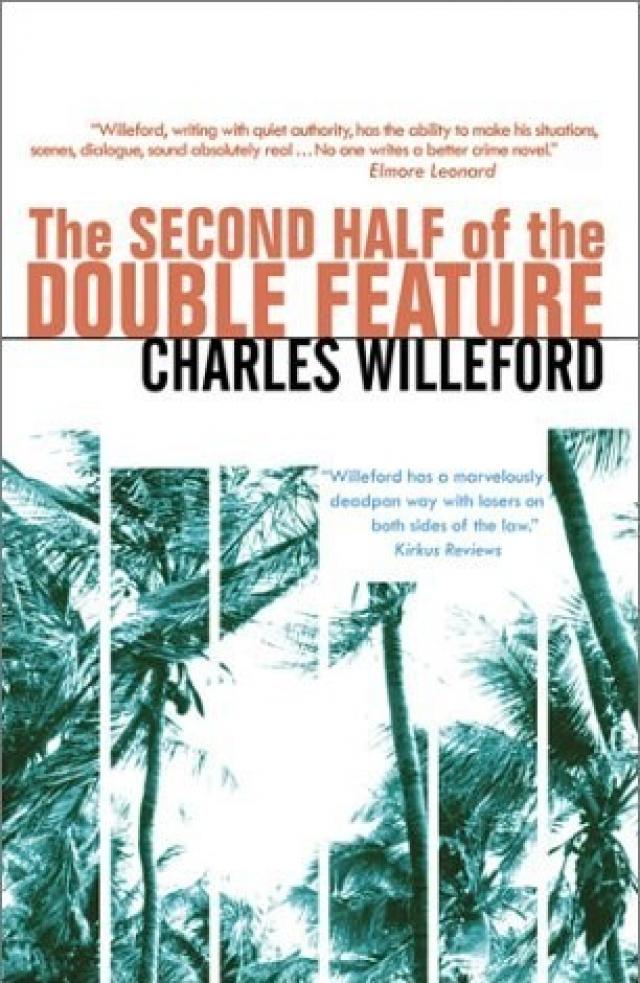


to lose Willeford
we can ill afford
THE SECOND HALF OF
THE DOUBLE FEATURE
Charles Willeford
By Charles Willeford
Novels
High Priest of California (1953)
Pick-Up (1955)
Wild Wives (1956)
The Black Mass of Brother Springer (as Honey Gal, 1958)
Made in Miami (as Lust is a Woman, 1958)
The Woman Chaser (1960)
Deliver Me From Dallas! (as The Whip Hand, 1961)
Understudy for Love (1961)
No Experience Necessary (1962)
Cockfighter (1962, revised 1972)
The Burnt Orange Heresey (1971)
The Difference (as The Hombre From Sonora, 1971)
Kiss Your Ass Goodbye (1987)
The Shark Infested Custard (1993)
The Hoke Moseley Series
Miami Blues (1984)
New Hope For the Dead (1985)
Sideswipe (1987)
The Way We Die Now (1988)
Grimhaven (unpublished initial sequel to Miami Blues)
Story Collections
The Machine in Ward Eleven (1963)
Everybody’s Metamorphosis (1988)
The Second Half of the Double Feature (2003)
Non-Fiction
A Guide for the Undehemorrhoided (1977)
Off the Wall (1980)
Something About a Soldier (1986)
I Was Looking For a Street (1988)
Cockfighter Journal: The Story of a Shooting (1989)
Writing & Other Blood Sports (2000)
Poetry
The Outcast Poets (1947)
Proletarian Laughter (1948)
Poontang & Other Poems (1967)
My work is one long triumph over my limitations
—Charles Willeford
The Old Man at the Bridge
ONE DAY some years ago I drove from Miami to Palm Beach for a business appointment, and it was on the kind of day that causes a man to move to Florida in the first place. Bright, sunny, with just enough homemade divinity in the sky to break up the monotony of the flat horizon. It was a goof-off day and, because I was goofing off, I took the slower but scenic A1A route after the maze at Fort Lauderdale.
I crossed a drawbridge past Deerfield Beach and noticed the cluster of ancient fishermen on the crest of the bridge, their lines dripping over the concrete balustrade. But there was one old man down at the end of the bridge, well away from the other fishermen. The water was shallow near the bank, and I wondered why he didn’t move higher up, where he could cast into deeper water. Perhaps the old man had discovered a deep pool or eddy that could not be seen from the highway. Perhaps, if the old man had not been standing all alone, I would not have noticed him.
The business transaction in Palm Beach was pleasant. The man who gave me the check was happy to do so because the money belonged to his company and not to him, and I was happy to get the check because I had already worked out a great way to spend it when I got back to Miami.
Going home, I drove even slower than on the way to Palm Beach. This time when I approached the drawbridge below Deerfield the jaws were open. I parked on the side of the road and walked over to the abutment to watch a powerboat chug through. The captain, or pilot, wore a Navy blue flannel jacket and a yellow silk scarf. The woman with him, however, was wearing an orange bikini and a heavy layer of suntan oil. I could smell the woman and the coconut in the oil as the boat passed. The boat was almost out of sight before I spoke to the old man, who was still there, fishing.
“Catching anything, Pop?”
He nodded. “Three bream. More’n I wanted to catch.”
He was a clean old man, wearing stiff khaki chinos, blue canvas tennis shoes and a long-billed cap. His long-sleeved sport shirt still had starch in it, even though he had been standing out in the sun all day. His face was close-shaven and there was a scaly circle on each cheek the color of a ripe Valencia orange. Sun cancers. Benign, of course, but potentially dangerous—and sometimes they itch a little. I had one carved off my left temple by a dermatologist for $50, and it left a round white scar the size of a dime. Now that we are all wearing our hair a little longer, the scar is almost hidden. Florida fishermen get them constantly. Even if you wear a hat the reflection from the water gets to your face. But the prospect of sun cancers has had no statistical effect on the mass migration of old men to Florida.
I looked into this one’s yellow plastic bucket. It held a Col. Sanders snack box, an empty Nehi bottle and a wadded Oh Henry wrapper.
“Where are the fish?”
He shrugged. “I turned ‘em loose.”
“But bream are supposed to be good eating.”
“If you like to eat fish, they are.”
“You don’t eat fish?”
He shook his head. “No, and I don’t like fishin’, either.”
I didn’t laugh. I took out a cigarette, and offered the pack to the old man. His fingers reached out, and then he swiftly pulled back his hand.
“I don’t smoke,” he said firmly.
After lighting my cigarette I said, not unkindly, “If you don’t like to fish and you don’t eat fish, why have you been fishing all day? I remember seeing you in this same spot when I crossed the bridge at around nine this morning.” He was silent.
“Because,” he said at last, “I don’t know what else to do. Before I retired I was vice-president of an insurance company in St. Louis. And this is what I always thought I wanted to do someday, retire to Florida and fish. The first day I tried it I discovered I disliked it. I had already bought a house, and my wife wouldn’t let me stay home during the day.
“So I fish. Every day. In the beginning I used to take my catch home. But when I did, my wife felt that it was her duty to cook them. And I hate the taste of fish, the stink of fish and even the smell of other fishermen. That’s why I stand down here by myself. Now when I go home in the evening I tell my wife that I didn’t catch anything. It’s simpler that way. She doesn’t have to prepare the fish, and I don’t have to eat any.”
“Why don’t you stay home and get a hobby of some kind?”
“I’d love to, but a woman can’t stand to have a man around all day. I’d like to stay home and watch TV. The house is air conditioned, and”—he fingered the sun cancers—“maybe I could get these things cleared up. But my wife gets jittery when I’m around the house, and runs me out. And after talking about wanting to come to Florida for 30 years I can’t tell her that I hate to fish.”
“To get it straight: you hate to fish, but you’re forced by circumstances to fish every day.”
“That’s about the size of it. I believe I will take one of those cigarettes if you don’t mind.”
“Sure.”
He was a fine old man with fissured character lines and pale but keen eyes. The white hair that puffed out below his cap was more plentiful than mine. I thought about the check in my billfold. If this tough old man had handled the insurance deal instead of the young guy in Palm Beach, the check would have been halved. At least 67, maybe 68, the fisherman had several more unhappy years ahead on this bridge.
“I guess that you’ll be fishing here tomorrow, then?” I said.
“That’s right.” He returned the cigarettes and lighter. “When 8:30 rolls around, I’ll be standing right here with my line out.”
“I—I hope you don’t catch anything!”
“Thanks,” he said gravely. “I appreciate that.”
I returned to my car, and driving over the bridge wondered about the other old men who were there. How many fished because they had to and not because they wanted to? It was a cinch that none of them fished out of necessity, out of hunger. How many of these fishermen, like the man I had talked with, hated fishing as much as he did but didn’t have the guts to admit it?
I reviewed my own fishing experiences. When I was younger and living in Los Angeles, a gang of us occasionally went out to the all-night fishing barge off Santa Monica. But we never did much fishing. We would try for half an hour or so, and someone might catch a barracuda or a sand shark, and then we would all go inside where it was warm and drink beer and play poker for the rest of the night. None of us really liked to fish. We used the overnight barge merely as an excuse to get drunk and play poker.
Once in Bimini I tried sail fishing on a charter boat, but I got seasick after an hour and, to the captain’s disgust, made him take me back to the dock. The only other time I could remember going out to fish was in Georgia while I was stationed at Fort Gordon. A sergeant I knew had a musette bag full of concussion grenades. We killed half a dozen bass, a dozen frogs and a cottonmouth that day. The bass, after being roasted over a smoky fire, tasted like salted buffalo chips. By the end of the day I had a swollen face full of mosquito bites, and chiggers all over my arms and hands. By the following morning the scratches on the backs of my hands had festered, and they resembled yellow worms. All day long I had been fearful of getting caught with the bag of grenades. The sergeant claimed, falsely as I discovered later, that the laws against fishing with explosives didn’t apply to professional soldiers.
After reviewing these admittedly limited experiences I knew that I hated fishing and that I would never go fishing again.
This was five years ago. Since then, on my own and without the help of a federal grant, I have talked to a lot of fishermen, more than
The only excuse for fishing, like hand-to-hand combat, is that it gives you something to do with your hands. There it is, the ugly truth about fishing for “pleasure” and for profit. I spend a good deal of time—too much—just sitting and don’t get nearly enough exercise. Last night, to do something about it, I dug out my bowling shoes and ball and drove to the nearest alley. Not wanting to bowl alone, I asked a guy who was putting on his shoes if he wanted to bowl with me.
“If you want to,” he replied.
“Fine. You can go first.”
“No,” he said, “go ahead.”
“All right. You can keep the score.”
“No.” He shook his head. “I don’t keep score.”
I laughed. “You sound like a guy who doesn’t like. . .” I didn’t finish the sentence. In the morning my back muscles would ache, and the stiffness would bother me all day. My thumb and middle finger would be swollen and sore.
Without another word, and without keeping score, we grimly rolled about ten lines before we earned enough manhood to call it quits and get the hell out of there.
The Condemned
WE WERE in the Baguio market one morning, walking around and looking at the bare breasts of the Igorot women. Their breasts were brown and taut, and the nipples stuck straight out. This was because, D’Angelo said, none of these women had ever worn brassieres, which break down the muscles under the arms and cause breasts to sag. We ran into Tom Higdon in the market, and Higdon had a grande of gin. Higdon was an M.P. from Manila who came from Terrell, Texas, and he was already a little drunk. He offered us each a drink from his bottle, and told us that they were going to hang an Igorot in the morning. The Igorot had killed a man, and then he had eaten the man’s heart after roasting it on a charcoal fire. Because of the American influence, the Philippines were sensitive to things like cannibalism, and they were making an example of this Igorot, although they had never bothered them much before, not while the Philippines were still under Spain, anyway. After all, it was a tribal custom to eat the heart of an enemy after killing him. The bolo fight, apparently, had been a fair one, so they were hanging the Igorot more to stamp out cannibalism than they were for murder.
“What I’m worried about,” Higdon said, “is that this here Igorot’s a pagan. What I’m going to do is go down to the jail and talk to him and show him the light. If I can convert the little fucker, he’ll have a chance to go to heaven instead of purgatory.”
Higdon was Southern Baptist, and even though he was a little drunk, he seemed serious about this mission.
“I don’t think they’ll let you talk to him, Higdon,” I said. “And even if you did, he won’t understand English.”
“That’s right,” D’Angelo said. “With your Texas accent, I can hardly understand you myself.”
“Look who’s talking!” Higdon said, bristling. “You got a black dago Brooklyn accent that only foreigners talk.”
“I’m as white as you are,” D’Angelo said. I think he was probably sensitive about his dark Mediterranean skin. Texans like Higdon didn’t make any distinction between Negroes, Mexicans, Portuguese, Italians, or anyone else with dark skins—they were all black to Higdon. I didn’t want to see these two guys get into a fight about something stupid. I stepped between them.
“We’ll go with you, Higdon. The constabulary might let three of us see the Igorot, where he might turn down just one guy.”
“It’s not that I want to go,” Higdon said, shrugging, “but I wouldn’t be much of a Christian if I didn’t try.”
So we walked to the jail, finishing the rest of the gin on the way.
There was an uneasy relationship between the Philippine Constabulary and the armed forces in P.I. As a national police force, they could, technically, arrest a soldier or a sailor, but they never did. They might hold on to some soldier who was tearing up a bar or something, but they turned him over to the M.P.’s as soon as possible.
The constabulary, anywhere you went, was a smart group of policemen. They were well trained and bore no resemblance to the sloppy new Philippine Army. I don’t think they were paid well, but they undoubtedly had several kinds of graft working for them, and you never saw a member of the constabulary in a dirty or sloppy uniform. Higdon was an M.P., but he was on furlough and had no official capacity in Baguio.
There were three members of the constabulary at the jail, a corporal and two patrolmen. The sullen corporal didn’t want us to see the Igorot.
“No.” He shook his head. “I can’t let you bother the Igorot. He’s going to be hanged in the morning.”
“That’s why we have to see him today,” Higdon explained. “Tomorrow will be too late. I’ve got to show him the light.” Then Higdon pulled out his M.P. I.D. card, and that placed the corporal in a quandary. He knew that he was supposed to cooperate with American M.P.’s, so he reluctantly took us back to the cells.
The Igorot, wearing a pair of dirty white pants, was a dark little man of about four six. When we stopped outside his cell he scrambled up the tier of six bunks and peered down at us over the edge of the top bunk with the terrified dark eyes of a lemur.
“Come down here a minute,” Higdon said. “I want to talk to you.”
“He don’t understand English,” the corporal said.
“You tell him then.”
“I talk Tagalog, not Igorot.”
“Tell him in Tagalog.”
The corporal said something in Tagalog, but there was no response. The little Igorot just backed away in that top bunk until all we could see were his nose, brown eyes, and his fingers gripping the iron rail of the top bunk.
“I guess you’ll have to open the door,” Higdon said. “I’ll have to go in there and get him.”
“No,” the corporal said. “I can’t let you bother that Igorot. He’s going to be hanged in the morning.”
Higdon was six four, and he must have weighed at least 190 pounds. He had red hair, bright blue bloodshot eyes, and long arms. He squatted down until his eyes were level with the corporal’s. He lowered his voice to a whisper: “Open the door.”
The way he said it, anyone would have reached for the keys, let alone a little constabulary cop in a small town like Baguio. He opened the cell.
Higdon went inside while we stayed outside and watched. After a few minutes our sides were hurting from laughter. I’ve never laughed so hard before in my whole life. The little Igorot didn’t come as high as Higdon’s chest, and he was faster than greased owl shit. Higdon would climb the tier, and then the Igorot would scramble down headfirst, as slippery as mercury. Then, as Higdon started down, up the Igorot would climb again to the top bunk. Higdon was getting angrier by the minute, calling him a pagan sonofabitch, and anything else he could think of. By the time Higdon finally caught the Igorot by the leg, he was breathing heavily through his mouth. He twisted the little man’s arm behind his back, forced him to kneel, and said:
“Do you accept Jesus Christ as your Lord and Savior?”
The Igorot didn’t say anything, so Higdon jerked the arm up a little higher and asked him the same question. This time the corporal said something in Tagalog, and the Igorot nodded his head vigorously. Higdon accepted the nod for a yes and released the man. He immediately scrambled up the tier again and looked down at us from the top bunk. If the Igorot was saved, he sure as hell didn’t know it.
“I’m sorry if I hurt you, boy,” Higdon apologized. “But you’ll thank me for it someday when we meet in heaven.”
D’Angelo also thanked the constabulary corporal for his cooperation, and I gave him a cigarette and lighted it for him. The cell was locked again, and Higdon seemed oddly subdued and sobered. The corporal was happy to see us leave the jail, and he shook his head solemnly as we left. “You shouldn’t have bothered that Igorot. He’s going to be hanged in the morning.”