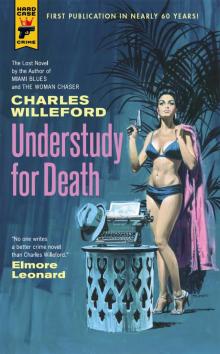
Grimhaven, page 1


By Charles Willeford
Novels
High Priest of California (1953)
Pick-Up (1955)
Wild Wives (1956)
The Black Mass of Brother Springer (as Honey Gal, 1958)
Made in Miami (as Lust is a Woman, 1958)
The Woman Chaser (1960)
Deliver Me From Dallas! (as The Whip Hand, 1961)
Understudy for Love (1961)
No Experience Necessary (1962)
Cockfighter (1962, revised 1972)
The Burnt Orange Heresy (1971)
The Difference (as The Hombre From Sonora, 1971)
Kiss Your Ass Goodbye (1987)
The Shark Infested Custard (1993)
The Hoke Moseley Series
Miami Blues (1984)
New Hope For the Dead (1985)
Sideswipe (1987)
The Way We Die Now (1988)
Grimhaven (unpublished initial sequel to Miami Blues)
Story Collections
The Machine in Ward Eleven (1963)
Everybody’s Metamorphosis (1988)
The Second Half of the Double Feature (2003)
Non-Fiction
A Guide for the Undehemorrhoided (1977)
Off the Wall (1980)
Something About a Soldier (1986)
I Was Looking For a Street (1988)
Cockfighter Journal: The Story of a Shooting (1989)
Writing & Other Blood Sports (2000)
Poetry
The Outcast Poets (1947)
Proletarian Laughter (1948)
Poontang & Other Poems (1967)
Written circa 1984-5, Grimhaven was Willeford’s first response to the soliticitation of a sequel to Miami Blues. It remains unpublished.
GRIMHAVEN
Man’s unhappiness stems from his inability to sit quietly in his room.
—Pascal
Chapter One
SOMETIMES THERE WERE NIGHTMARES. A hand would appear out of the darkness, and it would either be gripping a handgun or a curved knife. The gun, when it was a gun, would be smoking; the knife, when it was a knife, would be dripping with blood. The looming figure, in the darkness behind the knife or gun hand, would be a darker silhouette against the blackness, of indeterminate sex and unrecognizable; but the hand with the weapon, bathed in light, was always pale, with the knuckles white as it pointed the gun or lifted the knife. At that point in the dream, knowing he was going to be killed - murdered in his bed, he would awake, startled, his heart pounding and his mouth dry. The white ceiling would be aglow from the sodium vapor streetlights outside the window, and he would hear the reassuring murmur of surf rolling in on the wide beach. He could never recall the dream clearly, except that it had been scary and threatening. His body would be damp with perspiration, and he would still be breathing hard through his dry mouth.
Afterwards, sometimes, he could fall asleep again almost immediately. At other times, he wouldn’t be able to get back to sleep again for two or three hours. It was probably only anxiety, he thought, but he wished to hell it would stop.
Hoke Moseley’s eyes were chocolate brown, a brown so richly dark it was difficult to see his pupils. During his twelve years on the police department in Miami, this genetic gift had been useful to him on many occasions. Hoke could stare at people for a long time before they realized that he was looking at them. By any aesthetic standard, Hoke’s eyes were beautiful; but the rest of his face, if not ordinary, was unremarkable. Hoke was forty-two years old, he looked older. He had lost most of his sandy hair in front, and his high balding dome gave his longish face a sorrowful expression. He wore false upper and lower dentures, and these cheap grayish blue teeth were so patently false they were the first thing people noticed when they met him for the first time. His tanned cheeks were sunken and striated, and there were dark, deep lines from the wings of his prominent nose to the corners of his all but lipless mouth.
Hoke was wearing a yellow poplin jumpsuit and Nike running shoes without socks. The sleeves were rolled up above his elbows, and there was a $19.95 Timex wristwatch on his hairy left wrist. He took a folded white cotton handkerchief out of his left hip pocket, wiped his forehead, and replaced the handkerchief. He glanced at his watch. For the last fifteen minutes, he noted, twisting his mouth, he had been counting wing-nuts. Each time he counted them, he came up with a different total. First 193, then 192, then 195. He shook his head and wrote 193 on his clipboard inventory sheet.
“Dad,” he called to his father, “I’m going to pack it in for the day. I counted these wing-nuts three times and came up with a different number each time.”
Frank Moseley, Hoke’s father, who was working on a puzzle in his crossword magazine, filled in seven blank spaces with his ballpoint: L-A-C-U-N-A-E. “The secret to inventory,” Frank lifted his head, “is to write down your first count, at least on small items.”
“That’s what I decided to do.”
“Rodriquez’ll be back tomorrow. I’ll put him on inventory, and you can wait on customers.”
“That’s okay. I’d just as soon do the inventory.”
“Whatever.” The old man shrugged. Frank Moseley was almost seventy, but he looked more like Hoke’s older brother than he did his father. He was thin and wiry, and his new wife, who was closing in on forty, took very good care of him.
“Go on home, Hoke. Take your swim. I’ll close up. We could close now, but I’m waiting for Captain Reinerth to come in for his new outboard.”
“I’ll wait for him, Dad.”
“No. You look tired. Get along.”
“I’m not tired.”
“Bored, then. Go ahead. There’s something I want to talk to Captain Reinerth about anyway.”
Before leaving, Hoke reset the thermostat, raising the store temperature to eighty-five degrees. This small task, taking care of the air conditioning unit, changing the filters twice a month, and dusting the vents, was a duty Hoke had assumed without being told. His father had agreed to take him back into the hardware store, but had never told him what he was supposed to do. When Hoke had asked what his specific duties would be, the old man had merely shrugged. “Make yourself useful, that’s all.”
That had sounded simple enough, but it wasn’t. Jose Rodriquez, who preferred to be called “Joe,” and Helen Wadsworth, a divorcee with two kids in junior high school, had both been working for Mr. Moseley as clerks for some years. They had already divided the work between them and there was very little left for Hoke to do in the store. The old man took care of the cash register, and he did all of the ordering and helped Mrs. Wadsworth with her bookkeeping. Hoke, after working in the store for two months, sometimes felt like a fifth wheel. Nevertheless, the store looked much neater and cleaner, thanks to Hoke’s efforts.
Moseley’s Hardware and Chandlery had expanded considerably since Hoke had worked there as a boy in high school. The chandlery part of the store’s sign was mostly exaggeration, but because small boat items had been added over the years, and parts for power boats could be ordered, the old man had added “Chandlery” to the outside sign when he had it repainted. Hoke, trying to make himself useful, kept the bins straightened, learned where everything was stored, and, when he couldn’t think of anything else to do, swept, mopped, and dusted.
The more mindless the task, the better Hoke liked it.
When Hoke came back to the store to work, his father had said nothing about how much his salary would be, and Hoke hadn’t asked. At the end of his first two weeks, Hoke received a check for $200. When he caught his father alone, Hoke asked him about the salary, just to make certain there was no mistake.
“Is this for one week, Dad, or two?”
“Two. That little apartment I let you have over at the beach usually rents out for four-twenty-five a month, and I’ve always paid the utilities. So instead of you paying me rent on the apartment, as we agreed on first, you can have the apartment rent-free, as a part of your salary. So that’s four-twenty-five. Add another hundred a week, and you’re making more than two hundred a week. That’s more ‘n I pay Rodriquez or Mrs. Wadsworth. Of course, if there’s a profit at the end of the year, and there always has been so far, you’ll share the same bonuses as Joe and Mrs. Wadsworth. The only way I can justify giving you more money than I give Mrs. Wadsworth and Joe is to have you come in on Saturday mornings. I’ve been the only one in the store on Saturday mornings for the last thirty years, but now I’m planning on taking Saturdays off and letting you stay here by yourself. Is that fair enough?”
“It’s more than fair.”
A free apartment, utilities included, was enough for Hoke’s needs, now that he had resolved to simplify his life. When he thought about it, he was almost as well off financially in his new situation as he had been as a police sergeant of Homicide in Miami, when he had earned a salary of $32,000 a year. Half of his policeman’s salary had gone to his ex-wife each month for alimony and child support for his two teenaged daughters. Out of the remaining $15,000, or thereabouts, he had to pay taxes, union dues, retirement, and everything else. He had never had a spare cent left over, but now he had a small bank account started in the Riviera Beach National Bank, and a few dollars in his pockets besides.
When Hoke resigned from the police department, he had received a lump sum of $12,000, all of the money he had paid into the retirement fund throughout the years. He could have left the money in the retirement fund, and drawn a reduced retirement for life when he reached fifty years of age, but he had opted to draw it out instead, pay the punitive taxe
But for now, the $3,200 was it.
Patsy had not taken Hoke’s letter with good grace, nor had he expected her to; she had never taken anything he ever did with good grace. She had, after cashing the check, written him an angry, bitter letter. But she did not take him back to court—not yet, anyway. Patsy was a cunning woman, in Hoke’s opinion, and a sharp businesswoman as well. As a realtor in Vero Beach, she was making at least $30,000 a year, so if she took Hoke to court for non-support and back alimony, the chances were better than even that the judge would reduce the child support payments substantially, and take away her alimony altogether.
The financial circumstances had changed considerably for both of them in the last decade. Patsy had been an unemployed housewife and fulltime mother when they got their divorce, and Hoke had had a secure future with the Miami Police Department. Now Patsy was a fairly well-off businesswoman, and Hoke was no longer on the force. He could also prove, in court, that his take-home salary at the hardware store was only a hundred dollars a week. No, knowing Patsy, and Hoke thought he knew her very well, she would wait, believing that Hoke would come eventually to his senses and obtain another cop’s job somewhere. And then she would take him back to court.
That left out the matter of vindictiveness. Patsy could still take him to court to be vindictive, but Hoke didn’t care. They rarely jailed a man who could not pay alimony and child support, so the worst that could happen to him would be the loss of his three-year-old Datsun Li’l Hustler pick-up truck he had purchased with his pension money. Even jail, Hoke thought, if it came to that, would be better than remaining on the Miami, or any other police department. Now that he had made up his mind to simplify his life, he knew he could keep it simple in jail, too.
Hoke’s small white truck was parked next to his father’s new Buick Riviera in the parking lot behind the store. He rolled down the windows and opened both doors for a minute or so to let the baked air out of the cab before getting into the driver’s seat. The steering wheel, after its all-day bath in the Florida sun, was almost too hot to touch.
Hoke left Riviera Beach, the city proper, and took the Blue Heron causeway over to Singer Island. Singer Island, which was part of the Riviera Beach township, had grown tenfold since Hoke had been born. The old man’s island property, which he had bought back in the early 1930s before the causeway had been built to the island, had made him a rich man. Singer Island was filled now with expensive homes and tall condominiums, but it still had the widest beach in Florida, except, perhaps, for Daytona Beach. The sand on the Riviera Municipal Beach, however, was whiter, cleaner, and deeper than the hard-packed beach at Daytona.
When the old man had first built the duplex, where Hoke lived now in the southern half of the upstairs apartment, there were no other homes for five hundred yards or more on either side of it. But now the duplex had almost disappeared as it became a small part of a burgeoning shopping center.
Frank Moseley had built the duplex in 1946, right after the war, and the building was on sturdy concrete stilts. The two apartments, high above the ground, caught the breezes from the Atlantic, and the open spaces beneath them had been used for parking and storage. Steep outside staircases led up to each apartment. They both had screened porches then, but now the two porches had been enclosed with jalousied windows. The prospect across the beach was still the same, but little else was. On either side of the duplex, shops had been constructed, and at the northern end of the center there was a three-story office building. The two parking spaces beneath the duplex had been enclosed with walls and remodeled into shops. Instead of car ports, there was a gift and shell shop beneath Hoke’s apartment, and a scuba gear rental shop beneath the other apartment. There were pink concrete sidewalks on both sides of the shopping strip, and Hoke had to find a parking space in the crowded municipal lot, now that his former parking space was a shell shop.
Hoke could still remember vaguely when the duplex was the only structure this close to the beach. Sometimes, as a boy he had walked to Niggerhead and back along the shoreline without seeing a single swimmer or sunbather. But not now; the beach was always crowded, winter and summer, and those were the only seasons Florida had. No one, except for Frank Moseley, could have foreseen this phenomenal growth, and even the old man must have been surprised a little, although he would never admit it. At any rate, Frank Moseley had, at one time, owned all of the lots on both sides of the duplex; and the sales of those lots had made him a very rich hardware store owner.
But all the same, and despite all of the people, Hoke’s life was beginning to go exactly the way he had always wanted it.
Chapter Two
HOKE PARKED AND LOCKED HIS TRUCK IN THE ASPHALT LOT, dodged a kid on a forbidden skateboard as he crossed the pink concrete sidewalk, and climbed the steep stairs to his apartment. There was no mail in his box. He opened the jalousied windows on the porch, checked the length of the shadows on Ocean Boulevard, and took a look at the ocean. The snot-green water was glassy. Three black tankers skirted the Gulfstream on the horizon. Because of daylight savings time, the sun wouldn’t set until almost eight p.m., which gave Hoke more than two hours of sunlight for his afternoon swim and daily run on the beach.
Hoke removed his poplin jumpsuit, emptied the pockets, and washed it while he took his shower. He put on his swimming trunks, twisted his jumpsuit as dry as he could with his powerful hands, and hung the jumpsuit on a plastic hanger in the doorway from the living room to the porch, where it would catch the breeze coming in through the windows. The jumpsuit would be dry by morning, and he could wear it to work again. Hoke had reduced his wardrobe to two yellow poplin jumpsuits, but he liked to wash the one he wore each day every evening so he could wear the same one again the next day. He felt that this daily chore simplified his life even more, and he would also have the other, fresher and newer, jumpsuit in reserve.
The apartment had a living room, one bedroom, and one bathroom. Instead of a kitchen, there was a narrow galley and counter with two stools in the living room. There was an accordion Naugahyde curtain that could be closed to conceal the galley, but Hoke had never closed it. The rooms were large, however, having been built during the postwar construction boom, and the ceilings were fourteen feet high. There were ceiling fans in the living room and in the bedroom—installed and left behind by an earlier tenant—and Hoke rarely turned on the air conditioning. Although free utilities were a part of his deal with his old man, Hoke had no intention of running up a high electric bill on his father. Besides, the Hunter fans were effective enough to cool the apartment and there was almost always a breeze coming through the windows off the water.
Hoke pinned his house key into the small pocket of his faded trunks, slipped into rubber-soled skivvy slippers, and went down to the beach, dodging the one-way traffic on Ocean Boulevard. The white stretch of sand was too hot for his bare feet, so he always wore his slippers until he reached the littoral. He took off his slippers and sunglasses and waded into the warm waters before diving into a breaking wave. The temperature of the water was the same as the air—about eighty-seven degrees—and the water, except for being wet, was not refreshing. The ocean was as warm at night as it was during the day, and sometimes a night swim was better because the air was cooler than the water at night. But Hoke tried to take his swim at the same time every day, hewing to his schedule. He counted to himself, after he got beyond the breakers, adding one count to every two arm strokes, until he had completed what he considered the equivalent of thirty laps in an Olympic-sized pool.