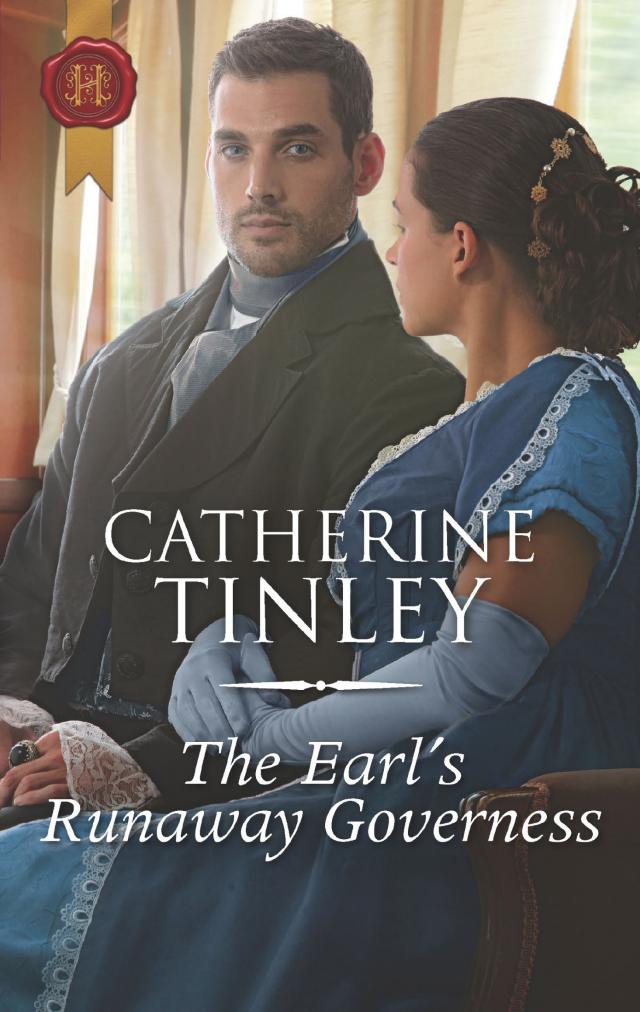
The Earl's Runaway Governess, page 13


Ash’s eyebrows rose. ‘My dear Fanny, you may accuse me of many things, but an interest in farming and managing house servants is not among them. I am unspeakably jaded by the entire enterprise and mean to make the most of my time here in London before I am forced to return to the countryside.’
He gestured firmly to emphasise the point.
‘Why, one of my acquaintances has this day suffered a carriage accident—Miss Bolton will share the details with you—and I intend to stay long enough to ensure that he is fully recovered.’ He rose. ‘No, I shall adhere to my plan and remain here until next week. Now, if you’ll forgive me, I have had more than enough of domestic matters today—enough, in fact, to last me a lifetime—so I shall take my leave of you. You shall have your footman!’
He rose, his air that of a man jaded beyond endurance, bowed curtly and left.
‘Well!’ uttered Fanny, after the door had closed behind him. ‘I asked only a civil question. It is not my fault that he has the running of the estate!’
Marianne barely heard her. It felt to her as though the floor beneath her feet had turned to quicksand. In her mind she listed the various shocks of the day: Mrs Bailey’s appearance at the register office. Her tale about Henry attacking Jane. The carriage journey with Ash. That kiss. The accident. Seeing Henry. That sense of connection she had felt to Ash.
Ash? When had she begun calling him Ash in her mind? Some time today, certainly.
And now two further shocks. First, he found his life at Ledbury House tedious, and had no true interest in running the estate. And second, he knew Henry.
Chapter Thirteen
Ash strode through Berkeley Square on the way back to his lodgings, glad now that he had directed his coachman to return without him. He needed the walk to clear his head and try and work out what on earth was happening to him. His fixation with Miss Bolton was fast becoming an obsession.
Today he had betrayed all his higher instincts and kissed her. And, while he revelled in the memory, he regretted succumbing to his baser nature. Although notionally in Fanny’s employ, Miss Bolton was in a real sense in his power, and today he had abused that. He had seen enough over the years to understand that women sometimes co-operated out of fear, and had sworn never to step over such self-imposed lines.
Until today he had managed to keep to that vow. Until today he had never had to wonder why a woman kissed him. Until today his relationships had always been fairly distant, unambiguous—almost businesslike. Until today.
He literally had no idea whether Miss Bolton had genuinely welcomed his kiss or whether she’d felt compelled to pretend so for fear of losing her situation as a governess in his household. She had seemed to enjoy his attentions, he reflected, remembering the enthusiasm with which she had returned his embrace. But had it been genuine, or had it been feigned?
He had no way of knowing, and no way of finding out in future.
His uncertainty was partly fuelled by another concern. He was sure now that she was hiding something from him. Today at the register office he had noted her reaction to Mrs Bailey and to the story she had told about her daughter Jane. Did Miss Bolton know them? Or had the story triggered something she had seen or heard about before?
Her reaction had reminded him of the anxious, fearful Miss Bolton he had met at the inn at Netherton two months ago. That lady had gradually disappeared, to be replaced by a relaxed, quick-witted, managing woman who challenged his mind and tested his sense of authority.
Initially he had accepted her tale about it being her first post as a governess and that she had decided to take up the role after her father had died, leaving her without independent funds. Now—now he simply did not know what to believe.
Fanny’s observation had also rocked him. The fact that Fanny, not known for her insight, had realised he was interested in the governess had caused him to act decisively.
He hoped his pretence about Henry Grant being his friend and his words about being tired of estate management and desiring only to stay in London for as long as possible had dented Fanny’s notion that he might be attracted to Miss Bolton. For he knew that was exactly why she had asked if he, too, was planning to return to Ledbury House early.
And what was the truth?
He had, he admitted, been tempted to break his engagements and travel back to Ledbury House early. If only to discuss with Mr Cronin and Mrs Bailey—and Miss Bolton, of course—the works to be completed in the house. He wanted Mrs Bailey’s assurance that the London servants would work co-operatively with Mrs Cullen and the village girls. It was nothing to do with missing Miss Bolton. Of course it was not!
Miss Bolton herself, he had noted, had only looked mildly confused. She seemed not to have grasped the implication of Fanny’s words, thank goodness.
Now, he decided, I must be resolute. I must put all thoughts of Miss Bolton and Ledbury House out of my head. I am back in London, where I belong. The rest matters not.
* * *
Two days later Marianne waited anxiously in the sitting room at Grillon’s for the arrival of Mrs Bailey and her daughter. Her luggage rested by her feet, for she was packed and ready to return home to Ledbury House.
Ash had made his travelling carriage available to them—an unexpected and unlooked-for privilege. Ledbury House’s new housekeeper and her daughter had been instructed to present themselves here at ten o’clock, to meet Lady Kingswood, after which they would set out for Ledbury House with Marianne.
Lady Kingswood, however, had been somewhat distracted by the arrival, an hour before, of her new footman—a superior-looking, confident young man in magnificent livery. She was still preening herself at this boost to her consequence, and hoping she would be seen by as many ladies of her acquaintance as possible, when the footman who was stationed outside the door of their suite opened it to announce the new housekeeper and her daughter.
‘Allow them to enter,’ intoned Lady Kingswood dramatically, ‘for I am quite at my leisure!’
Mrs Bailey and Jane entered, looking a little anxious. Marianne exchanged a glance with the housekeeper, giving her what she hoped was a welcoming smile. She had not seen Mrs Bailey since that day at the register office, and of course had not seen Jane since she’d left home.
If they were anxious, their anxiety did not last long. Within a very few moments it became clear that Lady Kingswood had already tired of the conversation, and before long she had dismissed the three of them.
They made their way silently to the carriage, and then finally they were inside and the door closed. As the carriage left all three women expressed their relief, and Marianne hugged both Mrs Bailey and Jane fiercely.
‘Oh, Miss Marianne!’ Mrs Bailey cried, wiping away a tear. ‘It is so good to see you again and to see that you are safe. I thought I should pass out when I saw you in that register office!’
‘Me too!’ said Marianne fervently. ‘I had no expectation of seeing either of you—though of course when I heard what had happened with Henry I understood it all immediately!’ She turned to Jane. ‘I am so, so sorry that he importuned you. Are you—are you still unwell?’
Jane looked at her steadily. ‘I was at first. But I am much recovered now and I am determined to be well.’ She smiled shyly. ‘It is a relief to be away from—from him, and to be working for you again, miss!’
‘Oh, no! You are not working for me, but with me,’ said Marianne. ‘You must not forget that I, too, am an employee at Ledbury House—the governess only. I eat with the family, it is true, but I have friends among the servants. It is most gratifying!’
Jane looked shocked. ‘Friends with the servants—oh, miss! And you such a fine lady!’
‘I was born a lady, that is true, but we are both women, are we not? And we are nearly the same age. My changed circumstance means, I hope, that we can be friends. What say you?’
Jane’s mouth fell open. She looked to her mother, who nodded.
‘I think it will serve very well. You two have always rubbed along together nicely—and do not forget, Jane, that your father was the son of a gentleman, though my family were all servants. These are unusual circumstances, and we need people who care for us. And people to care for.’ She thought for a moment. ‘Tell me of Lord Kingswood. He holds you in high regard, I think?’
For some reason Marianne felt a slow blush rise in her cheeks. ‘Oh—um...he is most considerate.’
Mrs Bailey was eyeing her keenly.
Marianne rushed on. ‘He is not happy to have inherited the title, I think. In fact he has said, very recently, that he is tired of the entire thing and will only return to Ledbury House when forced to by the pressure of business.’
Mrs Bailey’s gaze dropped to Marianne’s lap, where she was desperately screwing a handkerchief into a crumpled mess. ‘I see. He said this to you? Directly?’
‘He told Lady Kingswood. I was there.’
Mrs Bailey tapped a finger against her cheek, considering this. ‘Interesting... What is his relation to Lady Kingswood?’
‘Cousin by marriage. She is the Dowager Countess.’
Mrs Bailey nodded thoughtfully, then changed the topic, asking about the house, the other servants, and the work to be done.
Marianne answered as well as she could, and spoke plainly about the challenges ahead. ‘So A—Lord Kingswood has begun spending money on staff and repairs, but there is still much to be done.’
‘Good,’ said Mrs Bailey firmly. ‘I enjoy a challenge.’
A little later, with the ease of long acquaintance, they lapsed into a comfortable silence. Marianne could not resist just looking at both of them from time to time. Their faces were so familiar, had been part of her life for so long...and she had taken them—taken her whole life—for granted.
Never again. From now on she would count all her blessings and be grateful.
She pictured her plain little room at Ledbury House. Tonight she would sleep there again—would close her own curtains and her own chamber door and rest, secure in the knowledge that now she had allies and friends around her.
She thought back to her earlier comment. Mr Cronin was her friend too. She was looking forward to seeing the steward again and hearing his news about the work that had begun on the farms—especially his efforts to repair the outbuildings and labourers’ cottages.
Lady Cecily was, she reflected, also a positive part of her life. Although her charge was almost eight years younger, Marianne enjoyed her company. She would miss her in these next few days.
Guiltily, she realised that she felt a measure of relief that Lady Kingswood was remaining in London until the end of the week. It would allow Mrs Bailey and Jane to settle in, and Marianne to have a quiet, peaceful few days.
Finally, she allowed herself to think of Ash. Immediately an image of him sprang into her mind’s eye. Ash, smiling at her. Then another. Ash telling her she could come to him in need. What had he meant?
Does he know, or suspect, that I was lying to him?
Her thoughts moved on to the kiss they had shared. Immediately her heart stilled, then raced as her body relived the delightful sensations she had felt when his lips had been pressed to hers. She closed her eyes and the memory strengthened. Oh, but she had had no idea that a kiss could leave you feeling blissful, shaken and frightened all at the same time.
Frightened? Why did she feel frightened?
She opened her eyes again. Mrs Bailey was sleeping and Jane was looking out of the other window. In truth, she acknowledged, she had felt no fear at the time—only excitement, and passion and a wish for the kiss to continue and continue.
The fear had come since. She had always been too trusting. Her life, she knew, had been sheltered, and her parents had kept from her much of the reality of life. But she knew things, too. She had been the first to visit a sick tenant, or to insist her father pay for some need she had discovered in a groom or a retired servant or a wounded animal.
And she had seen animals mating at times—it had always struck her as strange and almost comical.
Her fear of Henry was acute—but then, he had singled her out. She knew what could happen to maidens who were unwary. And since Henry’s attack on her she’d had knowledge of how a man could force himself on an unwilling maid.
What she was now learning was that sometimes a maid was willing. She had known of maids who disappeared from service with whispers that they were with child after a willing liaison. She had often wondered why such girls would allow themselves to be ruined in that way. Why would they risk their position for a dalliance?
Some of those girls never married, and their mothers and aunts helped them raise their offspring. They would tut and complain about ‘feckless young men’ and ‘philanderers,’ but were ultimately powerless to make the fathers take responsibility for their children.
Marianne had never thought about this before—about the difference between men who took what they wanted by force and those who got their way through seduction. If an uncaring man achieved his goal through sweet words and tender kisses, rather than by force, and the outcome was the same, was he really any better than Henry?
She squirmed uncomfortably. Yes. Yes, he was. Of course he was. Lord, there was no comparison between someone like Henry and someone like Ash!
And yet there were similarities too. Ash had claimed to be Henry’s acquaintance. She was still shaken by that. Ash had never, Marianne was sure, visited her former home, for she surely would have remembered him. But they wore similar clothes, were part of the same set, and enjoyed the same pastimes in London. Drinking. Gambling. Betting on boxing and horse racing.
Lady Kingswood had been frank about Ash’s reputation with women. ‘Always a high-flyer in his keeping, my friends tell me!’ she had confided to Marianne just last night. ‘Well, that might suit his wife—if he should ever marry—for once he has sired an heir he will perhaps not bother her any more.’ Her eyes had taken on a faraway look. ‘I wonder...’ she had said thoughtfully. ‘There may be possibilities there...’
Marianne had waited patiently for some explanation, but it had not come. Lady Kingswood had retired early, leaving Marianne frowning and confused.
All in all, it had reinforced Marianne’s fears. Ash? A libertine and a seducer? Remembering that kiss, she could well believe it, and it served only to strengthen her resolve that it must not happen again.
The danger was not that he would force her, as Henry had tried. The danger was that he might not need to. The danger was in her own traitorous body, her own heart.
* * *
Ash sighed and sipped his wine. Once again he was overwhelmed by a feeling of ennui. His friends were—as they usually were—currently trying to outdo each other as to who could drink themselves into oblivion soonest. He had left the card tables an hour ago, and was now listlessly contemplating his wine in solitude, in a quiet corner of his club. There was a group of young cubs in the far corner, but no one was bothering him.
Really, he could not account for his feeling so unsettled. It was with him constantly. He was back in Town, living the life that he had built for himself—the life that his father had helped him build before his death. And yet Ash could not shake a feeling of restlessness, of waiting for some other life to claim him again.
All his usual pleasures seemed flat. He had enjoyed his time in Jackson’s earlier, and had taken his stallion for a long gallop this morning. But the drinking, gambling and easy repartee that had until recently been his habit had somehow lost its flavour.
‘Lord Kingswood?’
Ash looked up. One of the young cubs had approached him. He looked familiar, but Ash, with wine-induced sleepiness dulling his wits, could not immediately place him.
‘Yes?’
‘I am Grant. Henry Grant. You came to my assistance a few days ago and I wish to thank you.’
Ash remembered him now. The man in the carriage accident—the one he had lied to Fanny about, saying he was an acquaintance. In truth, he barely knew him.
He waved the man’s thanks away. ‘Think nothing of it. I’d have done the same for anyone.’
‘Nevertheless, it was me you assisted and I am truly grateful.’
‘Never mind that,’ said Ash, feeling a little uncomfortable, ‘how is your head?’
Grant smiled. ‘I had the devil of a headache for a day or so, but I am fully recovered, I assure you. One of my horses, however, remains lame and may not improve.’
‘Glad to hear you are recuperated. I am sorry about your horse.’
Grant shrugged. ‘It is of no matter. I will buy another.’
Ash frowned slightly. A man should have more care for his horses than that!
He drained his wine glass and stood up. ‘I am glad you are on the mend. Now, if you will excuse me...’
‘Er—there is one thing I wish to ask you.’
Grant put a hand on Ash’s sleeve, as if to prevent him from leaving. Ash looked pointedly at it and Grant removed it with alacrity.
‘Well?’ His tone was curt.
His friends would have read the danger signs. Grant, however, was either oblivious to Ash’s irritation or uncaring.
‘My memories of that day are a little hazy—’ he began.
‘Yes—that would be because you were bosky.’
Grant looked startled.
‘You know,’ said Ash, who was beginning to enjoy himself a little. ‘Foxed. Drunk as a wheelbarrow.’
Grant had the grace to flush. ‘Yes, well, everyone has too much to drink once in a while.’
But not at one o’clock in the afternoon, Ash was tempted to retort. And not when trying to drive a high-perch phaeton through Jermyn Street!
Henry Grant was only a few years younger than Ash, but Ash felt a hundred years older than him. He let the man’s defensive words pass unchallenged, however, and waited for Grant to say whatever it was he was so determined to say.