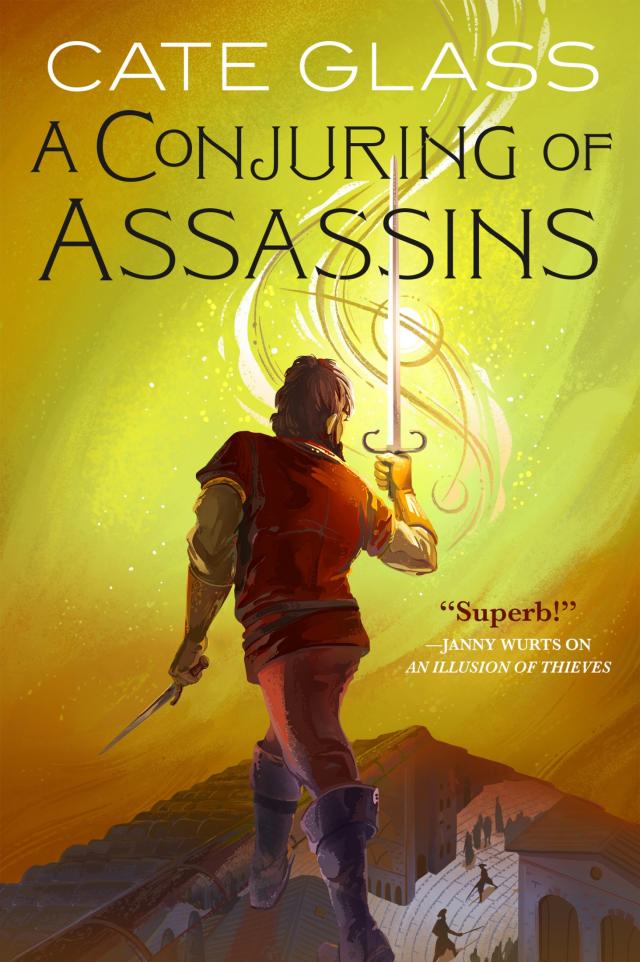
A Conjuring of Assassins, page 4


Once back to the Ring Road, I stopped at a narrow house front adorned with a double row of small locking boxes under the window and a carved plaque beside the door. The plaque read:
L’SCRITTÓRE
COPYING, LETTERS,
CONFIDENTIAL MESSAGE EXCHANGE
After my dismissal from il Padroné’s household, taking up my exiled father’s profession as a law scribe had seemed a reasonable way to keep Neri and me from starvation. When I’d grown the business enough to move it out of our house to a little room that opened onto the Ring Road, Neri and I installed the row of locking boxes. Customers could rent one for a small fee. The Chimera’s box was still empty.
Cursing my squirming conscience, I unlocked the shop, stuffed my journal and a sheet of parchment into my writing case, and headed for the Duck’s Bone alehouse. Most of my clients were lawyers and notaries. But a growing number were Beggars Ring folk who needed someone to draft a letter or a will or a business agreement. They often felt more at ease meeting at the Duck’s Bone. It was my preference as well. To work in their familiar place instead of my own granted me a certain anonymity.
Until yesterday, this ordinary life had seemed but an impersonation. Surely my home was the house where I’d lived with Sandro. The city of Cantagna was the city he had shown me in the walks we’d taken, in the stories he’d told. My friends were his friends. The art, the conversations, the books, and studies, and confidences I’d shared with him were my true life. Except for my brother and partners of the Chimera and those exceptionally vivid moments of magic and adventure the four of us had shared, the world of the Beggars Ring and Cantagna’s lower city was a world of strangers. A place I would never belong. Yet losing all this, even for a few hours, being so lost, made me more appreciative of my circumstances.
“Lady scribe,” said Neri’s employer as I entered the smoky alehouse.
“Fortune’s benefice, Fesci.” The fierce, granite-boned taverner would threaten a fist in your face if you called her Mistress Fesci.
“Surprised to see you in,” she said.
She thunked a crock of pickled fish in the middle of her longest table, already crowded with chattering customers. Brisk and efficient, she carried an overloaded tray of empty mugs and bowls back to her counter, angled across one corner of the overheated room. After shoving the tray into the arms of a girl with a straw-colored topknot, she planted her hands on the counter.
“Neri said you were ailing again like yesterday, so he had to forfeit his hours today.”
“Forfeit? Oh—” I stuttered. “Yes, I’ve been—”
“No need to give him excuses. The lad’s got ten girlies and a few of the boys making to lure him down under the bridge. Didn’t take a philosophist to skin he was inventing his story. Do it too many times, though, and I’ll find someone else to toss my rowdies.”
“Too many times and I’ll stop feeding him,” I said, angry at Neri for more evidence of irresponsibility and at myself for attempting an excuse. Fesci could ferret out a lie better than any magistrate born. “He oughtn’t take advantage of your patience.”
And I’d thought the horror at Bawds Field had touched him.
“Have you come for more than that scallywag?”
“I’m to meet the ironmonger for business later,” I said. “But a mug of your best would do me well for now.”
“Someone was in earlier, asking for ‘the lady who wrote letters.’ Thought she might be another doe pining for the young buck, but she claimed it were the scribe she had an urgent message for. She called herself Tarenah di … Gilfi?… something like that. Said she’d look for you elsewhere.”
“Tarenah?” Astonished, I raised a finger to stay Fesci’s hand on the tap. “I should find her. Hold the ale till I come back. I’ll leave my things.”
I abandoned my writing case on a corner table where I often sat, and left by the door into the horse yard behind the tavern. Tarenah di Guelfi. Only a few knew that name—one of my impersonation pseudonyms.
My partners knew, of course.
The Shadow Lord suspected, though he was far too careful to use it.
His wife Gilliette, a spiteful girl of fifteen, had heard the name. And she was of an age with those who so admired Neri’s winsome ways. But she’d no reason to suspect Tarenah was me, or that I might be found at the Duck’s Bone alehouse.
After a careful scan of the street to find no one obviously loitering, I slipped into the afternoon business of the River Quarter and strolled toward Lizard’s Alley.
“Hsst…”
The source of the noise was a sheltered doorway. I passed it by. Didn’t even look.
Another hiss, and then, “Back here.”
Most definitely this girl was an amateur. I walked a little faster and rounded the corner into Lizard’s Alley. When someone dashed around the corner in my wake, I grabbed the small cloaked body, spun her around, and shoved her face gently, but firmly, to the brick wall. “A spy should not be so free with names.”
“Oof.” The rapid outbreath was followed by a familiar giggle.
I yanked down the person’s hood and a pair of intensely dark eyes peered at me excitedly over the slender shoulder. They belonged to a young girl with blade-sharp cheekbones and lips the hue of pomegranates that could reduce Neri to a gibbering idiot in a matter of three heartbeats.
“Cittina,” I said, keeping my voice soft and tight as I stepped back, “what are you doing here? Does your mam or da know? Do you understand that the name you tossed off must never, ever be connected to Neri or your parents?”
Dumond and Vashti’s eldest daughter was a clever girl fully aware of the dangers her father’s magical gift brought to her family, but often silly, nonetheless.
She twirled around and pressed her back to the wall. “I brought a message from Neri. He swore me not to be seen and not to say your name aloud. But I figured he meant your ordinary name, or how else was I to get your attention? So sorry if I chose wrong.”
“Neri’s at your house? He was supposed to work this afternoon.”
“Nearly on his knees, he was, when he begged me to bring the message.” Cittina breathed a little sigh of satisfaction. “Told me that you’d walk right by the Duck’s Bone sometime in the afternoon. And here you are. He’s such a clever one, in’t he?”
“Clever is not what I’d name him just now. What’s the message?”
“He says he and papa have important work doing. Says you and the swordmaster must meet them in the Piazza Livello at the Hour of the Spirits, and you’re to use the ‘path of the dead,’ which sounds rather dreadful, but that’s what he said, and he told me you’d understand?” Curiosity stretched her eyebrows almost to her sleek black hair.
“Not a dreadful path. Just a route to a gate.” A secret gate that the Shadow Lord had shown me to pass between the Merchants Ring and the Heights. It sat at the end of the Street of the Coffinmakers—thus, the path of the dead. “It’s the time is dreadful. You’re sure of it. The middle of the night? Whatever for?”
“He says to wear your sneaking clothes,” she whispered. “He’s found your prisoner.”
* * *
Though I hammered on Placidio’s unpainted door at a volume that could revive the slaughtered beasts in the butcher shop below, he didn’t answer. No real surprise. Between the sultry weather, the ever-present stench, and the noisy street outside, I doubted even Neri could sleep in Placidio’s cramped quarters in the afternoon. But I’d hoped to give Placidio the word about the prisoner and our meeting time in the Piazza Livello. He’d not said whether his “rough match” was this evening or next morning.
If not napping, his primary preparation for any match, Placidio would be eating, the second most important preparation. I poked my head into three of his favored establishments without success before heading back to the Duck’s Bone to await Germond, the lovestruck ironmonger.
My blood raced as I walked. Sneaking clothes. The Hour of the Spirits. The third hour after midnight. Neri and Dumond must believe we could get to the prisoner tonight. As every time the Chimera prepared for action, part of me wanted to get to it immediately, and part of me wanted to wait more, to plan more, to ensure we hadn’t overlooked any details. If I’d thought I’d need to do an impersonation, I might have kept walking right out of the city.
It surprised me that the news came from Neri and Dumond rather than the Shadow Lord. Did Sandro not know the prisoner had been delivered? That seemed unlikely; he ran the most extensive ring of spies in the Costa Drago. If he’d changed his mind about the mission, he would certainly have let me know.
That Cinque was imprisoned in the Heights surprised me too. That meant he was jailed in the Sestorale Prison, the holding cells for newly arrested felons awaiting their hearing before a magistrate. That was good news in a fashion, as it suggested the arresting authorities still didn’t know the prisoner was a hardened spy like Cinque. Even so, it seemed lax for a criminal awaiting a politically important transfer. It also made things riskier for the Chimera. Neri and Dumond and perhaps Placidio would be using magic in the most public, most secure, and most important building in Cantagna. Magic sniffers were frequently abroad in the Heights.
As ever at the thought of sniffers, my fingers rubbed the small bronze luck charm in my pocket. Dumond had made it. Supposedly the engraving—a triangular form of three intersecting arcs, one concave, one convex, one sinuous, bracketing a tightly coiled spiral—masked the shimmer of magic in a sorcerer’s blood from those able to detect it.
The crowd had gotten rowdier at the Duck’s Bone. I shut off thoughts of the Chimera, and returned to being lady scribe. Everyone in the neighborhood seemed to have taken up Placidio’s mode of addressing me. I supposed it avoided the difficulties of choosing between damizella and Romy. Damizella had an overtone of carnal innocence inappropriate for a woman rumored to have been a whore for someone very important. Romy likely struck them as too familiar for an odd stranger with habits far too refined for the Beggars Ring. Was she truly the girl who had vanished when she was ten, only to turn up again fourteen years later, just as her father’s hand was lopped for thieving?
Fesci had a cup of ale in my hand before I could reclaim my belongings.
“All’s well?” she said as she wiped her hands on her apron.
“It was indeed one of Neri’s admirers,” I said, which was absolutely true. “She hoped I might provide a key to his heart.”
Fesci burst into laughter appropriately robust for her outsized frame. “Thought so. I doubt his heart is the part rules him nowadays.”
“Indeed not,” I said. “I do appreciate your giving him more work hours. Between you and the swordmaster, he’s generally too tired for outings under the bridge.”
* * *
It was later than I planned when I left the Duck’s Bone. The ironmonger, a shy giant of a man, had insisted on buying my supper. Basilio, a fellow whose infectious good humor made him seem almost as large as Germond, had shown up to join us with a glow of good cheer. No coincidence, as Germond had just expressed his wish that Basilio inherit his house and business if aught should happen to him. It seemed only right that I stay to wish them well.
The city bells rang half-even, three hours before midnight, when I raced up the stair to Placidio’s room the second time. He’d not shown up at the Duck’s Bone, which was his unvarying habit after a match—easy or rough as it might be. Which meant the duel had not been at sunset.
Still no answer. So I used the lingering afterglow to charge through the streets and out the River Gate to the woolhouse. Perhaps he’d actually chosen to sleep in the quiet of our practice arena or use the cooler hours of the evening to loosen up for a difficult match at dawn.
Sunrise and sunset were considered the most fortuitous times for such fraught events as duels. Legend said that the boundaries between the human world and the Night Eternal were thinnest at those times, and that petitions might actually reach the ears of the Unseeable Gods, rousing them to action. Supposedly our creator gods had retired to the Night Eternal millennia ago, driven to exhaustion after imprisoning the monster Dragonis under the earth.
Believing myself god-cursed, I’d had little use for divinities in my childhood. Only in working with Placidio, Dumond, and Neri—and at last the fullness of my own magic—had I come to believe that those who used magic were not intrinsically corrupt and destined for madness. None of us rejoiced that fiery ash spewed from Aesol Mount had buried the city of Fugano three decades ago, nor did we feel compelled to dig into any volcano or dive into ocean depths to set some monster free so he could ravage the world. As far as I knew, it was humans—primarily the Philosophic Confraternity—who had blamed every disaster on sorcery and decided that those tainted with magic needed to die.
Yet magic itself, the destiny that entwined some of us humans while ignoring others, had infused myth with some kind of substance in my mind. The Chimera’s first mission had involved a small bronze statue of great antiquity, greatly desired by a devout and scholarly grand duc. The statue seemed quite ordinary—a depiction of the god Atladu, Dragonis, and a third figure that had been broken off and lost over the centuries. Unlike every other image of that millennia-long relationship, the god and the monster had not been engaged in combat, but in a race or a hunt or some other side-by-side endeavor with their lost companion.
More astounding was what happened when, at Dumond’s urging, I had reached for magic while touching the statue. I had been taken—transported, it seemed—to another place, a palazzo of sculpted grandeur, arches, pillars, domes, and mosaics. Deserted, filled with sadness, the place had promised knowledge to any who sought it, even as molten fire and cracking stone threatened its destruction. Had Dumond not experienced a similar vision, I’d have believed I was under the mind-shredding influence of mysenthe.
We had never come up with an explanation. Nor had we been enlightened as to the grand duc’s understanding of the statue. Someday I would understand its place in the world.
The walk to the woolhouse was fruitless. Placidio wasn’t there either. Hot, tired, and frustrated, I set my writing case by the door and fetched myself water from my cask.
Sitting in the doorway of the woolhouse, hoping some heavy breeze off the river might cool me down, I sipped the lukewarm water as night swallowed the last vestiges of sunlight. Perhaps Placidio had found a companion for the night. Neri seemed to think his swordmaster had a longtime partner or two who shared a bed with him on occasion. But that might just have been that Neri’s mind could not conceive of a healthy man foregoing such pleasures. For myself, I could not imagine Placidio sharing such intimacy. Not from lack of desire or inability, but because of his fierce protection of his privacy. Thinking on his generosity of the previous night, I could only grieve for such a choice—both for him and for whomever might be able to capture his heart.
I hefted my writing case and headed homeward. Only to turn back immediately, dig out flint and steel, and light the woolhouse lantern.
The Month of Fogs was aptly named; a turgid cloud of yellow gray had settled over the surging river, the fog’s whorls, ripples, and swells miming the green-black water below. Even with the lantern, it was near impossible to find my way. The lamps of the distant docks and bridges were but pale smears. The torchlight atop the city walls glowed dull; the city’s rattle of evening business, audible on a clear evening, was silenced. The farther I walked, the worse things got.
I knew the route across the wasteland as well as anyone could. But the familiar broken walls and chimneys along the riverbank path had become apparitions, looming unexpectedly out of the fog as if the thousands of plague victims who had died in the woolhouse had descended all at once and rearranged them. When a trip over a broken foundation stone placed me much closer to the water than I intended, I halted, wondering if it was riskier to go back and spend an uncomfortable night at the woolhouse or forge ahead before the murk grew deeper yet.
“Skatá.” The breathless epithet was almost lost in the quiet slopping of the Venia. Had the sound of agonized retching not followed so quickly, I’d have thought it the plop of a fish or shifting flotsam caught in the snags. Had I not paused my steps, I’d never have heard him.
A drunkard, most likely. The count of such lackwits outnumbered the stars. It would serve him right to wallow in the mud.
Yet the ensuing silence pricked my conscience. Dissipation could sneak up on a person, as I well knew. Even a drunkard didn’t deserve to drown.
“Who’s there?” I said. “Do you need help?”
Frogs croaked. A night bird screeched from the wooded hill on the opposite bank. Water gurgled around the remains of the old docks. Then came a deep slosh and the unmistakable groan of painful effort. Theía Mitéra, dose mou dynami—
The whispered petition broke off in another bout of heaving.
Any scalawag thinking to lure a passerby into his clutches might feign sickness and call on our Unseeable Goddess mother to grant him strength, but what common soul would do so in Annisi, a language not spoken since humankind learned to craft swords with iron instead of bronze? Even then it was spoken only in the realm of Typhon—thirty or forty southern islands absorbed centuries ago by Mercediare.
Another—weaker—splash, then silence.
“Who are you?” I called.
Not a shift or a whisper hinted anyone near. But he hadn’t gone anywhere. I would have heard him slosh and creep away.
I knew better than to go looking for a stranger in the fog. Beyond the threats of common rogues, il Padroné’s enemies were countless. If one of them had traced his vanished mistress …
Drawing my dagger, I edged closer to the river. I was not defenseless. I almost hoped it was Lawyer Cinnetti.
The language belied that fantasy—and drew me onward. A pious man or scholarly one might know a bit of Annisi. So did a wealthy collector’s whore, one who had learned enough of it to read the inscriptions on her owner’s tablets and statuary. Sandro had ever delighted in my enthusiastic embrace of his passion for art and history.