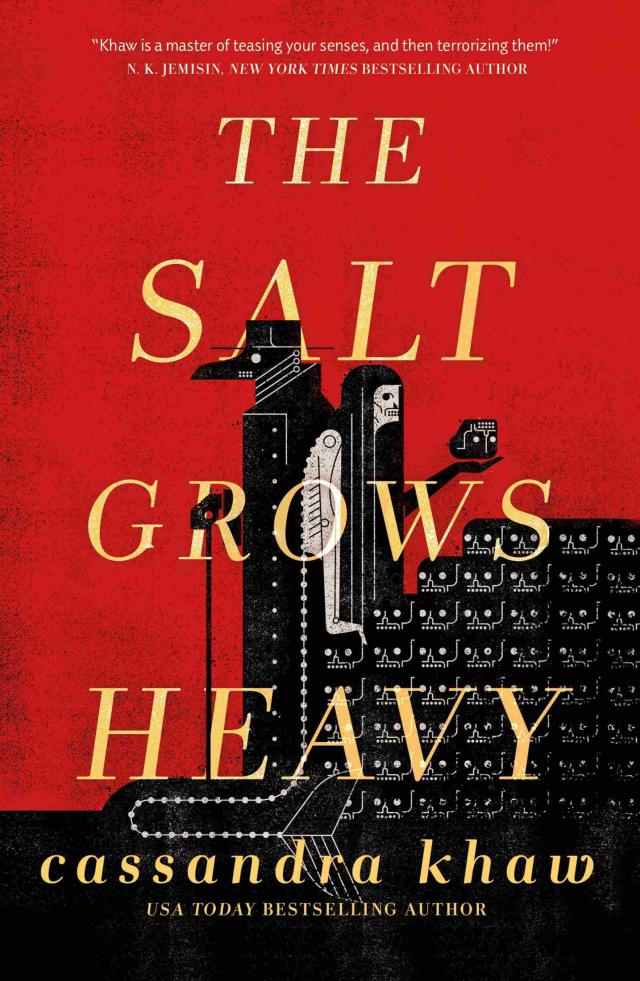
The Salt Grows Heavy, page 4


“The fact they killed Samson?”
The plague doctor flinches. “Must you put it so bluntly?”
“I cannot change what I am.” I sit beside our horse, the animal tethered to an ancient cedar, the puzzle of its dry, dead boughs adorned with ribbons chewed ragged by the passing seasons. I am surprised that the skittish beast tolerates me so well. Already, my mount has taken one life since our journey together began, collapsing that poor boy’s sternum like bird bones between my teeth. But me, the equine indulges with its indifference, even the occasional nuzzle.
“I forget that your kind are so practical.”
If the remark was intended as insult, it finds no crack in my psyche. The truth liberates; it cannot cripple or maul, cannot injure, not unless one declares themselves its apostate. I shrug, one-shouldered. The abyss does not leave much room for niceties. “A mermaid—”
“Are the rumors true then? Are you all female? Do you—” Even in an hour of crisis, one’s nature is difficult to refute. The plague doctor ceases their listless patrol, widens their eyes, curiosity unfurling the lengthy comma of their spine.
I merely gaze at them in return, impassive.
“My apologies.” They palm the back of their neck. “That was unnecessary.”
I say nothing. The ice breaks beneath the lynx, gobbles it whole; the cat doesn’t even have opportunity to scream, only vanishes beneath the black water, a gasp of gold and then nothing at all. The plague doctor doesn’t take notice, frozen in their ruminations.
“We should leave,” I whisper, after the silence has had time to steep, a fog breathing across the river.
“We can’t. I told you,” the plague doctor replies rigidly, as though compelled by rote. “Well. You can. I won’t stop you. But I have to stay. I can’t—” They stiffen. “I can’t.”
I fit a burlap morral—while we slept, someone’d filled it with hay, cabbage, wilted baby’s breath—around the horse’s skull and pat its flank. It rises, grumbling into its feed. “You cannot save everyone. You know that.”
“I do.”
Between us stretches the recollection of a massacre, the bodies stacked shoulders-deep, mostly eaten, the sun red, and the sky sloughing soot and skin. An entire country, ingested in days. Not for the first time, I wonder why they tolerate my presence. After all, I am the distillation of their failure, the mother of the plague they could not stop. They stare at me, loss in their expression.
“So let us leave,” I say, gentler than before, different words crowding my lungs, the ghosts of a separate life. “There is nothing for us here.”
They sigh. “I cannot.”
“Clearly, your makers—”
“Do not call them that.”
“Creators, then. Gods. What would you prefer I call them?” My tone is measured, modulated, still as the water in a corpse’s lungs. “You are their offspring, are you not? Would you prefer I call them your parents? I can.”
“Stop.” The plague doctor kneads the bridge of their nose. A muscle beneath their eye quivers.
“I tire of this. I understand your Hippocratic impulse for compassion, but you are too late. These children are already like you. Every last one of them, I’m certain. And they relish this existence. Can you not see that? You may have no love for your makers—”
“I said stop.”
“—but these children worship the surgeons. Who are you trying to save? Really? Them, or some image of your juvenile self that you’ve preserved through the years?”
“Go.” The word unwraps into a moan. Every sentence that follows is snapped. Every syllable is brittle as old bone. “I promised you nothing. I vowed nothing. I swore no oath of service. If what you desire is to leave? Leave. I don’t understand your insistence that I follow. We owe each other nothi—”
“I owe you the loyalty of being the only other one.”
“Ha.” An expulsion of air, sharp and short, as though they’d endured the impact of a fist. The plague doctor sways and buries their face in their palms, shoulders quivering. The laugh that seeps from between their fingers is a lunatic noise, untethered to decorum or rhythm. It is all agony, the sound, like the hitching gasps of a dying child. “You’re absolutely right. We are but distorted mirrors of one another. Murderer and murdered, butcher and doctor.”
A ragged breath, filtered through clenched teeth.
“You are probably right. It is—” Always a pause before the word is spoken, always a tremor in its lilt. They drop their hands, straighten. “—probably too late for some. For most, even. It is probably a foolish idea … but yet. I remember being them, you understand? And I remember what followed. I was so young then. I—you are a mother. Surely, you must understand where I am coming from. Do you not care that they are children?”
“No.” I think of the lynx beneath the river, its veins crystallizing. Of Luke on his bier, newborn and screaming, the wet pink of his lungs like the ruined stub of a tongue hidden behind a smile. Of my daughters, suckling the marrow from their father’s kingdom, growing stronger by the hour. “Like everything else, they are only meat.”
* * *
“Perhaps, we could simply kill them in their sleep.”
The plague doctor crooks a humorless smile. “Martyrs are more powerful than gods.”
The village is awake. It bustles with music, off-key and playful. Children, no more than eight or nine in age, drag buckets from the outhouses, while others boil water, fillet root vegetables, defeather poultry, wash, sweep, mop, and otherwise attend to the myriad drudgeries of a pastoral existence. As for the older denizens: girls, rangy from neglect, their hair plaited into single braids, hack at the ice-crusted earth. Grim-faced boys claw at the tilled soil with their fingernails, sowing—
Bones.
Femurs like corn stalks, slender tibias, knucklebones they carefully pat into the moist loam. But it is the fecundity of the land that surprises me, not its morbid harvest. Under the snow, the dirt is rich and dark, looking like something you might grasp in the summer, soft enough to crumble between the fingers.
Beside me, the plague doctor’s steps stutter to a pause. “What is this? I’ve never seen bones planted in the soil like such.”
“It’s for the Witch Bride,” a familiar voice intones, polite and petulant. I look down to where the girl stands, defiant, the zenith of her head barely grazing the circumference of the plague doctor’s shoulder. Unlike her peers, she wears her tresses in a topknot, the carmine strands oiled to a sheen. Her garments are androgynous, practical: tan blouse, leather doublet, breeches without a stitch of ornamentation, high boots, and an overcoat cinched at narrow hip bones.
I know the name. No one in my husband’s kingdom did not. It was rumored that she was the downfall of that distant principality, a tepid marsh without historic importance, its only economy a trade in the hides of small mammals. It was rumored that she had no heart and thus had to steal the king’s own organ, that she was a bone-wight, cruel, a lie accoutred in stolen flesh, that she was hungry, bitter, resentful of her spouse’s sweet son.
It is always interesting to see how often women are described as ravenous when it is the men who, without exception, take without thought of compensation.
I smile at the girl and stoop so that we are eye to eye. “Why would she want a harvest of bones?”
“Don’t know. They say she’s building a new kingdom. Could be she’s starting her own religion. I hear that she’s been calling the bones back from the grave.” Her pale brow rucks further. The bridge of her nose is sunburned, peeling, and her lips are flaked with dry skin. She scratches at her jaw. “None of your business, anyway.”
“No, but nothing of what you’re doing is labor a child should worry about,” says the plague doctor.
I smile, careful not to expose my teeth. “Where is Samson?”
“Away. Like the saints said.” Resentment fruits in her expression, a bitter crop. “I’d appreciate that you don’t ask them any more questions on the subject.”
“Why is that?” The plague doctor speaks, voice languorous. But I am learning to recognize its nuances, to identify performativity in their address.
“None of your business either.”
“Fine.” A sigh that ends with a sharp clack of molars, the plague doctor’s manner turns impatient. Whatever poise they once possessed, it is gone now, pulped to an aftertaste. I straighten as they speak, hands vanished into my sleeves. “Can you at least attend to the horse?”
“Sure.” The girl takes the proffered reins. For all their difference in stature, she exhibits no fear of the gelding, only that precocious surliness unique to youth. Both the plague doctor and I are silent as we watch the two depart, one clopping docilely behind the other. No one raises their attention from their labor to greet them. The children work without halt, breath crisping in the air.
Then at last:
“What now?”
The plague doctor pivots, raises themself slightly on the arch of a heel as they lean in, their voice warm against the skin of my ear. There is a grin in their next words, a texturing of teeth bared, feral. “How do you kill any religion? You convince its flock that their shepherds are wolves.”
“And how do you plan to do that?”
“We find a Judas goat.”
* * *
We find Luke by a pond at the back of the village, kneeling before a stone shrine. It sits canopied beneath ice-beaded brambles, a single candle guttering at its heart. Its architecture is not wholly alien. Somewhere in my husband’s library, I’ve glimpsed that gabled roof, the ligature of serpents; only larger, more elaborate in composition, with masonry whorled with creeping vines. A sight removed from the taiga and the terrain that the cold has annexed. I wonder: how would something like this find its way here?
Someone had brought offerings in obsidian plates, the black surface veined with gold. Nothing complicated: fresh bread, cured meats, a winter’s repast. I sink onto the earth behind Luke, while the plague doctor remains standing. A breeze drags the scent of salt and woodsmoke, tannic acids and animal musk.
“What do you want?” Luke’s voice is raw, low, hoarse from screaming. He slants a rheumatic gaze over his shoulder, mouth pulled into a line, and I see: pink muscle ribboning from his chin to his throat, an imperfection in the set of his eyes. The left—pellucid grey, almost without fault, only the tiniest fissuring—does not fit quite right in its socket. He blinks, the motion reptilian, right eye more sluggish than its counterpart.
“We’ve come to pay our respects,” my plague doctor intones.
“Well, sod off.”
Luke is thin as the turn of the waning moon, wrist bones protruding against waxy skin. His blond hair has been tonsured. On his bare scalp, a Vitruvian diagram in blue ink; some treatise on anatomy, perhaps, or a nautical chart with which sailors might sail the arteries of a leviathan.
“We apologize if we’re overstepping,” I begin. “Your makers—”
He flinches at the word the way my plague doctor does, and I know then that I have him. Like a fisherman, I am patient. I lower my timbre, adjust the intonation for sweetness, and watch as Luke works the hook inside his throat, shuddering with every gulp. “Your masters? Would you prefer that word?”
“T-the saints.” He sags, finally relenting. “We call them the saints.”
“The saints.” I wind my tongue around the word, savor it. “Your saints told us little about what we may or may not do. We don’t mean to offend.”
When he does not reply:
“Does it hurt?” I cup my hand around his shoulder, fingers mapped to his clavicle.
Luke moans at the contact, like something broken-backed and dying. “Only a little,” he whispers. “Only a little. A small thing, a small pain compared to the reward. I believe—”
“I can help stop the pain.” A rustle of footsteps, heavy fabrics shifting and settling. The plague doctor interrupts. I withdraw. Their tone is gentle, tender even. “You don’t have to suffer like this.”
“The saints—”
“They don’t have to know.” Seduction at its most austere, an appeal to the simplest desire: survival. “Let me at least see what they’ve done, Luke. A look. That is all I ask. I will not make a single cut. Not unless you tell me to.”
“Yes.” So very soft, the tired answer. So very frightened.
I look to the tree line where the pines stand like a tribunal in judgment. Sunlight breaks itself upon their branches, and the world beneath them is stark, no color at all, a chiaroscuro of midnight and salt. I tilt my head. Between the roots, there are graves, I realize, planted so close to the trees that there can be no mistaking the purpose. What better use is there for the rotting tenement of the soul than as sustenance for new life, life that’d linger longer after history has been digested by moths and mold? Meat may be mulch when left for long enough.
Such a provident, unsentimental decision. Surely, one made by the surgeons, the saints of this strange place.
“Do they do this often?”
I blink, retrain my attention onto Luke and the plague doctor. They’d convinced the boy to partially disrobe, divulging shoulder blade and vertebrae. His back is a codex of mismatched dermis: dusk-dark, ivory, shades of red-gold bronze. The stitching is sloppy, wide and uneven, performed with rough hessian thread instead of catgut.
“Only when we come back. The saints say it’s to make us stronger for the next time.”
“Shoddy work,” the plague doctor remarks, perfunctory. They sit cross-legged behind Luke, tools and opened vials fanned out around them, a miasma of prophylactics souring the cold. With care, the plague doctor removes a scroll of pale vellum from a satchel, unfurls the sheet, makes cuts lengthwise. “If—”
I almost do not hear the words that follow. “They take things too.”
“What things?” Their timbre is clinical, without unnecessary inflection. The plague doctor dips a scalpel in a bottle, wipes the flat of the blade along Luke’s scapula, the latter’s skin pimpling at the contact. “If you permit me, I can ease some of your discomfort. Muscle is not intended to be exposed like this. And the stitching”—a tsking noise—“is appalling.”
“Yes.”
A flick of the wrist. Light darts along sterilized steel. Thread unravels; the first loop comes apart. Steadily, the plague doctor descends the rung of sutures, daubing the places they pass with an astringent-smelling paste; citrus and cyanide, a tinting of caladium, foxglove in equal measure. Slowly, skin is exuviated, unwrapped in strips.
Through it all, Luke says nothing, emits no sound, only shudders and quakes. Perhaps from the cold, or perhaps the pain, or perhaps this show of compassion, however utilitarian its presentation.
“What did they take from you, Luke?” The plague doctor is efficient, methodical. Their stitching is evanescent. You’d miss it if you didn’t know where to look. I recognize the smell of the string they’ve used: goat intestine shaved into fibers, cured and knitted together. In time, it will disintegrate, absorb into flesh, and the worst that Luke will endure is a stutter of scars.
“A half of my liver,” he says, almost ashamed. “A kidney. Skin—”
“That much is evident.”
A fluttering laugh. “They put some back.”
I pick a coil of sloughed dermis from the snow and begin to gnaw on an end. The skin tastes musty, parchment-like. “Was that your punishment? For being caught?”
Killed, I almost say instead. Would have said were it not for the look in his eyes, his stare, the way he begins to shake, as though his skeleton might unlatch, separate into verses and phrases of hurt.
I hesitate. “You needn’t tell me.”
His tongue, small and pale, makes a circuit of his lips. “No, no. It’s alright. The saints—they say fear is one of our two teachers. That if we want to, ah”—a hiss, as fresh skin is transposed onto trembling meat—“ascend, we must know what it is like to be hunted, afraid. The pig always dies. It has to.”
“Why?” asks the plague doctor
“Because there must always be a beginning and an end.”
The plague doctor vents their displeasure, a thrumming deep in the grooves of their chest. “Strange words from men hoping to capture immortality in a bottle. Tell me: is your joy sweeter for your knowledge of what it is like to die? Do you enjoy every sunset better? Or does it stain you, follow like the whisper of a nightmare that will not end with your waking? A whipped dog is not happy to see its owner, it is merely counting the hours until the next torment.”
“The saints—” Defiance in the yaw of the words, his voice pitched high and quick. But Luke’s protest is reflexive, without conviction.
“The saints don’t know everything,” says my companion.
“They promised.”
“They lie.”
* * *
We left him with a bottle of the poultice that my plague doctor had used. Enough, they’d said, to survive him a week and four nights. More, if he could stand to ration himself. The substrate dispensed chemical ecstasy, orgasmic yet knifelike.
“Don’t drink it, though.” The plague doctor had chuckled, the noise like an ice floe riving beneath small paws. “You’ll die and there’d be nothing that your saints can do about it. There’d be nothing left of you but a silhouette on the ground.”
For the first time since I’d known him, Luke looked happy.
* * *
“It has been a day, at least, since you’ve eaten.”
The plague doctor slows, smiles, their natural inimicality softened for the pivot of a second. “You care.”
When I commit nothing in answer, having no want to either reassure or reprimand, they laugh, basal and heady. The woods grow thick here, along the hem of the village where it swells widest. Cedar and aspen, pine and white spruce, bent together in conspiracy. Under the eaves of their branches, the plague doctor’s face turns strange, honeycombed by harsh shadow.