The Last Supper Before Ragnarok, page 20


“I’m not sure I want this much pork, either!”
“You think too much, Rupert. Always have.” His admonishment is full of teeth. He can’t help it. Werewolf cults tint the divine soul. “Just eat.”
“It really is a matter of principle. When a menu says that something is served with steamed broccoli, it should come out with an actual portion of steamed broccoli.” I spear the lonely green vegetable on my plate with a fork. Now and then, I find myself wondering how it all became so banal. We’d kicked down the foundations of Heaven and installed the data-ghost of the World Wide Web in its place. Such an act should have more monumental consequences. Yet here I am, staring at broccoli and arguing with my maitre d’ as we survey the competition. “This is just garnish.”
“Also steam broccoli.”
“All I’m saying is that this is ridiculous. But if this is what the adversary is doing, we’re going to have to keep up, I guess.” I nibble on one of the cutlets. Not bad. The curry is meekly spiced, but otherwise functional: not watery, not overly salted, one-note, which isn’t strictly a mark against its flavour. “You know, they’re really good at frying things here.”
I wasn’t sure if I could love Edinburgh. Half because it was forced upon me: Amanda and Fitz, despite the fact they own penthouses in six countries, wouldn’t let me pick my own new nationality. It was Scotland or nothing. Like it or stay pathetically destitute for a man of my age. Also, it is intrinsically difficult to present any sort of argument when one’s still processing the idea that Amanda, despite her new omnipotence, had elected to keep Fitz’s prolonged company. Neither of them will admit to any kind of romantic relationship, but I have my suspicions. And frankly, it seems appropriate: a strung-out prophet on the road to recovery and the impartial spirit of information. If those aren’t holy icons for the new millennium, I don’t know what is.
So, I let Amanda write me my backstory: birth certificate, credit cards, a college degree I’d barely earned, a few failed applications locked in the system of Le Cordon Bleu, a single award nomination somewhere foreign to suggest that there is substance behind what initial reviews have labelled ‘brazen’ and ‘experimental.’
The restaurant, I admit, I wasn’t expecting.
At best, I thought they’d give me a nest egg to ration while I set myself up as a line-cook somewhere mediocre. But there it was, in an alley branching from Prince’s street, less than ideal but not prohibitively out of the way, a second-storey restaurant all of my own. A fixer-upper with black mould in the back room, a kitchen so archaic it deserved its own museum. But it came with rent so cheap, I didn’t think twice.
Because more important than anything else, this place is mine.
I ran the first phase of the restaurant as a dinner club, specialising in Malaysian-Scottish fusion, and it was moderately successful: Edinburgh, I discover, thanks to its predilection for spiced offal, has a reasonably adventurous palate. But then the gods came to my door. Not the ones from the formalised pantheons, the ones canonised by mythology. But the forgotten ones, the YouTube manifestations, the ones still trying to find their way, learning as the world does the new words for hope and faith.
The God of Being Missing serves as security detail these days, keeping out stray apparitions. The God of Missing People is my sous chef, happy in the idea of each thing in its place. And Veles, I found on my own, luring him to Edinburgh with a decent insurance plan. No reason to leave an old dog out there to fend for himself.
Cason shows up once, his entire family in tow, to celebrate the opening of Ambrosia. Tanis and Naree come every year, when fall transforms the city into fire. I make sure we have an outrageously ornamented birthday cake for Bee each time.
“By the way, here is review of restaurant.” Veles holds out the papers. “You should read.”
“Is it that bad?”
“No.” Veles noisily spoons broth into his mouth. “You see.”
It is on the last page of the entertainment section, nestled amid breathless accounts of trips to the Isle of Skye and nostalgic essays about the Mediterranean, all likely written by middle-aged white women of certain material standing who get together to expense a brunch every Saturday. The article isn’t long, but there’s a picture of me, standing at the top of the stairwell up to the restaurant, trying my hardest to look debonair. In the background, Veles, rolling his eyes at the camera.
I scan the review. Ambrosia, it writes and I try again to picture who the undercover critic could have been, whether it was the pencil-thin woman with a fur coat, or the man who lingered from morning to closing time, pecking at the daily rotations, does not appear like much, at first glance, the refurbishment efforts clearly knee-capped by an uncooperative budget.
Ouch.
But if you’re willing to put aside the lacklustre furnishings and the uneven service (the head waiter, Veles, is frighteningly enthusiastic and possibly prescient, in a very real Twilight Zone way), you’ll find yourself treated to food befitting the ambitious name. Ambrosia is divine, if dangerously in love with spices…
I skim the criticism of the food.
…Overall, however, I recommend this new rising star in the neighbourhood. Ambrosia will go far. And honestly, I’d die happy if this was my last supper before Ragnarök.
And that, ang moh, is how you end a story.
ACKNOWLEDGEMENTS
I LIKE THE IDEA of happy endings for urban fantasy heroes. I can’t imagine what it’s like: not only being told you have to save the world repeatedly, but having to repeatedly choke down all of your trauma because you’re not supposed to talk about it. So, these guys get to have a happy ending. Just because.
And also because I’ve murdered Rupert Wong so many times now, it’s getting a little ridiculous.
They say you’ll always remember your first and I guess that’s true. Rupert was my first entry into fiction; he was the first character I’d ever written with the intention of placing in a book. At least as an adult. And I will always love him for that reason. Guilt aside, it’s why he’s now running a little restaurant in my favorite European city. It’ll be years before I can finally settle down in Edinburgh, but at least Rupert will live in her heart for me.
To everyone who has stayed with me throughout this ride, thank you. There may be prequels in the future, I don’t know. We’ll see. But either way, I hope y’all enjoyed yourselves.
To my mouse, thank you for listening to me wail about Rupert for years and years and years.
To my editor again, thank you for believing in me. You were the first person to give me faith that I could do this writing thing, and you were there for me as my friend through some of the worst years of my life.
To my guard puppy, thank you for being the heart of this book in some ways. The Last Supper Before Ragnarok is about love, about how love’s the reason we fight, about where love will take us. Thank you for reminding me of that.
ABOUT THE AUTHOR
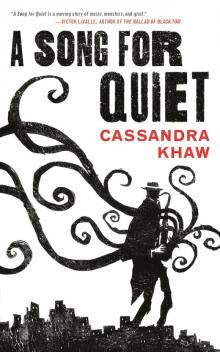
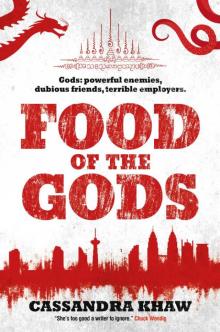
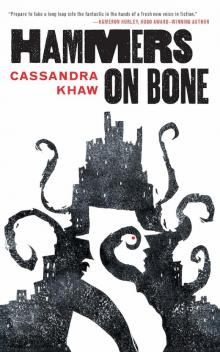
Cassandra Khaw is a scriptwriter in Ubisoft Montreal. Her work can be found in F&SF, Lightspeed, Tor.com and Strange Horizons. She has also contributed to titles like Sunless Skies, Fallen London, Wasteland 3, and She Remembered Caterpillars, which won the German Game Award for Best Children’s Game. Hammers on Bone, her first novella, was nominated for the Locus Award and the British Fantasy Award. Her most recent novel Food of the Gods was nominated for the Locus Award.
Life begins when your boss is killed.
Five years ago, Cason Cole walked away from his wife and son and became a chew toy to an actual god. Now, as the being he both loves and hates lies dying at his feet, the explosion still ringing in his ears, Cason is finally free.
For the past thirty years, gods and monsters have walked among us, making us their pawns and playthings. But mortals aren’t the poor things they were in aeons past. It’s time for payback.
Includes Bonus Novella Drag Hunt by Pat Kelleher
Someone has stolen Coyote’s penis. His quest to retrieve it—his latest victim, Richard Greene, in tow—will drag him into a terrifying conspiracy. Saving the world is going to take everything in his bag of tricks—and he’s suffering from the ultimate performance anxiety.
“Ultra-twisted.”
Charlie Jane Anders, io9
“A grittier version of American Gods... Unclean Spirits is a lesson in how to write godpunk.”
Starburst Magazine
“There is a powerful edge to Wendig’s writing, a unique voice that stands apart. This voice is dark, gritty, dirty almost, but elegant and rich and absorbing.”
SFBook Reviews
www.abaddonbooks.com
Louie “Fitz” Fitzsimmons is getting out of the drugs business. It was never what you might call a career, anyway; he’s got problems – strange, violent, vivid hallucinations that have plagued him since he was a kid – and what with one thing and another, this is where he’s ended up. So he’s been cooking Hollywood gangster Blake Kaplan’s books, and putting a little aside for a rainy day – fifteen million, give or take – and he figures it’s time to cut and run. Until a vision hits at the worst possible moment, and now he’s in hospital and looking at a stretch in County on a possession charge.
Then a Lithuanian goddess of the hunt murders her way into the hospital, and Fitz ends up on the run from a pissed-off angel, and there’s new gods – gods of business and the internet – hunting him down, and what started as a bad day gets a whole lot worse. Because Fitz is a Chronicler, a prophet – a modern Moses or Hesiod – with the power to make, or break, the gods themselves...
‘A head-shakingly perfect blend of deadpan wit, startling profanity, desperate improvisation and inventive brilliance’
Kirkus Reviews on City of the Lost
‘Blackmoore is taking urban fantasy in all new directions and setting fire to its cherished tropes’
SF Revu
www.abaddonbooks.com
Tanis Barlas is, in no particular order, a daughter of Lamia, a snake-woman, a killer and a hunter, collecting men to mate with her mother and continue the precious line. She hates it, like she hates her messed-up family and everything that goes with it.
And now Lamia’s favourite daughter has gone missing, and Tanis is sent into enemy territory – the snake-haired gorgons, whose turf starts at the edge of the swamp – to find her, starting a chain of events that will change every part of her life.
“A high-octane thriller, rife with mythology and god-killing. Highly recommended.”
The Raggedy Author on Mythbreaker
“The hero’s profanity-laced, snarky, deeply loving, yet antagonistic relationship with her mother is delightful.”
Kirkus Reviews on The Awesome
“Monahan does a brilliant job of racheting up tension and keeping the stakes high throughout the novel.”
The Book Smugglers on Mary: The Summoning
www.abaddonbooks.com
Cassandra Khaw, The Last Supper Before Ragnarok