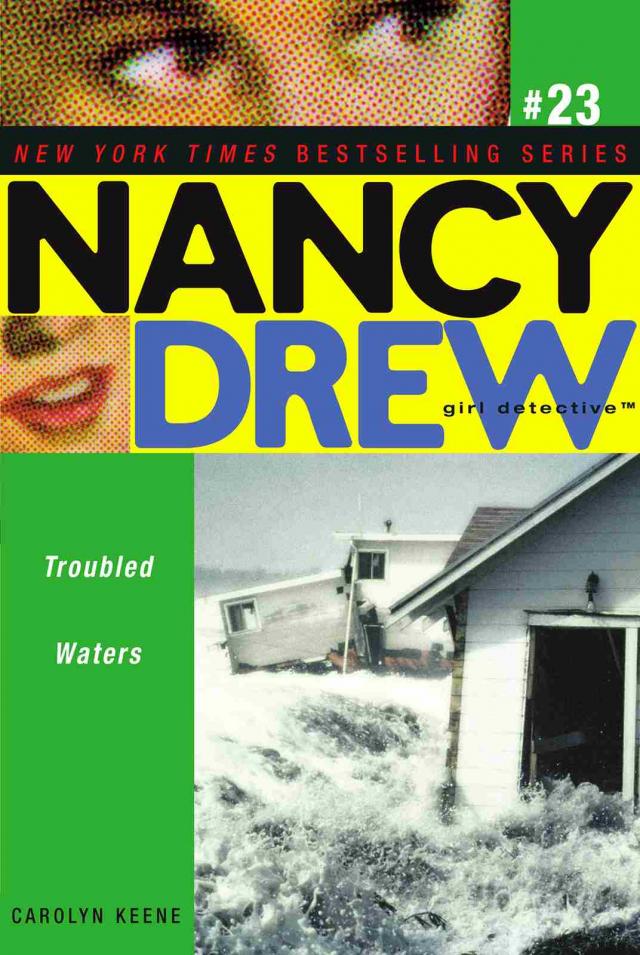
Troubled Waters, page 1


ALL NEW ALL NEW ALL NEW
When heavy rains washed out the low-lying towns around River Heights, my friends and I knew we had to help. That’s when we hooked up with Helping Homes to build apartments. Then the two-time state champion basketball team, the Lowell University Bullets, showed up—and the waters, so to speak, turned murky.
While George couldn’t be happier about working close to J. C. Valdez, the Bullets’ star forward, not everyone around us is a fan. Take the person who is destroying our work and spray painting threats to J. C. on the walls, for starters. Is this the product of some basketball feud, or something much larger? I may be up to my elbows in sheet rock, but that won’t slow my sleuthing. . . .
Troubled
Waters
ALADDIN PAPERBACKS
Simon & Schuster, New York
Cover designed by Debra Sfetsios Cover photograph copyright © 2007 by
Getty Images/Photodisc Green
Ages 8–12
Kids.SimonandSchuster.com
0507
Let me introduce myself. I’m Nancy Drew.
My friends call me Nancy. My enemies call me a lot of other things, like “that girl who cooked my goose.” They actually sometimes speak like that, but what can you expect from criminals? See, I’m a detective. Well, not really. I mean, I don’t have a license or anything. I don’t carry a badge or a gun, in part because I wouldn’t touch a gun even if I could, and also because I’m just not old enough. But I am old enough to know when something isn’t right, when somebody’s getting an unfair deal, when someone’s done something they shouldn’t do. And I know how to stop them, catch them, and get them into the hands of the law, where they belong. I take those things seriously, and I’m almost never wrong.
My best friends, Bess and George, might not totally agree with me. They tell me I’m wrong a lot, and that they have to cover for me all of the time just to make me look good. Bess would tell you I dress badly. I call it casual. George would tell you I’m not focused. By that she’d mean that once again I forgot to fill my car with gas or bring enough money to buy lunch. But they both know I’m always focused when it comes to crime. Always.
Nancy Drew
In Deep Water . . .
“By mistake?” I repeated. “You think someone tracked down the water valve and took a wrench to it by mistake?”
“You’d be surprised,” Owen said, laughing. “This isn’t the first time an overeager volunteer did something they shouldn’t have and didn’t want to admit it.”
I didn’t say anything more. I mean, the guy had a lot more experience at construction work than I did. Still, I didn’t feel nearly as sure as Owen that the valve had been opened accidentally.
“Uh-oh. I know that look.” George raised an eyebrow at me. “What are you thinking, Nancy?”
girl detective ™
#1 Without a Trace
#2 A Race Against Time
#3 False Notes
#4 High Risk
#5 Lights, Camera . . .
#6 Action!
#7 The Stolen Relic
#8 The Scarlet Macaw Scandal
#9 Secret of the Spa
#10 Uncivil Acts
#11 Riverboat Ruse
#12 Stop the Clock
#13 Trade Wind Danger
#14 Bad Times, Big Crimes
#15 Framed
#16 Dangerous Plays
#17 En Garde
#18 Pit of Vipers
#19 Orchid Thief
#20 Getting Burned
#21 Close Encounters
#22 Dressed to Steal
#23 Troubled Waters
Available from Aladdin Paperbacks
This book is a work of fiction. Any references to historical events, real people, or real locales are used fictitiously. Other names, characters, places, and incidents are the product of the author’s imagination, and any resemblance to actual events or locales or persons, living or dead, is entirely coincidental.
ALADDIN PAPERBACKS
An imprint of Simon & Schuster Children’s Publishing Division
1230 Avenue of the Americas, New York, NY 10020
www.SimonandSchuster.com
Copyright © 2007 by Simon & Schuster, Inc.
All rights reserved, including the right of
reproduction in whole or in part in any form.
NANCY DREW is a registered trademark of Simon & Schuster, Inc.
ALADDIN PAPERBACKS, NANCY DREW: GIRL DETECTIVE, and
colophon are trademarks of Simon & Schuster, Inc.
ISBN: 978-1-4424-6543-5(eBook)
First Aladdin Paperbacks edition April 2007
Library of Congress Control Number 2006924387
ISBN-13: 978-1-4169-2513-2
ISBN-10: 1-4169-2513-9
Chapter 1: After the Flood
Chapter 2: Rivals
Chapter 3: Troubled Start
Chapter 4: Waterlogged!
Chapter 5: Getting Even
Chapter 6: J.C. Go Home
Chapter 7: Lies and Excuses
Chapter 8: Night Chase
Chapter 9: The Search for Secret Rooms
Chapter 10: Friends—or Foes?
Chapter 11: A Clue in the Night
Chapter 12: Follow Them!
Chapter 13: Mission in the Flood Zone
Chapter 14: Race to the Stolen Money
Chapter 15: Thief’s Reward
Troubled Waters
1
After the Flood
Voila! Two dozen turkey sandwiches with lettuce, cheese, and tomato, all wrapped and ready to go,” I said.
I held up a tray in the middle of our kitchen and grinned at my two best friends, Bess Marvin and George Fayne. The three of us had been making sandwiches for the past hour—maybe longer. We were totally surrounded by cold cuts, lettuce, bread, cucumbers, sliced peppers . . . you name it.
“I’ve got ham on whole wheat,” George added. She tore some plastic wrap from a roll, stretched it around the sandwich she’d just made, and added it to a pile on the counter.
“And I’m almost done with these veggie wraps,” George’s cousin Bess spoke up, standing at the counter next to George. “They look delicious, if I say so myself.”
“Hey, no tasting,” George teased. “Remember what Cathy said. People over at the Historical Society and the Senior Center are waiting for these sandwiches.”
I’ll be the first to admit that my friends and I can get food obsessed. Give us three spoons and a pint of ice cream, and we’re in heaven. But this time we’d actually been motivated by something other than our bottomless-pit stomachs.
We’d had record-breaking spring rains in our area. When you live near a river, like we do, wet weather can cause big trouble. Our town of River Heights hadn’t been hit too badly. The cliffs along the river kept water from overflowing. But some of the low-lying towns south of us hadn’t been so lucky. Every night we heard on the news how the floods were the worst our area had seen in a century. Hundreds of people had lost their homes. They were being put up temporarily in places like the Historical Society building, the Senior Center, local hotels—anyplace that had room . . . including the guest room and the sofa bed in the Drew family home. My house, in other words.
Bess, George, and I turned as the kitchen door opened. Our housekeeper, Hannah Gruen, came in. Her niece, Cathy Fogler, was behind her, along with Cathy’s seventeen-year-old son, Brad. They carried bulky cardboard boxes, which they angled through the doorway. It didn’t take a detective to see that the three of them were related. They all had the same blue eyes and broad cheeks. But Hannah and Cathy were round and curvy and on the short side, while Brad had the tall, muscular build of an athlete. He towered over the rest of us as he placed his boxes on the counter near George.
“Where should we put these sandwiches, Hannah?” George asked.
Hannah has lived with Dad and me ever since my mother died, when I was three. The kitchen is usually her territory. But in the two weeks since Cathy and Brad had been staying with us, Cathy had done even more cooking than Hannah. So I wasn’t surprised when Cathy was the one who answered George’s question. Dropping her boxes on the floor, she took a look around.
“Brad, why don’t you help the girls load sandwiches in these boxes? Aunt Hannah and I will pack up the cakes and quiches we made this morning,” Cathy said. She nodded at a dozen quiches and chocolate cakes that covered the kitchen table. “I’m sure everyone will appreciate a tasty meal after all they’ve been through.”
“You make it sound like the floods have only been hard for other people. You and Brad lost your house too,” Bess said, bending to place veggie wraps in one of the boxes. “And your business.”
I saw a sad gleam in Cathy’s eyes. “It figures the floods would hit right after I redid the kitchen so I could handle more catering jobs. I never imagined the whole house would collapse like it did. Brad and I didn’t take anything but some clothes when we left,” she said. “Now it’s all gone. Brad’s baby pictures . . . everything.”
I wasn’t sure what to say. But then Cathy smiled and said, “We’re just lucky to know people like you and your dad, Nancy. I don’t know where Brad and I would be if you hadn’t insisted that we stay here. And Mrs. Mahoney has me delivering meals to flood victims all over the county. I’m actually busier now than I was before the floods.”
Mrs. Mahoney is like a one-person good-deeds factory in River Heights. She runs the Mahoney Foundation, which has contributed to just about every worthy cause around. Ha lf the buildings in town have her name on them. Making sure flood victims had enough to eat was exactly the kind of thing she would do. And by hiring Cathy to supply meals, Mrs. Mahoney was helping to keep Cathy’s catering business—called the Catered Table—going strong too.
“The floods have been hard on Brad, though,” Cathy went on. She sighed as Brad headed out the kitchen door with a box that George had just finished packing. “Our whole neighborhood in Cedar Plains was pretty much destroyed. About half of the boys on Brad’s basketball team are staying with friends or relatives. It’ll be months before they can get back in their homes—if their houses are still standing.”
“Ouch,” George said, grimacing.
Cathy nodded. “Thank goodness the school gym didn’t flood, that’s all I can say. Basketball is the one normal thing a lot of the kids have left,” she said. “That’s why their coach is holding practice this week, even though school’s closed for vacation.”
I felt an ache in the pit of my stomach. It was the same ache I got every time I saw another story on the news about a building that had been washed away or a family pet that was missing. So many people had lost so much. I wished I could do more to help.
Maybe it was a coincidence that Dad called right then. He likes to check in with me when he’s at the office, especially when I’m trying to solve a mystery and he’s worried I might be in some kind of trouble. Not that there was any mystery in my life at the moment. Still, Dad’s timing was perfect. As soon as I heard what he had to say, the ache in my stomach turned into an excited buzz.
“Guess what?” I said, dropping the phone on the counter. “Dad just told me that—”
“Tell us while we drive to the Historical Society,” Cathy cut in. She headed for the door with a box of quiches. “We were supposed to be there ten minutes ago!”
“Let me get this straight. We’re going to be part of the Helping Homes renovation team?” George said twenty minutes later. “Those guys do amazing work.”
“That’s for sure. Did you see the TV special about that old factory in California? Helping Homes made it over into apartments for people with disabilities,” Bess added. “They had six teams of volunteers working like crazy. The whole place was ready in less than a month.”
We had just arrived at the River Heights Historical Society—though, to be honest, it looked more like a shelter than anything else. Cots and bags of people’s personal belongings filled the open room where lectures and exhibits were usually held. The two long tables in the adjoining library had been cleared of old books and maps and letters. I counted about two dozen people who sat there ready to eat the lunch we’d brought—from little kids to a wiry, white-haired man who used a walker. Cathy had been right about them appreciating a tasty meal. They all dug in with gusto when we handed out sandwiches and slices of cake.
“Well, now Helping Homes is doing the same thing with the old Davis Foundry,” I said, making my way down one of the tables with plastic cups of milk and water.
“That run-down old metalworks next to the river?” Bess said. She handed veggie wraps to two teenage girls while George held the box. “It shut down ages ago.”
“In nineteen fifty-six, according to Dad. But he says the building is solid. And it’s huge. When Helping Homes is done, there’ll be one hundred new apartments for people who lost their houses in the floods.”
Cathy grinned over her should at me as she handed out plates of quiche. “Including Brad and me?” she said, shaking her head. “You’re sure, Nancy?”
“Definitely. Dad is handling some of the legal details, so he ought to know,” I told her. “He knew Bess and George and I would want to help, so he signed all three of us up as volunteers. Actually, tons of people are helping. Dad said the whole Lowell University basketball team is going to be working with us.”
“The Bullets?” George glanced over the top of the bulky box, and her eyes lit up. “They won the state championship, two years running! Their starting forward is awesome. J.C. Valdez. I’m pretty sure he’s from around here.”
Cathy nodded. “J.C. went to Cedar Plains High,” she said. “All the guys on Brad’s team idolize him. The way they see it, he’s living proof that a local boy can make it big.”
“Anyway, I guess we’ll meet the whole team later,” I said. “All the volunteers are supposed to meet at the Davis Foundry at four o’clock for a press conference.”
As we moved to the second table, the heavy wooden door to the Historical Society banged open. A teenage boy with a mop of reddish hair ran in. He looked excitedly around until his gaze landed on Brad.
“Put that stuff down,” the boy said, nodding at the tray of cake slices Brad was holding. “We’ve got to head over to the school right away. Coach wants to talk to the whole team. We’re going to be training with the Bullets!”
Brad’s eyes snapped toward the other boy. “The Bullets? Cam, are you serious?” I noticed that Brad hadn’t kept pace with the rest of us, but was stuck halfway down the first table. He’d been held up by the older man who had snow-white hair and a walker. The guy didn’t seem to have heard what Brad’s friend Cam had said. He just hung on to Brad’s arm and kept on talking.
“Poor Otis is out there all by himself,” he said in a worried, raspy voice. “I called and called, but that old dog wouldn’t come. The water got so high that I had to leave without him.”
Cam glanced impatiently at his watch. “Coach Stanislaus wants us to meet now,” he said to Brad. “The Bullets are going to be working on some building renovation. Coach wants us to volunteer too. And we’ll be training with the Bullets every night.”
“Awesome!” Brad started to move toward Cam, but the white-haired man had a firm grip on his arm. “Um, I’ve really got to go, Mr. Fillmore. . . .”
“Looks like Brad needs some backup,” George said under her breath.
Putting down my tray of drinks, I walked back to the other table and said, “I’ll take over here, Brad. Um, Mr. Fillmore, have you tried calling the animal shelter?”
I felt sorry for Mr. Fillmore. He wasn’t exactly fit enough to go looking for his dog, and it had to be awful not knowing what had happened to him. Mr. Fillmore really didn’t want Brad to go. Even after I took over handing out the cake, he hung on to Brad’s sleeve and kept going on—and on—about Otis. It took Brad about five more minutes before he finally broke free and left with Cam.
“Did you see how happy they looked?” Cathy commented, watching the boys disappear through the door. “Working with the Bullets is a dream come true for those boys.”
“For us, too,” Bess said as she and George finished handing out sandwiches. “We get to help flood victims and hang out with the top basketball players in the state. How great is that?”
We were all so psyched that I didn’t think we could stand to wait until the Helping Homes press conference at four o’clock. But Cathy kept us busy. After delivering meals to people at the Historical Society, the Senior Center, and the River Heights Inn, we barely had time to change before heading to the old foundry.
“There’s the turnoff,” Bess said, leaning forward in the backseat of my car. She pointed to our right, and I saw a battered, weathered-looking sign marked DAVIS FOUNDRY. Just beyond, a narrow drive curved out of sight behind the trees.
I turned onto it, and we zigzagged through more trees. The narrow road, edged by a strip of muddy ground, rose uphill toward cliffs that overlooked the river. The woods were so thick around us that we didn’t see the old foundry until we came out of the trees right next to it.
“Whoa!” George said, blinking into the sudden daylight. “Talk about massive!”
There, perched at the edge of the cliffs, was a huge, rambling brick building. It looked as if a couple of football fields could fit inside of it. The brick exterior was grimy and worn, but it was clear that work to renovate the old foundry had begun. A blue tarp had been stretched over tent poles outside the building, and plywood and other building materials were piled underneath it. New windows had been put in from top to bottom, and a crew was steam cleaning the brick to reveal a startlingly bright reddish brown beneath the grime.
“There’s the RH News truck!” Bess said as I pulled into the parking lot. About thirty cars, trucks, and SUVs were parked there. We pulled to a stop right next to the van from our local TV station, with its satellite dish on the roof. A truck from the local newspaper, the River Heights Bugle, was parked a few cars down.