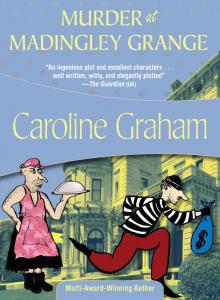
Murder at Maddingley Grange, page 3


“I have no intention of plucking my eyebrows.”
“Well, you can’t swan around in backless lamé with the ones you’ve got. They’re like overhanging eaves.”
“They’re fine.” Laurie smoothed the glossy dark wings with a fingertip. “And if the success of our whole enterprise depends on—” She was interrupted by the shrill ring of a bell, cried “That’s Hugh!” and ran into the hall.
The telephones at Madingley Grange had been installed in the forties and were great heavy Bakelite things with a receiver that put real demands on the muscles of the forearm. Laurie heaved it up to her ear. “Hugh? Where are you?”
“Still in Gloucester, darling. I’m most awfully sorry. The thing is, halfway to the station the Land-Rover blew a fuse or a gasket or whatever it is they blow…and we had to wait simply hours before someone came—”
“We?”
“Pacey was driving. I mean—someone had to return the thing.”
“They’ve got more than one car, surely?”
“Yes, but by the time we’d made it back to the Hall, Sir Piers had left with Frobisher in the Rolls, Nanny had gone in the Mini to visit Nanny Pargeter in Chipping Campden and Lady Kettersley-Gore had taken the Rover out shopping.”
“That’s a bit quixotic, isn’t it?”
“What?” A puzzled pause. “And by the time a car did become available it was too late to get a train that would connect to Oxford.”
“What about Betsy?”
“Toby’s borrowed her pro tem. You’re not miffed, are you, darling?” continued Hugh. “You sound a bit…well… distant…”
“Hugh,” said Laurie, struggling to hold her voice steady and choosing her words with care. “You know our murder weekend starts tomorrow. I shall need all the help and moral support that I can get. Now—you will be here by teatime at the very latest, won’t you?” In spite of her resolve, Laurie’s voice broke on the last sentence and panic rushed through the gap.
“Positively. Although I’m sure you’ve got everything organized.”
“Well, I think I’ve got the food sorted. The costumes are a scream. We’ve laid out your plus fours.”
There was a brief hiatus; just long enough for a man who has received a nonfatal body blow to fall to the ground and pick himself up again, then Hugh said: “There must be something wrong with this line. For a minute I thought you said you’d laid out my plus fours.”
“Ohhh, no…” replied Laurie, sensing a possible slackening of enthusiasm in her intended. “I said…um…It’s lovely… outdoors.”
“Is it? It’s raining buckets here.”
When Laurie returned to the annex Simon said: “You look shattered. Explain.” Laurie explained. “What’s he doing down there anyway?”
“Toby Kettersley-Gore is his best friend. They were at Greshams together. Hypaetia and Poppy are Toby’s sisters. Surely you remember Pacey. She was my best friend.”
“Mmmm.”
“What do you mean, ‘mmm’ ?”
“Perhaps he’s succumbed to all that propinquity.”
“Rubbish. Poppy’s a revolting little beast with pigtails who used to put toads in my bed when I went to stay. And Pacey’s teeth stick out and she’s always rushing at people.”
“How long is it since you’ve seen her?”
“A year…eighteen months…”
“She might have got them fixed by now. And some men like being rushed at.”
Laurie ignored him, emptied the basket and started carrying the costumes upstairs.
Chapter Three
At twelve noon on Friday Simon, having spaced the croquet hoops out on the lawns and cleaned the mallets, was preparing to drive into Oxford and collect the hired help.
“Don’t forget,” he said to Laurie as he climbed into the bus, “you’re the chatelaine and you do the bossing about. Use a firm hand. And no kindly queries about his gout or suggestions that she put her feet up—OK?” He paused, studying her frowning face. “Now what?”
“Do you think I’ll have time before you get back to pinch out the tomatoes?”
“Don’t you dare go anywhere near that greenhouse! Or that filthy herbaceous border. You’ll never get the upper hand if they arrive and find you standing around with straws in your hair.”
So after lunch Laurie scrubbed her nails, got out of her old dungarees and into her periwinkle-blue frock. As she waited nervously in the hall she practiced an “in charge” voice and kept telling herself that he who paid the piper called the tune. She wished she wasn’t quite so hazy as to what butlers actually did. She knew for certain only that they opened doors, received visitors’ outer garments and rolled around smoothly on little wheels bearing silver trays.
Her knowledge of a maid’s duties was even sketchier and culled mainly from old movies in which they put up the young mistress’s hair and laced her nineteen-inch waist, pushing a knee into the small of her back while crying: “Lawdy, Miss Scarlett—y’all shoh look mighty purty.”
Feeling fairly certain none of the guests would require this particular mix of brute strength and flattery, Laurie only hoped that A. Bennet (Mrs.) could carry out whatever was the twentieth-century equivalent should she be called upon to do so.
Laurie pulled the flowers on the refectory table about unnecessarily, then paced up and down a bit. Her eye caught the heavy rose velvet curtain at the far end of the hall behind which a corridor led to the kitchen and servants’ quarters. Wasn’t it the case that those above the salt passed through this cutoff point, “the green baize door,” at their peril? And that once the staff was firmly installed, the whole area could become a no-man’s-land unnegotiable except through the most ingratiating application?
Tires crunched on the gravel. They were here! If they call me madam, thought Laurie, I shall die.
She knew at once from the slightly defiant note in Simon’s “Hullo-o-o” as he ran up the steps that les domestiques would leave something to be desired. Had she known then quite how comprehensive this lack would prove to be, she would have taken to her heels and not stopped running till she reached the Barbary Coast. As it was, she cleared her throat nervously and stepped forward. The woman entered first. Laurie stepped back again.
Mrs. Bennet was a tall streak of unrelieved gloom. Her coat and skirt were gray, her lisle stockings were gray and her limp woolly the color of mouse droppings. Her feet were encased in the sort of shoes that expanded to accommodate bunions and were of glacé kid. A hat, charmingly styled after the manner of a German helmet, was rammed upon her head. Her eyes, the color of dirty gray ice, seemed huge behind pebbly glasses.
“Good afternoon, Mrs. Bennet,” said Laurie, stepping bravely forward once more and holding out her hand.
“Good afternoon, I’m sure, madam,” said the maid, hardly opening the grim line of her mouth and just brushing Laurie’s fingertips. Then, peering through the thick lenses, “Miss, that is. And it is not necessary to use my marital designation. Bennet will suffice.”
Her tone implied that anyone who needed to be told what was surely common knowledge to a person of refinement didn’t deserve a maid in the first place. The Hon. Mrs. Hatherley and Lady Keele, thought Laurie peevishly, no doubt absorbed such matters with their mothers’ milk.
“Very well, Bennet,” she said coolly, thinking: It’s only for two days and perhaps the butler might be less formidable.
He was a short man and stood preternaturally upright. But although he wore a well-pressed dark suit and a crisp white shirt and was parade-ground straight, there was about this ramrod stance, Laurie felt, something slightly fishy. A disquieting impression of secret shambolism. A feeling that this was a man to crack under the slightest pressure. Such as being asked to clean a boot or make a pot of tea for one. His eyes were rheumy, his teeth stained and his cheeks almost regally purple.
Laurie did not repeat the mistake of offering a hand but simply said: “Good afternoon…um…?”
“Gaunt, madam.”
“Gaunt?”
“That is correct.” The butler observed Laurie’s suddenly clamped lips and twitching brows and added, “Is something wrong, madam?”
“No, no,” Laurie hastened to reply though her voice shook. “Simon—Mr. Hannaford will show you to your quarters. Perhaps, after you’ve washed and unpacked you would come to the library, that’s the door on the far right, and I’ll explain what will be happening over the weekend.”
When Simon returned Laurie immediately said: “You might have warned me. Gaunt and Bennet!”
“There’s no need to chortle.”
“I’m not chortling.”
“Well whatever it was it sounded most peculiar. I must say, though, your manner seemed just about right. Firm but dignified. I know they’re not ideal—”
“That man drinks. You don’t get a complexion like a baboon’s bottom on Perrier and lemon squash.”
Simon rolled back his eyes. “All butlers drink. It’s par for the course. That’s why the butler’s pantry was invented.”
“I shall lock ours up,” said Laurie. “They do know about wearing funny clothes?”
“Period costume. Yes. And they don’t mind. Their reference from Mrs. Hatherley,” he went on as Laurie continued to look disenchanted, “was excellent.”
“Did you ring to check it?”
“I didn’t see the necessity.”
“I shall, then.”
But half an hour later, when Gaunt and Bennet presented themselves in the library, so perfectly did they appear to embody the prewar domestic virtues that Laurie felt her misgivings might have been a little hasty. She had pressed their outfits the previous day and could not but admire the results. Gaunt’s tails were immaculate, his dickey ice-white and firmly restrained by pearl studs. Bennet’s apron was a snowy exclamation point on a background of sooty black. Her starched and goffered cap was worn with unsaucy lack of compromise straight across her forehead and the basilisk gaze had become somewhat muted. Laurie was surprised to notice beneath the dark dress the swell of a quite attractive bosom and realized that Bennet, in spite of her gray hair, a few whiskery moles and a slight moustache, was hardly middle-aged. And Gaunt not that much older. As Laurie started to speak, both of them looked at her respectfully.
She started by showing them the dining room and explaining the menus. Bennet seemed quite unfazed by the fact that there would be twelve for dinner in less than four hours’ time, merely commenting that the Honorable Mrs. Hatherley had often had twice that number at a split second’s notice and them with hardly a game bird in the larder to bless themselves with.
Encouraged, Laurie led them both through the various bedrooms, giving Gaunt a list of the guests’ names with the appropriate room titles alongside.
“Charmingly furbished, madam, if I might say so?” said the butler, giving the toile de Jouy the once-over.
She showed them the vast kitchen somewhat apprehensively. It was not a cozy place (Simon called it “Ghormanghastly”) and there was no dishwasher. Aunt Maude’s modest amount of dirty crockery and silver was cleaned by Ivy, Cook washed up as she went along and, when the WI came to tea, they did the same. There was a huge stainless steel unit running down the center of the room, consisting of twelve gas rings, and three ovens with a freezer at each end. The gaping fireplace housed an iron spit. Faggots of herbs, gathered by Mrs. Maberley the previous summer during an evanescent attack of the Laura Ashleys, dangled dryly from blackened beams. The floor was stone-flagged and even on a hot June day very cool. On a side table were a portable oven and a little electric ring.
After opening various cupboards and showing the servants where the towels and cleaning materials were kept, and after Bennet had pointed out that stone did draw your feet something chronic and no mistake, Laurie explained that the glass and cutlery were in the armoire in the dining room.
“And the napery, miss?”
“That also.”
This professional-sounding inquiry cheered Laurie. Suddenly what had seemed impossible twenty-four hours ago—a table full of contented people chatting happily together while being quickly and discreetly served with delicious food and wine—began to seem not only possible but almost probable. Boldly she added: “And there might be shoes to be cleaned.” A certain lack of response. “Not everyone’s of course. I expect some guests will prefer to do their own.” She hurried on, “If it’s too much extra work…” and thought: Damn—I’m sliding into subservience already.
“I thrayve on hard work, madam,” said Gaunt.
“Oh…terrific.”
“And now,” the butler continued, “perhaps you would be kind enough to direct me to the pantry.”
“Ah. Well…the problem there is—”
“If you are serving port, madam, it should have been decanted by now.”
“We’re not.”
The butler reeled delicately. “No port, madam?”
“Or nuts. Except with the cocktails.”
“Then the waynes…”
“The what?”
“Have they been brought up from the cellar? Are they opened? Have they breathed?”
“Yes. And no. So probably not.”
Oh, hell. Laurie frowned as the man stood politely expectant. They’ll think I’m an absolute fool. And what, when you really came down to it, was the point of keeping him out of the pantry? If he seriously intended to start soaking up the juice he could do so anywhere. In fact, you could argue it was better that he should be doing it in a known and confined area. At least that way one could tot up the empties. And there was always the chance that she had been mistaken in her judgment of that delicate French violet complexion. The poor chap might have high blood pressure. Or heart trouble. Laurie berated herself for losing her nerve so early in the game.
“You’re quite right, Gaunt,” she said. “I just didn’t get around to the drinks side of things. If you come along with me now, I’ll give you the keys.”
Two hours later Simon was ready to set off for the station and Hugh had still not arrived. Laurie had eventually, resentfully, taken it upon herself to ring Kettersley Hall. There had been no reply. Simon said an empty house must mean Hugh was on his way and Laurie said she hoped to heaven he wasn’t bringing the entire Kettersley-Gore contingent with him.
“You could have worn the plus fours after all,” she continued, eyeing Simon’s cream Oxford bags, short-sleeved shirt and sleeveless Fair Isle pullover.
“Don’t be spiteful,” retorted Simon. “I’ve no intention of inflicting such garments upon our guests. There’s enough sorrow in the world as it is.”
Laurie watched him drive away and pictured his return, the vehicle disgorging hordes of avid punters all seeking mayhem, blood and gore. Nine strangers loose among Aunt Maude’s beautiful treasured possessions. She felt her throat close in panic and flutter as if a tiny bird were trapped there. How had she allowed herself to be persuaded into this dreadful venture? A spot of discreet throat clearing recalled her to the present. Gaunt was standing by one of the oleanders.
“I have prepared everything for drinks out here with the exception of the ace, madam. And Bennet asks if you would be kind enough to come and look at the setting for dinner.”
“Of course.” Laurie followed the stately figure into the dining room, where the surface of the long Sheraton table had almost vanished beneath a positive splendor of sparkling crystal, heavy silver, starched mats, napkins and fragrant flowers. “That looks lovely. Thank you, Bennet.”
The maid tucked in her chin and made a little bob; then they both stood looking expectant while Laurie realized that all three of them now had an hour and a half on their hands.
“Are things progressing in the kitchen?”
“Yes’m. Everything’s in order.”
“Right. In that case I don’t see why you shouldn’t relax for an hour. There’ll be a lot to do this evening. I don’t suppose we’ll finish till late. If Mr. Wriothesley calls you’ll find me in the—” Laurie broke off, looking down at her silk dress. The herbaceous border was obviously out. As was her favorite retreat of all, the vegetable garden. On the other hand, she urgently needed to be in close proximity with green and growing things. Her troubled spirit felt calmer at the very thought. “You’ll find me in the conservatory.”
Chapter Four
“I don’t like the way that owl’s looking at me.”
“Shut the frigging door, then.”
“You shut it. You’re the one that’s on your feet.”
Gaunt was lying on the bed smoking. He had removed his tailcoat and rolled up his sleeves but still had his shoes on. Bennet, wearing a neon-pink shortie dressing gown and a pair of boxer shorts paced up and down.
Their bedroom was very large and held a washbasin, one double bed (walnut veneer, circa 1950) and a narrow divan, both made up with clean cotton sheets and clean, but rather worn, cellular blankets. This opened off a sitting room which was almost impenetrable, being crammed with all the bits and pieces unwanted elsewhere. A round table, a wormy prie-dieu, a drop-leaf table, its bloom disfigured by many overlapping pale gray rings, six chairs with fraying petit-point seats, a broken bamboo whatnot and several cases of stuffed birds, one of which contained the observant owl.
“We shall want locking up if we don’t get a result in a place like this.” Gaunt turned his back on the open door. “Fancy leaving two kids in charge.”
“I wouldn’t call him a kid. He’s a cold-eyed sod. She’s all right.”
“We’ll walk it.” The butler stubbed out his fag. “Dance it.”
“Where’ve I heard that before?”
“It’s the brotherly support that keeps me going.”
“All I’m saying is—”
“We got a weekend filler here could set us up for life.”
“Don’t use that word, Gordon. You know how it affects me.”