Larrimah, page 1


When Caroline Graham and Kylie Stevenson first met in a regional Queensland newsroom, neither of them imagined that thirteen years later they’d be sharing a room in a tiny outback town embroiled in a murder mystery. Before co-writing this book, they made the 2018 Walkley Award–winning podcast Lost in Larrimah. In the process, they have eaten more meat pies and pub schnitzels than they should have.
Kylie Stevenson has 20 years’ experience as a journalist, her work appearing in The Guardian, The Australian, the Weekend Australian Magazine, the Saturday Paper and numerous health, lifestyle and travel publications. She has spent the last 14 years working in the Northern Territory, eight of them at the iconic, croc-obsessed NT News. She is currently undertaking a Doctorate of Creative Arts at the University of Wollongong, and to fund this folly she continues freelance writing. Kylie lives on Larrakia country in Darwin with her husband Michael, son Eddie and their dog Walter.
Caroline Graham has worked as a newspaper reporter and magazine writer, and has taught journalism at Bond University for more than a decade. She is the co-author of Writing Feature Stories: How to research and write articles—from listicles to longform, has a PhD in creative writing and has written for a range of publications, including the Weekend Australian, The Guardian and the Daily Mercury. Her short fiction and creative non-fiction has been published by Day One and Text. She lives on Yugambeh country on the Gold Coast and nothing makes her feel more smug than when someone congratulates her on her morning ocean swim in winter. It isn’t even that cold on the Gold Coast.
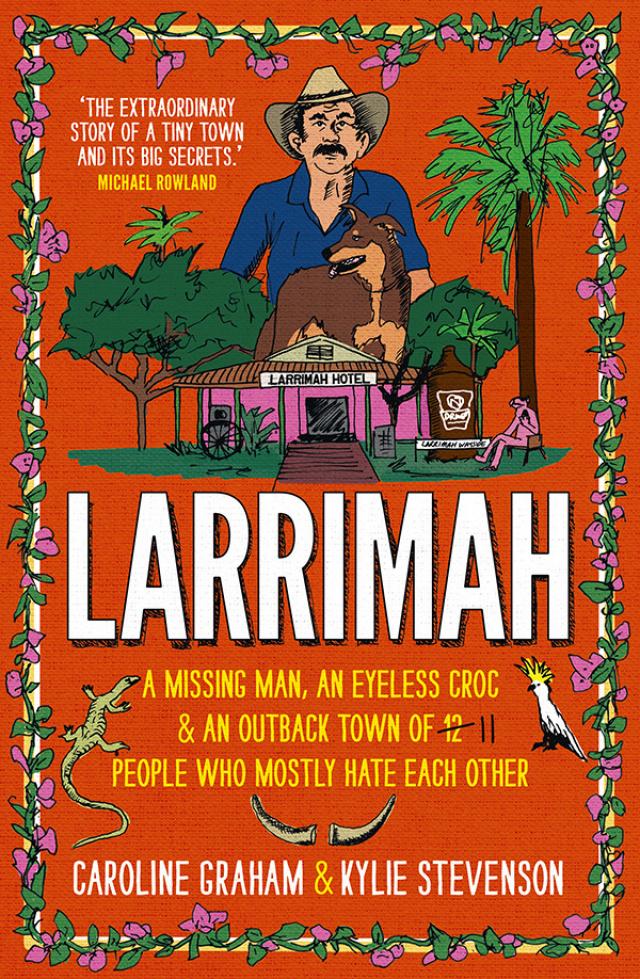
As with all images on the cover, the Pink Panther and NT Draught bottle reflect some of the characteristics of the town of Larrimah (in this instance the local hotel) and neither the authors nor the publisher have any connection with Metro-Goldwyn-Mayer Studios Inc or CUB Pty Ltd or any other product of those companies and readers should not interpret anything in this book as giving rise to any such connection.
First published in 2021
Copyright © Caroline Graham and Kylie Stevenson 2021
All rights reserved. No part of this book may be reproduced or transmitted in any form or by any means, electronic or mechanical, including photocopying, recording or by any information storage and retrieval system, without prior permission in writing from the publisher. The Australian Copyright Act 1968 (the Act) allows a maximum of one chapter or 10 per cent of this book, whichever is the greater, to be photocopied by any educational institution for its educational purposes provided that the educational institution (or body that administers it) has given a remuneration notice to the Copyright Agency (Australia) under the Act.
Allen & Unwin
83 Alexander Street
Crows Nest NSW 2065
Australia
Phone:(61 2) 8425 0100
Email:info@allenandunwin.com
Web:www.allenandunwin.com
ISBN 978 1 76087 783 5
eISBN 978 1 76106 292 6
Cover design and illustration: Luke Causby / Blue Cork
Maps by Mika Tabata
Set by Post Pre-press Group, Australia
For Larrimah, a town that isn’t good and isn’t ours but that we love, earnestly.
Contents
Maps
Prologue
PART ONE The disappearing man
1 A pink pub, a blind croc and an empty bar stool
2 An esky race, 600,000 mealworms and an uncollected mower
3 Some dingo scalps, a stolen piano accordion and a desperate search through the wretched Never Never
4 A half-liquefied chicken, a pop band attacked by termites and the word ‘murder’
5 A dead donkey, fifty shades of biscuit and the problem with pies
6 A suspicious croc, a drained septic tank and a landscape full of secrets
7 Camel mince waffles, a roadkill prank and a yearning for a gin and squash
8 A world war, a maybe-murdered buffalo and Monty the unbeatable lizard
9 A town war, a prince with the trots and enough sinkholes to make you nervous
10 A moment of civic glory, an alcoholic donkey and two not-so-undercover cops
11 A bogged camel, an exploding cow and a series of fallings-out
12 A long-awaited homecoming, kangaroo for dinner and 65,000 years of history
13 A faceful of grasshoppers, some Russian peanut farmers and the loneliness of a ghost town
PART TWO The disappearing town
14 The sound of falcons being shot, an octogenarian looking for love and a quest for justice
15 A rejected gardening book, a lover (not a fighter) and a case of osteoarthritis
16 A bushie who finally talks, a gentle red nose pit bull and a case of osteoporosis
17 A soon-to-be-homeless crocodile, a plate full of rissoles and a lack of closure
PART THREE The disappearing outback
18 An angry ghost woman, a mobile phone black spot and a highway of tears
19 A publican who went troppo, a million bats and a town set on repeat
20 A family full of Patricks, a horny border collie and a man without a past
21 Some legless trousers, the world's loudest burper and a shameful history
22 Some weird energy, a dead-weird PhD and an even weirder offer
23 A maybe-mercenary, a man in the scrub and a policeman haunted by Paddy
24 A lost cemetery, cane toad curry and a cockatoo with chlamydia
25 More buffalo shooting, some heat-stroked mealworms and all the ways to die in the bush
26 A pub full of bras, a Super Mega Fugly stunt and a feed of beef and barra
27 A burnt-down supermarket, a disgraced All Blacks player and another Moriarty
28 An abandoned Mardi Gras, $6000 in change and an accidental eavesdropping
29 Some booze-smuggling scumbags, a covert sausage sizzle and a lot of broken hearts
30 A pelican plague, two million cows and a poacher with a thorny devil
31 A lost city, a miraculously green lawn and an endangered pygmy hippopotamus
32 A vegan dog, a stuffed panda and thirteen death adders in a jar
33 A space mural, some fluffy scones and the town dreamer
34 A graveyard of barrels, a drink-driving cowboy and a final bittersweet beer
Epilogue
Postscript
Acknowledgements
We acknowledge the traditional owners of the lands we have visited in telling this story, including the Wubalawun people of the Larrimah area. They are the first and rightful storytellers and keepers of knowledge of our land.
Disclaimer
They say not to let the truth get in the way of a good story, but it very much got in the way of this one. It turns out it’s impossible to fact-check who killed whose pet buffalo two decades ago, so we apologise for any errors. If you take out everything we couldn’t pin down, this is really just a book about how hot the outback is. That’s pretty much the only thing we could prove. Believe us when we tell you: we really tried.
Prologue
If she’d known what would come later, Fran Hodgetts probably wouldn’t have bothered with the haircut.
It was an ordinary December morning. The sun had just come up, but the Stuart Highway was already shimmering in the heat. Without the grey nomads and backpackers who usually filled its lanes in the dry season, the highway sat quiet. The wet season is not the time to visit Larrimah—the thermometer hovers around 40 degrees Celsius and the humidity just about kills you. Last night, a big downpour had dumped 33 millimetres on the town and, this morning, the air had thickened in its wake.
Without any tourists, business was slow at Fran’s outback Devonshire teahouse. In the dry season, she was flat out brewing tea, baking scones and cooking buffalo and crocodile pies. She’d recently been inspired to add waffles topped with camel mince to the menu. But with the big rains due, there just wasn’t the demand. At this time of year, sometimes she’d only sell a coffee a week. Sometimes it was one a month. Still, she tried to keep the gates open—mostly for the company. If no one were around, she’d cook batches of pies and scones and freeze them for the busy times. That was the usual pattern of things.
But today, Fran was taking the day off.
She stood in her bathroom applying eyeliner and pencilling in her eyebrows, knowing full well sweat would distort her efforts before she made it out the front door. It was about seven thirty and she had to hit the road soon if she was going to make her hairdressing appointment in Katherine at nine thirty. She grabbed her handbag and hurried downstairs to her car, only to be interrupted by her gardener’s large frame loping across the yard.
‘Look at that,’ he called. Owen Laurie had been in Larrimah a few months, tending Fran’s bougainvillea and expansive lawn in exchange for a room for him and his dog. He was an old bushie and mostly kept to himself, but he was a good worker.
‘Look at all those coppas,’ Owen said, pointing towards Paddy Moriarty’s house, directly across the highway. Fran nodded. The police had been there yesterday too, crawling over the old roadhouse Paddy lived in, like ants on a nest. She knew what this was about—she’d suspected Paddy of drug dealing for years. Someone who had been mates with him told her Paddy sold dope, kept it hidden under his floorboards. The drug bust she’d been waiting for had arrived.
She was eager to pay the cops a visit to tell them what she knew. But first, the haircut.
Larrimah is stranded halfway between Mataranka and Daly Waters, in what’s called Never Never country. Katherine, 180 kilometres away, is the closest major town—but calli ng it major is probably overstating it. The book Sh*t Towns of Australia says Katherine is ‘basically a tarted-up gulag masquerading as civilisation’, which seems a little unfair. It does have a Woolworths, a McDonald’s and at least five bottle shops, which is a lot more than what’s available in Larrimah. The closest thing to a shop here is a dusty shelf at the pub, which at last count held seventeen cans, most of them tinned asparagus.
But the dearth of local produce in Larrimah is fair enough; demand isn’t high when you’re catering to a population of about a dozen. And, so, regular trips to Katherine for supplies and services are a necessary ordeal for Larrimah’s handful of residents, and with a speed limit of 130 kilometres per hour the journey along the Stuart Highway, known as The Track to locals, goes quickly. Fran was only ten minutes away from her Katherine appointment when the police pulled her over.
‘You’re Fran?’ the officer asked.
‘Yeah.’ Fran wasn’t fazed that he knew her name. She was well known in these parts. Anyone who’d driven along her stretch of The Track had encountered her teahouse and homemade pies—or, at the very least, the signs pointing to them. The business had landed her in Lonely Planet guidebooks and on several travel programs. She was also a bit of a character—mid-seventies, so short she barely reached most people’s shoulders, and built like a kindly grandmother whose soft appearance was at odds with her penchant for the F-word.
The officer leaned in. ‘We want you to go up to the head office in Katherine and make a statement.’
‘Well, that’s where I’m going. I seen you had a drug bust over the road.’
‘No,’ the officer said. ‘Paddy’s missing.’
Fran was shocked. ‘Nah.’
‘Yeah, he’s missing.’
The officer told her Paddy’s dog was missing, too.
There was a moment of silence as Fran digested the news.
‘Well, I never murdered him,’ she said.
It was a joke, something she said in the spur of the moment. But, as she conceded later, it turned out not to be that funny.
Fran had travelled almost two hours, so she kept her appointment. At that stage, Paddy’s disappearance wasn’t considered suspicious. He was only missing. Police just needed to know if Fran had seen him or knew where he might be.
When the haircut was finished, Fran made her way to the police station, ready to tell her story. She hadn’t seen Paddy since 12 December, four days before he disappeared. She remembered it well because it wasn’t even midday, but it was scorching—the hottest day of the year. She had been in her bedroom packing a bag for a trip to Darwin, and when she looked out the window, she saw a figure on the road, struggling with something heavy. She squinted, and as the silhouette got closer, she realised it was Paddy dragging a dead kangaroo across the highway by its tail. His dog, Kellie, was by his side. He threw the kangaroo somewhere between Fran’s driveway and bedroom. Then he looked up at her, smiled, and walked away. That was the last time she saw Paddy, she told officers.
The police interview was the beginning of a nightmare for Fran. The hullabaloo soon moved over the road, from Paddy’s place to hers. In the coming weeks, she gave police eighty-one pages of statements. Owen, her gardener, was questioned, too. Search teams went through everything—Fran’s personal effects, her business papers. They went through the whole house five times. They took her receipts away. They drained her septic tank, emptied and searched the incinerator, combed through the shed. They unpacked her freezers, turning up a $7000 wad of cash.
Pretty soon, the story travelled. Reporters started turning up at her house. She appeared on A Current Affair and Leigh Sales interviewed her on 7.30. She got a publicity manager. Fame became infamy, and before long there was no pleasure in being recognised. People were driving past her teahouse shouting, ‘Murderer!’
Mark Twain once said that a lie can gallop halfway around the world before the truth has time to pull its britches on, and maybe that’s what happened to Larrimah. It wasn’t that the story got twisted into lies, exactly, it’s just that it was already such a strange, tall tale: a dying town, a missing man, his missing dog, a deadly landscape. Alcohol. Enemies. Sinkholes. And a setting so tiny and remote that it seemed tantalisingly contained. Like an outback Agatha Christie. Then, under the heat of the media spotlight, the story grew. The whole thing became mythic. Bigger than the truth. Or, at least, bigger than a truth.
Which is how we ended up in Larrimah.
Before we set off to write a book about Larrimah and Paddy, we told ourselves we weren’t like all the others—the Hollywood producers, documentary makers and shock jocks, caught up in telling what might be the best Australian story that ever really happened. We were different, we thought, because one of us had met Paddy. We already knew most of the people in town and our interest in Larrimah predated the disappearance. We’d been obsessed with the place for ages—nattering about it at barbecues and pitching stories about the town’s history to media outlets and gifting souvenir Larrimah stubby coolers to our long-suffering friends and family.
But maybe that’s a lie, too. Something we said to make ourselves feel better. In the end, we got caught up in the story. And the myth.
What we do know is this: back in 2017, Paddy Moriarty was not the only one doing a disappearing act. The town of Larrimah—and maybe the outback itself—was balancing on some kind of knife’s edge and we wanted there to be a record of it before it slipped off the map. We needed to find out what the hell happened to the almost ghost town of Larrimah and what happened to Paddy. Because it’s impossible to tease the two stories apart. They’re like two whodunnits, twisted together.
PART ONE
The disappearing man
Three months after the disappearance.
1
A pink pub, a blind croc and an empty bar stool
It’s almost 500 kilometres from Darwin to Larrimah and people say there’s not a lot to see, but we see plenty. Sixty-eight termite mounds dressed up like people—one in a Santa hat, another in soggy old jocks. One dead pig. Eighteen dead wallabies and two live ones. A broken-down car with all its wheels stolen. Dozens of roadside memorials.
We speed past a tree with hundreds of shoes tied to it, signs about alcohol restrictions, flood markers stranded in the dust, lots of questionable accommodation facilities all calling themselves ‘resorts’. The scrub on one side of the highway is burnt black, like someone has tried to match it to the bitumen. Scavenger birds pick at roadkill.
We’ve seen no one else driving south, and only a handful of cars travelling north. At one point, the odometer stops working, and then it starts going backwards. Somewhere between Mataranka and Larrimah, a whirly-whirly appears, like an angry god has cast a tiny dusty tornado into our path. It’s hard to pretend it doesn’t feel like an omen.
It is 2 April 2018. Paddy’s seventy-first birthday would have been three days ago. He’s been missing for more than three months.
The town appears like an absurd oasis on the dusty horizon. After a long stretch of scrub, it’s an assault of red earth, green palms, magenta bougainvillea. But an oasis is supposed to be an idyllic escape and, up close, Larrimah is not.
We follow some beat-up billboards with Pink Panthers on them—mostly hand-painted, and not always perfectly proportioned—directing traffic towards the pub, although the town’s handful of streets present very little opportunity for a wrong turn. Plus, the pub—commonly known as the Pink Panther—is easy to find because it’s painted bright pink and has a giant beer bottle out the front.
If it’s possible for a place to look hungover, the Larrimah Hotel does. It’s clear something wild happened here—some huge, eras-long party. But it’s also obvious the party is over, and the after-effects are showing. Everything is haggard.
For the past twenty years, Larrimah has been one of those few-and-far-between places on the highway that people either sped past or briefly stretched their legs in. But in World War II, thousands of soldiers were stationed here. The region had a picture theatre, a bakery, an ice factory, a railway station and a racecourse, and people reckon part of the war in the Pacific was directed from the verandah of the pub. There was a time when Larrimah mattered.