Now You See It, page 1


Also by Carol J. Perry
Haunted Haven Mysteries
High Spirits
Be My Ghost
Witch City Mysteries
Caught Dead Handed
Tails, You Lose
Look Both Ways
Murder Go Round
Grave Errors
It Takes a Coven
Bells, Spells, and Murders
Final Exam
Late Checkout
Murder, Take Two
See Something
’Til Death
Now You See It
Anthologies
Halloween Cupcake Murder
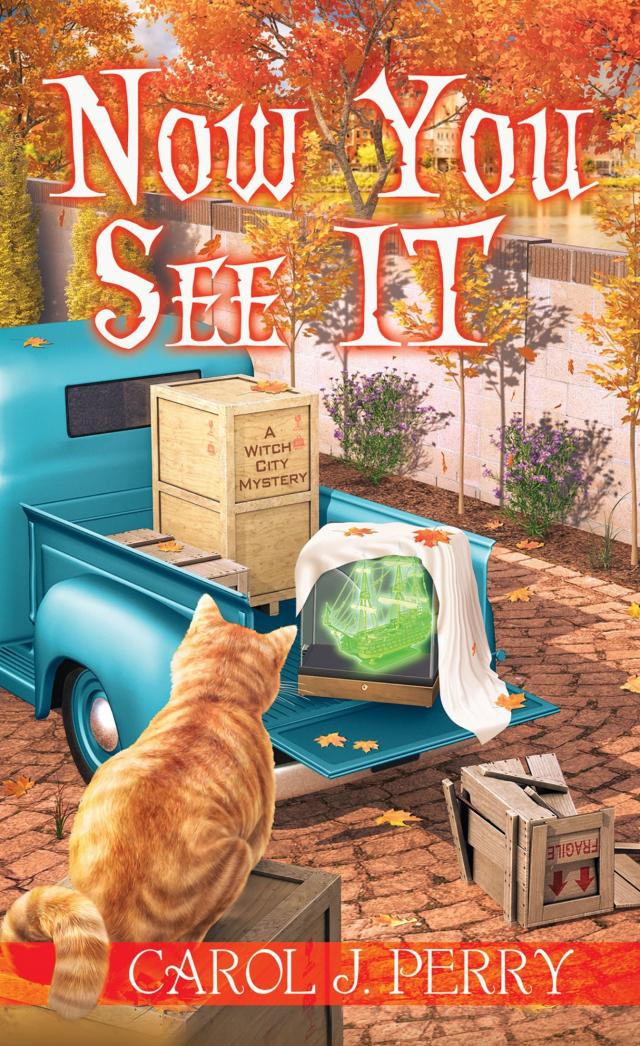
Now You SEE IT
CAROL J. PERRY
Kensington Publishing Corp.
www.kensingtonbooks.com
Table of Contents
Also by
Title Page
Copyright Page
Dedication
CHAPTER 1
CHAPTER 2
CHAPTER 3
CHAPTER 4
CHAPTER 5
CHAPTER 6
CHAPTER 7
CHAPTER 8
CHAPTER 9
CHAPTER 10
CHAPTER 11
CHAPTER 12
CHAPTER 13
CHAPTER 14
CHAPTER 15
CHAPTER 16
CHAPTER 17
CHAPTER 18
CHAPTER 19
CHAPTER 20
CHAPTER 21
CHAPTER 22
CHAPTER 23
CHAPTER 24
CHAPTER 25
CHAPTER 26
CHAPTER 27
CHAPTER 28
CHAPTER 29
CHAPTER 30
CHAPTER 31
CHAPTER 32
CHAPTER 33
CHAPTER 34
CHAPTER 35
CHAPTER 36
CHAPTER 37
CHAPTER 38
CHAPTER 39
EPILOGUE
ACKNOWLEDGMENTS
RECIPES
KENSINGTON BOOKS are published by
Kensington Publishing Corp.
119 West 40th Street
New York, NY 10018
Copyright © 2023 by Carol J. Perry
All rights reserved. No part of this book may be reproduced in any form or by any means without the prior written consent of the Publisher, excepting brief quotes used in reviews.
To the extent that the image or images on the cover of this book depict a person or persons, such person or persons are merely models, and are not intended to portray any character or characters featured in the book.
This book is a work of fiction. Names, characters, businesses, organizations, places, events, and incidents either are the product of the author’s imagination or are used fictitiously. Any resemblance to actual persons, living or dead, events, or locales is entirely coincidental.
If you purchased this book without a cover you should be aware that this book is stolen property. It was reported as “unsold and destroyed” to the Publisher and neither the Author nor the Publisher has received any payment for this “stripped book.”
The K and Teapot logo is a trademark of Kensington Publishing Corp.
ISBN: 978-1-4967-4364-0
ISBN: 978-1-4967- 4365-7 (ebook)
For Dan, my husband and best friend.
“It’s not what you look at that matters, it’s what you see.”
—Henry David Thoreau
CHAPTER 1
Labor Day in Salem means a day off from work, maybe an end-of-summer cookout, and the annual putting-away of all the white jeans, jackets, dresses, and shoes. Nobody knows who made up that “no white after Labor Day” rule, but my Aunt Ibby raised me to take it as gospel.
I’m a thirty-five-year-old redhead, born in Salem. My parents, Jack and Carrie Kowalski, named me Maralee. Orphaned when I was five, I came to live with my research librarian aunt, Isobel “Ibby” Russell, and grew up in the old family home on Salem’s Winter Street. I’d known from the time I got a part in my seventh-grade school play that I wanted a career in television, and thanks to an Emerson College education, a lot of persistence, and some dumb luck, that dream came true. Maralee Kowalski became Lee Barrett when I married NASCAR driver Johnny Barrett, but sadly, I became a young widow when Johnny died in an auto crash. As Lee Barrett, I’ve been a weather girl, a home-shopping show host, and I even did a brief and unmemorable stint as a call-in psychic. I’m currently the program director and occasional field reporter at Salem’s WICH-TV. But much more important than that, I’m now Lee Mondello, newlywed. My husband, Salem police detective Pete Mondello, and I now have our own home on Winter Street, and it was there, on the Wednesday evening before the Labor Day long weekend, that I washed, ironed, folded, and neatly packed that summer wardrobe into a large, covered blue plastic container.
My aunt and I had shared our home with a big, beautiful yellow gentleman cat named O’Ryan, and now, since we both lived on Winter Street, we had a kind of “shared custody” arrangement. With cat door entrances to both homes, O’Ryan came and went as he pleased, so I wasn’t surprised when he strolled into the bedroom, hopped up onto the top of the plastic box, lay down, and closed his eyes.
Aunt Ibby’s house is a lot bigger than ours, with plenty of spaces—cellar and attic, closets and cupboards—for storing off-season clothing, sports equipment, and things “too good to throw away” or “might come in handy someday.” I stood in the center of the master bedroom and turned in a slow circle, wondering where I could stash the now-full blue plastic box. I could, of course, take it to Aunt Ibby’s.
“No,” I told myself. “You’re a grown, married woman with a home of your own. You’ve been depending on your aunt for far too long. Figure this out for yourself.”
O’Ryan opened golden eyes. “Mmmrupp,” he said, as though echoing my thought.
“There’s the den, and the second bedroom and bath,” I said aloud to the cat. “There’s space in each of those that’ll do for now.” I picked up the box, carried it down a short hall to what we called the “guest room,” and shoved it into the bottom of an empty closet. “It’s a good thing we haven’t invited any guests,” I told O’Ryan. “If things go the way Mr. Doan plans, this room might have to become my home office.”
Bruce Doan is the station manager at WICH-TV. He’s well-known for expecting all his employees to “wear more than one hat,” as he playfully describes it, and he’d offered me a brand-new hat that very morning. I already wore two—one as program director, the other as an occasional field reporter. Since neither job was what one might consider “full-time,” he apparently felt justified in offering me yet another title.
“Lee, how would you like to be my historical documentary executive director?” he’d asked. “Sound good?”
“It sounds pretty highfalutin,” I’d acknowledged. “Exactly what does it mean?”
“You know Rupert Pennington, of course,” he began. He knew perfectly well that I did know Mr. Pennington, the director of Salem’s prestigious Tabitha Trumbull Academy of the Arts. I had, in fact, worked as a television production instructor there a few years earlier—to say nothing of the fact that Mr. Pennington is one of Aunt Ibby’s favorite gentleman friends. I waited for him to continue.
“You’ve heard about the Salem International Museum project, of course?” he asked.
“Of course,” I agreed.
I knew that the new museum was to be located in a sturdy, old brick building that once had housed an A&P grocery store. Fortuitously saved from the wrecking ball of Salem’s infamous “urban renewal” phase, the place had housed a series of retail stores, a couple of restaurants, and most recently, a fitness center. Unlike the justly famous Peabody Essex Museum and the much younger Witch Museum, the International Museum was not intended to house a permanent placement, but rather to be a location for traveling blockbuster exhibits from around the world.
“There are already floor plans for exactly how much space each display will take,” Doan explained. “They’ve brought in some big-shot art directors and history experts who’ll figure out where everything is supposed to go—you know, paintings on the walls, expensive stuff in locked glass cases. You just follow them around and get them to talk to you. Piece of cake.”
I was pretty confident it wasn’t going to be all that easy, but it was an interesting challenge. I’d heard my aunt discussing the museum with her girlfriends, but my knowledge of what it was all about was pretty sketchy. It was time for me to do some serious homework if I was going to don the hat of “historical documentary executive director.”
“When would you want me to get started on this?” I asked. “I’ll have to figure out how to fit it in with my program director duties.” I’d been “promoted” to program director when Buffy Doan, the station manager’s wife, had insisted that a job as field reporter be handed over to her straight-out-of-broadcasting-school nephew Howie—that’s Howard Templeton. That moved Scott Palmer—not my favorite person—into the lead reporting position I’d held. Don’t get me wrong—I love being program director. The hours are way better for married me, and it came with a little pay raise. But sometimes I miss the edge-of-your-seat, race-out-the-door, day-or-night excitement of being in the middle of the news action—and every time I see Scott Palmer doing a report on something I’d have loved to cover, I feel a little pang of jealousy.
“You can get started right away—” Mr. Doan paused, giving me a kind of up-and-down look. I realized I looked awfully casual for a highfalutin job in my faded jeans and loose T-shirt. “You might want to update your wardrobe a little. I’ll tell you what. I’ll get you started with one of our new green WICH-TV jackets.” Big smile. “Enjoy your weekend and Labor Day Monday off. Let’s see. Today is Wednesday. You might as well take tomorrow and Friday off, too, and get yourself organized. Maybe do some shopping. They’ll be starting to get stuff shipped in to the museum pretty soon. The designers might already be working in there. Your press credentials will get you in so you can get some ‘before’ footage of the place while it’s empty. Get with Francine Hunter. She’ll be your videographer for this. Just get your programs lined up first, then get right on it. If you start on Tuesday, that’ll give you and Francine a good three weeks to get it all filmed and edited—from the empty rooms right up until the mayor cuts the ribbon for the October opening.”
“Start Tuesday,” the man says! “Get your programs lined up first,” the man says! Does he think it’s easy making sure all the shows under my direction are properly staffed every day with sets and props in place, scripts up-to-date, talent prepared, wardrobe clean and pressed, lights and sound and cameras tested, and everything ready on time? I was in charge of the morning kiddie show, Ranger Rob’s Rodeo, the daily Shopping Salem, and The Saturday Business Hour. I also did some of the set décor for Tarot Time with River North and Cooking with Wanda the Weather Girl. None of it was a piece of cake or even easy as pie. Fortunately, plans for the following week’s shows were already firmly in place. Ranger Rob and his co-host, Katie the Clown, would feature fun indoor and outdoor games and some interviews with local high school football players. Shopping Salem had a lineup of the newest back-to-school fashions. The man who did the Business Hour was always prepared; all I had to do for him was keep his set neat and clean and make sure he had plenty of yellow legal pads. I knew I was going to take the new challenge. At least I’d be in front of the camera again, talking to an audience, introducing them to something new and hopefully exciting in my city. I told the boss I’d do my best.
“Good,” he said, as though he’d never had any doubts about it. “Stop and see Rhonda and she’ll fix up your new schedule.”
Rhonda manned the station’s reception desk and kept careful track of everyone’s schedule and did myriad other things. I told her I’d see her on Tuesday and asked her to alert Francine about what was going on. “Wow,” she said. “This must be important. He gave you two extra days off? With pay?” She was still marveling at such a miracle when I left the office and took the aged elevator—we call it “Old Clunky”—down to the first-floor lobby, climbed into my almost-new Jeep, and went home to prepare for my new journey into New England history.
Over dinner that night of baked chicken breasts, mashed potatoes, and canned peas—I’m not much of a cook yet, but I’m learning—I told Pete about my new assignment. The only thing I knew for sure about the show was its name—Seafaring New England—and the fact that Salem was to be the show’s first stop. Mr. Doan had assured me that my documentary would be of “major importance” because “the first time is when they get all the bugs out, and the TV audience loves being in on all the screwups.”
Pete, as always, greeted the news with loving enthusiasm and cautious optimism. “This sounds like it’s right up your alley, babe, with your love of history, and with a research librarian for an aunt. It’s all on top of your regular job, though. Are you sure you can handle both?”
I wasn’t sure, and I told him so. “I promised Mr. Doan I’d do my best. If it’s not going to work out, I guess I’ll know it before long. I’ve already started a file.”
He grinned. He knows my penchant for creating files, filling out index cards, and posting sticky notes. “Of course, you have. What are they calling it?”
“Nothing fancy. Just Seafaring New England. The whole thing is centered around New England’s maritime and seafaring history from the arrival of the Pilgrims in Plymouth in 1620 up to the present,” I explained. “The exhibit starts off right here at the new Salem International Museum. After us, it goes to Mystic Seaport in Connecticut and after that to Newport, Rhode Island. Each city hosts the exhibition for six months.”
“The department is already gearing up for extra security,” Pete said. “They’ve got their own people, but there’ll be a lot of really expensive stuff in there. Chief Whaley doesn’t want anything bad to happen on our watch.”
“That’s good,” I said. “I hadn’t even started to think about that part of it.”
“Oh yeah. The whole building will be rigged up with cameras and alarms everywhere. Naturally it’s all insured to the hilt. For millions, I’d guess.” He smiled. “It should draw some good crowds.”
I agreed. From what little I’d learned so far, the show would cover a lot of territory. Maritime history and industry from every New England state would be displayed, including commerce, fishing, whaling, and ship building. I figured a pretty good-sized chunk of it would come from the days when Salem ships were legendary—the vessels that historians claim traded with more different peoples in Asia, India, Africa, South America, and China than all the ships of other American ports put together. The more I learned about it, the more my interest in the project grew.
I cleared away the dinner plates and took a couple of Fiesta ware bowls from the cupboard. I hadn’t attempted anything in the way of real homemade desserts yet, so I depended pretty much on a variety of ice-cream treats. This evening’s offering was Little Debbie brownies topped with vanilla ice cream and sprinkled with crunched-up Oreos. Worked for me, and Pete didn’t complain. “Has O’Ryan been by to visit today?” he asked, adding some more Oreo crumbs to his bowl.
“He helped me put the summer clothes away,” I told him. “It was just one big plastic box full, but I didn’t know exactly where to put it, so for now, it’s in the guest room closet.”
“Maybe we should start using our side of the attic,” he said. “There’s plenty of room up there.” Our house was built like a “row house,” with a wall separating our half from the mirror-image other half. But the top floor—the attic—was one long, unfinished room, which the two sections of the building shared.
“I suppose we could,” I said, without enthusiasm. In the first place, I don’t like attics. I had a really bad experience in one once. Now all attics creep me out, and it didn’t help that our next-door neighbor whom we shared one with was a convicted wife killer. Oh, Dr. Michael Martell had served his twenty years and was totally rehabilitated, according to the authorities. He’d even become a close friend of my Aunt Ibby’s and was a respected creative writing instructor at Salem’s Tabitha Trumbull Academy of the Arts, where Mr. Pennington was the executive director. Besides that, while Dr. Martell was “doing time,” he’d become a mystery writer and—as Fenton Bishop—had authored a series of best selling “Antique Alley” murder mysteries.
“It’s not as though a box of old summer clothes is of very much value,” Pete pointed out. “I doubt that our attic-sharing neighbor would covet any of them.
I had to laugh at that idea. “I wasn’t worried about Dr. Martell showing up in my white jeans, silly. I just don’t want to go up there.”
Pete understood about my fear of attics. Aunt Ibby and I had once been trapped in one by a killer. O’Ryan had saved our lives, and Pete also had begun to understand that the big yellow cat had some special skills that regular, everyday housecats don’t have. When Pete and I were in the “getting-to-know-you stage” of our relationship, there was another thing I’d had to share with him that up until then, only Aunt Ibby and my best friend, River North, knew about me. I am what’s known as a scryer. That’s a person who sees things in reflective surfaces—things other people cannot see. River calls me a “gazer,” and says that the ability is a special gift. I don’t think of it as a gift. Almost all the visions I’ve seen—in mirrors, windows, silverware, hubcaps, anything reflective—have had something to do with death. I dislike my “special gift” even more than I dislike attics. Pete tries to understand that secret scryer part of me, but he doesn’t like to talk about it.