Texas, page 1


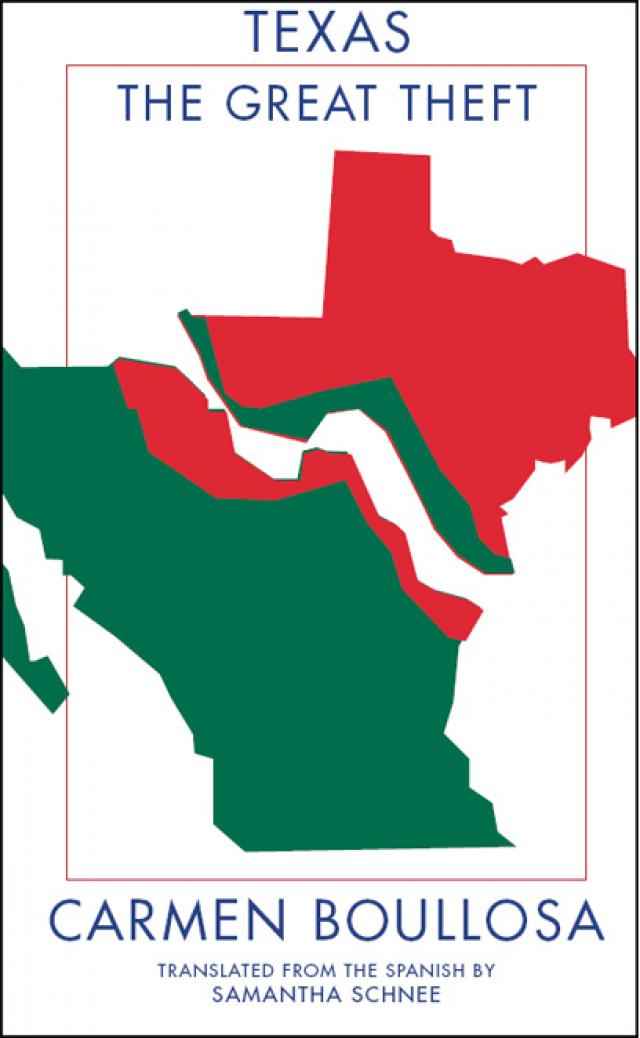
TEXAS
THE GREAT THEFT
Deep Vellum Publishing
2919 Commerce St. #159, Dallas, Texas 75226
deepvellum.org · @deepvellum
Copyright © 2013 by Carmen Boullosa
Originally published by Alfaguara, Mexico City, Mexico as Texas, 2013
Translation copyright © 2014 by Samantha Schnee
First edition, 2014
All rights reserved.
ISBN: 978-1-941920-01-5 (ebook)
LIBRARY OF CONGRESS CONTROL NUMBER: 2014948227
—
Esta publicación fue realizada con el estímulo del PROGRAMA DE APOYO A LA TRADUCCIÓN (PROTRAD) dependiente de instituciones culturales mexicanas.
This publication was carried out with the support of the PROGRAM TO SUPPORT THE TRANSLATION OF MEXICAN WORKS INTO FOREIGN LANGUAGES (PROTRAD) with the collective support of Mexico’s cultural institutions.
—
Cover design & typesetting by Anna Zylicz · annazylicz.com
Map designed by Brad Albright Illustration & Design · albrightillustration.com
Text set in Bembo, a typeface modeled on typefaces cut by Francesco Griffo for Aldo Manuzio’s printing of De Aetna in 1495 in Venice.
Deep Vellum titles are published under the fiscal sponsorship of The Writer’s Garret, a nationally recognized nonprofit literary arts organization.
Distributed by Consortium Book Sales & Distribution.
Contents
A BUSYBODY’S BRIEF NOTE
PART ONE
PART TWO
AUTHOR’S NOTE
CODA
ACKNOWLEDGMENTS & HOMAGES
PUBLISHER’S NOTE
Texas-Mexico Border (1859)
A BUSYBODY’S BRIEF NOTE
(go ahead and skip it if you want)
LET’S STATE IT UP FRONT, so we don’t get muddled: this is the year 1859.
We’re on the northern and southern banks of the Río Bravo, known to some as the Rio Grande, in the cities of Bruneville and Matasánchez. Heading into the wind on horseback we could make it to the sea in half a morning.
Bruneville and Matasánchez call themselves cities, but you be the judge of whether they should be called towns.
I should tell you a few things about them: Bruneville is part of the state of Texas, Matasánchez is part of Mexico. The former (Bruneville) hasn’t been around long, only since ’21, when Mexico declared its independence.
That year, Mexico’s Far North was sparsely populated, though there were a few ranches scattered around—like the ones owned by Doña Estefanía which extend from the Nueces River all the way south to the Río Bravo—you’d have to ride four days to cross her lands from south to north.
Back then buffalo flourished. Mustangs ran free. Since the grasslands hadn’t been sown, you didn’t find cattle in herds; they grazed in twos or threes. But the Indians abounded, and they traveled in bands.
Indian Territory lay to the northeast, where the Apaches had lived since God created the Earth, and where a variety of northern tribes had moved, evicted from their homelands by the Americans, or fleeing from them. Since the Indians were so different (some were hunters and tanners, some farmers, some warriors), they didn’t share their territory in holy peace, no matter how similar we’d like to think they were.
To protect their northern frontier from greedy Europeans and warlike Indians, the Mexican federal government invited Americans to live there. The government loaned them land or just gave it to them, sometimes even throwing in some livestock on certain conditions. To be perfectly clear: they made them sign contracts swearing to abide by the Catholic faith and pledge their allegiance to the Mexican government. However, they refused from the beginning to allow the importation of slaves, relenting only under great pressure, allowing a few in dribs and drabs.
In ’35 the gringos responded to Mexico’s generosity by declaring their independence. They were motivated by their own interests, especially the right to own slaves. The brand new (slaveholding) Republic of Texas declared its southern frontier to be the Nueces River.
At that time the sowing of the grasslands had begun—the grass seeds greedily hogging everything the earth had to offer—while acacias were burned down to make way for herds of livestock, which grazed and multiplied. The buffalo were decimated by hunters. The arrows of the hunter tribes frequently flew in vain, without finding targets.
It goes without saying that this was like a slap in the face to the Mexican government and made its landowners and ranchers hopping mad.
Then, in ’46, the Republic of Texas joined the United States, becoming the Lone Star State.
Immediately Texas claimed that its territories extended to the Río Bravo.
And you already know what happened after that. The Americans invaded us.
In ’48, after the invasion (which they called the Mexican-American War, some nerve!), they declared that the Río Bravo was the official border. To stake their claim, the Texans founded Bruneville where previously there had been nothing but a dock built by the town of Matasánchez, “just in case.” Matasánchez became a border town.
Immigrants flooded into Bruneville from all over, some respectable folks, and some American lawyers determined to enforce the new laws, which meant shifting ownership of the land to the gringos. There were all kinds of crooks, the aforementioned, well-dressed ones who robbed (Mexicans) from behind their desks, as well as the kind who tied kerchiefs over their faces. And there were those who did a little of both.
It’s under these circumstances that our story takes place, at the time of the Great Theft.
PART ONE
(which begins in Bruneville, Texas, on the northern bank of the Río Bravo, one day in July of ’59)
IT’S HIGH NOON IN BRUNEVILLE. Not a cloud in the sky. The sun beats down, piercing the veil of shimmering dust. Eyes droop from the heat. In the Market Square, in front of Café Ronsard, Sheriff Shears spits five words at Don Nepomuceno:
“Shut up, you dirty greaser.”
He says the words in English.
At that moment, Frank is crossing the plaza, muttering to himself, “…and make it snappy, make it snappy,” in English, which he speaks so well that people have changed his name from Pancho Lopez to Frank. He’s just delivered two pounds of meat and one of bones (for stewing) to the home of Stealman, the lawyer. Frank is one of the many Mexicans in the streets of Bruneville who run errands and spread gossip, a “run-speak-go-tell,” a pelado. He hears the insult, raises his eyes, sees the scene, leaps the last few feet to the market, and runs to Sharp, the butcher, to whom he blurts out the burning phrase at point-blank range: “The new sheriff said, ‘Shut up you dirty greaser!’ to Señor Nepomuceno!”, the syllables almost melting together, and continues immediately, in the same exhalation, to relay the message he’s been rehearsing since he left the Stealmans’ home, “Señora Luz says that Mrs. Lazy says to send some oxtail for the soup,” adding with his last bit of breath, “and make it snappy.”
Sharp, standing behind his butcher’s block, is so startled that he doesn’t respond by saying: “How could a puffed up carpenter dare speak that way to Don Nepomuceno, Doña Estefanía’s son, the grandson and great-grandson of the owners of more than a thousand acres, including those on which Bruneville sits?!” Nor does he take the opposing stance, “Nepomuceno, that no-good, goddamned, cattle-thieving, red-headed bandit, he can rot in hell for all I care!” These two perspectives will soon be widely debated. Rather, in his eagerness to spread the news, he (somewhat melodramatically) claps his left hand to his forehead and glides (dragging his long butcher knife, which scratches a jagged line on the earthen floor) two steps to the next stall, which he rents to the chicken dealer, and shouts, “Hey, Alitas!”, repeating in Spanish what Frank has just told him.
It’s been three weeks since Sharp has spoken to Alitas, supposedly they had a disagreement about the rent for the market stall, but everyone knows that what’s really pissed off Sharp is that Alitas has been trying to win his sister’s heart.
Alitas—happy to be on speaking terms again—enthusiastically joins in broadcasting the news, shouting, “Shears told Nepomuceno, ‘Shut up, you dirty greaser!’” The greengrocer, on hearing the news, repeats it to Frenchie at his seed stall, Frenchie passes it on to Cherem, the Maronite at the fabric stand, where Miss Lace, Judge Gold’s housekeeper, is examining a sample of material that’s recently arrived—a kind she hasn’t seen before but is perfect for the parlor curtains.
Sid Cherem translates the phrase back into English and explains to Miss Lace what has happened; she asks Cherem to save the cloth for her and hurries off to share the news with her employer, leaving behind Luis, the skinny kid who’s carrying her overloaded baskets. Luis, distracted from his duties by the rubber bands at a neighboring stand (one would be great for his slingshot), doesn’t even realize Miss Lace has gone.
Miss Lace scurries across the Market Square and half way down the next block, where she sees Judge Gold coming out of his office, heading to the Town Hall just across the street.
It’s important to explain that Judge Gold is not a judge, despite his name; he’s in the business of stuffing his wallet. His métier is money. Who knows how he got his name.
“Nepomuceno’s goose is cooked,” is what Judge Gold tells Miss Lace, because he’s just received another report, and with both bits of news in mind he continues on his way to the Town Hall, from which Sabas and Refugio, Nepomuceno’s half-brothers by Doña Estefanía’s previous husband, are exiting angrily.
Sabas and Refugio are proper gentlemen from the best of the best families of the region. Wagging tongues can’t understand how Doña Estefanía could produce these two jewels, and then the roughneck Nepomuceno, who doesn’t even know how to read. Others claim it’s a blatant lie that Nepumuceno is illiterate and consider him the most elegant and best-dressed of the three, with the manners of a prince.
Sabas and Refugio owe Judge Gold a lot of money. They’ve just been to testify before Judge White (who is a real judge, though not necessarily an honest one); the Mexicans in town call him “Whatshisname” instead of Judge. Nepomuceno preceded them but they waited until their messenger, Nat, told them that their half-brother had left so that they wouldn’t run into him. Nat was the one who reported to Judge Gold that the legal proceedings would be delayed “until further notice”—bad news for Sabas and Refugio, who want a ruling soon so they can get the payoff promised by Stealman. It’s even worse news for Nepomuceno.
A shot is heard. No one is particularly alarmed by the sound—for every 500 head of livestock you need 50 gunmen to guard them, and each of those gunmen will pass through Bruneville at some point; each of them are capable of acts of lawlessness and all sorts of violence. Shots are nothing.
Judge Gold hurls the sheriff’s words at Sabas and Refugio, thinking to himself, Now they won’t be able to pay me for who knows how long, but at least I have the pleasure of delivering bad news. But he immediately feels uncomfortable: the taunt was unnecessary, and he has nothing to gain from it. That’s Judge Gold for you, callous impulses and heartfelt regrets.
Nat, overhearing this interchange, rushes off to the Market Square to check out what’s happening with Nepomuceno and Shears.
Sabas and Refugio would have celebrated the humiliation of their mother’s golden boy but they can’t because the news has been delivered by Judge Gold with intent to wound. So they continue on their way as if nothing of consequence has been said.
Glevack, arriving from Mrs. Big’s Café, is about to approach Sabas and Refugio but stops abruptly and turns—he sees his chance to speak with Judge Gold.
A few seconds later Olga, a laundress who occasionally works for Doña Estefanía, approaches the brothers. She wants to tell them the news about Shears in hopes of patching things up with them but they’re annoyed with her because they’ve heard she’s told Doña Estefanía they don’t have her best interests at heart. Of course Olga was right, and everyone knows it (even Doña Estefanía, even Sabas and Refugio), but was it really necessary to spread such poisonous gossip?
The brothers ignore Olga and keep walking side-by-side, each wrapped in his own thoughts, each unaware the other is counting the seconds, the minutes, the hours till they can go to Stealman’s house, where they’ll discuss the Shears-Nepomuceno affair at length, each thinking to himself, We have to make it clear there’s a world of difference between us and that good-for-nothing, and worrying that if they go they run the risk of being snubbed. Damn Nepomuceno, that troublemaker. He had to stir things up today, just when we’re invited over there.
Olga tries Judge Gold. He too ignores her. Desperate for attention, she runs to tell Glevack, who is trying to catch up with Judge Gold, but Glevack forges ahead as if no one is there.
Glevack is in a bad mood, though for no good reason, since he is a primary beneficiary of the fraud against Doña Estefanía, which Nepomuceno is trying to reverse by legal means, the reason for his recent visit to the court. Indeed, it was Glevack who sweet-talked Doña Estefanía into making the deal with the gringos, knowing full well they would take advantage of her and that he would get part of the profit. Glevack would love to be the one to insult Nepomuceno in the Market Square, to call him a worthless nobody in front of everyone. He’s called him worse, the man who was his friend and associate.
Once Glevack had nearly got him thrown in jail. The two of them had hired a mule driver to steal back some livestock that Stealman had rustled from them. When the mule driver turned up dead on the steps of the Town Hall, people blamed Glevack and Nepomuceno. Glevack testified he had nothing to do with the murder, that it was all Nepomuceno’s doing. He gave lots of details and made up others, even saying that it was Nepomuceno who had robbed the mail.
Glevack should be relishing the insult, but it’s not in his nature to enjoy anything. And his perpetual foul humor has deepened because Judge Gold won’t stop and listen to him, and because he suspects that Sabas and Refugio are turning against him. He feels beset by problems.
Olga’s got her own worries. She’s no longer eighteen, twice that in fact. She’s lost her bloom. No one, not even Glevack, looks at her like they used to. When women lose their glow they’re like ghosts to men; out on the street, no one turns to admire them. Some feel liberated by this lack of interest, but others, like Olga, won’t stand for it, they’ll do anything for attention. So Olga crosses the main road, Elizabeth Street, walks to the intersection of Charles Street, and knocks on Minister Fear’s door.
It’s not yet a month since Olga helped unpack the trousseau of the minister’s new wife, Eleonor.
Although Eleonor is a recent bride, she is no spring chicken either: she’s past twenty. Her husband, Minister Fear, is forty-five; he had been a widower for two years when he placed an advertisement for a new wife. The ad, which appeared in papers in Tucson, California, and New York, stated in succinct English:
LONELY WIDOWER SEEKS WIFE TO ACCOMPANY METHODIST MINISTER ON THE SOUTHERN FRONTIER AND ASSIST WITH HIS WORK. PLEASE RESPOND TO LEE FEAR IN BRUNEVILLE, TEXAS.
Olga knocks impatiently on the Fears’ door a second time, so hard that the Smiths’ door pops open (their house is adjacent, on the corner of James, which runs parallel to Elizabeth), and out comes the lovely Moonbeam, an Asinai Indian (some call them the Tejas Indians, though the gringos call them Hasinai, part of the Caddo tribe). The Smiths bought her for next to nothing a few years back, before it became fashionable to have Indians as servants. Now they would have to pay twice as much. She’d be a bargain at any price: she’s beautiful and hard-working with a pleasant manner about her, though sometimes she gets distracted.
Moonbeam steps into the street. A second later, Eleonor Fear opens her door with an expression of befuddlement. Eleonor doesn’t speak a word of Spanish, but Olga makes herself understood. First, she offers her services—washing, cleaning, cooking—whatever the Fears might need. Eleonor declines amicably. Minister Fear arrives (curious to see who is at the door) as does Moonbeam (the Smiths’ young slave is always interested in gossip), and Olga tells them about the incident, using gestures to make herself understood: a five-pointed star for the sheriff, a violin and a lasso for Lázaro, but Nepomuceno’s name alone is enough, everyone knows who Don Nepomuceno is.
The Fears don’t show the least interest (the minister is too prudent, and Eleonor is wrapped up in her own world) but Moonbeam is captivated. She knows how stupid Sheriff Shears is—he came to fix the Smiths’ dining room table and left it even wobblier than before—and she thinks the world of handsome Nepomuceno (the Smiths’ daughter Caroline carries a torch for him, and Moonbeam does a little too, like all the young girls in Bruneville).
When Minister Fear closes the door, Olga turns and heads back to the market. Moonbeam glances up and down Elizabeth Street, looking for a reason not to go back inside the Smiths’ and finish her chores, when around the corner come Strong Water and Blue Falls, two Lipans—the Lipans are fiercer than most Indians, but friendly with the gringos—astride two handsome mounts, followed by a heavily loaded pinto mustang, a typical prairie horse (if someone offers a good price, it’s for sale).
Strong Water and Blue Falls are turning onto James Street to avoid Nepomuceno’s men; they haven’t come to Bruneville looking for trouble.
Despite the heat, the Lipans are in long, fitted sleeves with bright, colorful stripes, and they’re wearing embroidered moccasins. They have bands of colored beads tied around their foreheads and their necks; their long hair is adorned with feathers, leather strips, and rabbit tails; and they have embossed spurs.