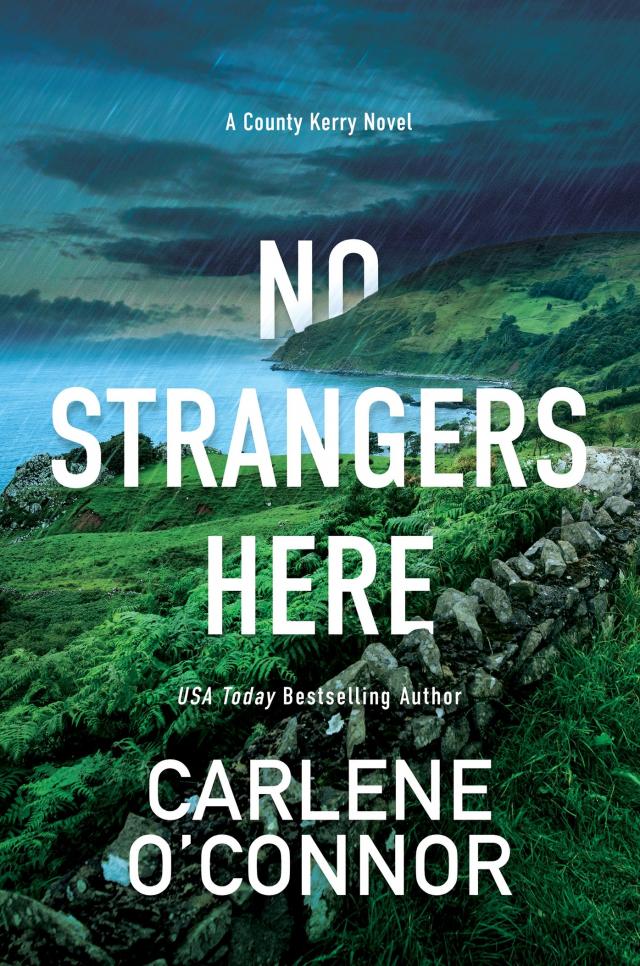
No Strangers Here: a Riveting Dark Irish Mystery, page 20


“Just what the hell are you involved in?”
“Nothing.” He picked up the empty bottle of Bulmers, twirled it, and set it back down with a plunk.
“I heard you were at the Dingle Inn the night of the murder with some lad. Who was it?”
“What did you hear?”
He’d lost weight. Was he using again? “For one thing, you were cleaning Johnny O’Reilly’s yacht with bleach the morning they found his body.”
“You know everything, do you?” He pushed past her and jumped onto the dock. “Right. I’m going to buy a new pack of fags.”
“I’m coming with you.”
“What are you? My child minder?”
“That fits, given you’re acting like a child.”
He strode away from the harbor toward the shops in town. Dimpna scrambled after him, hating the optics of the older sister hounding the younger brother. “Whatever illegal or disgusting things you’re up to that you don’t want me to know about, I think you should know that it really hurts.” She yelled it. Not her finest moment, given there were fishermen and tourists nearby, but Donnecha had given her no choice.
He came to an abrupt stop, his face flushed. “Keep your voice down.”
“Don’t run away from me.”
“Jesus.” He pinched the bridge of his nose, then crossed his arms over his chest. Had he always been this scrawny? Was his appearance alone a cry for help. “What? What have I done to hurt you?”
She opened her arms. “I’m in town and you don’t come to see me? Da is suffering from dementia and you don’t even pick up the phone? Our parents are suspects in a murder inquiry and you can’t be bothered?”
He clamped his lips shut. “You have no idea.”
“Then tell me.”
He was on the move again and this time he picked up the pace. “You have absolutely no clue as usual.”
“As usual?” Now her yelling was born of rage. “What’s that supposed to mean?”
“Never mind.”
His vehemence came as a shock. Whatever trouble he was in, it was worse than she thought. “I need you,” she said. “I need my brother.”
He stopped again. “Since when?” He locked eyes with her.
“Don’t do this,” she said. “Don’t make me feel guilty.”
“You’ve been living your life in ignorant bliss up until the past year. And I’m sorry about that business with Niall. I really am. But most of your life you couldn’t be bothered to come home. And now you want me to roll out the red carpet?”
He wasn’t usually this mean. It was his defense mechanism. He was afraid of something. Someone? “That’s your hangover talking, is it?”
He chortled. “Right, so. I’m still the same old screw-up you’ve always hated to love.”
Dimpna closed the gap between them so she could lower her voice.
“Hang your self-pity on the nearest hook, because Mam and Da need us.”
“I’m well aware.” A couple strolled past pushing a pram. Tourists, from the grins on their faces as they took in the harbor.
“Do you know anything about Johnny O’Reilly’s murder?” Dimpna’s voice was a whisper. She had to ask.
He brushed his fringe back with a trembling hand. “Are you joking me?” He grabbed her arms. “I had nothing to do with that. Nothing.”
“Then why are you in this state?”
“I told you. The guards are crawling up me arse.” He let go of her and crossed Strand Street making a beeline for the closest shop, a small market that dealt in a little bit of everything. He disappeared inside and Dimpna waited on the footpath, trying to collect her thoughts. It took her five minutes too long to realize that Donnecha was taking a long time. She went into the shop. The clerk, a twenty-something, leaned against the counter and jerked his thumb toward the back door. “That way.”
Typical. That’s why he’d chosen this shop, just so he could sneak out the back. Humiliating. “Just here for some tea,” Dimpna said.
“Uh-huh.”
She did her best imitation of a stroll and picked up a box of Barry’s. He smirked as he took her money. “He’s up to no good, if you ask me.”
She hadn’t, of course. “What makes you say that?”
“I hear things.”
“What things?”
“Fella with a similar shop in Tralee says he buys a dozen mobile phones a month. Throwaways.”
“A dozen?”
“That’s what I heard.”
A dozen throwaway phones a month? Even if it was a slight exaggeration, how could he be so stupid? She quickly paid for her tea and then stood on the footpath. Was he a drug dealer now? The southwest coastline had historically been a convenient drop-off point for hard drugs, namely heroin and cocaine out of Cork. Did drugs have anything to do with O’Reilly’s murder? Was the O’Reilly yacht involved? Or maybe Dimpna’s imagination was getting the best of her. What if Donnecha witnessed something? Maybe the killer had threatened him the same way Saoirse had been threatened. A crawling sensation up her spine prompted her to look around. She had the feeling she was being watched. Strand Street was alive with shoppers and tourists. She could almost picture Donnecha studying her from afar. He’d always been an excellent watcher. In school he knew all the gossip about everyone’s mam and da just from his creeping. It wasn’t something she was proud to admit, but it was the truth. Her brother liked to sneak and he liked to watch. He’d even roped her into it once.
I could teach you. You’re so small, no one would ever know you’re there.
And so they went to the O’Sheas’. Jack O’Shea had been a reporter, and he wore a cracking leather jacket around town that he showed off from atop his cracking motorcycle. They’d snuck into his back garden and hid behind a hedge just underneath their kitchen window. They watched him and his wife move in and out of the frame, making dinner. Once, Jack came up behind her, put his arms around her, and kissed her neck. Dimpna had never seen her parents show any kind of affection. She wondered what it would be like if Jack was her da, and his pretty wife her mam. They talked to each other as they sat at the table with their dinner, talking and laughing until their candle had burned down.
“I wish we could hear them,” Donnecha said.
“Me too.” They stayed until it got dark. Jack O’Shea came out to let his dog out and lit a cigarette. They were cramped up by the time he went back inside and the lights went off. When they scrambled out of their hiding nook and onto the footpath, Dimpna’s dress was covered in dirt and hedge trimmings. Every time after that, whenever Dimpna saw Jack or his wife in town, she glowed with the secret. But she never did it again. She was terrified of getting caught. Not Donnecha. He thrived on the danger. And maybe he still did. But maybe this time he’d been caught. She didn’t think there was anything sexual about his spying, although the feeling of being creeped on was just as violating. But why did he need throwaway mobile phones? A dark thought descended. The vial of Release. The one her father had accused Sheila of stealing. What if it had been Donnecha? Was he stealing vet meds on the side? One vial was hardly a windfall.
Donnecha had never wanted anything to do with the family business. He’d been the first to go on a middle-of-the-night call with their da. He’d come home absolutely beside himself. It had been a calving and the baby was born dead. That wasn’t the part that gutted Donnecha. It was the wails of the mother. Donnecha had crawled into bed with her, his toes ice cold, snot hanging from his nose, and tears running down his cheeks. “She was crying, Dimp. She was crying.”
“You need to focus your energy on the ones you can help,” she said. But it only made him cry harder. He told Dimpna about her sad brown eyes and her wails, and he never went on another animal call again. After that he started hanging around the fishermen in the harbor. Carrying their heavy buckets, humming their shanty songs, and stinking of fish. Her mam complained about it every time she did the wash, hanging his trousers outside to dry, grumbling that she could still smell the slime. That was the start of Donnecha drifting away from them, and now it was all too clear. One of them should have reeled him back in.
CHAPTER 23
EAMON WILDE WAS PROPPED UP IN A HOSPITAL BED FULLY DRESSED and reading a newspaper. His luggage bag sat by the bed. “There you are,” he said when Dimpna walked in. “Off to bed, Dew.” He pointed to the door. Her mother rose from a chair next to her husband’s bedside.
“My Dimpna,” she said. “C’mere to me.” She held out her arms. Dimpna rushed and embraced her, her mother’s silver bracelets jingling against her back. She hadn’t realized how much she’d missed her until she smelled her jasmine-scented perfume and felt her touch. Maeve Wilde still made an effort to look glamorous and it suited her.
Dimpna glanced at her father. It felt wrong to be a witness to his decline. “How is he?”
“He was given a little something to calm down,” a nurse answered, stepping into the room. “He should be asleep.”
“Try a horse tranquilizer,” Maeve said.
Dimpna flinched. Her mother was going to have to stop being so flippant while this murder inquiry was underway. “When is he getting discharged?”
“Today,” Maeve said. “After we talk to the doctor.” She sighed. “That inspector has been pestering us for an interview. We need guidance.”
“You also need a solicitor.”
Maeve waved her hand as if brushing the thought out of the air. “We do not. We’re innocent.”
“Innocent people need solicitors too.” Especially when they were up against the O’Reillys. “You’re taking him home? And staying with him?”
“Of course. If you want to sleep in the caravan that’s fine, but absolutely no animals.”
“I’ll stick with the upstairs flat,” Dimpna said. “Where I go, my pack goes.”
Maeve pursed her lips but didn’t reply.
“Where’s that handsome grandson of mine?” Eamon asked, looking around the room as if Ben might be hiding, ready to jump out for the big surprise.
“In Spain,” Dimpna said, surprised at where his mind had gone. “With his new girlfriend.”
Her father wrinkled his nose. “He has a new girlfriend? He never told me that.”
“It’s new. I only just found out meself.”
“Ben has a half sister,” her father said as if this were a delightful bit of news, as if Aisling O’Reilly had been born today and not eight years ago. “Did you know that?”
“Eamon!” Maeve’s face went scarlet.
Dimpna thought of the necklace. “Has Aisling O’Reilly ever been to the clinic, Da?”
He wrinkled his nose. “What clinic?” It was then that she realized he was holding the newspaper upside down. She walked over and tried to turn it upright, but he held on to it.
Dimpna turned to her mother. “Can we talk?” Her father had suddenly fallen asleep, mouth open, snoring.
The nurse caught her eye. “Now that’s exactly what he should be doing.”
Dimpna pulled a chair up next to the bed across from her mother. They simply looked at each other until the nurse left the room. Dimpna’s heartbeat had already ticked up a notch and she was in the midst of telling herself not to lose her temper with her mother, not here, not at the hospital. Her mother had her own ways about her and there was no changing her. A few days after Niall hung himself, Dimpna received one of her mother’s postcards from Dallas, Texas: Big problems seem small under Texas skies. She sent another one to Ben from Miami Beach, Florida: Sunny days ahead. Love, Maeve. Not Granny. Or Grandmother. Maeve.
“I saw Donnecha. He ran away from me,” Dimpna said. It was beyond the pale.
“You have pet hair on your dress,” her mother replied, handing her a tissue, as if that would do the trick.
Dimpna crumpled the tissue in her hand and looked down at her flowery green dress. “I brought a nice sheepdog back from Finbar Malone’s. I’ve named him E.T.”
“Edie? That’s a strange name.”
“E.T.”
“I don’t understand what you’re saying.”
“E.T. phone home?” Her mother scrunched her face. “Never mind.”
“What on earth were you doing at Finbar Malone’s house? Don’t tell me you’re sneaking around again.”
Sneaking around again. As if she was a child. “No, Mammy. I was helping out a stubborn donkey.” Dimpna filled her in on the call. She left out the bit about her father palming the ruby ring into her hand, and Finbar burying a mobile phone. She didn’t want her parents any more involved than they already were.
Her mother’s mouth twitched. “I knew Finbar’s story was a fishy one,” she said, laughing at her own pun. “He just happens to stop off for a smoke? Drives all that way to Clogher Strand to smoke after days gone fishing?”
Dimpna shrugged. “Do you really think a fisherman murdered Johnny O’Reilly?”
“Catch of the day,” her mother mused.
“I wish you wouldn’t be so flippant,” Dimpna said. “What if someone hears you and takes it the wrong way?”
“What’s the wrong way?”
“You’re a suspect in this murder inquiry. You get that, don’t you? Tell me you get that.”
“If you want to speak with your brother, why don’t you give him a bell?” Her mother was an expert at changing the subject whenever it didn’t suit her.
“Have you even talked to Donnecha since the murder?”
Maeve chewed on her lip. “I can’t recall. It’s been a very busy time.” Maeve examined her fingernails. They were too long for Dimpna’s liking, Like sharp little knives.
“When did you get your nails done?” Dimpna leaned forward. If the answer was before the dance, then her mother couldn’t be the killer. There had to have been some kind of struggle. Handling a body, placing stones on the beach. Her mother’s nails would have been a wreck.
Her mother curled her nails in, like a turtle slipping into its shell. “What does that matter?”
“Was it before or after the dance?”
“Before.”
“Do you have the receipt?”
Maeve frowned. “I did them myself.”
Dimpna groaned. “Don’t tell the detective that.”
“What on earth are you on about?”
“If your nails had been that nice the evening Mr. O’Reilly was murdered, then it couldn’t have been you.”
Her mother examined her nails again. “That’s right!”
“But you need someone else to verify that.” She waited for a response. Zilch. “Did anyone at the dance compliment your nails?”
“Johnny did,” Maeve said. She smiled and then abruptly stopped. “Oh.”
“No one else?”
“Why? The word of a dead man isn’t good enough?”
Dimpna shook her head. “Joking around when you’re not a suspect is a matter of poor taste. But joking around when you are? That’s a horse of a different color.”
“Horse!” her father exclaimed. “He’s got a scrotum the size of a football.” Eyes closed, her father held both hands up as if cupping a football, or a very large horse scrotum.
Dimpna clamped her lips shut, trying not to laugh. She turned to her mother who had her head thrown back and was positively howling with laughter. When she stopped, she wiped tears out of her eyes. Her mirth was cut short by the presence of a nurse who pushed an old man in a wheelchair into the room, situating him near the empty bed. Her father’s flatmate.
“Inspector O’Brien said nothing about me being a suspect,” her mother said, oblivious to the fact that other people were now in the room.
A prickling sensation came over Dimpna. “You spoke with him?”
She nodded. “He came into my caravan the other day and we had a nice little chat.”
“What did you tell him? I need to know every detail.”
“You do not. You’re not a detective.”
“You shouldn’t have talked to him without a solicitor.”
“He said it was a normal house-to-house inquiry, and if I didn’t answer his questions I would have to come into the station.” Dimpna nodded, swiveling her head around. The old man was in his bed and the nurse had left the room. She turned back.
“Please, Mam. I need to know what you told him. In fact, I want to know everything about that night starting from the time Johnny O’Reilly picked you up for the dance.”
“Johnny didn’t pick me up that night,” Maeve said. “He said he had personal business and would see me at the dance.”
Interesting. “Did you tell the inspector that?”
“He had so many questions you can’t expect me to remember all of them.”
Dimpna took a moment to center herself. “Alright, Mam. Just tell me what you remember of the inspector’s visit.” Silence filled the space between them. “Please, Mam. I’m on your side.”
Maeve sighed. “He brought the tarot card with him, the one found in Johnny’s pocket, but you’ll be relieved to know it wasn’t my card.” She frowned. “He still wants me to check my deck, so I suppose he didn’t believe me.”
“How do you know it wasn’t your card?”
“It was brand-new. I’ve had that deck for ages. It’s worn.”
“Maybe he brought a duplicate.”
Maeve shook her head. “It was in an evidence bag.”
“I suppose that’s a relief.”
“You see. I’m in the clear.”
“I’d like a solicitor to weigh in on that. What else did he want?”
Her mother leaned forward. “There was one piece of information he chomped on like a dog with a bone.”
“What was that?”
“He came alive when I told him that Johnny O’Reilly didn’t wear neckties. I think they found him in a necktie.”
“He hated ties,” Dimpna said. Dimpna hated them as well. Especially after Sean O’Reilly pretended to strangle Tommy Healy with one right in front of her.
“It seems I’ve given the detective a very valuable clue,” Maeve said. “He should have paid me a consulting fee.”
Dimpna groaned. “Tell me you didn’t suggest that he pay for a reading?”
“Well, why not? I’m good, and he wanted to take up my time. He should have done so.”