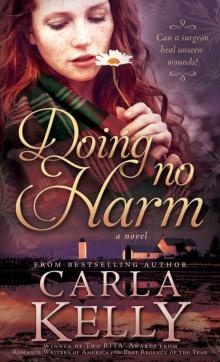
Doing No Harm, page 27


“I don’t think we did much good,” Olive whispered, “but between you and me, it felt fine.”
Douglas laughed out loud, which only increased the impotent fury of those two oblivious, cruel people on the raised dais. He saw footmen coming toward them. “Oops.”
He tightened his grip on Olive, pushing his hand down into the waistband of her skirt, determined not to let go of her, no matter what the footmen tried.
“Just one more thing!”
He stopped in surprise, amazed at the calm, splendid protest coming from the only woman he would ever need in his life. She must have taken lessons from watching her father, minister of the Church of Scotland, hold a congregation in the palm of his hand. Silence reigned again.
“Lady Stafford, I wish you would call Patrick Sellar over there to account, but I am no fool. You would probably only hire another factor equally cruel. Shame on you. Shame on you both.”
She looked around the hall, slowly eyeing everyone in turn. Douglas watched some of those men of power avoid her glance.
“There will come a judgment,” she said, her voice conversational now, but equally compelling. “Someday you, as all of us must, will stand before the judgment seat of Christ. May God have mercy on you.”
She turned then, this remarkable woman, put her condemning pictures drawn by little ones under her arm and nodded to Douglas. “Maybe I have said enough.”
“You covered the subject,” he assured her as they walked slowly from the audience hall, footmen in front of them, in back of them, and on each side.
“Really, Doug,” she said, her head held high. He couldn’t see a defeated bone in her body, and he knew enough about anatomy to pass any examination.
The footmen let him collect his luggage and his medical satchel from the alcove where he had left them what seemed like years ago. The front door slammed shut behind them.
He realized he still held her skirt in his death grip. He took his hand out, only to have her sink to her knees as if he had been holding her up. He tugged her to her feet and walked her to a nearby bench on the street. She sat down, and to his delight, discarded all propriety and rested her head on his shoulder.
They sat in silence for a few minutes. Douglas gradually felt the roaring in his ears give way to ordinary street sounds. He even thought he heard a robin.
The delightful woman tucked so close to him chuckled. “When that … that odious Mr. Sellar started toward you, I was afraid you were going to try to thrash him, and you know you’re not good at that.”
Douglas leaned back against the bench and put his arm around Olive’s waist, not with a tight hold, but because she had a nice waist and he enjoyed touching her. “No, I’m not a brawler. You could have found a better defender.”
“No, I couldn’t,” she said. “Doug, since I am sitting here with my head on your shoulder—I would even put my hand on your knee, but I have a few standards remaining—you won’t be terribly surprised if I tell you I love you, will you?”
He closed his eyes with the pleasure of her announcement, amazed at the speed with which he could go from horrible anger and indignation to nothing short of bliss. Medical science treatises suggested that such extreme dislocation of bodily humors would bring on indigestion or worse, but a little upset to his system could be easily cured with bicarbonate of soda. Or maybe marriage.
“Would you be surprised if I told you the same thing? I do love you, Miss Grant.”
She kissed his cheek then, which further stirred up those bodily humors.
“Curious,” he mused. “I came out of this endless war feeling like a man of eighty. I don’t feel like a man of twenty, but will thirty-seven do for you?”
“I’d be robbing the cradle if you felt twenty,” she informed him. “Remember my standards?”
“I’ve been thinking … ,” he began, then paused, amazed all over again about what had happened in the few months since he stopped in a shabby town to help a little boy.
“Don’t quit now,” Olive said. “I hope you’re planning to ask me a question.”
“Eventually,” he teased and ducked when she swatted at him. “I was going to make the observation, Miss Grant, that I was seriously disappointed when I came to your country, passed through Gretna Green, and didn’t see a single blacksmith marrying anyone over the anvil.”
“Disappointed, were you?” She threw caution completely to the wind and put her hand on his knee.
“Yes, disappointed.” He took a deep breath and tied himself irrevocably to shabby little Edgar, and work and worry for the rest of his days. “Let me propose—”
“High time.”
“—that we go to Gretna Green and give that blacksmith something to do. I have a post chaise located at a nearby hotel, and the post riders said they would remain in my employ until they heard otherwise from me.”
“Aye, then,” she said. “If that was a marriage proposal, I accept.”
He laughed, loud and long until Olive gave him a shake.
“What in the world … ,” she began.
“It’s this, my love,” he told her. “I just remembered that I promised Joe Tavish I would keep you from doing something rash in Edinburgh that you would regret.” He inclined his head toward hers. “Any regrets yet?”
She appeared to give the matter significant thought, which assured him that he was marrying a woman with a sense of humor.
“Well?” he asked.
She leaned in closer. “Only that Gretna Green isn’t just around the corner. I am thirty and ready for misbehavior right now.”
“It’s not misbehavior if we’re married,” he assured her.
“Then no regrets, Doug,” she said so softly into his ear.
Hang propriety. Anyone passing on the street in front of the Countess of Sutherland’s manor would have seen a middle-aged man with graying hair wrapped up in the embrace of a woman a little younger and with red hair. No one could have seen her interesting eyes because they were closed as he kissed her once or twice, maybe more.
They came to their senses eventually and sat in pleasant silence. He remembered the other drawing in his portfolio with the yacht sketches. He took it out and handed it to her.
She sucked in her breath as she looked over his sketch of a man sitting up in bed and staring with wide eyes at a circle of imploring, pleading hands raised all around his bed.
“I see those men every night,” he said softly. “I assure them I did everything I was capable of, but it’s never enough.”
She was silent a long time, looking at the picture, then traced the drawing of the man with fright in his eyes. She kissed her finger, touched his image, and then tore the sketch into small pieces. She threw the pieces into the air and they watched them scatter down the street.
“It’s not that simple,” he said.
“Nothing is,” she agreed. “I believe that we will be bearing one another’s burdens after that anvil business. You can rely on me, Doug.”
“And you on me.”
Then hang propriety again.
Epilogue
AUGUST, 1987
Dear Owen Brackett,
Cross your fingers I have time to finish this letter before some crisis or another demands my attention.
I can’t believe it’s been six months since I wrote last. If I had suspected that a quiet country practice would be anything but, I might have taken Sir David Care-Less’s advice and accepted that assistant superintendency at Stonehouse when he offered it to me. That’s a fib of vast proportions, because Edgar suits me right down to the ground.
Olive and I send our congratulations to you on the birth of your third child. Owen, you’ve been a busy surgeon, indeed. I hope your life in Kent continues to satisfy both you and Aggie. We’re a long way from the Royal Navy, eh?
It’s finally here: the yacht will be christened today. Homer Bennett (I know you remember him) and his crew have taken longer than usual, but this pretty little ship was done with such care, since it has been the training vessel for new but willing Highland ship builders. Almost without exception, they have proved to be apt pupils. All anyone needs is a chance, and they have succeeded. There is a fishing boat being built now in the other graving dock, and orders for two more. I don’t doubt that once this yacht goes down the ways and sets sail, other orders will pour in.
We owe such a debt to Lord Crenshaw. Olive and I were so certain that nothing good had come of our efforts in that infamous audience hall that I wrote you about, and we are happy to be proved wrong. Lord Crenshaw was in attendance and heard us. He sent a letter to Homer and arrived in Edgar a week later to look at more detailed plans, visit the Telford Boat Works, chat with our Highland crew, and make an offer.
He had wanted Olive herself to christen the yacht. After all, he insisted it be named Fiery Miss Grant, but she begged off. With blushes a-plenty, she told him she felt too self-conscious about christening anything, not in her interesting condition. On Olive’s suggestion, Lord Crenshaw chose Flora MacLeod instead. She is over the moon with joy.
Flora and her own crew have become quite the entrepreneurs. Nancy Fillion (I know you remember the redoubtable Mrs. Fillion) has commissioned Flora to make Seven Seas Fancies to sell at the Drake. Nancy has visited us several times this year. She claims it is to make certain that I am treating my darling Olive well and drop off more shells, but she has her own pleasure in watching “her girls” make the fancies. The Dougalls are parenting Flora well.
On a less sanguine note, Patrick Sellar was acquitted of all charges involving the murder of Mary MacKay. We were not surprised at the outcome. Money and titles have a way of talking so loud that no one can hear the truth. He did have the grace to retire, but I hear that the Countess of Sutherland has advanced James Loch, a lowland Scot, who is as cruel as, if not more cruel than, his predecessor. You’re a man of the world, same as I. You won’t be surprised to learn that Patrick Sellar is now a large landowner and runs sheep in the Countess of Sutherland’s domain.
The Highlands continue to suffer. More of its poor uprooted citizens are taking ship for Canada and the United States. Those nations will someday reap the benefits of Highland courage and strength, mark my words.
On to better subjects. In your last letter, you inquired about the outcome with Mrs. Aintree’s digitus annularis and digitus minimus mani. I am pleased to report that she has nearly full use of both fingers. I give the credit to looping sutures, rather than tight ones. And credit must also go to her housekeeper (more of a confidante) Rhona Tavish, who exerted firm control and made Mrs. Aintree obey my instructions. In her gentle way, my kind lady is nagging me to write a “wee paper” on hand surgery for the medical society. What do you advise?
Tommy Tavish walks with a slight limp, but since he is usually running, who notices? Only his surgeon.
Joe Tavish has just recently stopped apologizing for thrashing me. He claims he has not drunk a drop (“nary a bare dram” as he puts it) since he beat me to a pulp. I believe him. He is sober and Homer Bennett’s prize draughtsman. And Joe is also to become a father again, so he told me only last week. All is well in the Tavish household.
Oh, and this: Lady Telford invited Olive and me to tea last week. She weakens daily, and there is nothing I can do. But you know the feeling all too well. At any rate, she showed us her latest will (I say latest, because she is a changeable old sort). Currently, Olive and I are to be the recipients of her manor when she passes. She wants us to live in it, of course, and we will appreciate the space, but she also wishes a portion of the house to become a hospital. She is supplying sufficient funds for such alterations as will be required. The rest of her fortune goes to Telford Boat Works.
I am a happy man, Owen. I have fewer nightmares, which is a relief. Olive just holds me close until they go away. Was ever a man more blessed than I? Yes, blessed. Olive has convinced me to go to church with her. There might be something to religion, after all.
Edgar is the best place to practice medicine. There is always something (or someone) here to heal, or plaster, or set, or bleed. I’m thinking about looking for another surgeon because Edgar is growing. The shipyard flourishes, and it has been the means of increasing all other businesses in town. We even have a solicitor of our own. Whether that proves to be a blessing or not, who knows? At any rate, another surgeon would permit me to sleep in my bed for a whole night. (Again, you know the feeling.) A two-man practice would come as a relief.
Must stop. Olive is standing in the doorway, looking down at a little puddle. It’s her time. I believe we’ll both miss the yacht christening. Let’s see if my delivery skills are good enough to take her mind off the pain, considering that her surgeon got her this way in the first place!
(Evening now) A boy! He is red-haired and heterochromatic like his mother, although eye color might change. My only contribution appears to be his plumbing. Olive is fine. Our best to you and Aggie.
Yrs with affection,
Douglas Bowden—husband, father now, and Edgar’s surgeon
Afterword
In the history of genocide and cruelty to one’s own people, the Highland Clearances have to rank somewhere near the top of that most unsavory list. The Clearances began roughly in 1792 and dribbled out by the later nineteenth century. By 1900, the wild mountains and breathtaking glens of Scotland’s far north were nearly devoid of people.
The reasons are complicated. Scottish history is no stranger to betrayal by her own. The centuries-old system of small farmers holding land tenancies at the good will of their clan chieftains had devolved into a near serfdom quite at odds with long-held notions of a fiercely independent people.
Beginning in the late 1600s, clan chiefs were required to travel to Edinburgh to account for their clan members’ good conduct. Through the years, this annual accounting created a mind-set among the hereditary chieftains that they were landlords and no longer just leaders. As such, clan members were forced to provide labor for their chiefs in a near-feudal arrangement.
Clan members farmed as tenants on unproductive soil in the harsh climate of northern Scotland. They also raised black cattle we know as Aberdeen Angus, and Highland cattle. They maintained a thrifty existence and mainly spoke only Gaelic, unlike the Scots of the Lowlands, who had more contact with England whose border they shared.
In truth, the Highlanders were poor, uneducated for the most part, and over-populating their breathtaking vales and glens. The hereditary, aristocratic Scots who “owned” this land became known as Improvers. It became common knowledge that running sheep in the Highlands would be far more profitable to them, even though it meant the forcible removal of their clan-tenants. But, those aristos reasoned, surely it was for the benefit of the Highlanders to yank them into a modern age.
Writs of removal (eviction), such as Joe Tavish described, typically gave the bewildered folk three months to vacate their ancestral homes. If they did not move of their own accord, they were driven from their homes on pain of death and forced into exile, no exception. Some were herded to the Highland seacoast, where they were told to become fisherfolk, never mind that they knew nothing of such a livelihood. Other were put aboard ships and sent to Canada, the new United States, and some to Australia. The suffering of a whole people can only be imagined. Although figures are uncertain, 15,000 exiles is the usual estimate.
The utter brutality of the Clearances devastated Highland life and put an effective end to Gaelic culture. A few shepherds from Lowland Scotland, with their black and white dogs, could easily manage huge flocks of Cheviot sheep, an English breed hardy enough to withstand the fierce Scottish climate, and meaty and woolly enough to bring a good profit. The land become devoid of people.
Elizabeth Gordon, nineteenth Countess of Sutherland, was a major Improver. Her husband, George Leveson-Gower, Marquess of Stafford, and England’s richest man, encouraged her to evict her tenants and open the land to sheepherding. If our kind lady, Olive Grant, had known how wealthy the marquess was, she would surely have questioned why he needed more money at the expense of ruining lives. I can nearly hear Olive asking, “How much wealth does one man need, my lord? Is it worth the misery of thousands?”
The greatest beneficiaries of this forced eviction were the commonwealth of Canada and the new United States of America. Many people of Scottish ancestry trace their roots to those suffering but stalwart folk who made new lives in foreign lands. Canada and the United States are richer for the now-distant brutality of the Clearances.
Ironically, the novelist Sir Walter Scott, a Lowlander, became enamored of the old stories of the brave and independent Highlanders. His novels of the Highlands sparked a voracious literary interest in the far north and became best sellers, just as the very people who had lived there were being cleared out.
Today, travelers are awed by the wild remoteness and the fierce beauty of the Highlands. Thoughtful travelers are also aware of the land’s great emptiness. The friendly folk who might have greeted them had been driven out on the point of bayonets and swords, their homes burned, their fields flattened and their cattle slaughtered or sold to others. This is one of history’s great injustices, and the role of the Countess of Sutherland and her husband, the Marquess of Stafford, remains controversial.
What can one make of such a tragedy? Although it has been more than two centuries, bitterness remains. Again, the kind lady understood something about Judgment Day, when there will be a reckoning.
On a personal note, some of my own relatives were Lowland Scots who lived near Kirkcudbright, disguised as Edgar in my story. In 1867, Thomas Fergusson, a stone mason and my great-great-grandfather, along with other relatives, friends, and their Presbyterian minister, left Scotland and settled around Chatfield, Minnesota. With them was my great-grandfather Samuel. My grandfather Carl, after whom I am named, was born in Chatfield, as was my father, Kenneth Carl.