A Haunting in the Arctic, page 1


Praise for The Nesting
“A taut, scary thriller that winds the suspense so tightly you can barely breathe. I was rooting for the heroine all the way to the terrifying conclusion. This one will definitely keep you up at night.”
—Simone St. James, New York Times bestselling author of The Book of Cold Cases
“[A] hypnotic psychological thriller. . . . Readers will keep guessing what’s really going on right up to the surprise ending. Rebecca fans won’t want to miss this one.”
—Publishers Weekly (starred review)
“An original and haunting thriller, filled with secrets, ghosts, and Norse folktales. The Nesting is an evocative and chilling tale that will keep you guessing and is best read with the lights on.”
—Alice Feeney, New York Times bestselling author of Daisy Darker
“Dive into The Nesting for some creepy full-body chills.”
—Shondaland
“An atmospheric thriller.”
—New York Post
“[A] nail-biting Gothic suspense novel.”
—OK!
“[A] fast-paced, gripping plot.”
—Chicago Review of Books
“A thrilling blend of lore and suspense, The Nesting is a gripping, deliciously tense page-turner that will give you chills.”
—Rachel Harrison, national bestselling author of Black Sheep
“Chilling, totally engrossing, and full of intrigue. The pages just whizzed by.”
—Katherine May, New York Times bestselling author of Enchantment
“Norwegian fjords and folktales are beautifully evoked in this vivid and compelling novel.”
—Rosamund Lupton, New York Times bestselling author of Three Hours
“The Nesting is at once a taut psychological thriller, an eerie Nordic fable, and a thoughtful meditation on stewardship. . . . Ms. Cooke tells her story with a spare, elegant prose that betrays a poet’s ear and also a poet’s discipline. . . . The characters are heartbreakingly three-dimensional. . . . A quick read with a long echo.”
—Christopher Buehlman, author of The Blacktongue Thief
Praise for The Lighthouse Witches
“Right from the start, I was hooked on this eerie, cryptic novel. I don’t know how C. J. Cooke does it, but every time I pick up one of her books, I can’t stop reading until the last page.”
—Samantha Downing, USA Today bestselling author of A Twisted Love Story
“If you like your thrillers chilling and Gothic, The Lighthouse Witches is a creepy and atmospheric read.”
—Book Riot
“This chilling tale weaves a web of superstition and truth that fans of Gothic horror won’t want to miss.”
—Library Journal
“In her deeply atmospheric new novel, Cooke weaves together multiple genres into an intriguing story about longing, lost love, and family. . . . Cooke does an excellent job of bringing together three time periods and multiple storylines. Readers of Audrey Niffenegger’s The Time Traveler’s Wife and students of Scottish history and myth will love this read.”
—Booklist
“The story is executed like a dream. A frightening, suspenseful, and otherworldly dream. It was very difficult to put this book down and go to bed at a reasonable time.”
—Culturess
“The Lighthouse Witches captures the essence of how fear can bring out the worst in people, and rumors can carry on for generations.”
—San Francisco Book Review
“All the best elements of a Gothic thriller are balanced in this story—grim terror and death, awe and [a] pinch of romance, amazing architectural features, and a peek into past and present witch hunts and the island public’s perceptions about these. If you’re looking for a chillingly good read and new favorite novel, don’t delay in picking up C. J. Cooke’s The Lighthouse Witches today!”
—Fresh Fiction
“The Lighthouse Witches is a dark and moody book, perfect for the spooky season. It contains some genuine scares and truly horrific moments, but it’s also a really interesting story about family dynamics.”
—Game Vortex
Also by C. J. Cooke
I Know My Name
The Nesting
The Lighthouse Witches
BERKLEY
An imprint of Penguin Random House LLC
penguinrandomhouse.com
Copyright © 2024 by C. J. Cooke
Penguin Random House supports copyright. Copyright fuels creativity, encourages diverse voices, promotes free speech, and creates a vibrant culture. Thank you for buying an authorized edition of this book and for complying with copyright laws by not reproducing, scanning, or distributing any part of it in any form without permission. You are supporting writers and allowing Penguin Random House to continue to publish books for every reader.
BERKLEY and the BERKLEY & B colophon are registered trademarks of Penguin Random House LLC.
The Edgar® name is a registered service mark of the Mystery Writers of America, Inc.
Library of Congress Cataloging-in-Publication Data
Names: Jess-Cooke, Carolyn, 1978- author.
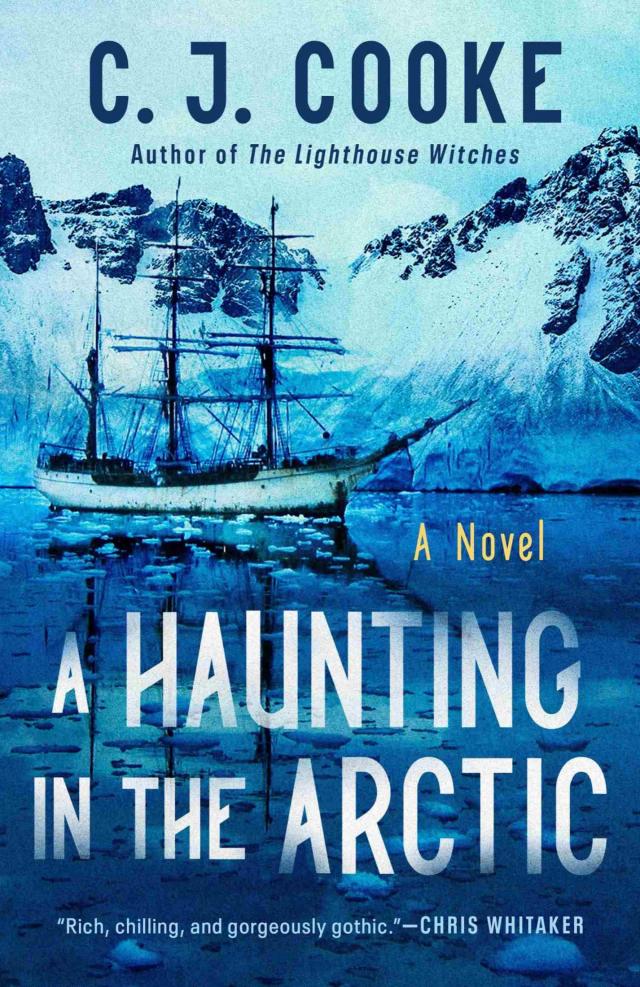
Title: A haunting in the arctic / C. J. Cooke.
Description: First edition. | New York : Berkley, 2024.
Identifiers: LCCN 2023032407 (print) | LCCN 2023032408 (ebook) | ISBN 9780593550205 (trade paperback) | ISBN 9780593550212 (ebook)
Subjects: LCGFT: Novels. | Novels. | Horror fiction.
Classification: LCC PR6110.E78 H38 2024 (print) | LCC PR6110.E78 (ebook) | DDC 823/.92—dc23/eng/20230731
LC record available at https://lccn.loc.gov/2023032407
LC ebook record available at https://lccn.loc.gov/2023032408
First Edition: February 2024
Cover design by Sarah Oberrender
Cover images: (Arctic coast) Christy Berry / Arcangel; (shipwreck) The Laundry Room / Stocksy
Book design by Nancy Resnick, adapted for ebook by Kelly Brennan
This is a work of fiction. Names, characters, places, and incidents either are the product of the author’s imagination or are used fictitiously, and any resemblance to actual persons, living or dead, business establishments, events, or locales is entirely coincidental.
pid_prh_6.2_146236080_c0_r0
Contents
Cover
Praise for C. J. Cooke
Also by C. J. Cooke
Title Page
Copyright
Dedication
Prologue
Part One: The Selkie Wife
Nicky
Dominique
Nicky
Dominique
Nicky
Dominique
Nicky
Dominique
Nicky
Dominique
Nicky
Olav
Dominique
Nicky
Dominique
Part Two: The Mermaid Stone
Nicky
Sigrún
Dominique
Nicky
Dominique
Nicky
Dominique
Nicky
Dominique
Nicky
Dominique
Einar
Nicky
Dominique
Nicky
Dominique
Nicky
Dominique
Part Three: Attempt Two Hundred Twelve
Diego
Dominique
Nicky
Dominique
Nicky
Dominique
Nicky
Dominique
The Selkie Wife
Author’s Note
Acknowledgments
About the Author
_146236080_
for all who live with
the many hauntings
of trauma
July 1973
Barents Sea, 100 nautical miles north of Murmansk, Russia
The man was covered in seaweed, gnarled fronds covering him like garlands. He was fully clothed and curled up by his bed, but his face had been gnawed to the bone, and the bloodied scratches on the wood of the door matched his missing fingernails.
The two coast guard officers shared a long look.
They circled the body slowly before crouching to inspect what had become of his legs. Beneath the torn fabric of his trousers they could see that the flesh had swollen and blackened. The mottled bare feet had split in two, no sign of the toenails, his toes lengthened to flaps of meat that had fused strangely together in a clean bisection. Like grotesque fish tails.
Dental records would confirm that he was Dr. Diego Almeyda, a twenty-eight-year-old postdoc from Argentina. He had spent his last months collecting ice samples with fifteen colleagues on board the Ormen, a barque-rigged steam whaling ship from the late 1800s repurposed as a research ship. Contact from the research team ceased a week ago, and the Ormen had drifted almost a thousand kilometers from its base in Svalbard until the Russian coast guard pulled up alongside it. Cups of coffee paused on a table in the cabin, slices of burned bread in the toaster. Bloods tains on the floor. Bullet holes puncturing the sails.
Pirates, perhaps.
But the man’s death was harder to explain. The door was locked from the inside. His face and feet were mutilated. He was the sole occupant of the ghost ship, the bodies of the other researchers unrecovered.
These were the only facts.
They found pictures under the mattress, penned by Almeyda—presumably—in a frenzy.
All depicted the same scene: a figure on the upper deck of the ship.
They were a series of images, as though for a flipbook, and when organized they seemed to form a coherent spool of movement: each hastily drawn sketch portrayed a figure of a woman who grew gradually closer to the wreck, her face always turned away, until the last image. That sketch filled the page, a macabre spectacle of a woman with seaweed for hair and white, sightless eyes.
And the chilling words on that last image, devoured now by flame:
She is on board
PART ONE
The Selkie Wife
Nicky
I
May 1901
Dundee, Scotland
Nicky woke to gold morning light effervescing in the eaves of her parents’ house. It was May, but in this small room winter lingered, the old fireplace unused on account of the coal stains that had ruined the stair carpet.
She pressed her feet on the floorboards, heat from the downstairs fire held in the wood, slowly creeping into her bones. The mirrored door of the Georgian wardrobe threw back the white fangs of her nightdress collar, two dark curtains of her unpinned hair framing her face. Recently, her temples had begun to shimmer with strands of gray. She was only twenty-seven, and at forty-nine her mother Mhairi still had a vivid red crown, even when she removed her hairpieces. But they said gray hair was the flower of worry, and she had spent the last twenty months in two halves—her body here in Dundee, installed in her parents’ house like a child, and her mind with Allan in the Transvaal, fighting the Boers.
She frightened herself by struggling to recall the exact line of his jaw, the texture of his palms, his smell. Her own husband. So far, marriage had not been as she expected.
But then, she had not expected a war.
She washed quickly by the sink, fastened her corset, slipped her petticoat and dress over her head. Then she pinned up her hair, clipping two long ringlets that had come from her sister’s head just above her ears. Her own hair was poker-straight; not even the hottest iron produced a lasting curl.
It was Monday—the day Allan’s letters arrived at their house on Faulkner Street. The postman came at nine, which was yet two hours away, but on Mondays she took the chance to spend the day there, beating the rugs and airing the rooms. It had been her mother’s idea for her to move back into her parents’ home while Allan was dispatched—a woman living alone was indecent, whether wedded or not—but she had surprised herself by how indignant she felt at this requirement. Wasn’t war indecent? And yet. There was certainly nothing wrong with her childhood home—Larkbrae was one of the finest homes in Dundee, sitting proud above the Tay—but she felt she had moved backward in time into her old life.
The main reason she went, aside from collecting mail, was to feel the embrace of her marital home, and all its promise: a future with Allan.
From the floors below, a voice sailed through the shadowy hall. “Wheesht, now. I’ve got you!”
She rushed downstairs to find her father, stooped over, his shirt and waistcoat unbuttoned, revealing his vest. Something was clasped between his palms, his strong arms held at right angles as he addressed whatever he held. His hands were covered in soot. Then, sensing her there, he looked up and tilted his chin. “Open the door.”
She turned and unlocked the storm doors, watching as he inched past, two small wings poking through the gaps in his hands. He had caught a bird, and from the soot marks on his forearms and vest she gathered it had fallen down the chimney.
“Steady, now,” he said, stepping out onto the porch with his arms outstretched. He lifted his top hand away to reveal a sparrow crouching in his palm. A second later, it shot off toward the trees.
Her father clapped his hands together as he looked after it, and she watched him carefully, unnerved. George Abney wasn’t a man to care about small things, and never a man inclined to save a creature that had fallen into the grate. He looked like he’d not slept all night, still in yesterday’s shirt and waistcoat, his eyes shadowy and the gray hair at the sides of his head ruffled.
“Are you well, Father?” she asked.
He kept his pale eyes on the garden ahead, searching after the bird. “Yes,” he said. “I think I am. I think I am.” He turned to her. “Have you time for a word?”
She raised her eyebrows, certain now that something was amiss. Her father never sought her out, never asked to speak to her. They were too similar, her mother always said. Each as headstrong as the other, long grudges held.
“Is something the matter?” she asked, following him slowly along the hall to his office at the other end. He didn’t answer, but she noticed he walked as though carrying an unseen stone on his back, weary from wrestling all night with the cares of his mind. Except her father never worried, never struggled. George ran one of the oldest and most successful whaling companies in Scotland, and he did so by being bullish and fierce, and sometimes cruel. Whaling was as perilous as it was necessary, for without blubber the streets and the factories would lie dark. A venture of blood and bone to sequester light.
Though George never ventured out on the ships, he had his own tempests to weather, such as the loss of three ships in as many years, and all his profits with them. The newspapers had taken pleasure in printing their speculations about the finances of Abney & Sons Whale Fishing Company, with hints that the crew of George’s only remaining ship, the Ormen, were set to down tools in protest at their conditions.
Inside George’s office, the heavy curtains were still drawn from the night before, walnut paneling and bookcases cocooning them. A lamp on his desk set an amber glow across his face, and when he closed the door she saw he was troubled, a crease deepening in his forehead.
“I want to apologize,” he said, moving to his desk.
“For what?”
“I did something a few days ago that I deeply regret,” he said, looking down at something. A letter. “But today, I shall put it right.”
She frowned, wondering if she had missed a conversation. “Put what right?”
He pulled out the desk chair and sank into it as though the metal inside him had splintered. Should she call her mother, or her sister, Cat? Was he having a heart attack? There was a glass of water on the table next to the sofa; she passed it to him, watching nervously as he raised it to his mouth with a trembling hand. Then she pulled up another chair and sat close.
“Papa?”
She didn’t know what else to say. She couldn’t bring herself to touch him. They’d not touched in years. She knew he loved her in that deeply unacknowledged way that their family seemed to love one another, and she was suddenly moved by the thought that he might die.
“The company is folding,” he said, dabbing his mouth with a handkerchief. “I’ve not told your mother. You’re not to say a word.”
The words landed like stones. The company? He couldn’t mean the family business.
“I won’t tell a soul,” she said, staggered now by the realization that she was the first to receive this terrible news. He hadn’t told her mother. Of course not. It would devastate her if it was true.
“We may need to sell this house,” he said, nudging papers across the desktop with his fingertips, a general tabling his battle strategy. “I’ve written to Uncle Jim.”
“For what reason?”
“To see if he would help us move to Toronto.”
“Toronto?”
She’d suspected things with the company were tricky, especially after the last ship sank in the Arctic. Many said that Dundee was going the way of Aberdeen, whaling no longer profitable. The lost ships weren’t being replaced.
But this was something else. Her father wasn’t one to panic. He was never afraid.
“You need to be careful,” he said, coughing hoarsely into his fist. “I’m going to put things right. But I need you to keep out of sight for a while.”