

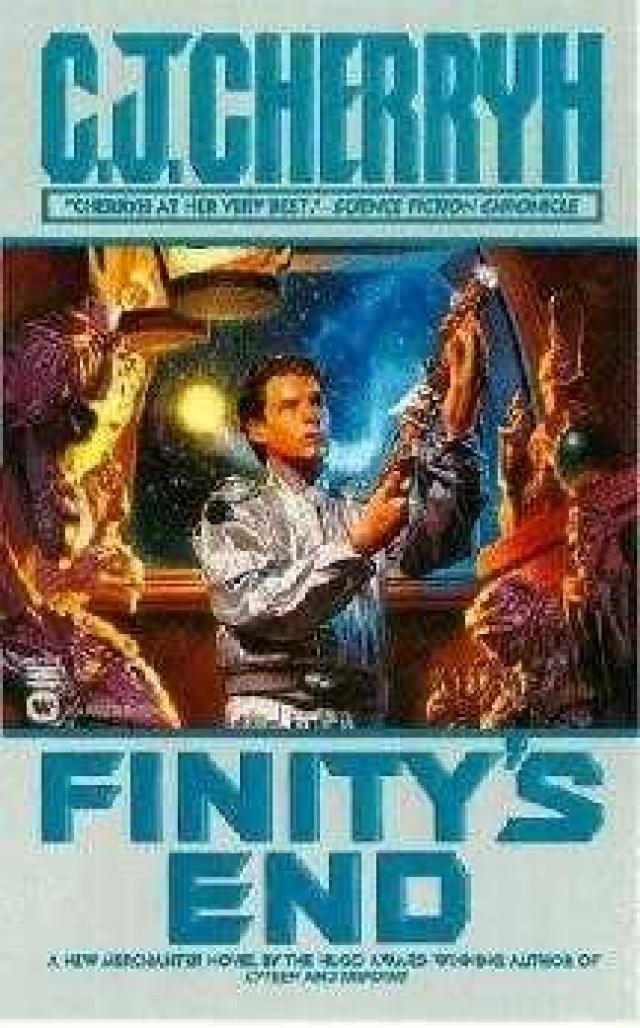
Finity's End, page 33
part #7 of Company Wars Series


She didn’t need to have an emergency message couriered by a spacer from a shiny alleged Union merchanter that happened to be in port—the quasi-merchanter Boreale, which if it hauled cargo only did so as a sideline. It was a Union cargo-carrier, it wasn’t Family, and it set the hairs on JR’s neck up to find himself facing a very nice-looking, very orderly young man who just happened to drop by a hand-written and sealed message at Finity’s berth.
Union military. He’d bet his next liberty on it. The physical perfection he’d seen in aggregations of Union personnel made his skin crawl. But the young man smiled in a friendly way and volunteered the information that they’d just come in from Cyteen.
“I’m pleased to meet you,” the young man said, shaking his hand with an enthusiasm that cast in doubt his suspicions the man was azi. “You have my admiration.”
“Thank you,” was all he knew how to say, on behalf of Finity crew, and stumbled his way into small talk with a sometime enemy, sometime ally who wasn’t privileged to set foot aboard. He was sure the courier was at least gene-altered, in the way that Cyteen was known to meddle with human heredity, and he was equally sure that the politeness and polish before him was tape-instructed and bent on getting information out of any chance remark he might make.
They stood behind the customs line, short of Finity’s entry port, where he’d come to prevent a Union spacer from visiting Finity’s airlock, and talked for as long as five minutes about Mariner’s attractions and about the chances for peace.
He couldn’t even remember what he’d said, except that it involved the fact that Mariner hit your account with charges for things Cyteen stations provided free. On one level it was a commercial for their trading with Union—a ridiculous notion, considering who they were. On the other, considering they were discussing details about Cyteen’s inmost station, about which Cyteen maintained strict security, he supposed the man had been outrageously talkative, even forthcoming. Had the man in fact known what Finity was? Could their absence in remote Sol space have taken them that far out of public consciousness?
No. It was not possible. People did know. And it had been decidedly odd, that meeting. Like a sensor-pass over them, wanting information on a more intimate level.
When he conveyed the envelope to the ops office inside the ship and the inner seal proved to be a private message to the Old Man—he was on the one hand not surprised by the address to the captain in the light of all the other hush-hush going on; and on the other, he became certain that the whiskey bottle was only the opening salvo in the business.
“Sir,” he said, proffering that inner message across the desk, in the Old Man’s downside office, next door to ops. “From Boreale?”
“Thank you,” the Old Man said, receiving the envelope, and proceeded to open it with not a word more. The message caused the mild lifting of brows and a slightly amused look.
The junior captain was not informed regarding what. “That’s all,” the Old Man said, and JR felt no small touch of irritation on his way to the door.
He walked out with the dead certainty that he’d not passed the test. He’d gotten far enough to know something was going on: his mirroring of Francie’s duty time told him the details of everything and the central facts of nothing, and he was starting to feel like a fool. If he, inside Finity, couldn’t penetrate the secrecy, he supposed the security was working; but he had the feeling that the Old Man had expected some challenge from him.
It was trade they were engaged in. It involved meetings with Quen, meetings with Mariner authorities, meetings with other merchant captains, to none of which he was admitted, and the Old Man, sure sign of something serious going on, had never briefed him.
Definitely it was a test. He’d grown up under the Old Man’s tutelage, closely so since he’d come under the Old Man’s guardianship. In a certain measure he was the accessible, onboard offspring no male spacer ever had—and which the Old Man had taken no opportunities to have elsewhere. While the Old Man had a habit of letting him find out things, figuring that an officer who couldn’t wasn’t good enough… he’d often reciprocated, letting the Old Man guess whether and when he’d gotten enough information into his hands. And he wondered by now which foot the Old Man thought he was on, whether he was being outstandingly clever, or outstandingly obtuse.
Meetings. All sorts of meetings. And a whiskey bottle from Mallory.
What they were doing came from Mallory, was agreed upon with Mallory… and ran a course from Earth to Pell to a Union carrier there was no human way to have set up a meeting with—unless it had been far in advance, at least a year in advance.
Nothing he could recall had set it up, except that a year ago a courier run had gone out from Mallory to Pell.
If something had gone farther than Pell it wouldn’t necessarily have gone through Quen. It could have gone through a merchant captain and through Viking or Mariner to reach Cyteen, to bring that ship out to wait for them——
Had Fletcher’s delay in boarding at Pell meant a Union carrier was sitting idle for five days?
Remarkable thought. It might account for Helm’s nervousness when they’d gone in.
A bottle of whiskey from Mallory and then all these meetings at a port which accepted a handful of carefully watched, carefully regulated Union ships.
But if one counted the shadow trade—
If one counted the shadow trade, and a hell of a lot of the shadow trade went on along their course, Mariner had a lot of shady contact. The next station over, Voyager, was a sieve, by reputation: it couldn’t communicate with anything but Mariner, it was a marginal station desperately clinging to existence, between Mariner and Esperance. The stations of the Hinder Stars, the stepping-stones which Earth had used in the pioneering days of starflight to get easy ship-runs for the old sublighters, had seen a rebirth after the War, and then, hardly a decade later, a rapid decline as a new route opened up to Earth trade, a route possible for big-engined military ships and also for the big merchant haulers, which were consequently out-competing the smaller ones and close to driving the little marginal merchanters out of business and out of their livelihood.
There was a lot of discontent among merchanters who’d suffered during the War, who’d remained loyal, who now saw their interests and their very existence threatened by big ships taking the best cargo farther, and by Union hauling cargo on military ships. They’d won the War only to see the post-War economy eat them alive.
And the Old Man was dealing with one of those cargo-hauling Union warships, and talking to merchanter captains and station authorities?
What concerned Finity? The Mazianni concerned them. That and their recent spate of armed engagements, not with Mazian’s Fleet, but with Mazian’s supply network. He knew that, as the condition which had applied during Finity’s most recent operations.
They’d crippled a little merchanter named Flare, not too seriously. Left her for Mallory… just before they’d made their break with pirate-hunting and come to Sol and then to Pell. Flare was, yes, a merchanter like other merchanters, and like no few merchanters, dealing with the shadow market. But Flare had been operating in that market in no casual, opportunistic way: she’d been running cargo out beyond Sol System, a maneuver that, just in terms of its technical difficulty and danger, lifted the hair on a starpilot’s neck: jumping out short-powered, deliberately letting Sol haul them back. It gave them a starship’s almost inconceivable speed at a short range ordinarily possible only for slow-haulers, freighters that took years reaching a destination. But it was a maneuver which, if miscalculated, or if aborted in an equipment malfunction, could land them in the Sun; and what they were doing had to be worth that terrible risk.
Flare had six different identities that they’d tracked at Sol One alone. You didn’t physically see a ship when it docked behind a station wall, and Mars Station was another security sieve, a system rife with corruption that went all the way up into administration and all the way back into the building of the station.
He stopped in the hallway, saying to himself that, yes, Mazian was indeed getting supply from such ships as Flare, well known fact of their recent lives; and, second thought, it was after that interception that the Old Man had gone to such uncommon lengths to put Finity into a strict compliance with the station tariff laws which every merchanter operating outright ignored, cheated on, or simply, brazenly defied—using the very principle of merchanter sovereignty which Finity’s End had won all those years ago.
That a ship couldn’t be entered or searched without permission of the ship’s owners put a ship’s manifest on the honor system. A ship could be denied docking, yes, and there’d been standoffs: stations insisted on customs search or no fueling; but a ship then told the customs agents which areas it would get to search, and in tacit arrangements that accompanied such searches, their own cabins full of whiskey, as crew area, could have gone completely undetected.
Third fact. Their luxury goods weren’t getting offloaded even this far along their course, and they were still paying those transit taxes, confessing to their load and paying. They’d laded their hold with staples, sold off a little whiskey and coffee at Pell and kept most of it. Added Pell wines and foodstuffs, which were high-temperature goods and which had to take the place of whiskey in those cabins.
And they weren’t offloading all those goods at Mariner, either. The plan was, he believed now, to carry them on to Esperance, where there was, as there was at Mariner, a pipeline to Union.
But hell if they had to go that far to sell whiskey at a profit.
Pell, Mariner, Voyager, Esperance. They were the border stations, the thin economic line that sustained the Alliance. Add Earth, and the stations involved were an economic bubble with a thin skin and two economic powers, Earth and Pell, producing goods that kept the Alliance going. Mariner was the one of the several stations that was prospering. Yes, those stations all had to stay viable for the health of the Alliance, and yet…
Union wouldn’t break the War open again to grab them: the collapse of a market for Union’s artificially inflated population and industry was too much risk. Union always trembled on the edge of too much growth too soon and expanded its own populations with azi destined to be workers and ultimately consumers of its production; but populations ready-made and hungry for Union luxuries and the all-important Union pharmaceuticals were too great a lure. Union had ended the War with a virtual lock on all the border stations. Now Union kept a mostly disinterested eye to the border stations’ slow drift into the Alliance system, because Union didn’t want to lose markets. Union was interested in Viking; interested in the border stations, which had gone onto the Alliance reporting system with scarcely a quibble. Nobody, not even Union, profited if the marginal stations collapsed, and the vigorous support of Alliance merchanters also moved Union goods into markets Union otherwise couldn’t reach.
The Old Man was talking to Union this trip. And they’d left an important military action to go off and enter the realm of trade. Madelaine, the night of the party, had talked about tariffs, just before she went off the topic of deals and railed on Quen.
He must have looked an idiot to Jake, who passed him in the corridor. He was still standing, adding things up the slow way.
But he stood there a moment longer reviewing his facts, and then turned around and signaled a request for entry to the Old Man’s office.
The light gave permission. He walked in and saw James Robert look at him with a little surprise, and a microscopic amount of anticipation.
“Trade talks with Union,” he said to the Old Man. “About the shadow market. Maybe the status of the border stations. Am I a fool?”
The Old Man grinned.
“Now what ever would make you think that?”
“Esperance and Voyager are leakier than Mars, in black market terms, and if we really wanted profit, we’d round-trip to Earth for another load of Scotch whiskey.”
“Is that all?”
“So it’s not money, and we’ve suddenly become immaculate about the tariff regulations. I know we have principles, sir, but it seems we’re making a point, and we’re agreeing to Quen’s shipbuilding and paying her station tariffs by the book.”
There was a moment of stony silence. “We don’t of course have a linkage.”
“No, sir, of course we don’t. We got Fletcher for the ship. We got Quen to agree to something else and we’re talking to Union couriers. I’d say we advised Union as early as last year we were shifting operations, and we promised them that Quen can pull Esperance and Voyager into agreement on whatever-it-is without her really raising a sweat, unless Union makes those two stations some backdoor offer to become solely Union ports. And Union won’t do that because they’re a military bridge to Earth and it would as good as declare war. Mariner, though, could play both ends against the middle. Except if the merchanters themselves threaten boycott. That would make Mariner fall in line.”
A twitch tugged the edge of the Old Man’s mouth. “Mariner isn’t going to fight us. But Mariner will play both sides. Security-wise, you just don’t tell Mariner anything except what you expect it to do. Its police are hair-triggered bullies, on dockside. But its politicians have no nerves for anything that could lead to another crisis or a renewal of Union claims on the station. The populace of Mariner is invested in rebuilding, trade, profit. They’re squealing in anguish over the thought of lowered tariffs, but they’re interested in the proposition of merchanters doing all their trading on dockside.”
“All their trading.”
“If the stations lower tariffs the key merchanters will agree to pay the tax on goods-in-transit and agree that goods will move on station docks. Only on station docks. That lets us trace Mazian’s supply routes far more accurately. It stops goods floating around out there at jump-points where they become Mazian’s supply. And it stops Union from building merchant ships… that’s the quid pro quo we get from Union: we hold up to them the prospect of stopping Mazian and stabilizing trade, which they desperately want.”
He let go a breath. Stopping the smuggling… a way of life among merchanters since the first merchanter picked up a little private stock to trade at his destination… revised all the rules of what had grown into a massive system of non-compliance.
“Are the captains going with it, sir?”
“Some. With some—they’re agreeing because I say try it. That’s why the first one to propose the change had to be this ship. We’re the oldest, we’re the richest, and that’s why we had to be the ones to go back to trade, put our profits at risk, lead the merchanters, pay the tariffs, and call in debts from Quen. The shipbuilding she wants to launch is an easy project compared to bringing every independent merchanter in space into compliance. But her deal does make a necessary point with Union—we build the merchant ships and they don’t. Building that ship of hers actually becomes a bonus with the merchanters, a proof we’re asserting merchanter rights against Union, not just giving up rights as one more sacrifice to beat Mazian. The black market is going to go out of fashion, and merchanters are going to police it. Not stations, and not Union warships. Esperance and Voyager are, you’re right, weak points that have to get something out of this, and the promise of their clientele paying tariffs on all the wealth passing through there on its way to Cyteen is going to revise their universe.”
“I’m amazed,” was all he found to say.
“Mazian, of course, isn’t going to like it. Neither are the merchanters that are trading with him. As some are. We know certain names. We just haven’t had a way to charge them with misbehaviors. Consequently we are a target, Jamie. I’ve wondered how much you could guess and when you’d penetrate the security screen. Pardon me for using you as a security gauge, but if you’ve figured it, I can assure myself that others with inside knowledge, on the opposing side, can figure it out, too. So I place myself on notice that we have to assume from now on that they do know, and that we need to be on our guard. We’re about to threaten the living of the most unprincipled bastards among our fellow merchanters. Not to mention the suppliers on station.”
“Sabotage?”
“Sabotage. Direct attack. Between you, me, and the senior crew, Jamie-lad, I’m hoping we get through this with no one trying it. But if you hear anything, however minor, report it, I don’t want one of you held hostage, I don’t want a poison pill, I don’t want a Mazianni carrier turning up in our path between here and Esperance. The danger will go off us once we’ve gotten our agreement. But if they can prevent us securing an agreement in the first place, by taking this ship out, or by taking me out, they’d go that far, damn sure they would.”
“I’ve put Fletcher out there on the docks with three kids.”
“Oh, he’s been watched. He’s being watched.” The Old Man gave a quiet chuckle. “He’s got those kids walking in step and saying yes, sir in unison.”
It was literally true. He’d been watching Fletcher, too, on the quiet.
“But we’ve got Champlain under watch, too,” the Old Man said. “Champlain’s listed for Voyager. They’re due to go out ahead of us, six days from now.”
JR was aware of that schedule, too. Champlain and China Clipper both were suspect ships on their general list of watch-its. A suspect ship running ahead of them on their route was worrisome.
“Once they’ve cleared the system,” the Old Man said, “you’ll see our departure time change for a six-hour notice. Boreale can out-muscle them on the jump, and Boreale is offering to run guard for us. I think we can rely on them. Let somebody else worry for a change. We’ll carry mail for Voyager and Esperance. We can clear the security requirements for the postal contract and I’ll guarantee Champlain can’t.”


