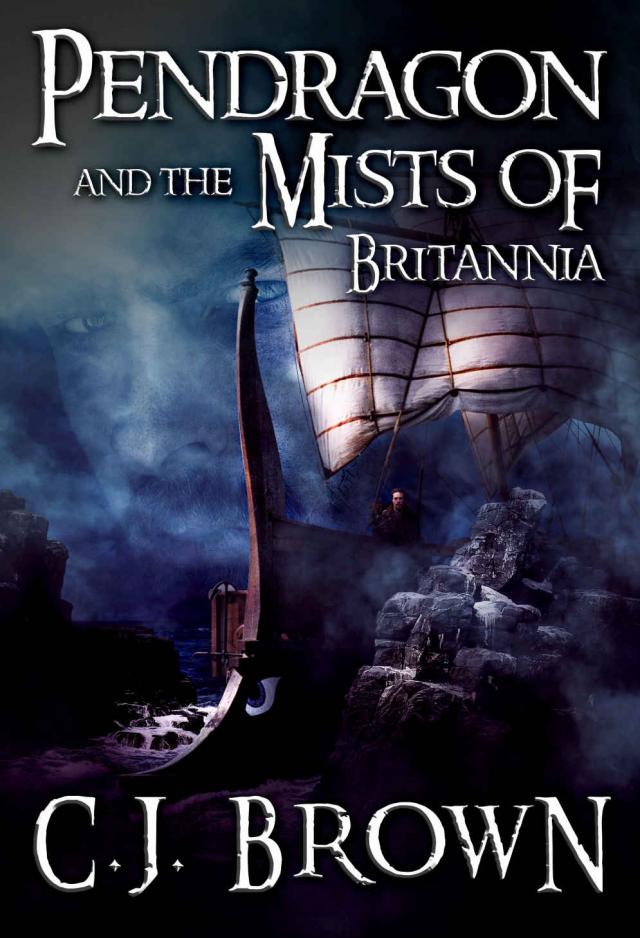
Pendragon and the Mists of Britannia (Pendragon Legend Book 2), page 3


Arthur and his new friend stood side by side, waiting to be invited to the king’s circle. Without the king’s permission, no one was allowed. But it didn’t take long. The king’s guard dispatched a soldier, a subject equivalent to the Praetorian Guard, Arthur surmised, to invite the two men to the circle. Unlike the Roman emperor’s personal guards, the Demetian Royal Guards wore no armor. In fact, they hardly wore any clothes. With enough hand-spun sackcloth to deem them decent, they allowed the rest of their bodies to be on full display, marked by a different kind of tattoo. This one did not glow like Verovingian’s. It was done in squid ink. Each line, each curve, each vertex, and angle had a special meaning and place. It was as intricate as the ones Arthur had witnessed on Verovingian, but not as vibrant.
As they walked, Verovingian noticed the look on Arthur’s face.
“Their tattoos are made for every battle they fought. One cannot become the king’s guard until there is no longer any space anywhere. If you watch carefully, you will notice that this one has markings on his tongue and teeth as well. It is the mark of bravery,” Verovingian explained.
Arthur was astonished. He hadn’t been in Demetia for long, and already he had learned so much about a culture that had been abandoned by the forefathers of his country. He had never studied about Britannia as a youth. He only knew about Britannia from reading the battles that General Aulus Plautius had conducted in his campaign under the Emperor Claudius.
But his perspective of Britannia was purely about conquering it, not about understanding its peoples and their ways.
As the two men approached, Verovingian gave him the signal that no more chatter was allowed past this point. Silence now had to continue until the first greeting. As instructed, Arthur arrived at the designated point and bowed while simultaneously uttering the standard greeting, “Your Grace.”
Verovingian did the same and the monarch looked down at his guest with astonishment.
“You are the one they call Arthur Pendragon?” His Grace began.
“Yes, Your Grace. I am.”
“Is your father, Uther Pendragon, here with you?”
“No, Your Grace. He remains at camp where we landed. He is not aware of my visit this day.”
“I see. You must bring him the next time you visit. Is that understood?”
“Certainly, Your Grace. I will make it a point to have him seek an audience with Your Grace.”
“Good. That’s very good. And your mother, Igraine. Is she in Britannia as well?”
King Megolin certainly seemed to know much about the affairs of the Pendragons and while it was out of place for Arthur to query that point it was a part of his curiosity to ask Merlin when time presented the opportunity to do so.
“You must be curious to meet my son,” he continued.
“Your son?”
“Yes. Merlin. Is that not who you seek?”
“Yes, of course. Indeed it is Merlin who I seek.”
“Well, it is customary for such important guests to first have their audience with the king and then to go on with their business. That is why you have been presented to me first. My son will join us shortly and show you to your quarters for the night. Not to worry, there is a great big hearth waiting for you and you will sleep warmly tonight.”
The king had known every last detail of Arthur and his family. How was that even possible? It would not be wrong to make the assumption that spies were involved or that they had been studied.
It was just too curious to leave for later. He had to find out now. But he was not permitted to speak unless spoken to and he had not been given leave to pose a question. As such, Arthur’s curiosity had to remain in his chest until another time.
While they waited, Arthur studied his host. Not a single mark showed on his face or hands. His skin was pale but not pasty. He was covered from head to toe in a garb that was different, a kind of shiny fabric like a damask weave. It was two shades of black. The patterns were exactly like those found on Verovingian’s body, except these were on the king’s robes. Arthur was not sure if that had any significance.
The king himself had a stumpy torso, and it was all Arthur could measure by sight. His legs were covered by a long cassock and he could not see where his legs ended and his feet began.
The king turned to the throne room’s rear access and announced that his son was about to appear. Arthur looked around and there was no indication of that and assumed that the father was just buying time for a tardy son. But just as the king had promised, Merlin appeared.
5
Mehmet
The middle of spring on the islands of Britannia did not guarantee warmth. In the midst of making its way to an eagerly-awaited summer, it would often reverse course and plunge the isles into gelid conditions. It was on one of these mornings, where the chill in the air penetrated deep down to the bone, that the rider had shown up. He was shown to the tent of the patriarch, Uther Pendragon. As Uther waited in his receiving tent for the man, he considered the timing of the visit. It had been merely a day.
Vipsanius parted the dual covers of the tent, allowing a rush of frigid air to rush into the tent and displace the warmth that had radiated from the central hearth. Uther held his tongue and intended with every fiber of his body to hold his expressions. At the least end of the possibilities, this was just a rider from a neighboring clan that came to welcome him. Unlikely.
At the worst, this was a spy from some warring party that came in peace but did so with the intent of scoping the enemy and understanding their numbers. Either way, Uther decided that he would be able to read the man’s intentions soon enough.
In the wake of the frigid air that Vipsanius had allowed to enter, walked a man, large and foreboding. Dressed in local garb, obviously new, his headgear was Caledonii while his robe was Welsh. It was an odd ensemble, one that did not settle the nerves of a man already warned of suspicious intentions.
Uther began to eye the man, surmising his analysis as he peeled back the layers of the man’s physical appearance and reading the heart that motivated his every action. The man walked with confidence, hardly consistent with a mismatched ensemble of gold threads and woolen headgear.
Upon entering, the man bowed, genuflected, then rose. He removed his headgear to reveal a man of modest beginnings but intelligence as he managed to advance in wealth. He had to do something smart, even if it was immoral. It took intelligence to pull it off, Uther thought as he eyed the man and engaged him in conversation.
“Welcome to my humble tent,” Uther began. “I am Uther Pendragon and all the men and women you see around you are my people. To what do we owe the pleasure of your visit, kind sir?”
The man hesitated. The opening salvo from the older and wiser patriarch was unexpected. Quick thoughts dashed through his mind: Why did he tell me the truth? Why did he not lie about who he is? Is this a trick? Or, is he a fool?
Thoughts kept rolling at the speed of lightning as the old man sitting behind the freshly hand-hewn table uttered his words of welcome.
The distracted man bowed his head, and his eyes caught a glimpse of a familiar sight. The rugs at the bottom of his feet struck memories that he did not know he had. He searched, looking for something and not knowing what it was that drove him into the sudden silence that he had fallen into.
“Are you alright?” Uther asked, seeing that the man had fallen into some kind of trance. He had walked in calm and confident but suddenly he had seemed to have fallen into a pit of despair. Uther determined that it was something about the intricately woven carpets that covered every inch of his tent.
A thought struck him and he raised his eyes to look directly at the man who was in his mid-thirties.
“What is a Turkic man doing this far from your native land?” Uther asked.
“The same a Roman man is this far from your native land, my lord.”
The answer caught Uther by surprise. It was a response that one does not expect from a person who seemed to be half in a daze. It was as though the man who was in a drunken stupor had miraculously sobered up and remembered his objective.
“My name is Bulanid Mehmet and I am not of this land. I am a descendant of Turkic tribes, and that rug, the rug two rugs in front of you, just to the left of your recently-hewn ash table, used to hang in my house when I was a child. The day that rug was taken from me thirty years ago, was the day I lost my family, became an orphan, and fell to the streets. Pray tell me how it has come to be in your possession.”
The conversation and the content of the man’s character were not anything that any sane and rational individual would have thought would materialize. A stranger had come out of nowhere and suddenly dropped such news. It was either a trick or something that was so true that it defied fiction.
Vipsanius, who was just outside, listened to every word of the conversation and was equally taken aback by the turn of events. He directed twelve archers to surround the tent and prepare to dispatch their arrows into the man if he were to cross the line and approach Uther.
“You say that this Anatolian rug used to hang in your house?” Uther said, pointing to one of the rugs.
“Not that one, my lord. That one,” he said, pointing vigorously at the carpet that had suddenly unearthed a ton of memories that he himself did not expect. His memories that had regressed so far in his mind now erupted until he could even smell the lunch his mother used to cook in the kitchen.
“That one,” he said again, as he pointed. “Where did you get that one?”
Uther focused on the rug that was being pointed to. He knew where he had gotten each and every rug. No one in the world had known other than the men who had been with him on the day he got the rug. Each one was on a different day. Uther knew each one. The Anatolian rug that the man was pointing to was acquired thirty-one years ago to be exact. Uther searched his memories until flashes of the rug started to pull old memories of the day he raided Salju.
Bulanid Mehmet watched the Roman lord stare at the rug he had pointed to and he watched the parlor of the man descend into chalk. The memories of the blood that he had placed on his hands in the name of the Roman empire, for his grandfather, came back to him like a glacier that moved with the speed of a chariot.
Flashes of that day, the blue skies over Salju, the screams of the women and children. One after the other, an overwhelming series of emotions hit him. Shaking his head, Uther sat back in his chair and pushed hard to regain his composure.
But it was too late. From a strategic perspective, the unexpected visitor had seized an unexpected opportunity and manipulated it to his advantage. It was the cleverest play he had ever orchestrated at the spur of the moment.
Trying to redeem himself, and get out of the hole he had just fallen into, Uther considered that this was a trap. Anyone who knew him would have known that he was the man who led the massacre of Salju. It was in the early days of his command and it was a mistake that he had learned to put behind him. But now, of all the times in the world, his most grievous sin had come to haunt him on his first day on a new land.
“If you are who you say you are, you know where this rug comes from?” Uther questioned his questioner.
Bulanid turned to him, and with all the disgust and pain he could muster, he channeled the anger to his face but kept his stance. He knew that arrows were pointed at him and it was not his intention to slay the patriarch of the Pendragon clan. His goal was to ingratiate himself into the old man’s business.
The rug was an opportunity and Bulanid saw it as such. For all the pain that the Roman legion had caused him that day, from the loss of his home and family, to the loss of a life of potential, and the life he inherited instead in the squalor found in the wake of a Roman raid, his day of retribution was upon him. He would push the knife into his target slowly and push it as deep as he could and he would twist it until every last ounce of life in the man who stood in front of him screamed in agony. He wanted to inflict so much pain on that man that he knew he could only do it by focusing that pain on his son.
“If you were there, then I challenge you, stranger, to tell me what happened that day,” Uther said.
Pressing his advantage, Bulanid began, “It was a bright summer morning. My father had just left to tend the store. He owned a spice and sweets trading post in town.” He stopped and closed his eyes as all those who were watching the scene unfold would see the memory pour into his head with such clarity that tears streamed down his face. For a moment, even Uther felt like he saw the little boy that once was.
“Mother was preparing dry bread in the kitchen. My grandmother had just left to send my sister to school.”
He stopped to take a deep breath as if he could smell every scintilla of the kitchen’s aroma that morning. Bulanid had indeed transported himself back to Salju that morning.
“Then we heard screams in the distance. We had no idea what that was or who that could be. We were a peaceful town, going about our business. Most fathers traded in some kind of wearable or consumable. No harm should have come to us. But then the sounds grew louder and the vibrations began to topple pots and jars.”
The more the memory flooded his consciousness, the more tense he became. Fists clenched and shoulders back, the stranger began recounting every element of the raid that only someone in the midst of such atrocities would remember. It seared only the victims as the soldiers never remembered the towns they looted, sacked, and pillaged. It was all one and the same.
Except for Uther who remembered it exactly as had just been recounted. In his shame and guilt, Uther waved his hands at the men beyond the tent to lower their bows. He walked over and held the stranger in his arms and laid his head on his shoulder.
“What is your name, son?” he said, as Igraine watched from the gap in the tent with bated breath. The story of what had happened had never fallen on her ears. She had just married Uther around that time and Arthur had not been born yet. Igraine did not have any idea that such a thing had happened but from what had happened in the tent, it occurred to her that it was not false, no matter how much her instincts told her that something nefarious was afoot.
In the receiving tent the two men, older and younger, had melted to tears as they both remembered the pain they both had suffered and a bond began to form between the two. For the older, it became a necessity for him to pay his penance for the deeds of the past. For the boy of Salju, it was clear that the find was priceless. He did not know that the man who had raided his town and killed his father, mother, grandmother, and sister was Uther Pendragon.
How fortunate, he thought, were the turn of events as he looked at the rug and shut the real pain that it invoked but capitalized on how it had catapulted him into the inner circle of the Pendragon clan.
6
Merlin
Dressed in black, and taller than the king, his father, Merlin Megolin, stepped out of the shadows and onto the throne’s elevated platform.
“Welcome General Arthur Pendragon,” he began, his eyes, a fiery yellow, glaring directly into the brown eyes of the young warrior in front of him. The two men looked at each other, both wanting to get a better hold of the other. It was Arthur who was behind in the race to read the other. Merlin had more insight into the mind and heart of the younger Pendragon than Arthur had of himself.
The yellow eyes that penetrated him felt like it went right through his soul. At the same time, it was mesmerizing. He had never come across anyone with features such as his. High cheekbones defined the edges of a serious face. A perpetual frown occupied his forehead.
But the most captivating feature of this man who seemed young for his oversized role in what was about to unfold seemed to be his baritone register. His short and well-enunciated welcome greeting, with all the necessary formalities neatly tied into a succinct package, spoke volumes of a man who spent more time with the company of his mental faculties than with the company of other beings.
“Prince Merlin—” Arthur began but was interrupted.
“Please. No. No titles or honorifics. Please,” he repeated himself in the same sentence, a fact that Arthur did not overlook. It told him that he had not appreciated being royalty, even if the royalty was merely one that occupied the extent of the woods.
“My sincere apologies,” Arthur replied. “Merlin, it is a pleasure to finally make your acquaintance. It is only our first meeting and I am already indebted to you. It is not a common occurrence. In fact, it is a first.”
“So I take it that you destroyed the ship that was tailing you?”
“Yes, I rammed him mid-ship in the fog.”
“Did you have anything to do with the timing of the fog, Merlin?” asked the king.
Arthur recoiled. The notion of controlling the weather was ludicrous. But this was the king and he had no leave to speak.
Merlin nodded, not wishing to take credit for something as simple as rolling the fog in at the precise moment. Looking at his guest, he knew that the revelation that it was Merlin who had been responsible for the fog at the opportune moments raised questions in his head.
“All in good time, Arthur,” Merlin said, as if hearing the thoughts that were filling his mind.
Arthur shook his head and looked at the king.