Year of Miracles, page 21
part #1 of Collected Stories of the Old Races Series
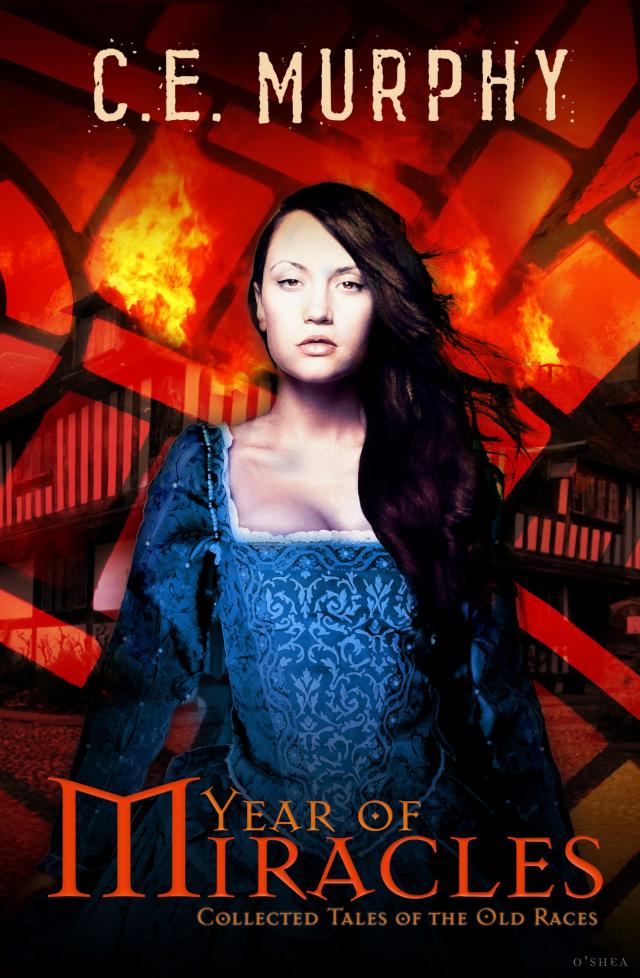


The land, the freehold, was more than she had ever dreamt of, only a few months earlier. It looked now to be not insufficient, but perfect: hard work for good gain, in its way more satisfying than the easy pearls and silks Janx had offered, though she could never regret having sampled those. "It's beautiful," she whispered, then looked up at the sharp planes and angles of the gargoyle's face. "Will they be all right?"
"In time. Will you? Is your fear lessened now?"
Sarah smiled through tears that had only just begun to fall. Her fears were lessened: there would be no war amongst the Old Races over a child they forbade, and her men would find a way to forgive one another. "In time."
"Good. I must go, Sarah. It's a long journey home, and they'll be looking for me when the fires go out. But if you should need us again, we always find one another at the highest point in a city. Search there and we'll be waiting."
Sarah turned a tear-blurred gaze at the orange horizon; at the town that had been her home and which now burned out of control. "There are no high places left in London."
Alban touched her shoulder. "There will be other cities."
She shook her head with the protestations and innocence of youth. "No. Not for me. Goodbye, Alban. Thank you for what you've done."
"Be well, Sarah Hopkins. For you and your child both, be well."
She was wrong, of course, as she'd been wrong about so many things, but there were no cities for long and long again. London's faintly visible presence on the horizon proved too much reminder, and Sarah left the quiet cottage Alban had found for her after her daughters were born in the spring. Red-haired Kate and black-haired Ursula, each of them their father's daughter and no other. Year of miracles indeed, Sarah thought, though the poet who had so named it had known nothing of the wonders Sarah had seen.
She did leave Alban a note, a rough sketch of the British island, with a marker at the very top: the highest point in the country. He found them in Scotland many years later, children of the moors and wild seas. The girls were seventeen by then, and Sarah looked barely older than they were. He left them there, but came back to watch over them from time to time, and when a century had gone by, offered passage on a ship to newborn America. Eliseo and Janx came and went from the new world, he said, but it was vast beyond imagining: they would never find her if she didn't wish to be found.
New York City
It was unfair of Alban, Sarah thought. Unfair of him to send a lovely young woman to her doorstep in search of the twins, when she had been so careful for so long to keep them hidden. She knew, knew, when the young black woman rang her doorbell, that it had to do with Alban.She opened the door, already in a temper, and snapped, "Well?"
The girl—they were all girls by comparison, of course—blushed in surprise and glanced up and down the street before speaking. "Hi. Sorry, my name's Margrit Knight. I'm a friend of Alban Korund's and I'm looking for Kate or Ursula Hopkins...?"
"Never heard of 'em." Sarah began to push the door closed, heartbeat higher than it had been in decades. She was old now: she looked old and she was careful to sound American. This Margrit could never imagine her to be the Sarah of the story. Still, the girl slapped her hand against the door, holding it open and startling them both. Sarah's eyebrows shot up and she swallowed a sound of glee. After so long it was hard to surprise her, and after all this time she still loved moments of theatre.
Margrit Knight's blush intensified, coloring mocha cheeks to a delicious burnished red. "Wait. I'm sorry, but I'm looking for two sisters who used to live here. I might have the names wrong, but—"
"I've lived here since 1962," Sarah snapped, perfectly honestly. "Now go away."
"Oh." Bewilderment filled the girl's face and she fell back a step. "I'm sorry. I must have gotten the wrong address. I'm..." She glanced at her watch, at the rising sun, and sighed. "I'm sorry to have disturbed you. Thanks for the information. I'll go now."
She did, and Sarah closed her front door with a resounding thump before scurrying down the hall to snatch up the telephone and dial swiftly. "Katherine? There's a young woman out on the street looking for you and your sister. Alban sent her. I don't know if you want to talk to her or not."
Moments later she peered out through lace curtains, smiling as Kate strode out of the home she shared with Ursula less than half a block from their mother. Within a minute or two Margrit Knight had been invited inside, and Sarah retreated, letting the curtains fall back into place.
It had been more than three centuries. Longer by far than she had ever hoped to protect her children from their fathers and their fathers' world. It had had to come to an end someday: nothing, Sarah had said so often, nothing lasts forever. But they were grown now, and would very soon be part of the Old Races one way or another. It was inevitable, and more, it was necessary. Content, Sarah went to her dressing room, there to examine her reflection.
The woman in the mirror was no longer young. It was easy to see her as elderly, fragile, frail, though in truth she was hearty and hale, a youth spent in the slaughterfields lending strength to an ancient body. Time and again over the years she had caught glimpses of what Janx had seen that day in the market: beauty and boldness, and no one era had ever drowned that spirit. They had brought it out in her, and it had served her well for decades upon decades.
For centuries she had withheld the making of a promise, one that always lingered half-thought at the edges of her mind. She'd kept it there deliberately, not fully realized, so that it could never become the final devil in Pandora's box. So that hope would be unable to taunt her, as it had so often taunted two men who were in no way, and in all ways, brothers.
The twins would be discussing it now, and soon they would choose to leave behind the human experience that Sarah had given them. They would meet Janx and Eli—who was now called Daisani by almost everyone—and they would begin a new life.
As would Sarah. Finally she allowed that box to open, allowed the unthought, unspoken promise to take form. Allowed it to fly free on dragon wings and vampire speed, and smiled.
She would see them one last time.
EARTH-BOUND MISFIT
Gardening with Ursula was wretched. Her hands flew when she dug the soil, darted when she pulled the weeds, scurried when she loosened the vegetables, and hurried when she pulled them free. It was the same with picking berries or even catching fish: her quick hands made light of the work, but in a wonderful show of pedancy, she never, ever did more than her half of it. Kate was left to plod along doing her own half while Ursula scampered about, playing with birds and chasing rabbits, neither of which usually ended well for the animals.
She did collect all the honey; that was something, at least. Of course, she licked her fingers so clean of it that she might have drunk half the hive's work, and neither Kate nor their mother would know for sure because Ursula was so quick. Kate could have helped; her skin tended toward a certain imperviousness, but their mother sent Kate to collect nettles for tea and soup instead, and called it fair enough.
The best bit was when Ursula had to milk the cows, which required patience and slow hands, both so anathema to Ursula that Kate often finished that job, at least, before her. But none of it made up for the fact that her sister was light and lithe and quick, and had been since either of them could remember, whilst Kate was stuck plodding along the earth like an ordinary mortal. The twins were nearly fourteen now, and it seemed intolerable.
Their mother would have, Kate thought, protected them both from the knowledge that they were not ordinary mortals, at least as long as she could have, were it not for Ursula's inherent speed. But there it was, and so there too lay the answers to their heritage, that they were half human, and half not. Ursula, whose father was Eliseo Daisani, had inherited the speed and hunting skills that defined a vampire, and their mother Sarah wondered at times if, although Eli hadn't demonstrated it to her, whether Ursula's attention span, which could be brief as a single breath, was some part of that legacy as well. Perhaps not; children were often caught by one fancy and then another, but Kate could sit and watch a caterpillar cocoon and wait for it to emerge a butterfly without any need to move in the interim, and that, Sarah thought, was her father's legacy. Janx the dragon, drawn to beauty, and his daughter, able to wait on unfolding glory with a patience beyond mortal ken.
That was, in Kate's reckoning, all well and good, but her father could fly.
Sarah had seen it, had even ridden on his back so high into the sky the air grew thin; so high that the moon seemed within reach, and so high her breath had felt like ice in her lungs. She could hardly express the size of him: huge, vastly, absurdly huge, all serpentine and slender wings that might blot out the very moon he flew so near to. In its blue light his scales gleamed almost purple, though under the sun's brilliance he shone red, red as his hair; red as Kate's. He could transform from the dragonly shape to the human, but Kate remained locked with two legs and two arms and no wings, and it tasted bitter. Ursula could run; she, Kate, ought at the least be able to fly. She built a story in her mind that age would do the trick, and that on their fourteenth birthday she would come into that birthright.
The day came and passed without any such incident; so too did another birthday, until Kate spent long raging hours stalking the fields and frightening cows with her anger, which Ursula felt had to be a sign of impending dragonhood, as Kate's own self, slender and strong with youth as she might be, was hardly terrifying. Their moon's blood came, and that was not enough either, although Ursula grew faster and faster still, while Kate only became increasingly choleric.
Worse yet, aggravating her further, her skin began to itch, as if it needed shedding, or greasing, or both. Some days she would turn inside the house and something across the room would fall. Nothing ever broke: Ursula would catch it, no matter how far away she was when it fell, but Kate couldn't stop the crashes, any more than she could escape the itch. After a week of that she moved into the barn, where there was more room and less to break, and after a month, she stomped out to a northerly field overlooking the lashing winter sea, and dug a hole to hide in. Ursula helped, for once doing more than her own share of the work, then stood back with ill-disguised worry as her sister buried into the soil like an animal, and hunkered down as if planning to wait out the winter. In there she could writhe and scratch and thump without doing damage, and if the hole got deeper, so be it.
At a certain depth, its scent changed. It still smelled earthy, but metallic too. Kate dug down, not asking for Ursula's help this time, and found, in time, a chest of rotted iron, and inside it, Roman coins and jewels. Part of her, still a girl, thought she ought to drag it up to the surface and bring it to their mother; the other part of her, the dragon's daughter, coiled around it in the earth's cool grasp and went to sleep.
She emerged, gaunt and dirty and hungry, into spring air filled with the bleats of lambs and birdsong, and the scent of turning soil and new growing things. The chest of coins she dragged along behind her until a calf mewled and hunger turned her dizzy. A few quick steps, a launch upward and a landing hard enough to shake the earth, and the little beast crunched to the earth beneath her; she had taken three savage bites before thought caught up to action, and then it was she who mewled, and ran for home.
Ursula flashed out of the house shrieking and waving her arms, stopping Kate a dozen earth-rucking steps before the door. Clods of dirt spattered across the house as Sarah appeared in the door, less agitated than Ursula but with a scent of relief. Kate yowled, unable to stretch human words from a mouth shaped wrong, but Ursula mitigated her fear by seizing around Kate's neck and swinging herself upward, until her sister was an unfamiliar weight between Kate's shoulders. Ursula pounded her shoulder, shouting nonsensically, and, like a half-wild horse, Kate bucked and twisted beneath the ruckus. Huge and terrible feet rent the ground, and she arched like a cat, jumping up and down, but Ursula, laughing, hung on.
Her sides, along the spine, below the shoulders, felt strangely constrained, as if her arms were somehow bound against her. They weren't: what she thought of as arms were beneath her, supporting her weight, as were her legs, but something lay there, uncomfortably tight. Kate inhaled, pumping her lungs like bellows, and Sarah gave a shout of alarm and laughter as she made enormous throwing-away gestures with her tiny human arms. Pointing Kate in another direction, perhaps; thus guided, Kate turned and bellowed again before with a rip, her wings tore free.
It was not the uncertainty of a bird trying its first flight, oh no. Still mucus-covered, still sticky and new, Kate lowered her belly to the earth, banging wings against the house, the gate, flattening parts of the garden, knocking askew a carefully-built stone fence, and then leapt to the sky with strength and confidence and a joyfully shrieking sister upon her back.
The world below became patched pieces: Sarah smiling upward from the house, the new green of the garden around her. A distant road threaded through hills, and fields that were thought of as fecund seemed stone-littered and impossible to farm, from above. Sheep and cows made bright spots of color against brown tilled soil and grass-green hills; there lay the bloody spattered mess of the calf she'd half eaten, and behind it the chest of coins she'd dragged out with her tail. The gold was too small to be seen, but she knew it was there, as certainly as she knew the slate-blue sea that rolled beyond the cliffs and rocky shores. It seemed so orderly, and she had reached hardly any height at all: from far above the world would be a serene place, untroubled and untroubling. Her wings dried with every heartbeat, with every wing beat, and Kate, soaring in this new shape, this hardly-known form, felt satisfaction rising up from within, a confidence in her wholeness, and with that sensation thought that had she known how to laugh in this new body, she might have, for she had never felt so very human.
LEGACY
1840, New York City
A Germanic voice murmured, "A shame about the old church," and Richard Upjohn snorted.
"Not at all. There was nothing extraordinary about it, nothing memorable. It lacked even the respect of age, and moreover, it was poorly enough constructed that the weight of winter snow weakened it beyond repair. My church," he said with already-significant satisfaction as he examined the enormous hole that the foundations would be laid in, "will stand for the ages." Then he glanced sideways at the man who had spoken, and fell silent in surprise.
He was perhaps the tallest man Upjohn had ever seen, standing two meters in height, and had the breadth of shoulder to match. He was not old, but his hair glowed white even in the early evening moonlight, and his eyes were so pale as to seem colorless. His hair was unfashionably long, not coiffed at temple and top but rather smoothed back in a tail that fell between his shoulderblades, and his coat was of a cut not seen in a decade or more.
No one, Upjohn thought, would mock him for his lack of style. Not with the height and breadth of him, nor the warning rumble in the deep voice. He found himself searching for, if not an apology, at least a moderation of his strong stance against the old church, when a smile flickered across the huge man's face. "The snow was very bad that year," he said, defending the older building, "but it is true that it lacked age. The second church on this site, I believe. I never saw the first."
"Of course you didn't. It burned during the Revolution." The war between the colonies, Upjohn had been taught to call it in childhood: the Revolution, the Glorious Revolution, had happened more than a century earlier by English reckoning, but he had come to America by choice, and become a citizen only four years ago. In America the colonial war was the Revolution, and so too for Richard Upjohn.
Either way, the first church had burned a quarter century before Upjohn was born, and the giant German at his side could certainly be no older than Upjohn himself.
Another smile flickered across the tall man's face. "Yes, of course. Still, I had some fondness for the second church. I lived here, you know."
Upjohn's gaze sharpened, then fell into puzzlement. The man was not the vicar or the reverend, nor did Trinity employ a groundskeeper that Upjohn was aware of. And he could hardly be unaware of this man, who might well cow the grounds into growing tidy hedges and short grass with no more than his size and presence. "That's absurd. I've never seen you before, and I was commissioned to work here when the old church was so badly damaged."
"And yet," the big man said idly. "Walk with me a while, Richard Upjohn. I have a favor to ask of you."
Upjohn, curious and mystified, matched the German's steps as they left Trinity's grounds for the surrounding city. Three hundred thousand people lived there, a tenth the number in London, but its freshness was rife with potential. New York could be beautiful, if Upjohn and others like him were allowed their way.
The German, as if hearing his thoughts, said, "I've followed your career, Master Upjohn. You have a love for the Gothic. What is it that draws you to it?"
"I am a faithful man, Master..."
"Korund," the German said. "Alban Korund. The pleasure is mine."
"Korund," Upjohn echoed after a moment. "I'm a faithful man, Master Korund. I believe the Gothic churches carried the eye and voice to God, as they should. Their churches were manifestations of truth, truth made visible to purify the heart. To build and restore in their style is the work of God."
The German—Korund's—eyebrows lifted. "How deeply do your convictions run, Master Upjohn? Do you believe, as Hamlet did, that there are more things in this world than are dreamt of in your philosophy? Or are the answers to God's mysteries all plain in the light of day?"
"I would not presume to know all God's secrets," Upjohn replied stiffly, and Korund waved a large hand in apology.