Twelve Tomorrows 2014, page 1


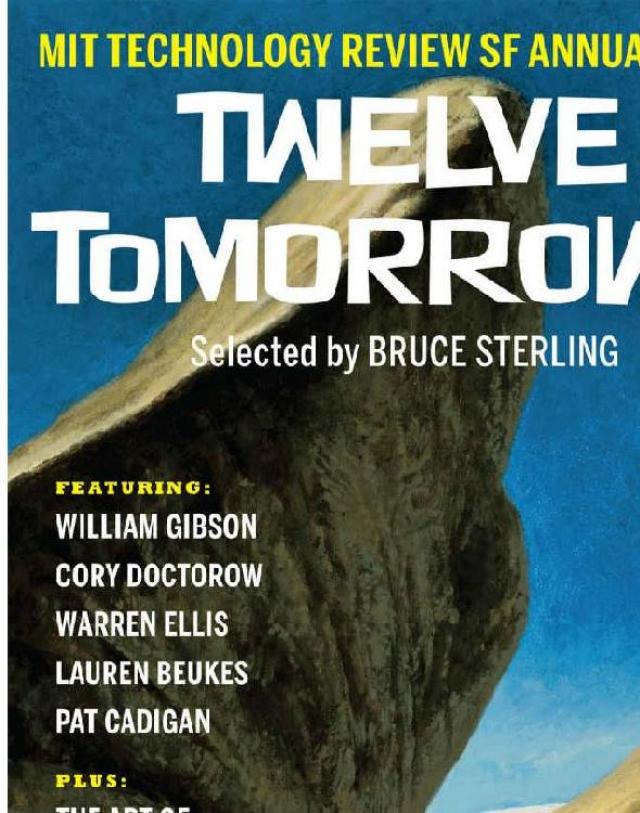
Twelve Tomorrows
TWELVE TOMORROWS
is published by
Technology Review, Inc.
One Main Street, 13th Floor
Cambridge, MA 02142
Tel: 617-475-8000 Fax: 617-475-8043
www.technologyreview.com
© 2014 All rights reserved.
Twelve Tomorrows Editor: Bruce Sterling
Editor in Chief and Publisher: Jason Pontin
Creative Director: Eric Mongeon
Editor: David Rotman
Deputy Editor: Brian Bergstein
Managing Editor: Timothy Maher
Copy Chief: Linda Lowenthal
Production Director: James LaBelle
Chief Digital Officer: Erik Pelletier
Project Manager: Jane Allen
Senior Software Engineers: Shaun Calhoun, Molly Frey
User Interface/Digital Designer: Emily Dunkle
Chief Financial Officer: Rick Crowley
Chief Operating Officer: James Coyle
Chief Strategy Officer: Kathleen Kennedy
Executive Assistant: Leila Snyder
Vice President, Consumer Marketing : Bruce Rhodes
Marketing Communications Manager: David W.M. Sweeney
Director of Advertising Sales: James Friedman
Technology Review, Inc., identifies the new technologies that matter - explaining how they work, deciphering their impact, and revealing how they'll change our lives. Founded at the Massachusetts Institute of Technology in 1899, we are a digitally oriented global media company that publishes serious journalism in magazines and on websites and mobile devices. We also host events around the world. Technology Review, Inc., is an independent nonprofit 501(c)(3) corporation wholly owned by MIT; the views expressed in our publications and at our events are not always shared by the Institute.
Contents
Q+A
with Gene Wolfe
Slipping
Lauren Beukes
Countermeasures
Christopher Brown
Business as Usual
Pat Cadigan
Petard: A Tale of Just Deserts
Cory Doctorow
The Shipping Forecast
Warren Ellis
Gallery
The artwork of John Schoenherr
Persona
Joel Garreau
Death Cookie/Easy Ice
William Gibson
Los Piratas del Mar de Plastico
(Pirates of the Plastic Ocean)
Paul Graham Raven
The Various Mansions of the Universe
Bruce Sterling
At Home in the Cosmos
A review by Peter Swirski
Contributors
Lauren Beukes lives in Cape Town, South Africa. She's the author of The Shining Girls, about a time-traveling serial killer; Zoo City , a phantasmagorical noir set in Johannesburg; and the neo-political thriller Moxyland. She's also written a best-selling comic, Fairest: The Hidden Kingdom . Her new book is Broken Monsters , set in Detroit.
Christopher Brown writes science fiction and criticism in Austin, Texas, where he also practices technology law. His stories frequently focus on issues at the nexus of technology, politics, and economics. He was a 2013 World Fantasy Award nominee for the anthology he coedited, Three Messages and a Warning: Contemporary Mexican Short Stories of the Fantastic.
Pat Cadigan is the author of 15 books, including two nonfiction books, a young adult novel, and the two Arthur C. Clarke Award - winning novels Synners and Fools . She has also won the Locus Award three times, as well as the Hugo Award. She lives in North London with her husband, the Original Chris Fowler.
Cory Doctorow, a science fiction author, activist, journalist, and blogger, is the coeditor of Boing Boing (boingboing.net) and the author of the bestselling novel Little Brother . His latest young adult novel is Homeland , and his latest novel for adults is Rapture of the Nerds .
Warren Ellis is an author, graphic novelist, and columnist. His new novel, Gun Machine , was a New York Times best-seller and is being developed for television. The Red films, starring Bruce Willis and Helen Mirren, were based on his graphic novel of the same name. His next books are a novella, Normal , and a graphic novel series, Trees .
Joel Garreau, the author of Radical Evolution: The Promise and Peril of Enhancing Our Minds, Our Bodies - And What It Means to Be Human and a former long-time reporter and editor at the Washington Post , is the Lincoln Professor of Law, Culture, and Values at Arizona State University, where he has found alter egos who collaborated on this tale.
William Gibson, born in South Carolina, has lived in Vancouver since 1972. He is the author of nine novels and coauthor (with Bruce Sterling) of one. His most recent book, Distrust That Particular Flavor , collects his nonfiction. His tenth novel, The Peripheral , will be published by Penguin in November.
Paul Graham Raven is a postgraduate researcher in infrastructural futures at the University of Sheffield. He's also a writer, science fiction critic, and essayist, as well as a persistent gadfly in the futurological ointment. He lives a stone's throw from the site of the Battle of Orgreave, with a duplicitous cat and three guitars he can barely play.
John Schoenherr (1935 - 2010) was an American artist and illustrator who is widely known for being the first to depict the world of Frank Herbert's Dune. A highly accomplished naturalist painter, he created exquisitely detailed work that appeared on the covers of scores of book jackets and magazines over the course of his 50-year career. He won the Hugo Award for Best Artist in 1965 and a Caldecott Medal for children's book illustration in 1988.
Bruce Sterling, author, journalist, editor, and critic, was born in 1954. Best known for his 10 science fiction novels, he unites his time among the cities of Austin, Belgrade, and Torino. His nonfiction works include The Hacker Crackdown: Law and Disorder on the Electric Frontier , Tomorrow Now: Envisioning the Next Fifty Years , and Shaping Things .
Listed in Canadian Who's Who , Peter Swirski is an authority on contemporary literary culture, including popular culture and digital culture. He is also recognized as the world's leading critic on Stanislaw Lem. He has written 14 acclaimed books, including the best-selling From Lowbrow to Nobrow ; Ars Americana, Ars Politica ; and From Literature to Biterature: Lem, Turing, Darwin .
Preface
EVEN THOUGH I'M TEXAN, I DON'T WANT TO BRAG ABOUT BEING the guest fiction editor of MIT Technology Review . It's truly a great magazine, and has long been of tremendous personal use to me as a publication - but I'm the editor of its annual science fiction special issue, Twelve Tomorrows, so it looks kinda bad if I say that in public.
I think I can safely remark that the MIT Press (which has nothing much to do with this book here, except for its MIT ownership) is the cat's pajamas among university presses. Boy, are they ever classy. If you're a big fan of contemporary science fiction and you wonder where it's going these days, you should widen your horizons and read Anthony Dunne and Fiona Raby's Speculative Everything: Design, Fiction, and Social Dreaming , published by MIT Press in late 2013. You'll see how effortlessly MIT can move the needle on our planet's cultural dial. When it comes t. "speculative." MIT doesn't need much hand-holding from us science fiction writers. MIT distributes the lessons there, basically.
Given that reality, I combed the planet for some with-it science fiction writers who are up to the job o. "reviewing technology." Mind you, I don't mean any louche, Hollywood-style, phony special-FX scifi technology. I mean the genuine, consequential technology that MIT Technology Review covers, the kind of real-world tech that can panic the Nasdaq and affect our planet's balance of power.
To do that, I had to look around. Since MIT Technology Review is so globally inclined, I found you a Canadian, and a South African, and two and a half Britons, and even one other Texan, because I didn't much feel like going it alone. I also recruited a pair of professional futurists. I know squadrons of these futurist guys: I meet them wherever the tech trouble is, and they're always knee-deep in the political, legal, social, and ethical implications. So I recruited a couple of fully briefed futurists who possess narrative skills and literary gifts, and I got them to create some science fiction, just for you. That wasn't easy.
When I, your tireless editor, told these highly various people. "MIT Technology Review is calling: they need you to write some science fiction." every last one of'em showed up bright-eyed, sober, and properly groomed. They come from all over the map, but they all know that MIT is a primal source of major change in our world. So they bent double over their keyboards and wrote like it mattered.
The upshot is now in your hands. I hope you have as much fun with this as I did.
Bruce Sterling,
FabLab Torino, Italy
Twelve Tomorrows
Q+A
Gene Wolfe
GENE WOLFE WAS BORN IN NEW YORK CITY IN 1931 AND SPENT his early childhood in Peoria, Illinois, where he lived near his future wife, Rosemary. He moved to Houston with his parents at the age of six, attended Lamar High School, and enrolled at Texas A & M. But when Wolfe dropped out of college, he was drafted into the Army, and fought in Korea as a combat engineer. He returned home, by his own account. "a mes." . "I'd hit the floor at the slightest noise." Rosemary, whom he met again shortly after he was discharged, he says simply. "saved me."
He married, attended the University of Houston and earned a degree in mechanical engineering, and then worked for Procter & Gamble, where he developed the machine that cooks the dough used to make Pringles potato chips. From 1972 to 1984, he was an editor at Plant Engineering , a trade journal. While working as an engineer and editor, he began writing in the margins of his daily life - publishing short stories, then an ill-received tyro novel, Operation Ares, before at last astonishing the world of science fiction with his first mature work, the novella The Fifth Head of Cerberus, a meditation on post-colonialism .
Published in 1972 as a book of the same name made up of three connected novellas, it begins, very beautifully:
"When I was a boy my brother and I had to go bed early whether we were sleepy or not. In summer particularly, bedtime often came before sunset; and because our dormitory was in the east wing of the house, with a broad window facing the central courtyard and thus looking west, the hard, pinkish light sometimes streamed in for hours while we lay staring out at my father's crippled monkey perched on a flaking parapet, or telling stories, one bed to another, with soundless gestures."
The Fifth Head of Cerberus was the first book Wolfe chose to preserve, and it is an introduction to his distinctive voice: rich, strange, allusive, reflective, and unlike any other in science fiction. His books have encouraged critical superlatives. Ursula Le Guin calls hi. "our Melville." and Michael Swanwick says h. "is the single greatest writer in the English language alive today."
That reputation is based on 30 novels, including a mainstream volume, Peace (1975), and many short story collections and chapbooks, but mostly upon his masterpiece, the tetralogy The Book of the New Sun (1980 - 1983), which is set in a distant future when the sun is dying and humanity exhausted. The books tell how Severian, a journeyman of the Guild of Torturers, is exiled for the sin of mercy, takes to the road, fights in a war, and becomes the ruler of Urth.
After the commercial success of The Book of the New Sun, Wolfe became a full-time author, writing two additional series set in the same universe and three historical novels of ancient Greece, as well as many stand-alone books. But none have repeated the impact of the initial tetralogy, which is universally recognized as seminal by readers who care about science fiction and grudgingly accepted as a major work of American fiction by journals that ordinarily dismiss the genre.
I met Gene Wolfe at home in Peoria, where he returned in 2013 after many years in Barrington, Illinois. Although he had recently published a new novel, The Land Across , and was working on another, it was a melancholy visit. He had moved because his wife, suffering from Alzheimer's disease, wanted to go home. But not long after their return, she entered an assisted-living facility, and died on December 14. Wolfe had been ill himself, his eyesight and heart troubled, and for a time he had also been confined to a facility. The day before I arrived, workers had found his dog, who had been missing for weeks: the animal had been hit by a car, and had crawled behind a garden bush to die. The house was nearly empty except for the author's own books, some family photographs (including one of an implausibly young Wolfe in uniform), a little furniture, and a makeshift shrine, with a statue of the Virgin, rosary beads, and a Bible, in front of a window overlooking the back lawn.
In person, Wolfe is large, kindly, and unfailingly courteous. His hands are huge and spatulate. He sports an exuberant hussar's moustache. He speaks carefully, in a higher register than the voice of the books might suggest. We talked the day after his 83rd birthday. - Jason Pontin
Influences and childhood
JP:
Which writers have most influenced you?
GW:
It's a difficult question. My first editor, Damon Knight, asked me the same thing when I was just starting out, and I told him my chief influences were G. K. Chesterton and Marks'[Standard] Handbook for [Mechanical] Engineers . And that's still about as good an answer as I can give. I've been impressed with a lot of people - with Kipling, for example; with Dickens - but I don't think I've been greatly influenced by them.
JP:
What struck you about Chesterton?
GW:
His charm; his willingness to follow an argument wherever it led.
JP:
What of the founders of science fiction?
GW:
When I was a boy, I read all the pulp magazines, which were still around in those days. You've no doubt seen collector editions, but in those days you could buy a pulp for 10 or 15 cents. One of my favorites was Famous Fantastic Mysteries , which reprinted good stuff from the turn of the century. Once, they did Wells's The Island of Dr. Moreau [1896] as an entire issue. And I read it, and I absolutely loved it, and when I had read the last page I went back to the first page, and I started again. And when I started my fourth reading I thought. "Well, I know everything that's going to happen now and I'll just put it aside for a while until I've kind of forgotten it, and then I'll read it again." And I never looked at it again until I was about 50. And when I was that age, somebody wrote to me and said he was putting together one of those books that honor the hundred best science fiction novels. It would have essays from writers like me, and this person wanted me to do The Island of Dr. Moreau . I thought. "Gee, I remember that fondly. I will take him up on that. But first, obviously, I have to get a copy of it and read it, since I haven't read it since I was a kid." And I did …
Wonderful cover on that book, by the way - wonderful! The man was bare-chested - not quite muscular enough to be a hero, but muscular and good-looking - and behind him is this enormous, shaggy monster. And the monster has one hand on the man's shoulder. In a most buddy-looking sort of way, you know. [Chuckles merrily.] I thought that was a lovely cover; I still do …
Anyhow, I read the book and immediately saw there were things in there that had completely sailed over me that were now hitting me like a brick. The book starts when the narrator gets on a ship from some city in South America. On the third day out, they ram a derelict and their ship sinks. He spends three days in a lifeboat with two men, a fellow passenger and a sailor, and he mentions, just in passing, that he never learned the name of the sailor in the boat with him. And another thing: the sailor and the passenger fall overboard in a struggle, and the narrator is picked up by a boat carrying Dr. Moreau's doctor, who gives hi. "a dose of some scarlet stuff, iced. It tasted like blood, and made me feel stronger." That one, too, just whizzed by me. All this stuff, and I was too dumb to appreciate it as a boy!
JP:
You revisited your boyhood attachment to that book in The Island of Dr. Death and Other Stories and Other Stories [1970]. Things whiz by Tacky, too. He doesn't understand his mother's relationship with her boyfriend, but he knows he doesn't like it.
GW:
Tacky has only very vague ideas of sex, as boys do at that age. And, of course, his mother's an addict, and the boyfriend supplies her with drugs.
JP:
It's a wonderful short story.
GW:
Yes, thank you: I think it's one of my better ones.
JP:
It begins. "Winter comes to water as well as to land, though there are no leaves to fall."
GW:
If you live on the seacoast, you realize that's true. The leaves don't fall, but things change. The quality of the light changes.
JP:
The sea becomes grayer and colder, and the waves shorter and more rapid.
GW:
The wind whistles down the beach, blowing sand.
JP:
You are always generous to Jack Vance, recognizing his series The Dying Earth [1950 - 1984] as the inspiration for The Book of the New Sun . But inspiration is implicit criticism, too. Why did you feel compelled to depart from Vance's idea o. "remote antiquit." ?
GW:
Because he had already done it.
JP:
I know you thought Algis Budrys a tremendous writer.
GW:
A. J. was a friend. I admired Who [1958] enormously. The plot of Rogue Moon [1960] is striking: Budrys tells us that if you destroyed a man here and reconstituted him somewhere else, you're fooling yourself if you think that the reconstituted man is the same as the original man. The man who goes into the matter transmitter is going to go dark; he's going to die. You can create a new man with the memories of the dead man; but that doesn't mean that the dead man is still alive. The dead man is dead.