Black Duck, page 22


One time I was working on a small repair for Nadgee and the seal began diving beside me. It came up with a little silver elver, gave it a smart flick and tossed it into its mouth. It didn’t exactly wink at me but it seemed pretty pleased with itself.
It dived like that for twenty minutes, always returning with a small eel and giving it the flick and toss treatment and then the sideways glance to see if I was suitably impressed.
We knew each other for a couple of decades. One night I was fishing up near Pine Corner on the Wallagaraugh and I caught my fish in twenty minutes, but it was such a beautiful night I dozed off with my head resting on the gunnel.
Suddenly there was a violent blast of air in my ear. That bloody seal had followed me all the way upstream. The water at the Corner is nearly fresh so it never occurred to me that she would come so far. Anyway, her presence meant the end of sleep and the disappearance of any fish in the vicinity.
While I was writing this book I saw her again. I assume it was the same animal because she made a great point of making sure I was watching her expertise. I was coming back from Gipsy and I saw a large body roiling close to the riverbank. The seal surfaced with a massive fish in her mouth. It might have been a ray because it was wide and its belly was snow white. The seal brought the catch up toward my boat and proceed to slap it with enormous violence on the surface of the water.
In between slaps the seal glanced up at me and assessed my admiration. It is hard for me not to think of it as the same seal. It might be a romantic thought or a wish for the longevity of a friend but, whatever the case, I enjoy the personality.
A male pelican used to visit me at the Gipsy jetty too. I would feed his family fish frames so we became close. The male bird took it into his head to wheel about and land on the jetty if ever he saw me there. I rarely fish from the jetty so there was nothing for him to eat but he would waddle along the jetty and greet me, it seemed, with a loud graak graak graak and then settle himself beside me and swing his great beak around on to his back. Most of the time it wouldn’t sleep but just regard me with that big yellow eye. The bird seemed not to defer to me, rather than confer with me. I hope I was up to scratch.
One autumn about six years ago I saw him leave with a large group when Lake Eyre was flooding and I haven’t noticed him return. There are plenty of other pelicans about in summer but none who seek my company. I miss that silent communion.
The morning after the Wallagaraugh adventure I woke to the lovely splintery call of the Yellow-rumped Thornbill. I listened to the usual pardalotes and monarchs but there was also another bird calling which I couldn’t recognise. I love knowing that there are still mysteries in the bush.
Charlee helped me tie up some tomatoes and do some weeding and install the white horse hose reel I bought at the Fletcher Jones market. I get so much pleasure out of resurrecting those old things and Charlee is a wonderful workmate.
I brought old friends Helen and David from Gipsy Point by boat to see what we were doing at the farm. I took them back in the Nadgee while the kids paddled down the river for Friday night drinks at the Gipsy Point jetty.
Gipsy Point goes through the normal generational cycles. Twenty years ago the town was dominated by middle-aged people of retiring age and now we have a new generation of grandchildren who dominate the town at this time of year.
The town installed a seat at the jetty for the comfort of tourists and we put a plaque in the middle of the back rail to commemorate an old resident. That was only a few years ago but the back of that four-seater park bench is now full.
We watch the kids bombing off the jetty as we eat our pies and drink our wine and beer. Those kids are so good with each other, so watchful of the young ones, but all so confident in the water. I love knowing my rather nervous grandchildren have this confidence and care surrounding them so they can risk doing things they might not do on their own.
Back at the farm the Buru have sorted out their order, so the days are serene now with the females and joeys lolling about. We enjoy the tender scenes as mothers groom the young. The young are sometimes caught between deciding whether to suckle or eat or try to coordinate their legs.
A young joey wonders about her next move
Lyn has been keeping an eye on a group where a big male is watching over the females and occasionally checking to see if a female will accept him. There is persistent tail scratching before he goes to the front of her and tries to touch her face. It is pretty obvious if she doesn’t care to have her face touched. He checks anyway.
Next morning, where the big mob had been, there is just a male and female and a joey and Lyn is wondering if this is the same male as yesterday or a nuclear family separated from the alpha male and his harem.
Brave New Year
On the last day of the year we all went into town by boat and had breakfast at Amy’s little cafe. Her dad, Presto, was doing the garbage run for her and so we had a yarn about the town. Presto is the mongrel who dropped me from the grand final this year. I haven’t forgotten but I still talk to him.
Presto is as right-wing as Abbott but is a wonderful person. We don’t vote the same but we talk the same. I miss that mad company. I went and watched one game during the season but I find it hard to watch my mates playing. It was the same with footy, I watched about two games but I was jealous. It’s a terrible emotion but I just couldn’t enjoy watching my mates having fun.
The family walked through the summer market. I paid all the kids for their Voyage of Discovery and they walked about making assessments of value. Alia is into saving so her wages went straight into her deepest pocket. Charlee bought a bracelet and a hippy cushion, she is a girl with firm opinions about style.
I helped Lyn make pizzas in the pizza oven she made fifteen years ago. We took the pizzas down to the jetty for another celebration with the Gipsies. More splashing and swimming and I know I’ll grieve for the mayhem as soon as it stops.
I left at about 8.30 and sailed back to the farm thinking of all the people who have passed in recent years. I don’t think it was gloom, more like reflection on the passing of time and souls. I listened to the weird call of the White-throated Nightjar, a bird with whom I am very close.
I saw one roosting on the ground in a spread of Round Leaf Box leaves on the top of the ridge at Maramingo in the seventies and I was riveted at seeing such a wild and cryptic creature.
I backed away but couldn’t take my eyes from the shape hidden in the Persian carpet of golden leaves. When the Round Leaf Box drops leaves they go a lovely range of European autumn shades. A grove of these trees is one of the most serene places on Earth. I still dream of that ridge.
I continued to listen to the Nightjar and concentrated on the warm air, waiting for a shift of air, a zephyr, Kurru Kurrai wind spirit. At last there was the feathery movement of breeze I had been waiting for and I used it to talk to Uncle Max about the difficulty of keeping the Gurandgi together. He said nothing but I felt that wry smile.
I was grateful for that warmth because these last years have worn me down. I don’t experience happiness in the same way as I did before. I am much more guarded and I don’t like that caution, it never used to be part of me.
But I think there is a big change coming. I meet so many people who want to embrace the full history of the country. Aboriginal history is Australian history, the future of Aboriginal people is the future of all Australians.
I believe a large majority want Aboriginal people to be included in the Constitution but will they also insist that Aboriginal people are included in the wealth made from the capital Aboriginal people invested in the land?
On the farm we have seen firsthand how some people proclaim their support and love for Aboriginal people and insist on their love and understanding of our culture, oh you wise and beautiful people … only to find that sentiment is wafer thin. It’s all about them. They want to salve their conscience while protecting their wallet.
I think my skin is paper thin these days, the slightest abrasion and I bleed. My toughness and endurance fading.
I didn’t speak to Uncle Max again that night but I was with him and I was grateful for the communion.
Night closes in on the farm
The following day the kids were learning to do handstands, cartwheels and backward flips on the paddle board. It thrilled me, of course, but the thrill was muffled, a siren call to a deaf man, deadened, snatched away by the wind and time.
I try not to think like this but perhaps it’s time I did. I love the world deeply but we cannot demand her eternal comfort.
Language Glossary
Barunguba
also known as Montague Island, is just off the coast of Narooma, NSW. It is a culturally significant Yuin place.
Biamanga
also known as Mumbulla Mountain; a sacred Yuin site in NSW, Biamanga is a landmark that can be seen throughout the Bega Valley.
Bidwell-Maap
Country and Traditional Owners of the area between Ganai and Yuin in Far East Gippsland.
Bimbla
Blood Mussel
Binyaroo
Little Black Cormorant
Birran Durran Durran
Plover or Masked Lapwing
Bodalla
Wallaby
buna
knoll (dance ground)
Bunjil
Wedge-tailed Eagle
Bura
fish
Buru
kangaroo
Buru Ngalluk
Kangaroo Grass; a tufted native Australian grass that can be used to make flour.
cobberer
Teredo worms; a mollusc found in saltwater, they were a favourite food of Aboriginal people in the Gipsy Point area.
Coolabah
Eucalyptus tree, native to Australia.
coolamon
Wiradjuri word for a wooden dish or vessel commonly used for water or food.
coolamon scar
a unique mark or scar seen on trees that have had bark stripped away to make a coolamon.
cumbungi
Wiradjuri word for Bulrush; native Australian aquatic plant found in swamps, billabongs, lakes, wetlands, drains, dams and lagoons.
cunjim winyu
a herb that grows at the edges of the salt swamp; the Yuin word translates to ‘salty sun’.
Dalgal
Black Mussel
Dangar
damper or bread
Dharug
Country and the Traditional Owners of the area from the Blue Mountains to the sea in the east and from the Hawkesbury River to Appin in the south.
Dulumunmun
short legs; one of Uncle Max’s names.
Gadu
ocean
Galoo
White-faced Heron; tall water bird sometimes called Blue Crane.
Ganai
Traditional Owners of the area from Warragul to the Snowy River in the east and from the Great Divide in the north to the coast in the south.
Garragagan
west wind
Garramagang
magpie
Garrara Ngalluk
Spear Grass; a sparsely tufted native Australian grass that can be used to make flour.
Giyong Budjarn
Welcome Swallow
Googar
goanna
Googoonyella
kookaburra
Goomera
Brush-tailed Possum
Grandfather Sun
name that shows respect for the Sun
that provides light and warmth and fosters life.
Grandmother Moon
name that shows respect for the Moon that moves the ocean and affects the tides.
Gunditjmara
the Traditional Owners of the area from Portland in the south, Port Fairy, Warrnambool and inland into Camperdown.
Gungwan
emu
Gunyu
swan
Gurandgi
Aboriginal lore group within Yuin Country that was formed by Uncle Max Harrison.
Gurawul
whale
Jitti Jitti
Willy Wagtail
Jungaa
octopus
Kina
sea urchins
Koon ar rook
Wood Duck
Kuboka
Grey Shrikethrush
Kurru Kurrai
wind spirit
Kuuku Ya’u
Traditional Owners of Cape York who have had native title rights recognised for over 10 square kilometres of land in the area.
Mamadyan Ngalluk
Dancing Grass; a native Australian millet that can be used to make flour.
Maramingo
fish spear; also the name of a creek.
Maran
seagull
Mirragunegin
place of the dogs; the name of a mountain in Yambulla.
Mirridar
Sea Eagle
Mirrigan
dog
Mirrigan
dingo
Munyang
Vanilla Lily; native Australian edible root of a vanilla-scented flower.
Slightly sweet, can be eaten raw or roasted and commonly found on the east coast of Australia.
Murnong
Yam Daisy; native Australian edible root of a yellow flower plant that’s similar to parsnip. It was a commodity among Aboriginal people in southern parts of Australia.
Nenak
Yellow-tailed Black Cockatoo
Nullamaa
north
Nyaampa
Country is south of the Barwon and Darling rivers, from Brewarrina to Dunlop, including Yanda Creek down to Mulga Creek and the Bogan River.
Rainbow Serpent
Creator Spirit known for creating waterways. The Rainbow Serpent is known by different names in different Countries and while the story has some variations, the essence of this Creator Spirit remains the same:
life-giving through rain but when not respected can cause drought or floods.
Walkun
abalone
Wathaurong
Country and the Traditional Owners of the area from the Great Dividing Range to the coast in the south and from the Werribee River to Aireys Inlet, with around 25 clans that are a part of the Kulin nation.
Wiradjuri
Country and the Traditional Owners of the area from the Great Dividing Range in the east, Hay and Nyngan in the west, Gunnedah in the north and Albury to the south.
Wurundjeri
Traditional Owners of the area known today as Melbourne in Victoria.
Yedding
Moon
Yorta Yorta
Country and Traditional Owners of the area on both sides of the Murray River from Cohuna to Albury/Wodonga and north to just south of Deniliquin and south to just north of Euroa.
Yuin
Country covers the area from Shoalhaven in the north to Eden in the south.
Yumburra
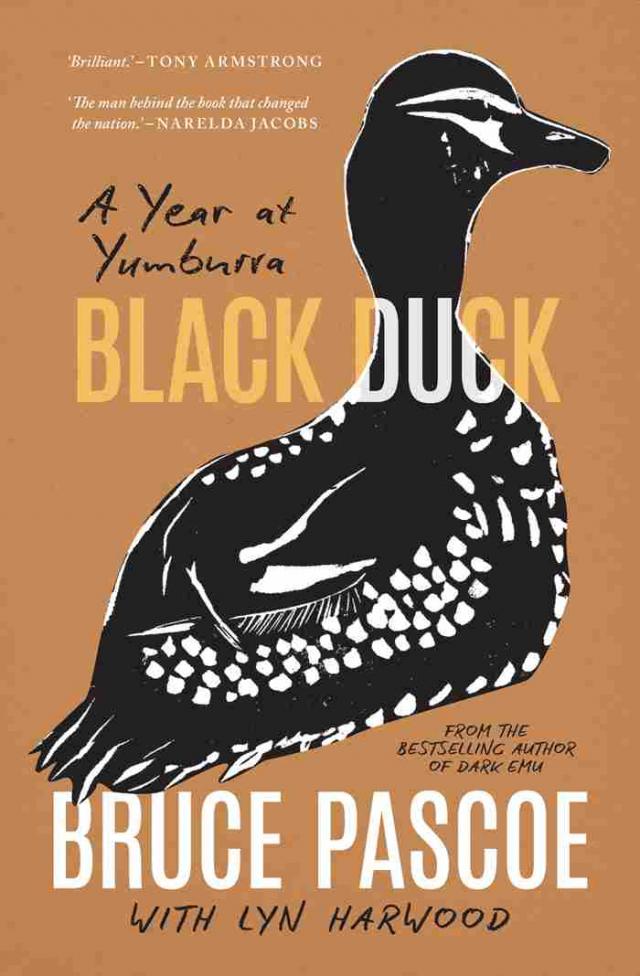
Black Duck
Acknowledgements
We would like to thank Chris, Mark, Terry, Nathan, Mook, Cal, Sean, Uncle Noel and Trish, Lindsay, Chris S, Kate and all who have worked on the farm. We would also like to acknowledge family and friends who appear in the book.
And, of course, the Country herself.
First published in Australia in 2024
by Thames & Hudson Australia Pty Ltd
11 Central Boulevard, Portside Business Park Port Melbourne, Victoria 3207
ABN: 72 004 751 964
thamesandhudson.com.au
Black Duck© Thames & Hudson Australia 2024
Text © Bruce Pascoe 2024
Images © remains with the original copyright holders
All uncredited photos and artworks are by Lyn Harwood.
Image on p. 28 of Uncle Max Harrison courtesy of the Harrison family. (Photography by Peter McConchie.)
Artwork on pp. 78–9, 235 reproduced with permission from Yuin Gurandji senior men.
27 26 25 24 5 4 3 2 1
The moral right of the author has been asserted.
All rights reserved. No part of this publication may be reproduced or transmitted in any form or by any means, electronic or mechanical, including photocopy, recording or any other information storage or retrieval system, without prior permission in writing from the publisher.
Any copy of this book issued by the publisher is sold subject to the condition that it shall not by way of trade or otherwise be lent, resold, hired out or otherwise circulated without the publisher’s prior consent in any form or binding or cover other than that in which it is published and without a similar condition including these words being imposed on a subsequent purchaser.
Thames & Hudson Australia wishes to acknowledge that Aboriginal and Torres Strait Islander people are the first storytellers of this nation and the Traditional Custodians of the land on which we live and work. We acknowledge their continuing culture and pay respect to Elders past and present.
ISBN 978-1-760-76311-4 (paperback)
ISBN 978-1-760-76320-6 (ebook)
Every effort has been made to trace accurate ownership of copyrighted text and visual materials used in this book. Errors or omissions will be corrected in subsequent editions, provided notification is sent to the publisher.
Cover design: Andy Warren
Cover artwork: Lyn Harwood
Typesetting: Cannon
Typesetting Editing: Melissa-Jane Fogarty
Printed and bound in Australia by McPherson’s Printing Group
FSC® is dedicated to the promotion of responsible forest management worldwide. This book is made of material from FSC®-certified forests and other controlled sources.
Bruce Pascoe, Black Duck