Year Zero (2000), page 4
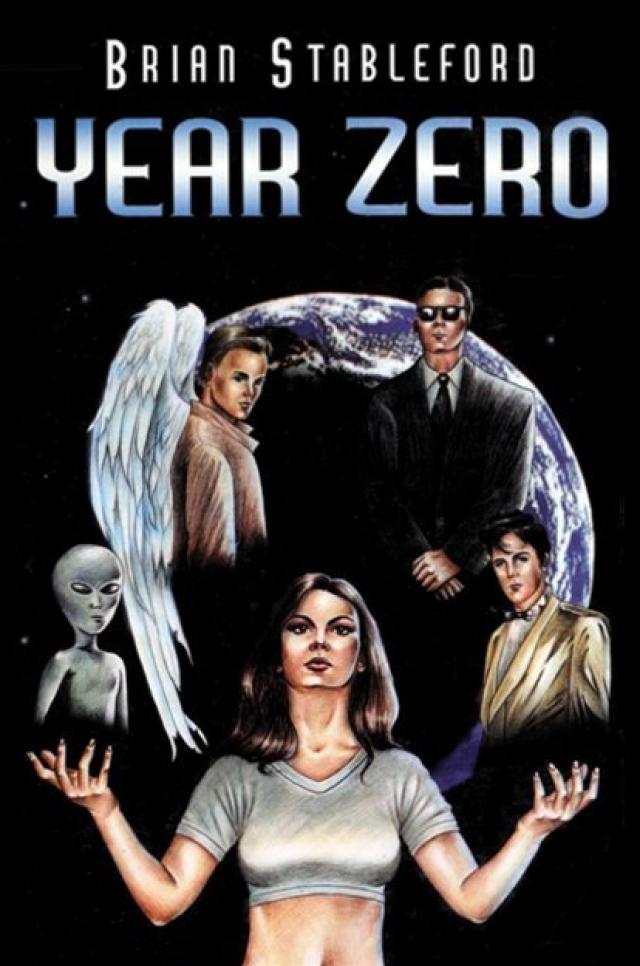


Molly sighed, but she didn't have the heart to be sarcastic. "So what are the other fallen angels doing these days?" she asked. She was genuinely interested. "According to Enoch, they taught mankind the fundamentals of technology and civilization, but the skills they passed on must have become obsolete ages ago. Unless, of course, they got more out of government retraining schemes than I ever did."
"I don't know," he said.
"But you're hoping to make contact, right? Or maybe not. I mean, if the fallen angels are all in Hell, you'd probably rather stay here. Always assuming, of course, that this isn't Hell and that I am out of it. That's Mephistopheles, you know." She felt slightly ashamed of showing off, especially as she'd only seen the Dr. Faustus movie with Richard Burton, way back in the days when she'd had the falling habit herself. At least she'd always had her own TV in those days; the only way to keep a TV was to have a bloke around who could nick someone else's when your own got burgled. Sometimes, she wondered whether there were any real victims any more, or whether there was just a vast population of knocked-off TVs that were kept constantly in circulation by the beating heart of larcenous intent. The ones that kept reappearing in the sitting room certainly hadn't come from Comet.
"I don't know anything about Hell," the angel said, stuffily, "but I know this isn't it."
Molly could see that it was going to be hard work getting any more out of him. She was half-inclined to drop it and go back to ignoring him, just like everybody else. Hadn't she already told herself that it was the sensible thing to do? But she couldn't rid herself of the nagging suspicion that even if Elvis hadn't been what she needed to get year zero off to a flying start, the angel might be.
"If you're not going to drink that tea," she said, in the end, "you might as well give it here and sod off."
8
There was a long pause while the angel considered his options. In the end, he decided not to give her the tea. He forced himself to drink. After two or three further sips, he seemed to get used to the sweetness. The colour of his eyes was like a sky looking down on someplace as far away as Molly could imagine—and she was not an unimaginative person.
"Well," Molly said, even though she knew it would make her sound like a social worker, "if it's nectar you want, you'll have to get up again, won't you? It's the only way to get over the falling habit—believe me, I know. Stick around here, and it isn't just the tea that will go from bad to worse. It won't be just a matter of losing the wings and your raincoat turning into something a flasher would be ashamed to open up. I saw what happened to Elvis when the serum got to work, and it wasn't a pretty sight." She figured that it was safe to mention Elvis to the angel. If you couldn't trust an angel not to shop you to the moral guardians of society, who could you trust?
The angel still didn't reply. He was now so deeply absorbed in the tea that he was at risk of becoming obsessed, and Molly began to wonder whether it had really been a kindness to tell him to sweeten it. Fortunately, she was spared the temptation to offer him a sausage or a bit of fried bread. She'd been hungry. Conversation always gave her an appetite—real conversation, that is, not the kind of chatting that the women in the B&B went in for.
"Of course," she said, figuring that if she were going to come on like a social worker she might as well go the whole hog, "you have to want to get up again. Nobody can help you if you won't be helped. Maybe you'd be happier down here on Earth. There's not much to recommend it, I suppose, but we do have time—all the time in the world. Places too, though rumour has it they're not as various as they used to be. Look, you're not exactly making this easy for me, are you? I mean, I'm trying to do you a good turn here. Who knows—this may be my last chance to qualify for Heaven? You could at least pretend that you're interested. Think of it as an episode of 'Touched by a Human.' I can only do so much—at the end of the day, it's up to you."
"Yes," he said, betraying a hint of positivity for the first time. "I can see that. But it's hard for me too."
The tone of his voice melted her heart all over again. The words I fell echoed in her mind, and echoed and echoed.
"It's okay," she said. "If you guys really did teach us the fundamentals of technology and civilization, we owe you one. Like they say in America, if you can't pay back, pay forward.
Between the two of us, we'll get it figured out. You lucked out—hardly anyone around here spends more time in the library than me, and I don't just pretend to read. You can come back to the B&B with me if you like, but you can't stay the night. It's the rules, and I can't afford to get chucked out, for the kids' sake." She was telling the truth about not pretending to read. She loved the Penguin Dictionary of Quotations, where Oscar Wilde had observed that it was better to be beautiful than good, but better to be good than ugly. If the beautiful angel wasn't going to cuddle her, she could at least pretend that it was her decision, her choice, her ruling.
"I understand," he said, although it wasn't at all clear what he understood—or was prepared to pretend that he understood, given that he probably didn't know anything at all about anything outside of a Heaven which wasn't a place and didn't even have time.
"Okay," she said. "Let's go."
The alkies didn't say a word when Molly and the angel walked past the old Salvation Army Temple, but that was probably because the cider had taken the edge off their wit. There was no sign of Saint Luke or his boozemobile but the down-and-outs had obviously experienced a visitation. They weren't as blissful as crackheads blessed by Saint John, but they weren't as mean as they were when they had hangovers.
There were five pre-schoolers playing on the stairs at the B&B, and a couple of the mums popped their heads out to make sure that the visitor wasn't an obvious child-molester, but neither passed any comment on the unlikelihood of Molly keeping company with an angel. They just stared, with eyes the colour of dirty dishwater—eyes incapable of reflecting anything but the dullest winter sky.
The angel was appropriately impressed by the tidiness of Molly's room, although it represented a very modest victory over the forces of chaos. She'd moved the wardrobe to cover up the corner where the mould kept growing on the wall, and she'd put the rug she'd salvaged from a skip over the shiny grease-patch on the carpet. The bed was made and there wasn't a single item of clothing draped over the back of the chair. Only the curtains were seriously disgusting, and she couldn't be expected to take them to the launderette. The angel didn't even glance at the curtains; a true representative of the Good, he let his eyes wander over the piles of books stacked—almost neatly—under the window, at the foot of the bed and all around the sink.
"Burglars never pinch books," she told him. "No point. And before you ask, I haven't read them all. I picked most of them up going through the boxes people leave at the side when the recycling bin gets too full, and I always figure it's better to take the ones that you might never get around to reading than leave anything you might regret not having picked up when you run out of ones you're actually keen on. Anyway, big thick paperbacks make bloody good draughtexcluders."
The angel turned to look at her, more appraisingly than before. Molly was alarmed to note that the summer sky had already begin to fade from his eyes. At what point, she wondered, would he pass the point of no return? And what would happen to him then? Would he have to fight just to hang on to human status? Could he hang on to human status, if that became his fallback position, or would he just keep on sliding, all the way to Lucifer and Hell?
When the angel sat down on the bed, slumping like Annie after a bad abduction experience or Francine after an extra-generous hit, Molly knew that she had her work cut out, but it was too late to complain. She'd already accepted the responsibility.
Maybe, she thought, this was the best way to make a new start—not by grabbing something new for yourself but by doing something new for someone else. Maybe, in the great cosmic scheme of things, you were supposed to build up a little moral credit before you could get the go-ahead to turn your own life around. If so, this was going to even more imagination and ingenuity than letting Elvis down gently.
9
"I suppose you've tried praying?" Molly said, dispiritedly.
"I've tried," the angel said, "but I seem to have lost the knack. " He looked up at her with his wonderful blue eyes, as if he were expecting a sympathetic pat on the head. Molly had to resist the temptation to join him. Now that he'd taken his raincoat off, his relatively unspoiled suit made him look way too good for this kind of environment, and she couldn't bear the prospect of seeing him flinch and move away if her cellulite should accidentally come into contact with his thigh.
"I think I tried it myself once," she said. "Way back when. It didn't do any good, even though I was still a virgin and didn't understand the chorus of Ebenezer Good. Maybe I couldn't take it seriously enough but lack of faith is one problem you shouldn't have. I suppose there's no point in asking what God's like. He's not like anything, is he? He just is."
"That's right," said the angel.
"Thought so. You haven't a fucking clue, have you? Down here, you're completely out of your depth."
Because she was looking him right in the eye she saw the colour weaken when she pronounced the obscenity, and was stricken by the terrible thought that if this was a test, she must be more than half way to failing by now whether she stooped to further obscenity or not. She was suddenly struck by a sense of awkward urgency. This was Earth, after all, and time was of the essence here. The angel probably couldn't stand much more exposure to the forces of change and decay—and as soon as she'd condescended to notice his presence in the world she'd become time's accomplice, aiding and abetting its patient assault on his divinity. If she wasn't part of the solution, she was part of the problem. She couldn't just wash her hands of this one.
As that revelation roughly took hold of her, Molly felt that she would have given anything in the world for the answer to the angel's problem to be easy. Love would have been so easy, but she already knew that it wasn't even worth a try. She knew beyond the shadow of a doubt that if she could only get the angel to take the least little bit of pleasure in her, she could do it with love and not just with lust, but she also knew far better than he did—with luck, far better than he ever would—where the limitations of reality lay.
It had been easier by far with Elvis. Elvis, immortality serum or no immortality serum, had already been finished. The angel, God bless him, hadn't even started. No matter what his timeless experience in Heaven had been like, and no matter what it was that had caused God to knock him down, the angel hadn't even begun. Molly supposed that you had to get used to being in time before you could get to grips with beginning, and that the angel simply hadn't had long enough, or help enough, even to think about what it would mean to pull himself back together.
"Well," she said, slightly startled by the desperation in her voice, "there are a few more things that aren't even worth trying. I think we can take it for granted that Prozac isn't the answer in this particular case, and Freudian analysis wouldn't get us anywhere even if we had the time. We need a fix that's quick, but one that isn't chemical." She nearly added and doesn't involve fucking but she caught herself in time. She didn't want to labour the point, or deepen the blue of his eyes any further than it was already deepened. Hastily, she added: "It might help if you could bring yourself to tell me exactly why you stand in need of absolution." No sooner had she said it, however, than she jumped to the conclusion that it probably wouldn't.
"I fell," said the angel, yet again.
There was nothing in the least infuriating about the repetition, because the pathos wrapped up in the remark was still undergoing a stage-by-stage metamorphosis that had not yet reached its heart-rending end.
That had to be the key, Molly thought. That had to be the vital clue, the vital cue, the vital Q to which she was required to find the A.
"I'm stupid, aren't I?" Molly whispered. "You keep telling me what the matter is, and I just keep missing it. I keep getting hung up on the questions that don't have any answers, like where you fell from and what made you fall, but the real point is that you're still falling, faster and faster, into time and into place and into the vortex of creation. Of course you don't know why, because there is no why in Heaven. All the worldly whys are in Hell, aren't they? Every last one."
"I don't know," said the angel, proving her point.
Molly realised that when she had first seen the angel he had been over six feet tall. Even in the library he'd topped five-seven, but now he was no taller than she was. In a matter of hours, he'd be no bigger than a child, but he'd still be too old to grow wings and fly, even in his imagination—and her presence was making it worse. Her nearness was accelerating the process. She was a carrier of time and place, and she was furthering the angel's infection with every breath she took, but she knew that it wouldn't do any good at all to send him back out on to the street. There were five billion people in the great wide world, and they had thousands of years of history in them, and the people closest to hand were as riddled and raddled with contagion as all the rest.
In spite of her resolution, Molly sat down on the bed, next to the angel. He didn't reach out to her, but at least he didn't move away. He wasn't afraid.
She closed her eyes, as if she were a little girl confronted with a birthday cake or some other everyday prodigy, who had to close her eyes to make a wish if she were to stand any chance at all of making it come true.
"I'll tell you a funny thing about the human brain, Mr. Angel," she said, speaking out of the darkness. "There are any number of ways to jolt it out of everyday misery, and all of them work for a while, but you can never get more than the merest delusory glimpse of Heaven. If you do something like heroin the brain just stops producing happy chemicals of its own, so when you try to give it up you just go crazy. It's different with Es and acid, but not so very different. Whatever the stuff gives you, you stop giving yourself, and when you stop doing the stuff because the effect's worn thin, you've lost it. People think it's just drugs, but it isn't. It's the same with everything you do that allows you to grasp the nearest atom of delight. Fucking, dreaming, reading, kids ... everything. Whatever gets you an inch nearer to Heaven only tantalises once or twice, and then it starts to become as ordinary as anything else, and leaves you without the ability to do it for yourself if you don't get the fix—and if you can't handle that, you just go crazy.
"I don't have the slightest idea what Heaven is really like, Mr. Angel, and I can't tell you anything about Hell, but I can tell you this: if you intend to stay here, you have to be able to handle it without going crazy. You have to realise that everything you try, everything you do, and everything you think of will only seem to work once or twice, and that the best you can hope for afterwards is that things will stay ordinary. If you can't help going crazy, everything you think and feel and do thereafter will be a matter of trying to get back to the beginning, of trying to hold on without shrinking any further and losing any more—because time leads nowhere except death, and you just have to learn to handle that, and get what you can out of a world without a Heaven. If you came here thinking that time heals, forget it, because time wastes. If you came here looking for a place to be, you shouldn't have bothered, because there's no place like home—and I don't mean that there's no place like home, I mean that there's no place even remotely like what you'd really like to think of as home, but you have to get used to that and make do with what there is, one way or another. You just have to get used to it, and make do with what there is, or else you get crazier and crazier and crazier until there's nothing left at all. Down here, you have to accept things as they are if you want to make a new start, because there's no other way to begin. Even in year zero, you have to see things as they are. There's no other way, except to oblivion.
"So if I were you, Mr. Angel, I'd stop fucking around down here where you don't belong and go back where you came from, where you don't have any time to waste or any place to call anything. It doesn't matter how or why you fell —what you have to do is get up again, while you still can. If you don't, you'll become just as human as the rest of us, and the only way to get up will be the hard way. That's the choice: either you get back up, right now, or you stay here and rot. Just do it. I know it's the most difficult thing in the world, but that's all there is to it, and all there can be to it. It's what all of us have to do, one way or another. I'm going to open my eyes now, and I want to see you gone."
Molly knew, even before she opened her eyes, that the angel would be gone, and so he was—because he was still an angel, even if his wings had gone into hiding. She had pronounced far too many obscenities to sustain the sky in his eyes. She had shown him darkness, and she had scared him as shitless as only an entity who didn't need food as such could be.
She wished that someone had done as much for her, way back when, although she knew perfectly well that she wouldn't have been able to take it in. Whatever else she'd been, she was no angel—but whatever she'd been, this was year zero and she was now the kind of person who could touch an angel and do him a good turn. She had to be. There wasn't any other option left.
She also knew, though, even before she got down to the serious business of planning the rest of her day, that she would probably never know for sure whether she had passed the test, if it actually had been a test, or whether the angel really had decided to go back to the place from which he had fallen instead of all the way to Hell. In her experience, people mostly did go back to the place from which they had fallen, if they only could—and she now had no good reason to suppose that angels were any different—but sometimes, like little anorectic Annie, they simply couldn't.
That was why, when people like her said, "I fell," it was hardly ever a lie—but that was why people like her who still had it in them to get up again did get up, even though they had no way to do it but the hard way.