The Wayward Muse, page 1


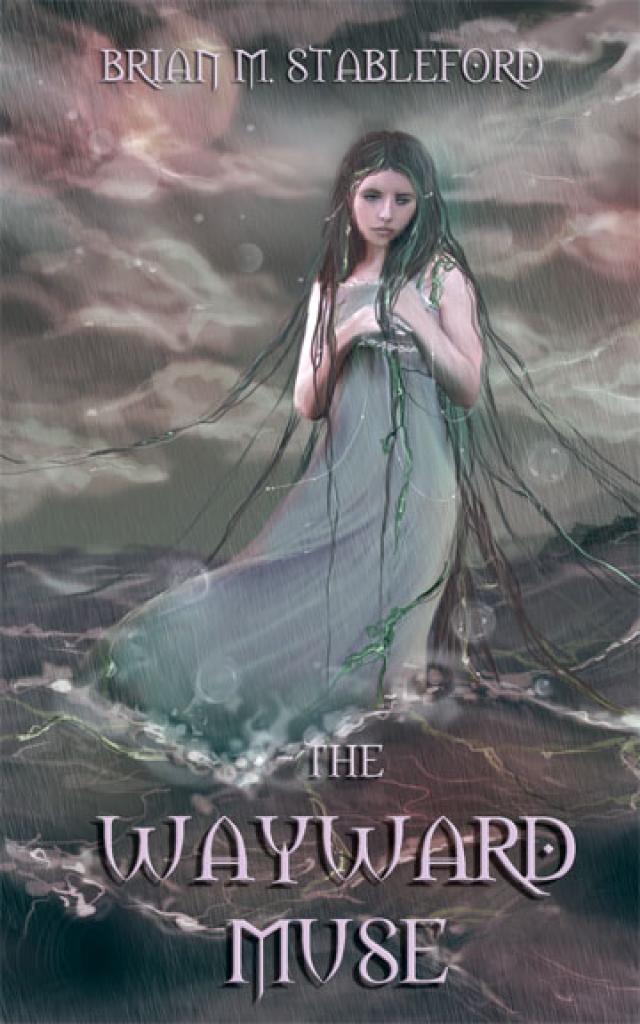
The Wayward Muse
by
Brian Stableford
A Black Coat Press Book
Introduction
The ultimate origin of this book was an invitation I received to submit some stories to an anthology that Stefan Dziemianowicz was co-editing for Barnes and Noble, which was to be a horror fiction “book of days” containing 365 stories, each one less than 750 words in length. Stefan said that I could submit as many stories as I wished, so I sketched out plans for four when I had a spare moment, and sat down to write them on a Wednesday morning.
Because they were so short, I had finished all four by lunchtime, so I while I was eating my customary sandwich, I planned out four more to write in the afternoon. As I was still having fun, I did another eight the day after and four more on the Friday morning–by which time I had run through all the adaptable synopses in my ideas file and all those I could produce off the top of my head. I printed them all off and put them in the post.
Unfortunately, Stefan and his co-editors only accepted nine items out of the 20–perhaps feeling that many of them were not really horror stories at all–which left me with 11 ultra-short stories on my hands. I set about rewriting the ones that were expandable, adjusting them to more easily marketable lengths. “The Secret Exhibition” is the second one that eventually became the basis of a book, by virtue of providing the foundation-stone for a story series. (The first was “When Molly Met Elvis,” which ultimately became Year Zero.)
The note in my file of story ideas that gave birth to the 750-word version of “The Secret Exhibition” had been made while I was translating Jean Lorrain’s decadent novel Monsieur de Phocas (1901) for Dedalus. Monsieur de Phocas is a transfigurative compendium of a number of short stories and newspaper articles that Lorrain had written over the previous decade, reformulated as a phantasmagoric account of the relentless exaggeration towards madness of the peculiar state of mind that the Decadents called spleen. There is a key episode in the novel in which the protagonist, the Duc de Fréneuse, visits his nemesis, the artist Claudius Ethal, in his studio. Ethal shows the Duc three portraits he has done of beautiful women, offering a scathing commentary on the personalities and careers of his three sitters. Ethal’s scabrous remarks outrage the Duc, proving to be the final straw in his long-drawn-out psychological struggle, and he stabs the artist to death. My variation on the theme transformed the motivation of the characters, in order to generate a markedly different outcome of a broadly similar scene.
(Most writers, when asked where they get their ideas from, are carefully evasive; I generally come clean and admit that I steal them, although I take some pride in being honest enough to pervert them considerably as I do so.)
When I expanded “The Secret Exhibition” for resubmission, I filled in the back stories of the two key characters and elaborated the setting of the story slightly, placing it in an “artists’ colony” of the kind that has figured in a number of conspicuously decadent science fiction series since J. G. Ballard transfigured Sunset Boulevard into Vermilion Sands. Because it was a copy taken from a standard template, I referred to it simply as “the Island” and placed it off the shore of “the Empire” without giving much thought to the specifics of the world in which the story was set. Once the story had appeared in Weird Tales, I began considering the possibility of extrapolating it into a series, in which the narrator’s cynically unorthodox voice could address other themes situated at the porous interface between artistic inspiration and the supernatural.
The initial inspiration of “The Incubus of the Rose” owed as much to the 1946 movie of The Specter of the Rose–scripted by Ben Hecht, author of one of the finest examples of American decadent prose, Fantazius Mallare–as to the notorious Nijinsky ballet on which the movie was based, but it is conscientiously perverted according to my usual strategy. The version that appeared in Weird Tales had to be cut by 3,000 words or so because Darrell Schweitzer thought the introductory phase far too languid and self-indulgent, but I restored the missing text to this version before beginning a final edit.
“The Arms of Morpheus” was begun in response to a note from Darrell to the effect that Weird Tales was planning to start running novellas as two-part serials, inviting me to submit something of that sort. When I started out, I was aiming for 20,000 words or so, but recklessly introduced too many complications into the dual-stranded plot, and soon had to give up any attempt to restrain the word length. Alas, letting the story run to what seemed to be its natural length produced something far too long for magazine publication and far too short for publication in the commercial sector of the book market.
(When I began my career back in the late 1960s, I was forbidden by my publisher to write less than 50,000 words or more than 65,000 words, so “The Arms of Morpheus” would have been ideal back then–lengthwise, if not in terms of its subject-matter–but now that British and American books are expected to be as obese as British and American children, nothing less than 100,000 words will suffice.)
Even as a long novella, “The Arms of Morpheus” required a more detailed backcloth than either of its predecessors, so I was forced to devote some more attention to the where and when of its proceedings. It was obvious, though not specifically stated, that the earlier stories took place in some kind of parallel world, which featured an Empire even more decadent than any in our own turbulent history. It was also tacitly obvious that the technological and cultural background of the stories, like their aesthetic sensibility, was approximately similar to that of the heyday of the Decadent Movement–the late 19th century, not a million miles away from Jean Lorrain’s Paris.
Aesthetic logic seemed to demand that, if a decadent Empire were to be located in an era of that sort, the perfect candidate would be the ultimate faded relic of the grandeur that had once been Rome–a Rome that had never actually fallen to the barbarians, even though it had doubtless gone through many slightly-less-drastic phases of transformation as it expanded to occupy the entire Western world, both Old and New.
The territory occupied in our world’s political geography by France would, in this world–nominally, at least–be a mere province, with an ethnic mix very different from the one imposed by Frankish and Norse invasions. Aesthetic logic also encouraged the notion that there was no reason why the heterocosmic physical geography of the story need be identical to that of our world, so there was no need to make the island–now named Mnemosyne, in honor of the mother of the Muses–identical to one or other of the Channel Islands that exist in our world.
The world of the story told in “The Arms of Morpheus” is, therefore, one that has a Classical heritage very similar to ours, its history having diverged some time in the first or second century A.D. (although the years are not named in that fashion, because Christianity, in the world of the text, never produced an all-consuming Christendom), but whose history has been markedly divergent for nearly two millennia.
Should the series continue, I shall doubtless add further detail to this vague scheme, filling in details as and when they may become useful or desirable in narrative terms. Although it seems improbable that the patterns of genealogical descent in the world of the story would have produced any individuals parallel to the individuals of our world, it is not beyond the possibility that parallels of a sort might exist, so some scope is conserved for exercises of the kind to which this book’s publisher is fondly devoted.
If any such series does unfold further, I shall of course have to address various issues raised in the first three stories in the form of dark and tantalizing hints. I shall, for instance, have to explain at some point how old their protagonist really is, and why he is so much older than he looks. Aesthetic logic requires him to have a complex personal history, inclusive of many interesting events, and I shall have to do my best to fill in that currently blank canvas, should the Muse demand it. In the meantime, though, this is the story so far.
In adapting the first two items to take their place alongside “The Arms of Morpheus,” I added in a little more background detail, including the island’s name and something of its history. I also added a few incidental references to characters and locations that play significant roles in “The Arms of Morpheus” but had not been thought of when I penned the earlier pieces, so as to increase the apparent coherency of the whole. The ultimate result of all the amendments is that the versions of “The Secret Exhibition” and “The Incubus of the Rose” featured here are each a few thousand words longer than their magazine versions.
None of the characters in the stories is based on any living person (alas!); the opinions of the protagonist are not necessarily those of the author, who is merely trying them out for size and has not yet made a final decision as to what, if anything, he believes.
Brian Stableford
The Secret Exhibition
Claudius Jaseph came to the island of Mnemosyne in the 14th year of the present Emperor’s reign. He arrived in early June with the last fleet of summer migrants, borne by one of those freak tides of fashion that catch up the idle rich, albeit in a far more gentle manner than they afflict the slaves of the Muse. His advent was, however, anticipated for some days beforehand, the news of his intention having traveled ahead of him by courtesy of his champions and his agent.
Given that more than half the island’s permanent population consisted by that time of writers, composers, players, painters, necromancers, mystics and similar recipients of unsteady aristocratic patronage, the last thing it required its seasonal visitors to bring was mo re writers, composers, players, painters, necromancers and mystics, but wealth inevitably nurtures an addiction to novelty. Were the rich ever to become content with what they already have, they would no longer be able to spend the dividends of their capital; the entire Imperial economy would then lurch towards collapse–or so the patient Physiocrats assure us. True artists know that true art is timeless, and that they are collaborators in a great endeavor rather than competitors for transient fame and fortune, but so-called patrons of the arts see things very differently.
I was not at all distressed by news of Jaseph’s impending arrival, and found it very difficult to muster any sentiment but indifference–but others would not let me be content in my carelessness. Even some few of my friends and admirers probably thought me incandescent with envious anticipation, but artists often conceive of one another as uncontainable whirlwinds of child-like emotion. Almost every one of us believes that he–or she–is clever enough to play the role without actually fitting it, although few of us actually are. I am, of course, the rarest of the rare exceptions, as befits a man who has been resident on Mnemosyne longer than anyone else can remember.
I suppose that I made a few acidic remarks in advance of Jaseph’s arrival, but only because it was expected of me; appearances have to be kept up when our patrons are watching expectantly, no matter how wearisome the work becomes. Privately, I did not expect the fuss to last long. I had seen other portraitists sail in on a wayward tide with a thousand eyes watching, and become passé long before they moved on to some comfortable city full of aspirant burghers and desperate matrons. I had no reason to think, when June began, that Claudius Jaseph would be any different.
“This one will offer you real competition, Axel,” Hecate Rain assured me, as we lounged on the terrace of the Sprite in the mid-day heat, looking out over the harbor. She was drinking absinthe but there was iced water in my own glass; I had work to do that afternoon. “They say that his brushwork is superb and his accuracy uncanny. More to the point, he makes a fetish of painting beautiful women, just as you have always done. They say that he plays them off against one another with consummate cruelty: the wives whose beauty is beginning to fade, anxious to be captured on canvas one last time, while they are still desirable; the daughters just coming into their inheritance of pulchritude, intoxicated and deranged by a magnetism they cannot yet control. Those have always been your favorite victims, have they not?”
“Victims?” I echoed, with ostentatious alarm. “Are my subjects victims? You have posed for me yourself, on more than one occasion. Did you feel victimized?”
“My vanity is less vulnerable than some,” she told me, closing her eyes against the sunlight as she leaned backward languidly, “but even I have felt a certain sting in your analytical eye. There are others whose souls have been more deeply penetrated.”
“There is all the difference in the world,” I pointed out, “between a painter whose brush reaches tenderly into the soul of a sitter in order to bring something precious to the surface of his canvas, and an assassin who puts away his palette when darkness falls in order to don a black domino and ply a gleaming dagger like some metropolitan bravo.”
“Your analogy is uncommonly poetic,” Hecate observed. She was a poet by vocation, although she had been given a necromantic name by a careless parent. “Do you really imagine your work as a kind of mining? Others might represent it quite differently. By day, they say, you regard your sitters with a cool and clinical eye, impassively noting their flaws and cleverly erasing them from the images that appear by degrees upon your canvas–but after dark, your face changes completely; your gaze becomes avid and your lips are reddened with lust. I do not speak for myself, of course, but the summer visitors do not see you as I do. Your reputation has its darker aspect.”
“Of course it does,” I told her, gesturing to the waiter as he passed by to request fresh ice. “I cultivate it very carefully.”
“But you cannot entirely control what others think. Rumor-mongers exaggerate. You may think of yourself as a gentle seducer, a lover whose artistry compensates more than adequately for your lack of attention to conventional morality, but there are some who say that, in your heart of hearts, you despise your subjects with a fervor you could never admit.”
“It is a silly slander,” I said. “You know it.”
“I do, and I defend you–but the summer visitors bring anxieties, jealousies and resentments to Mnemosyne that we permanent residents have long-since banished from our lives. There are some, even among your patrons, who believe that your habit of seducing your sitters is a kind of predation. They are not poetically inclined, for the most part, but they would not be unfavorable to the analogy of your driving a metaphorical dagger deep into the bodies of your clients’ wives and daughters, ripping their respectability to shreds.”
“It is because the rich have no souls to be ripped,” I opined, wearily, “that they speak of respectability. It is all nonsense. Why are we wasting our time with it?”
“Because it affects the way that your impending competition with Claudius Jaseph will be seen–and there will be a competition, no matter how you might try to avoid it. Everyone expects it: not merely the visitors but the permanent residents. You’ve ruled this little roost of ours for a long time, and there are a great many people who’d like to see you knocked off your perch, if only to stir things up a bit. Jaseph is the man who can do it, it’s said. He plays your game, but with the flair and fervor of a younger man.”
I looked around for the ice, but the waiter was nowhere to be seen. I shook my head, and looked out over the water instead, towards the Devil’s Rocks and Nicodemus Rham’s lighthouse, which stood guard over them.
Hecate knew perfectly well how insulting her reference to my “game” was, but she was not speaking for herself; she was trying to explain the curious excitement that had been generated on the island by the news of Claudius Jaseph’s impending arrival. I was not at all sure that I wanted to be bothered with it, not because I feared competition but because I was impatient with the popular misrepresentation of my character and ambition.
“As I understand it,” I said, “there has only been a single exhibition of this upstart’s work, in a gallery where my own work has been shown a dozen times.”
“In a gallery that you have never visited,” Hecate pointed out, “despite all of Myrica Mavor’s entreaties. I understand that your refusal to leave the island is the keystone of your carefully cultivated eccentricity, but there are people on the mainland who see it as simple rudeness. Claudius Jaseph is by no means a polite man, it’s said, let alone an unctuous one, but he’s willing to put in an appearance–and a single exhibition is more than enough to whip up a sensation nowadays. We’re approaching the Empire’s 20th century, after all. In ten years we’ll be celebrating the second millennium of Divine Caesar’s birth.”
“Yes,” I agreed, “but a further 56 will pass before those who come after us are forced to celebrate the actual inauguration of the Everlasting Empire. How different the world would be had Caesar’s would-be assassins succeeded! But I don’t understand why you’re so insistent on using the violent imagery of daggers and whips. Surely no one is expecting a competition between painters to extend as far as dueling?”
“Some might be hoping for that,” Hecate said, “but most seem to be anticipating a contest of metaphorical daggers, relishing the thought that as a much younger man, his might be a good deal straighter and more durable than yours. They say that he is one of those rare men who really does love women, although he never flatters them, by day or by night. He is honest, and he knows how precious they truly are. Myrica told me herself–so mournfully I had to believe her–that he would not lend her his very best work to show in his first public exhibition. There are those among his creations, it seems, which he adores so absolutely that he consigns them to a secret exhibition which none but he and a favored few may ever view. He refuses to accept his fee in such cases, because he believes that the portraits have souls of their own, which ought never to be sold.”