In the Kingdom of the Beasts (Dies Irae 02), page 1


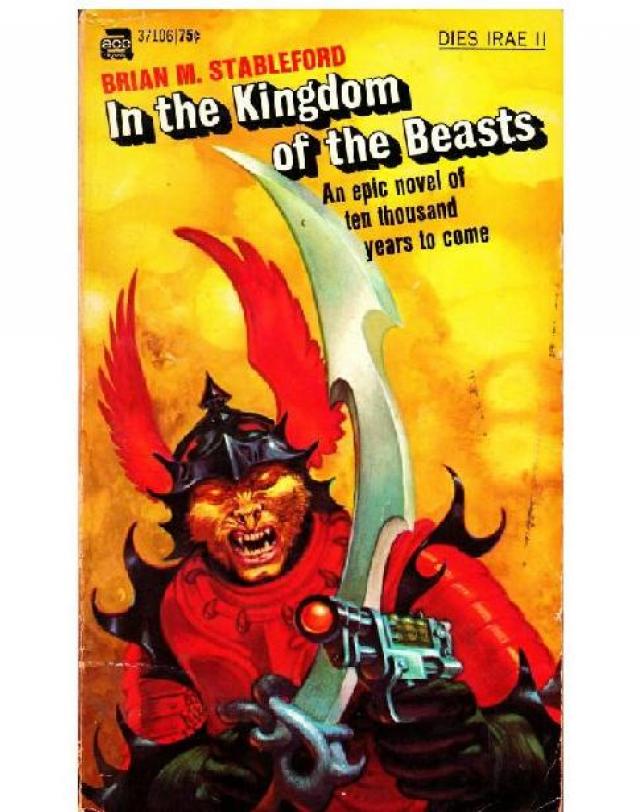
Table of Contents
IN THE KINGDOM OF THE BEASTS THEME
MARK CHAOS
IN TRANSIT
VISIONS OF YVAINE
CHAOS AND YVAINE
THE BEAST WAR
YVAINE
THE HOUSE OF STARS
DEEPNESS
THE END OF THE WAR
CHAOS AND YVAINE
THE STORM IN SPACE
THE TIME GAP
IN THE TIME GAP
THE DEVIL’S TRESSES
THE BLACK STAR
CHAOS AND YVAINE
PEOPLE OF THE BLACK STAR
THE STRANGER
ANACHRONISM
CHAOS AND YVAINE
THE CAVE
WIND
WORLD OF SNOWS
CHAOS AND YVAINE
MOTHER OF THE UNDERWORLD
THE INNER WORLD
THE CROOKED WHEEL
CHAOS AND YVAINE
THE MAN FROM DESPAIR
DARKSCAR
CHAOS ON DESPAIR
THE COLLECTOR
DESPAIR
LANDSCAPE OF DESPAIR
CHAOS AND YVAINE
DARKSCAR’S COLLECTION
THE HUMAN REACTION
LAST OF THE DEAD MEN
CHAOS AND YVAINE
DEPARTURE FROM DESPAIR
HELJANITA
DUEL IN SPACE
THE CALL OF HYPERSPACE
CHAOS AND YVAINE
JOURNEY THROUGH HYPERSPACE
CHAOS AND YVAINE
CALYPSO
END OF THE STORY
CHAOS AND YVAINE
AQUILA
CONCLUSION
Mark Chaos couldn’t find a way out. He always found himself in a new corridor of twisted glass, with a new angle on the myriad mirrors. He could swear they were identical to others he had seen moments before, but the images were not the same.
He opened his mouth a fraction and allowed a giggle to escape—and watched it run round the great arc of sneering mouths. He was suddenly certain that some of the images had not laughed with him. It was as if some of them had had enough of aping Mark Chaos with their shriveled limbs, humped backs, and balloonlike faces. They were creating identities of their own. They were detaching themselves from him…
BRIAN M. STABLEFORD
DIES IRAE II
ACE BOOKS
A Division of Charter Communications Inc.
1120 Avenue of the Americas
New York, N. Y. 10036
IN THE KINGDOM OF THE BEASTS
Copyright ©, 1971, by Brian M. Stableford All Rights Reserved.
Cover art by Kelly Freas.
For Mark Williamson
Printed in U.S.A.
THEME
This book tells the story of how Mark Chaos returned to his home after the Beast war, most of the story being told by Chaos himself.
MARK CHAOS
Mark Chaos is on Calypso’s world.
Ten years have gone by since Chaos set out from his home on Aquila to help Ralph Eagleheart in the war against the House of Stars. Seven of those years, the Beast lord has spent on Calypso’s world.
Calypso’s world is’ grim and gray, a world whose surface is forever hidden by cloud and mist. Its sun, behind the clouds, is dim yellow and sullen. No stars are ever visible in its skies. No ships ever come. If the world was ever given a name, that name has been forgotten, or is never used.
Only Calypso makes her home on Calypso’s world, although Mark Chaos has been her unwilling guest for seven years. Her home stands alone and aloof, with sheer mountains and deep abysses invisible on every side. As far as Calypso and Mark Chaos are concerned, the world is a lonely peak with a flat top and a sheer drop on all four sides of the square plateau. On the peak is a gray stone house and a garden. The house was built by a machine. The garden was made by Calypso, whose unceasing love and gentleness has made delicate blooms viable even in a hostile environment such as this one.
Calypso loves her garden because it is hers and hers alone. The seeds, which grew into flowers which produced more seeds, were the only living things she chose to bring with her from the civilized worlds. The seeds and the flowers depend upon her for life, and they are not as ungrateful as Mark Chaos. The flowers return her kindness with beauty and delicacy. Mark Chaos does not even recognize her kindness, but she keeps him alive with the same devotion which she gives to her flowers.
’ The flowers which grow in the garden are very different from the native life. The plants which are indigenous to Calypso’s world are motile sacs of enzymes, with leaves that take energy from the mist and not from the sun, because far too little sunlight ever reaches the depths of the ravines where they live. The native plants belong here, like Calypso. The flowers and Mark Chaos do not.
Chaos hates the gardens. He wanders through them, day after day, detesting their soulless perfection. He knows every inch of their lawns, every flower that grows. He hates the big red flowers that grow as tall as a man and hang their heads in shame before the weak sunlight. He hates the globes of tiny blue florets like clusters of dim stars. Most of all, he hates the white flowers which Calypso calls “little eyes” because they remind him of eyes, with their white petals, surrounding delicate blue irises, and jet black pinprick pupils. To him, they are the closest thing to people on the world. Calypso does not count as people. Calypso has sucked his will and drained his soul, so that even he no longer thinks of himself as a man.
While Mark Chaos wanders in the gardens, he is sometimes tempted to remember; but it is no longer easy to turn the pages of his memory. There was too much to hold in his memory, and most of it happened a long time ago. so he has forgotten a great deal. It is all there, somewhere in his mind, but he remembers people only as faces frozen into single expressions, characters coalesced into mere ideas. Nothing lives in his memory—it is all long dead.
He is no longer the Mark Chaos who set forth from Aquila to conquer the universe. He no longer understands what he wanted to find when he took to space with his handful of ships and men. Mark Chaos is now just a cunning, moon-shaped face in his memory. He has even forgotten himself.
The change in the man is not only internal, and it is not only time which has wrought the change. His face is different now. It retains its roundness, but lines are engraved deeply into its surface now; it has lost its youthfulness and its air of injured innocence. His eyes have faded in color and retreated deeper into his skull. His skin has darkened and altered in texture.
Time has left a recognizable mark, but the principal agent of change was hyperspace. Mark Chaos had been forced to look into the dimension which was supposed to drive men mad. He had piloted a spaceship without the help of computers and the protection of sensor screens. It was necessary at the time: he had been trapped in space, with no other way to find his home. Even now, Mark Chaos wants, desperately to get home. Then, it was a burning need. But he never saw Aquila again. Instead, he is on Calypso’s world, rotting away his years in the ugly mists, with shadows in the fog for his companions.
The subtlety is all gone from Mark Chaos now—the involved mind, the finesse, and the delicacy are all dead. They have been choked and destroyed during long years when he has faded from one man into another, and another. Life on Calypso’s world has made him dispense with most of his old identity, and hyperspace had devalued that identity in any case. He has been forced to concentrate more and more on simple thoughts and simple aims. He has no hope of ever leaving Calypso’s world—no hope that he can believe in. But he tries to hold himself together, to keep himself sane, just in case. He has developed a simple statement which reminds him who he is: an expression of belief in himself. But even this has become meaningless— a recitation of nonsense.
It says: “My name is Mark Chaos. My home is the world of Aquila. I left Aquila to help Ralph Eagleheart fight the war which broke the Human rule of the galaxy and brought about the fall of tire House of Stars. I did what I set out to do. I tried to go home, but I got lost. I spent a long time in the Time Gap, and even longer on Calypso’s world. All I want to do is go home.”
Once he repeated that every morning, when he walked through the gardens surrounding Calypso’s house. Now he repeats it only rarely, mouthing it without any sincerity or intensity. His walks through the garden simply take him to the lip of the gigantic cliff, where he can sit and stare into the mist-filled ravine where his ship lies smashed, its high-omega apparatus completely dead. A great staircase runs down into the ravine, but he never goes down any more. He simply sits on the edge for an hour or more every morning. Habit breeds its own precision and lack of imagination. Mark Chaos is no longer an imaginative man. There has been no change in his life for too long, and there is no point in changing his patterns of behavior. Over the years, he has become more and more set in his ways. He has become an automaton.
Once, when he sat and stared into the infinity of the shadowed mists, he had things to think about. But all that has drained away with the passing of time. Now there is nothing but dogma and dead memories. His whole existence is meaningless. The bleak mist hides the universe and absorbs all his hope and fear. Calypso has killed him, inside and out.
Years of imprisonment on Calypso’s world might not have done so much damage to another man. But they almost destroyed Mark Chaos. He was never strong, and he landed after traveling through hypersp ace without screens. Before hyperspace he had been very ill, and before that he had looked into Helianita’s crooked wheel and almost been destroyed. So Chaos was really in no condition to stand up to Calypso and her world. Somehow he survives, weak and often sick, neither wholly dead nor completely lost, but he is only a ghost of the man he once was, and if he ever does get away, he will have to spend a long time finding something of himself again.
And a day will come when, as he sits on the lip of the cliff watching the fog make wraithlike pictures in the empty crevasse, he will hear the distant sound of a spacedrive motor. He will not leap up and cry for joy. It will not mean anything to him, at first. But eventually, he will stand up and walk back towards the house, having heard and understood.
Release was to come, and his term of imprisonment was to end. There are people who think that he is still important, people who are looking for him. He will see his home world once again, and go back to the stars, in good time.
IN TRANSIT
Mark Chaos stared blindly at the control screen of the ship which had brought him from Calypso’s world. It was full of a red haze which was growing clearer by the minute. The ship had switched into normal space, and the computer was trying desperately to make the spacedrive motors halt the ship and lift it as it fell towards the planet.
Chaos was so tired that he hardly cared. The automatic pilot was doing all that he could have done, and there was no help he could give. A thin trickle of blood ran from his mouth, and he felt the warm, salty taste on his tongue. There was a dull pain deep inside his belly, and all his limbs felt too heavy to lift. His eyes did not see; his ears did not hear. His brain floated far away. He was very m, and very tired.
Somewhere on the screen, in the middle of the swelling mass of dim redness, was the spot where tire ship was going to crash. But he did not care.
The computer was heroically trying to arrest the ship and pull it out of its suicide dive; but too much damage had been done—both to the computer itself and to the systems it was straggling to operate. The spacedrive motors worked, but their power was inadequate. They screamed and stammered, and failed to do what the computers asked of them. The ship went down and down.
The redness on the screen became clearer. Features were gradually etched into the blankness. The roundness of the planet stood out sharply now, although only a fraction of the curved horizon could be seen on each of the six screens. There were continents, and oceans, and clouds—all blurred but clearly visible.
Chaos watched disinterestedly as the other man in the control room roused himself from sticky black unconsciousness and stared blankly, first at the screen and then at Chaos.
“Help me!” he croaked.
There was no response. The man shook his head, but that only hurt. He was a tall, angular man with a square face and insolent eyes. He had yellow hair. Although he was older than the last time Chaos had met him, he looked very much the same as ever. He had always impressed Chaos as a tidy man. Oddly enough, although he had twice saved Chaos’s life, Chaos did not know his name.
The tidy man began to crawl, painfully. The pain came mostly from a broken leg, but his skull was badly damaged too, and he seemed to be losing a lot of very red blood from somewhere. Somehow he kept himself conscious until he could reach out with one hand and clutch at Chaos’s clothing.
Chaos murmured something inaudible, and moved slowly. Their eyes met: Chaos’s weary and faded, the other’s sharp and frightened.
“What happened?” asked Chaos dreamily.
The injured man did not waste his time answering the pointless question. He channeled his energy into more urgent matters.
“The ship,” he said in a grotesque, blood-soaked whisper. “Pilot the ship.”
“Were going to crash,” said Chaos stupidly.
“At least try. You can save us.”
“No,” said Chaos, and shook his head slowly. It was true. Chaos could not save the ship. He was far too tired. And there really was very little which could be done. The spacedrive motors were as tired as he was.
The yellow-haired man swallowed twice to clear his throat He wanted to tell Chaos to put the ship hack into hyperspace and try to blast clear. But he never got a chance to speak again. He drowned in the blood he was trying to swallow, and died while he was still pulling Chaos’s sleeve to urge him to action. Chaos still felt the pressure even though the man was dead.
Chaos stared at the tidy man, watching the blood which still pulsed from the femoral artery, and the slight leakage from mouth and nose. He tried to sit up, but could not He contented himself with dislodging the dead man’s hand and pushing the body away. He thought of trying to go to sleep, but when his eyes had been closed for a few seconds and he was still awake, he decided not to bother. He opened his eyes to watch the crash…
The descent was very slow and getting slower. The computer’s efforts were being rewarded. As it wrestled with the temperamental spacedrive motors, coaxing them to give what they could in their remaining moments of life, it had a moderate amount of success. The needle-jets of flame began to kick the spaceship all over the sky. But still it fell, gently and reluctantly, but definitely. Chaos could not fathom where the power was coming from. He was sure that if he had been able to take over from the computer, he could not have done so well.
He watched the red clouds consume the ship, and was suddenly frightened as he could see nothing at all. There were long moments when he wondered whether they were saved. And then the ship fell from the clouds, and there was water all over the control screen. There was nothing but water, and it was very close. But the’ spacedrive motors were warming to their task. He saw the water stirred by the blasts of the jets.
Chaos summoned all his strength. He began a laborious crawl across the control room floor. He reached the head of the spiral staircase, which descended into the belly of the ship, caught the metal rail, and paused to rest and retch.
There was a brief shudder as impact was made. It was such a gentle impact. The computers had succeeded, and the spacedrive motors had soft-landed the ship. If there had been land beneath the ship, he would have been safe. The spacedrive motors finally quit their unequal struggle and expired. Tire death of their groaning left an eerie silence in the cabin. But they and the computers had achieved a small victory. Chaos lived, and the ship floated.
He found that the spiral staircase now extended instead of descending. He began to crawl along it, hanging on tight to each rung, and keeping himself straddled over tire edge that was “up.” Progress was desperately slow, and he often wondered why he was wasting his time.’ It was not courage that kept him going. He could not fathom the source of his inspiration at all. His mind was not working properly—the illness was consuming him again, and a terrible fatigue had caught him up. The space journey and the crippling of his ship had sapped all of his strength and most of his will. But somewhere there was something that wanted him to live. Something wanted him to go on. It gave him strength, or made him find it where he had believed there was none. It brought him to the end of tire staircase and allowed him to open the hatch.
Water splashed into the ship and onto his face; but there was very little. The hatchway was clear of the waterline. The water revived him a little, but not much. He sniffed a little of it into his throat, and it made him cough. It tasted bad.
He leaned his body forward, and put his head and shoulders out of the hatch. He lay on his back, and tilted his head right back, letting the sun shine into his face.
It was the first time he had seen a sun for many years, and he let his closed eyes and darkened skin soak up its radiance. There was a smell of burning, but that was only the carcasses of the spacedrive motors cooling in their pockets after their tremendous exertion.
Chaos at last managed to go to sleep, with brine sucking at his dangling hair and the sun shining on his upturned face. Fate was trying very hard to save him, but he did not seem to care. While he slept, the floating spaceship was carried safely to shore and deposited on the beach. It was almost too much to ask of coincidence, but Chaos had just served his seven years bad luck. He deserved a little bit of help for once.