The Pool of Mnemosyne, page 1


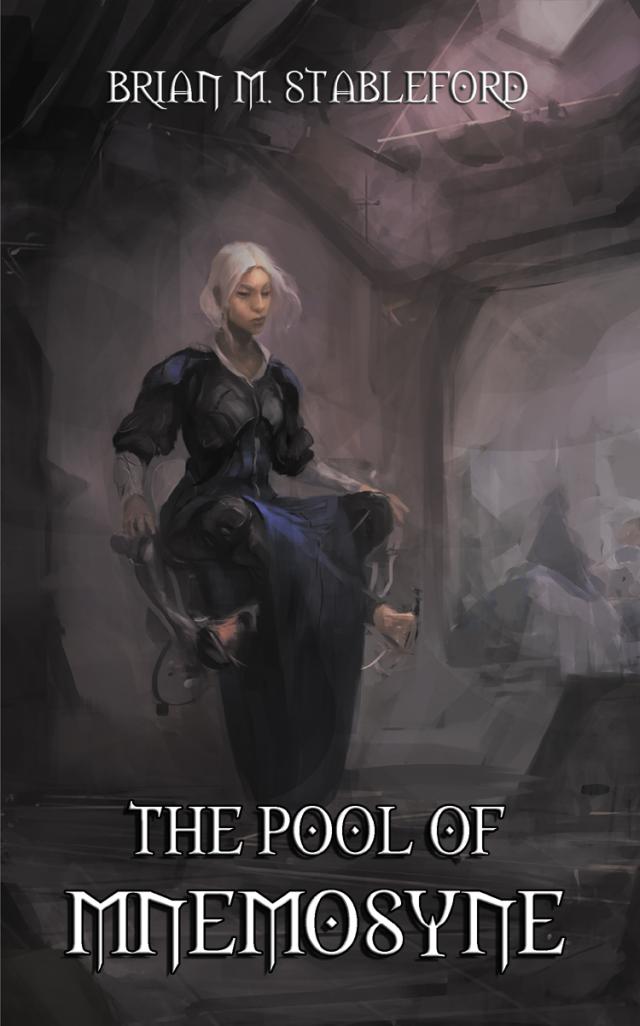
The Pool of Mnemosyne
by
Brian Stableford
A Black Coat Press Book
Introductory Note
This is the fourth volume featuring the autobiographical narrations of Axel Rathenius; the first of the four, The Wayward Muse, consists of three separate stories, whereas the present volume completes a trilogy containing a single coherent narrative, begun with Eurydice’s Lament and continued in The Mirror of Dionysus; it will complete the project definitively. Attentive readers will undoubtedly notice several discrepancies between the four volumes. Rathenius’ memory is not always reliable, and his accounts of what he thought and did at particular moments, written some time after the events in question, are often embroidered, not always consistently. It must also be remembered that the language Rathenius speaks is only distantly related to the French of our world by virtue of its Latin descent, causing problems in translation. Those problems are compounded by the fact that the translator knows nothing about the history of the alternative world and its geographical variations from our own world except what is actually written in Rathenius’ pages, inevitably inviting occasional false improvisations, for which he can only apologize.
Brian Stableford
THE POOL OF MNEMOSYNE
I. The Artist’s Eye
Elise, fatigued by her slightly artificial pose and, perhaps more remarkably, weary of playing her instrument, lowered her arms with a decisive gesture of defeat and dropped the lyre she was holding. For form’s sake, she said: “May I rest, Master Rathenius?” but I had no choice in the matter.
It was a moment that I had been anticipating for some time, with a certain amount of dread, but it was inevitable, and I was resigned to it. I looked at her during the few seconds that she maintained the stance of her head and the expression on her face, more by virtue of inertia than determination.
“Yes, of course,” I said. “I shouldn’t have kept you so long—I’m sorry.” I didn’t comment on the fact that she had not called me Axel; it was probably a sign of slight criticism or annoyance.
My eyes returned to the painting then, making the fatal comparison.
I couldn’t work out work out what I was doing wrong. I could still see all of Elise’s beauty, which had ripened somewhat in the months that I’d known her. Her black hair was more lustrous now than when I’d first seen her in the Sprite on the first night of the black snow, and her complexion, which had had no opportunity to lose its Lutecian winter pallor during the weeks she’d spent on Mnemosyne during the bizarre season that had followed the volcanic eruption, had taken on a delicate amber sheen under the subtropical sun of the Island of Dionysus. I could still see all her beauty, but I couldn’t capture it. What was worse, I had suspected for weeks that I wouldn’t be able to capture it. I had put off the acid test for as long as I could, but in the end, I had simply had to grasp the nettle—and I had been badly stung
We now knew, thanks to research carried out by Madame’ agents in Gaul, that Elise was older than she had first seemed when I had first seen her on Mnemosyne, and guessed that she was twelve. She was presently a few weeks past her fourteenth birthday, and that knowledge seemed to have helped her to appear more mature; always robust, her figure now seemed more luxurious in its feminine roundness. Perhaps she was not quite a young woman yet—although I was certain that she would disagree—but while she maintained the ardent concentration that she brought to playing any instrument, her features had an intense seriousness, and a hint of deep melancholy, that had absolutely nothing child-like about it. I didn’t think of it as a symptom of adulthood, but as a sign of true artistry, essentially ageless.
I could see all of that, and not with any common eye. When I looked at her, I could see her with my artist’s eye. Only fools think that beauty is in the eye of the beholder, but a beholder requires an artist’s eye to appreciate beauty fully, and to read the soul within the appearance. So what was wrong with my normally-reliable hand? Why hadn’t it begun to transfer that beauty to the canvas with its customary surety?
Had it been a mistake, I wondered, to ask her to pose with the lyre, which she’d only recently begun to play, instead of the viola da gamba, to which she was far more accustomed, in the interest of having her hold her head a little higher? She had certainly not been playing with her usual fluency or verve, and that had inevitably had a slight influence on her expression, which had occasionally taken on a perceptible frustration and disappointment, but she had made an effort every time, and had succeeded in restoring the composure I needed.
No, the problem was elsewhere, in me and not in her. Somehow, a kind of fracture had taken place in me, between the eye and the hand—and very recently, because no such fracture had been evident only six or seven weeks earlier, while I had been putting the finishing touches to my portrait of Mariette—a trifle belatedly, by my normally rapid standards, but with complete efficiency. Since then, I had only done sketches, although six weeks was an unusually long interval for me not to apply paint to canvas; the simple truth was that I had been direly anxious about making the attempt, and today’s fiasco had proved that I was right
My heart sank as Elise came across the room, saying: “May I see it?”
I have never been one of those temperamental artists who refuses to allow his sitters to see portraits in progress, and have rarely regretted the fact, even when the work was going poorly, but I had never before felt such sharp premonition of a sitter’s likely disappointment, or my own disappointment in having generated it. Elise had assumed a peculiar importance in my life, ever since the moment when she had instantly identified a crucial flaw in the then-incomplete Orpheus triptych, and had provided one of the crucial hints that had enabled me to complete the work—more successfully, it now appeared, than I had ever thought possible. I knew that she would not be able to provide the insight that would help me rescue her own portrait from the ignominy into which a dismal lack of inspiration was casting it, and I was fearful of any interpretation she might put on that failure, however temporary it might prove to be.
She looked at the incomplete portrait for a long minute, which seemed even longer, before finally saying: “Is that really how you want to see me?”
Obviously, she had no intention of putting up any pretence in order to spare my feelings. I supposed that I ought to be grateful for that, since it testified to a lack of any awkwardness in our relationship, which could easily have become manifest when I began sleeping with her adoptive mother, but it was difficult.
“I’ve hardly started,” I said, my quiver of apologies fully loaded. “I know it seems that it’s been a long sitting, and it has, but sometimes it takes time to get a grip on a subject. Sometimes, even after years of experience, it takes time and effort to develop a sketch into a painting...”
“That’s not what I asked,” she said bluntly, staring at me.
I couldn’t meet her eye, and felt desperately ashamed of the fact. I. Axel Rathenius, couldn’t meet the eye of an adolescent!—an exceptional adolescent, admittedly, but still an adolescent, barely out of childhood. To what had I been reduced, and how?
“I don’t know how to answer the question that you asked,” I admitted. “I’m not even sure what you mean by it.”
Her stare hardened. “You promised to tell me the truth, Axel,” she said. “I need that from you. You know exactly what I mean.”
What I had actually promised, a trifle recklessly, when she had asked for my advice on Mnemosyne, in circumstances very different from the ones in which we now found ourselves, was that I wouldn’t lie to her. I knew that she knew the difference, but I also knew that she probably had every intention of stretching the point as far as she could, and I wasn’t unsympathetic to her feeling that she needed the truth from me, for want of any other ready source.
“The simple truth is,” I told her, truthfully, “that I’m having a bad day. It happens sometimes. You know that. You first saw me when I was part way through the Orpheus triptych, when it wasn’t working…but in the end, it did. This is a work in progress; please don’t judge it until I’ve had a chance to put it right.”
She could have repeated her demand that I answer the question she had actually asked, and I think she hesitated over doing that, but it seemed that she became slightly alarmed by her own aggression, and the ill humor of which it was evidence. She really did feel that she needed me, as a source of advice, and she certainly didn’t want to risk alienating me. In a way, though, her sympathy would have been even worse than her disappointment. She had every right to be upset.
“It’s my fault, isn’t it?” she said, dolefully. “If I weren’t playing so poorly…in any case, how can I possibly criticize you, when I seem to have lost my own artistry?”
That surprised me slightly. I had certainly noticed that she wasn’t playing well, but, concentrating on my brushwork, I hadn’t attributed any importance to it, given that the changes of facial expression it induced were so fleeting. While I was painting her, the music she was playing was simply an element of the pose, rather than a performance, so far as I was concerned. It hadn’t occurred to me that she wouldn’t—couldn’t—think of it in the same way.
On the other hand, I honestly couldn’t imagine that my own failure could be any kind of reflection of her music. Living on Mnemosyne, I had had occasion to paint a great many musicians, ranging from the brilliant to the utterly incompetent, and I didn’t think, looking back, that I had ever been distracted from the focus of my own gaze simply because they were not playing well.
There had been times when music had been inspiring, perhaps magically, but usually with regard to works of art alternative or supplementary to portraiture.
“No, Elise,” I said, positively, “it certainly isn’t your fault. The flaw is definitely in me. I don’t know why, but for the moment, I’ve lost my touch. To tell the truth, I’ve been out of sorts for weeks, and that’s why I’ve been putting this off for so long. It’s happened before…I suspect it happens to all artists. Young as you are, you must have experienced something similar more than once. Sometimes, the inspiration simply isn’t there. It always comes back. It’s not something you can lose forever.”
I couldn’t be absolutely sure of that, of course, but I wasn’t lying. If I had faith anything, it was the resilience and durability of my own genius.
“Young as I am…,” she repeated, pensively. “Is that the problem? You still want to think of me as young, as a child, even though you know now…?” She stopped.
I remembered the odd way in which she’s framed her initial question, and realized that it might have been more significant that I had thought. Belatedly, I suspected that it might also be significant that she had assumed that I knew exactly what she had meant.
“I try to see all my subjects as they are,” I said, still drawing arrows of cliché from my quiver. “That’s the essence of the art. I aim for accuracy, for an essential truth. In this instance, I admit, I’m falling short for the moment, but...”
She didn’t let me go on. “You painted Mariette exactly as you wanted to see her,” she said, sharply. “What’s more, you painted her as she wanted to see herself—but that’s because you wanted to screw her, isn’t it?”
“That’s not...,” I began.
Again, she didn’t let me finish. “No,” she said, with a sigh. “I know it’s not.”
I was still at a loss, though, I didn’t know what it was that she thought it wasn’t.
She looked sideways at the portrait on the wall behind me: the portrait of Mariette, her adopted mother, and, at least for the moment, my mistress. Then she went to sit down on the sofa that was positioned beneath it, perhaps in order to turn her back on it. She didn’t have to take her eyes off me, and she didn’t.
“Sit down, Axel,” she said. “You’ve been on your feet for a long time. It can’t be good for you…at your age.”
That was pure malice, but I managed to smile at it. I had to admit that I felt older on the island of Dionysus than I ever had on Mnemosyne, and not simply because I had confessed my true age to Elise and Mariette. At that moment, I could almost have believed that, after more than seventy years of apparent existential stasis, I was beginning to age physically again. But that had feeling had come over me before, too, and the moments had always passed.
I didn’t sit down immediately, though, feeling that there was a point to prove. I had already set down the brush and the palette, but I folded my arms and stared at the portrait, as if staring might somehow cause the reason for its woeful imperfection to become manifest.
Her expression softened. “Please, Axel,” she said. “I need to talk to you. I need your advice...”
That sounded ominous, especially as I still considered myself bound by the promise I’d given her, but it was a tone of voice to which I couldn’t help responding. She was by no means the only female who had ever been able to soften me to that extent with a mere inflection, but she was the only one on the Island of Dionysus. I gave in promptly, and sat down beside her. “About what?” I asked.
She laughed, briefly. “Everything, alas,” she said. “First of all, though, I think I owe you an apology.”
“For what?”
“For making a stupid mistake. I practically told you to screw Mariette, while you were still hesitating. I did that because I thought it would make her happy. It was so obviously what she wanted.”
“Ah,” I said. “It’s a common mistake, I suppose, to assume that getting what we want will make us happy, but you don’t have anything for which to apologize. I had every intention of seducing Mariette if I could, having made the decision on the steamer, almost as soon as I discovered that she was aboard. I appreciated your blessing, obviously, but it didn’t change the course of events.”
“And you never had any intention of seducing me,” she said. It wasn’t a question. She glanced at the portrait as if she were putting two and two together. It was the wrong sum, even if it had produced the right answer.
“No,” I said, simply. “I never had. But that’s not why...”
Yet again, she didn’t let me finish.
“Where I grew up,” she observed, in a tone that was pretending to be clinical and distant, “girls my age are rarely virgins. As often as not, they’re already professionals. Mariette’s determination to save me from that by bringing me to Mnemosyne was…exceptional.”
“That’s not the point,” I said.
“Isn’t it?” she said, sounding more curious than challenging. She was frowning slightly, apparently not following the same train of thought as I was. I wondered whether she had been talking to Helen, and, if so, whether Helen had given her an excessively elaborate account of the reputation that I had cultivated on Mnemosyne—but I knew that she was far from stupid. She had had an opportunity to weigh me up now, and she knew that reputations acquired by gossip are highly unreliable measures, especially of artists.
“You don’t find me attractive—or don’t want to,” she said, looking at the portrait again.
“On the contrary,” I said. “I found you enormously attractive the first time I saw you, in the Sprite, and my appreciation has only grown since then—but one of the things I find enormously attractive about you is your innocence, and I wouldn’t want to spoil that for the world. In any case, I know perfectly well that you couldn’t find me attractive, even if I were only the age that I appear to be.”
I thought that was true—or, at last, that it ought to be.
The frown depended. “You do want to see me as a child,” she affirmed.
There was no point in denying it. “In a way, I do,” I said. “I can see quite clearly that you’re in the process of becoming a young woman, but looking back from my antiquity, yes, I do still want to think of you as someone very young, very new. And I don’t believe that you ought to want anything different, as yet. I think Mariette is entirely right in trying to protect you in that way, just as her own mother was right to try to protect her.”
There was a slight flash of anger in her eyes, which I thought unjustified. “She’s not my mother,” she said.
“She didn’t give birth to you,” I agreed, “but circumstances have dictated that she’s been the only mother you’ve known, and it seems to me that she’s exercised that function as well as anyone could reasonably have hoped, given the circumstances in which she found you.”
“Given that my grandfather had had my parents murdered, you mean?”
In fact, I had meant that fact that Mariette had been a very reluctant whore, trying to survive on Martyr’s Mount, and that Elise had just been dumped, as a helpless infant, on a struggling artist who hadn’t a clue how to look after her. Both Charles and Mariette, I thought, had executed the function of improvised and unlooked-for pseudoparenthood as well as could possibly have been expected. I didn’t bother to correct Elise, though; it seemed more politic to follow her agenda, wherever it might lead,
“I’ve told you before that I don’t believe that’s true,” I told her. “I had no reason at all to like Lord Dellacrusca, and I honestly feared at one point that he might have me murdered, but I’m perfectly certain that he didn’t have your mother murdered. She was his daughter. He would never have done that.”
She knew perfectly well what I wasn’t saying, but we were only talking about mothers, for the moment.
“She didn’t really love Charles,” she said, meaning Mariette. “She just wanted somewhere safe to live. I was just a ticket to that safety.”
I shrugged my shoulders. “Perhaps, to begin with,” I said, “but she certainly came to love both of you, deeply and sincerely. I could see that clearly, on Mnemosyne. You mustn’t think that because she’s with me now...”