To Challenge Chaos, page 1


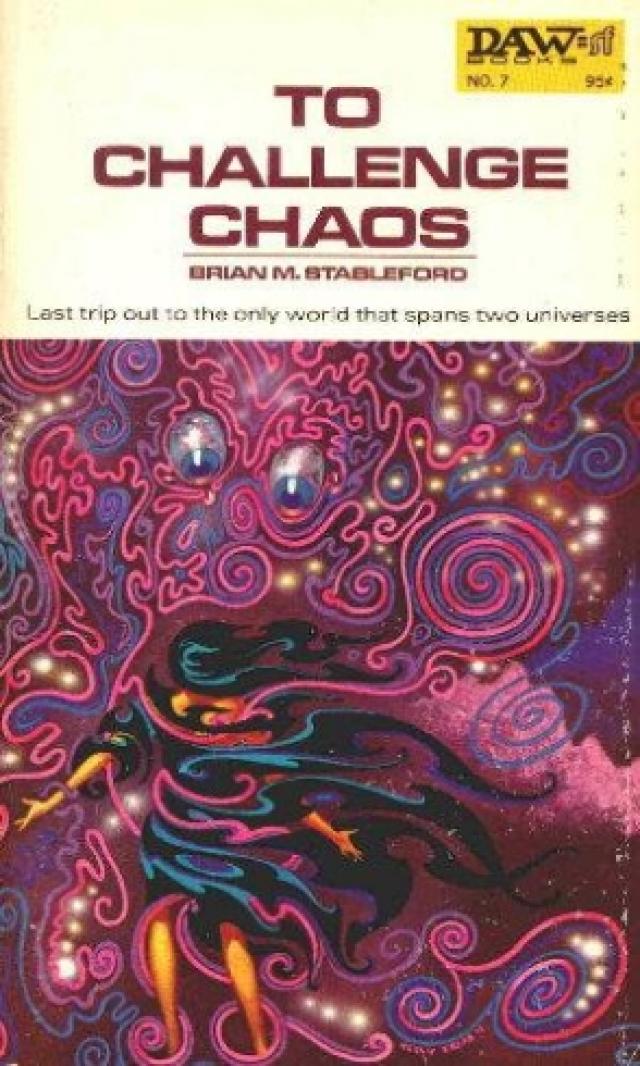
Title: To Challenge Chaos
Author: Brian M. Stableford
ISBN: 0879970073 / 9780879970079 USA edition
Publisher: DAW Books
*** Paperback book - 160 pages - scanned, and edited by biggles ***
Intro:
The “blackside” of Chaos X is in the ultrauniverse where the starships go to be free of the restrictive laws of physics. In ultra these so-called laws are mere irrelevances. Ultra belongs to the star wanderers. They it was who discovered the ways to the stars—for distances and directions are not the same in ultra as in space. They it was who ventured from system to system, galaxy to galaxy, not for exploration or for gain, but for experience.
It is perfectly possible that the star wanderers who made the ballads about the pioneers and the star wanderers they wrote about may be living still in some distant part of ultra. In ultra there is no death save destruction. To the blackside of Chaos X any man may go who wishes to live beyond his death. It is not easy. There is only one gateway, and where it is only three men know.
The fourth man who wanted to learn how to come and go through that gateway was Craig Star Gazer, star captain, space wanderer with a mission. This is his story—it is like no other science fiction novel you have ever read.
BRIAN M. STABLEFORD has also written
CRADLE OF THE SUN
THE BLIND WORM
DAY OF WRATH
and other novels.
TO CHALLENGE CHAOS
BRIAN M. STABLEFORD
DAW BOOKS, INC.
Donald A. Wollheim, Publisher
1301 Avenue of the Americas New York, N. Y. 10019
Copyright ©, 1972, by Brian M. Stableford
all rights reserved. cover art by Kelly Freas.
Dedication: For Mick Morriss
BOOKS printed in U. S. A.
Beginning
This is the story of Julius Watchgod’s last cargo—of Craig Star Gazer, of Ernst Nimrod, of John Wrath, of Donna Teredo, of Marc Coldflame, of Gray Gay Storm, of Dark Aura, and of Watchgod himself.
It is a fantastic extravaganza, a black melodrama, a mocking comedy, and a vicious tragedy.
Now read it if you want to. You’ve been warned.
page 5
Prologue
This story takes place on the blackside of Chaos X, the tenth planet of a star a very long way from this one.
Chaos X is the immobile planet around which the space storms rage ceaselessly. One hemisphere, the brightside, is forever directed at the burning glare of Chaos and is not a pleasant place to be.
The blackside of Chaos X is called black because it never faces the sun, but the blackside of Chaos X is not even in the same universe as the sun, and it is an even less pleasant place to be. There are no stars in the skies of blackside, only the space storms that demarcate the barrier on one side of which are two separate universes, and on the other side, only one. The blackside of Chaos X is a hole in space.
Blackside is in the ultrauniverse where the star ships go to be free of the restrictive laws of physics that determine the time they should spend in their traveling. In ultra the so-called laws are mere irrelevancies. Energy can be created or destroyed; no rules determine its flow. Time is not necessarily unidirectional and not necessarily there at all. When the star ships go into ultra, they take a little bit of space in with them, and that space will modify ultra, make ultra a distorted, unreliable shadow of itself. Then ultra might behave itself while the star ship reaches its destination. Or it might not—you can’t drive a ship through ultra if ultra doesn’t want to take you. There are winds that can spin you away to eternity and waves that can blot you out entirely. But with a good ship, and perhaps a prayer to one of your gods, you may reach your destination.
Millions of people are drifting in ultra during every moment I speak—passengers on the big liners, crewmen on the freighters. But ultra does not belong to them. Ultra belongs to the star wanderers, who do not carry bits of space into ultra with them, who cut themselves adrift on the winds of ultra and chart no course that has meaning in the spatial universe. They it was who discovered the ways to the stars—for distances and directions are not the same in ultra as in space. They it was who ventured from system to system, galaxy to galaxy, not for exploration or for gain but for experience.
The stories of the first star wanderers live now, magnified by time and the telling, becoming the legends and the myths of the star-spanning civilization. They grow and they multiply; every story is being perpetually added to as though the first star wanderers never died and are wandering still today in some distant, unimaginable fragment of the two universes.
Even this could be true because death is not the same in ultra, either. In ultra there is no death save destruction. In ultra you do not breathe, and neither do you eat. Energy is an irrelevancy, and you need neither oxygen nor food, nor any of the accessories concerned with the synthesis of energy. To drive your arms and legs and hold your mind together you need only create energy— after a while it becomes pure reflex, and you can have energy merely for the need of it, as any figment of the imagination may be called upon to supplement a dream.
In ultra I have seen men without hearts and men with smashed spines. As long as there is sufficient brain power to think and be aware, and sufficient will to want to be aware, then thinking and awareness will follow inevitably. Madness often also follows, but that is a matter of strength of mind. Ultra does not drive men mad, but it may often inspire them to insanity—madness, like energy, is free and readily available in ultra, not difficult to come by and often too late, as in the spatial universe.
And so it is perfectly possible that the star wanderers who made the ballads and the star wanderers they wrote about may be living still in some distant part of ultra, doomed to stay there because if they brought their shattered bodies back to space they would have been dead a hundred years. Dead men returning from ultra are dead in space, but dead men in space who are taken to ultra are destroyed men. Their minds are already oblivious. And so the ultralife is a conditional afterlife. Die in ultra and live until your mind gives up the struggle. Die in space and die forever. But who can take the emptiness and the loneliness of ultra for a home? Only men with lonely souls could tolerate ultra for a month (and a month can be eternity in ultra). Poets or artists with an endless capacity for experience, expression, and existence could drift forever in a tiny star ship—men like the star wanderers, whose ballads and poems are all that they have left to the “real” space and its people.
But could you or I do that? “Death is an ultimate condemnation to life without the security of imprisonment,” said someone—perhaps many people. The phrase is often attributed to Richard Orpheus, the greatest of the star wanderers, but many things are attributed to him, and the things that we can be sure that he did say are clearer than that. And Orpheus had seen the lie in the statement. There is a prison for afterlifers, and Orpheus was there.
To drift forever in a star ship is no kind of afterlife. But if there were a world in ultra—a place where there was surface—that would be quite a different thing. It would be a place to exist, a heaven or a hell, a haven of limited immortality. And there is such a world, or half a world— on the blackside of Chaos X.
To the blackside of Chaos X any man might go who wishes to live beyond his death. It is not easy. From ultra and space the planet is unapproachable because of the space storms that manifest the combination of the two and the extinction of one. Space ends abruptly a thousand miles from where the surface of blackside would be if it existed in space. Beyond that there are only the storms—unreachable because, relative to space, they are nowhere. Ultra does not stop, it continues behind the barrier. But at the barrier it is warped and twisted.
The barrier is on the surface of the planet, too—unreachable, unseeable, and uncrossable. But somewhere in
the interuniversal knot there is a flaw, a gap, a gateway. The boundary between brightside and blackside is a ring, half mountain, half sea, the mountains unclimbable and the sea unnavigable. Within the range of mountains and somewhere in the sea there is some unimaginable contortion of reality that will not permit a recognizable partition but will not permit a crossing, either. By means of some strange Moebius phenomenon there is no way from one side of the mountains to the other, or from one shore of the sea to the other. There is only one gateway, and where it is only three men know.
One is King Fury, the emperor of blackside, whose kingdom is the kingdom of the living dead. Another is Richard Orpheus, who came to blackside—so it is said— and left again. The third is Julius Watchgod, and if you want to go to Fury’s kingdom and live beyond your time, it is to Watchgod that you must go. Only Watchgod can take you through the mountains from brightside to blackside.
King Fury may not be an afterlifer—some say that he is a true immortal who can come and go as he pleases and is equally at home in ultra and in space. He has left Chaos X at least once. Who or what he was before he was emperor of blackside, I do not know. Again, there are stories. You can make them up yourself.
Only one man has ever been to Fury’s kingdom and returned, and that man is Richard Orpheus. Legend clings stubbornly to the assertion that this is truth and not romance, but what is legend to insist on such things? But if you believe it, Richard Orpheus rode with Watchgod’s cargo to Fury’s kingdom, saw Fury, and returned. His mission there was unimportant, but his escape was not. It gave every man in the universe the idea that, even if Chaos X was hell, it was not escape-proof. It sent a different kind of man to Fury’s kingdom.
In the beginning Julius Watchgod carried the hopeless and the stupid, the people who cling to life without even knowing what it is. He carried the old and the diseased, the weak and the fearful. After Orpheus came the heroes and the romantics. Perhaps King Fury was dissatisfied with his empire and allowed Richard Orpheus to go as bait for a different kind of subject so that the adventurers would come to Chaos X. It took only one example to put blackside into the legends, to put Fury’s kingdom on the map as “Heere be tygers” and not as wilderness. Watchgod’s cargoes grew and changed. Fury’s kingdom prospered, and a new kind of soul came to hell.
Watchgod toiled, carrying cargo after cargo through the gateway and across the surface of blackside to Fury’s kingdom. And Watchgod waited, waited for his debt to be paid and his last cargo delivered.
And this is the story of Watchgod’s last cargo, of Craig Star Gazer, Ernst Nimrod, Dark Aura, Marc Coldflame, John Wrath, Gray Gay Storm, and Donna Teredo. It was a small cargo. There were times when Watchgod carried a hundred or more. Watchgod didn’t care.
Page 9
CHAPTER ONE
Craig Star Gazer
Not tall and not strong—in mind as well as body. Hair of silver, but not old. Skin of bronze, but not suntanned. Eyes of medium brown, revealing conflicting evidence in answer to questions, which made him a very good liar if he chose to take advantage of it but really only meant that he was confused. His name was Craig Star Gazer, and he believed himself to be a simple man.
—12. Craig Star Gazer wandering in the ruined cities of Lyrex, looking for beauty and wanting to be loved. Melodramatic feelings burned into him by the blue-white sun and the fire in his mind. Not far from Chaos, even then— you could see the star quite clearly at night, but twelve years ago … he was a young man then. He loved a girl who had left him. He wasn’t contemplating suicide, just aching, more with injured vanity and cowering self-esteem than the pain of parting.
—8. Craig Star Gazer watching the six hundred colored moons of Campardal rising and setting, day after day, the black dwarf sun floating between them like a ghost against the white curtain of stars that comprised the Downwind cluster and made the night indistinguishable from the day. He was finding himself by now, finding himself lacking in the emotional depths necessary to respond to the beauties of the moons and their glorious dance. He was bitterly unimpressed by the most wondrous sights it was said the universe had to offer. This made him a simple man in his own eyes. Chaos was in another galaxy, but spiritually he was closer to it now.
In the eyes of other people his emotional shallowness made him strange and a little unattractive. In a very real sense the people around him—vast crowds come to watch the moon-dance-by-starlight—became meaningless, and he began to imagine himself lonely. He thought to himself: A man stranded by a fatal wound in the depths of ultra, on a crippled ship, might feel that he knows unbearable loneliness. But I am surrounded by people, and they serve to accentuate my loneliness.
The ultimate in loneliness, he thought, must be mine, in the midst of people too polite to be unfriendly but unable to conceal from a man that they do not like him. They can’t help it—it isn’t their fault that I am unable to respond to them and their universe in a way that they consider natural and acceptable, nor that I can detect their understandable alienation.
—5. Craig Star Gazer on Perma, a planet of ice and darkness, tenth from its lonely sun, in a loose array of stars hardly big enough to call a galaxy. Craig Star Gazer falling in love again. He made a habit of it. He was convinced that if one day his love could be returned, he would be saved from himself. His was a comic love—a love to be laughed at because it was so innocently wholehearted. And it was a tragic love, too, because it hurt him again and again. Craig Star Gazer, the simple man.
—2. This is the tragedy. This is the road to Chaos X. Craig Star Gazer, emotionally blind to everything except himself, fell in love with Anna. His body, which did not ask that he be ecstasized by the moon-dance of Campardal, demanded that he should love Anna. It was a love born of self-love, but it was true love nevertheless.
He talked to her, and she answered. He loved her, and she replied. He asked her, and she gave. His love for Anna became the absolute ruler of a pointless life. He never analyzed, never examined, never evaluated. He followed his star.
Anna went to Chaos X. Inevitably, Craig Star Gazer followed.
—7 hours. Talking to Watchgod.
“Why do you want to go to blackside?”
“Does it matter?” countered Craig, staring blandly at the other man. Julius Watchgod was a blank character— a nothing man with medium height, dull features, and quiet eyes. Craig was not impressed by his manner or his words.
“In a wide sense, no….”
“Then I will not tell you.”
“But …” continued Watchgod, stressing the syllable a little, “in this particular case it matters somewhat to me. I can’t refuse to take you to Fury’s kingdom whether you tell me or not, but I’d like to know—for myself.”
Craig was a little surprised. He did not, as a rule, matter to people, save as an unpushed pawn or a vaguely undesirable feature of the landscape. He was not used to people asking his reasons even out of curiosity. “Why?” he demanded.
Watchgod smiled a nothing smile—quick, unconvincing, and unreal. “This is the last, you see. My last cargo for King Fury. I’ve taken nine hundred and ninety-nine. This will be my last. Just seven people. It occurs to me sometimes that I’ve never known any of the people I’ve carried to Fury. They’re just cargoes. I don’t mind that as a rule. But it happens so inevitably, as though I can’t know them. I’d like to make an effort now. Just for once I’d like to find out why the people I’m carrying have come and who they are.
Craig nodded slowly, making believe that he understood or cared. He said, “You’re finally giving up? How long has it been?”
“Too long,” said Watchgod with a little laugh. “Thirty years, as near as I can say.
“Time ceases to have much meaning, you see. But yes, I’ve almost finished now.” He said it oddly, accenting it in the way one says a private aside to no one in particular. “I’d like some memories,” he continued, “but the only ones I have are of places and not of people. That’s why I want to know— Who are you, Craig Star Gazer? What do you want on Chaos X?”
Craig shook his head. “I don’t want to tell you what I’m looking for. I can’t tell you who I am.”
Watchgod looked disappointed. “No, I suppose not. Who am I? I didn’t really think that you could tell me your identity. But your aims—that should be simple. You’re young and healthy. You haven’t crawled here to die. You’re not morbid or psychotic. You hope to get away again. So why be ashamed of your reasons? There are a thousand worse. And they won’t matter, anyway, by the time we get to Fury’s kingdom. They’ll all lose their value once you’re dead. And nobody escapes from blackside. Nobody at all.” All the time Watchgod toyed with the empty glass that he held. It had not held anything since Craig had arrived. Watchgod spoke slowly and monotonously, sometimes plaintively. It was impossible for Craig to visualize him shouting or speaking with any strength of will.
“Richard Orpheus escaped from Chaos X,” said Craig.
“Did he? Perhaps he did and perhaps not. But you won’t. You can’t. You’ll stay on blackside until you die, and for some time after that, I imagine. Probably you won’t even notice that you’re dead—not all at once. You’ll slowly come around to realizing you’re an afterlifer, and you’ll be stuck with it. Fury’s kingdom forever and ever. Some people can take it. But it comes to everybody— nobody gets away before they die.”
“Richard Orpheus?”
“Forget him.”
“I can’t.” Craig paused. “This is your last trip.” “Yes. The thousandth and last.” “And you’re quitting?”
Watchgod’s head sank forward, and it finished up supported by the heels of his hands—his elbows were on the table. He had set down the empty glass. “That’s right,” he agreed.