

Scratch, page 7


Ellie hesitated, then smiled. She leaned in close to me, whispering conspiratorially. “Mr. Chickbaum’s friends are coming tonight.”
“Ellie ... we need to talk about ... Mr. Chickbaum.”
“I know you think he’s pretend, Daddy, but you’ll see. He had to do some stuff last night to get ready. Tonight, he can open the door to his world and then we can meet his friends.”
We walked out onto the deck.
“Ellie ...”
She screamed.
Lying on the deck was another half-corpse—two tiny, human legs about three inches tall, attached to the ragged remains of a miniature waist. It wore a little pair of green pants and one green shoe. The other shoe was missing. The bare foot had miniscule toes. Doll baby-sized blood and entrails spread out around the corpse.
Ellie screamed again, and then I joined her.
Hannibal lay nearby, sunning himself. He licked his lips and gazed at us with contentment.
Afterword
Most of this story is true. Except for the bit about the leprechaun. In real life, Hannibal’s name is Max. He showed up one day much like the cat in this story. He was just a tiny kitten, and fearful of everyone and everything. I don’t know if someone dumped him off at our house or if he was just born wild out in the woods. I fed him for a few days, but he still wouldn’t let anyone come near him.
Then, a week later, I was sitting in my office working on the first draft of Ghost Walk. I had the office door open to let in some fresh air. I heard a tiny little ‘meep’ and I looked down, and the kitten was standing at the foot of my chair. He crawled up into my lap, I named him Max (after the movie character Mad Max), and he’s been with me ever since. When I got divorced for the second time and moved into a new place, Max came with me. But before that, to repay my kindness, Max was very good at bringing me daily presents. He left them at the door to my office, which was on our property but in a separate building from the house. Often, the presents he brought me were half-presents. Usually, he caught mice and voles. Occasionally, he brought me a bird or a frog, which always saddened me a bit. I tried to discourage him from killing birds and frogs. Once, he killed a squirrel, just like the cat in the story. I wouldn’t have believed it if I hadn’t seen him for myself—dragging the squirrel across the yard. To the best of my knowledge, he never killed a snake, although I did find him messing around with a copperhead once. I shooed Max away and killed the snake with the .357 that I carried with me (the house was in a very remote area, with coyotes and snakes and bears and drunken rednecks, so I had good reason to carry a gun).
Several summers ago, author Tim Lebbon was visiting me for a few days. One evening, we were sitting around my fire pit, smoking good cigars and drinking some fine scotch (a gift from author Sarah Langan) and our conversation turned to cats, and their habit of leaving dead things lying around, and how, quite often, it was only half of a dead thing.
There’s a certain look an author gets when a story idea suddenly hits him. Tim and I got the look at the same time. We both grew quiet, stared into the fire, and mulled our ideas over.
“I just got a killer story idea,” I said.
Tim nodded. “Me, too.”
I told him mine and he told me his. They were both good ideas. We agreed that, since it was my house and my cat, I should get to write the story, but that I should include Tim’s daughter, Ellie, in it, since she also had a cat.
We finished our cigars and drank our scotch. The fire dwindled down to embers.
One year later, I wrote this tale. These days, Max is an indoor cat and occupies himself by chasing cat toys around my house.
The entity known as Mr. Chickbaum is also referenced in my novel A Gathering of Crows (but in a different form than a leprechaun). There’s a reason for this, which you’ll discover eventually. If I told you now, it would spoil the story to come ...
Brian Keene
September 2012
BRIAN KEENE is the author of over twenty-five books, including Darkness on the Edge of Town, Take The Long Way Home, Urban Gothic, Castaways, Kill Whitey, Dark Hollow, Dead Sea, and The Rising. He’s also written comic books such as The Last Zombie, Doom Patrol and Dead of Night: Devil Slayer. His work has been translated into German, Spanish, Polish, Italian, French and Taiwanese. Several of his novels and stories have been developed for film, including Ghoul and The Ties That Bind. In addition to writing, Keene also oversees Maelstrom, his own small press publishing imprint specializing in collectible limited editions, via Thunderstorm Books. Keene’s work has been praised in such diverse places as The New York Times, The History Channel, The Howard Stern Show, CNN.com, Publisher’s Weekly, Media Bistro, Fangoria Magazine, and Rue Morgue Magazine. Keene lives in Pennsylvania. You can communicate with him online at www.briankeene.com, on Facebook or on Twitter.
View more of Brian’s work in the US Kindle Store or the UK Kindle Store.
Also by Brian Keene
The Rising
City of the Dead
Earthworm Gods
Ghoul
Dead Sea
Kill Whitey
Dark Hollow
Darkness on the Edge of Town
Castaways
Urban Gothic
A Gathering of Crows
Take the Long Way Home
Jack’s Magic Beans
Tequila’s Sunrise
The Cage
Shades (with Geoff Cooper)
Clickers II: The Next Wave (with J.F. Gonzalez)
Clickers III: Dagon Rising (with J.F. Gonzalez)
The Damned Highway: Fear and Loathing in Arkham (with Nick Mamatas)
Continue reading for an excerpt from Robert Swartwood’s novella The Man on the Bench
“I absolutely loved The Man on the Bench. It was wondrous, intriguing, sweet, scary, surprising ... everything a good story should be.”
— David B. Silva
1
The summer of my first kiss was also the summer of the man on the bench.
It was 1922. Three years since the Treaty of Versailles was signed ending the war with Germany. Two years since a little unknown man named Adolf Hitler helped found the Nazi party in Munich. Henry Ford’s Model T was owned by over half the driving population of America, and in Paris James Joyce’s Ulysses was first published.
But all of this and everything else meant nothing to me.
I was nine years old, living in the backwater town of Benton, Pennsylvania. The only worries I had besides my chores were having fun and keeping out of trouble at the same time.
Except that all changed within the course of a few weeks.
A shadow fell across our tiny town.
First the cats disappeared.
Then the little girls.
But before that, there were Bobby, Joseph, Curtis, and Melvin. And their need to inflict pain on anyone younger than them.
2
Benton wasn’t one of your normal small towns.
Our general store wasn’t one of those places kids went into with wide eyes, their mouths drooling over all the candy in the jars. It was just some rundown house owned by Mr. Parker, who ordered supplies every week and had them shipped in from Harrisburg.
Our school had one room and was used for church on Sundays. Usually the only kids who attended were from ages six to twelve. The other kids took the three-mile hike into Providence, which was a prosperous mining town to the north. Not quite a suburb yet but getting mighty close.
There was no mayor, no township, and no office to elect a constable, so the one from Providence occasionally made his way into Benton to make sure everyone was keeping civil.
And for the most part everyone was.
Everyone except the children, though there were hardly many of them all told. Just enough to squeeze into that one-room school house, no more.
The only boys my age were William Dukes and Fred Wilson. We were best friends and closer than glue.
Except when Bobby and the rest of them were after us.
Then it was every man for himself.
3
It was a hot Thursday afternoon and we were down by the creek on the other side of Miller Road. It was a narrow thing, not much good for fishing and such, but at least the water was cool and came up to our knees when we stepped in. There were usually frogs in there along with crawfish and we’d try our best to find them, to try to get ourselves a new pet to play with.
We were doing just that when Bobby and the others showed up. They were all older than us, Bobby the oldest at fourteen. It seemed they never really had much to do except chase after us.
In Benton, there really wasn’t much else to do.
“Well, well,” Bobby said, grinning his crooked ugly grin. “What do we have here?”
It was enough for us. We darted out of the water towards the road, leaving our shoes and shirts behind. They weren’t worth getting anyway, and besides, it was a safe bet we’d find them eventually. Even if they would be hanging from a tree.
Though we weren’t a gang or anything, William was our leader. He was the strongest, the smartest, and we always listened to whatever it was he had to say. We’d follow him over a cliff if he led us. He was that kind of guy.
Now he was leading us up the road through the high grass. Behind us we heard Bobby and the rest as they splashed through the creek and shouted after us.
Across the road were the woods, which weren’t really woods at all but only a couple of acres of trees, with an opening in the middle with a small pond and field. Through the woods was Harris Road that led to most of the houses in Benton, ours included.
The obvious choice was to head through the woods and try to lose them there. Bobby and the others probably knew this, as did William, so maybe that was why William shouted, “Down the road!” and swerved that way.
Fred was right behind him, following without hesitation.
But I hesitated. I didn’t understand. Going through the woods would be the better choice.
Behind me, the shouting was getting closer.
I second-guessed myself and kept going straight.
I glanced over my shoulder just once as I broke into the shade and dashed through the trees. Bobby shouted something to Joseph, Curtis, and Melvin, and they took off down the road after William and Fred. Bobby kept going straight for me.
I never really understood why Bobby hated me so much. As he was the leader of the pack he roamed with, it would only make sense he’d go after the leader of our pack. Instead he always came after me.
Always made sure he had more punches for me than anyone else. But the beatings were never too bad. Not bad enough that my mother would notice. At least Bobby and the rest of them were smart on that end, because they knew none of us would say anything. Because we were nine and telling on them would mean we were babies and we were nine and we were not babies.
I guess, though, I did know the reason deep down.
Angela, Bobby’s sister, was almost a year younger than me. Eight years old wasn’t much, but she was pretty, that was for sure. And though I wasn’t in love with her, I did like her to some extent. But I guess she liked me even more and Bobby knew this and hated the idea of his sister liking a little brat like me.
I ran full out through the trees, dodging limbs and leaves. I’d been roaming through here as long as I’d been alive and knew the way pretty good. Then again, Bobby had been roaming them longer and he knew them even better.
I was chubbier than most kids my age, but not fat, and somehow I was able to run pretty fast for my size. But sometimes it wasn’t fast enough. I hoped it would be this time.
Through the trees out into the clearing towards the pond and open field. There was a wooden bench there by the pond, something that looked as if it’d been there since the beginning of time, and I wished an adult was sitting there now, because only adults made Bobby stop, made him slow down and smile and try to act like a decent young man his age.
But there was no one there. I was alone, just me and the huffing and puffing monster behind me, who sounded as if he was catching up.
I sprinted through the field, towards more trees, my bare feet smashing down the grass. I briefly wondered where William and Fred were, how far they’d gone and whether or not Joseph, Curtis, and Melvin had given them any punches yet.
“Come on,” Bobby shouted, eagerness in his voice, “I just want to talk!”
Heading into the trees that would take me out onto Harris Road and to the safety of houses and adults, I glanced over my shoulder only once, hoping and wishing and praying that Bobby would trip, that he would fall on his face.
Only it was me who tripped.
Right over my own stupid feet and then I was down, skidding across the grass and burning my chest.
Bobby was on me a second later, his knee digging into my back and his hand pressing my face into the ground.
“Aw, poor baby,” he said, laughing, and pressed my face even harder until I could hardly breath.
I did whatever I could to get him off, kicking and bucking and waving my arms, but it was no use. My eyes were squeezed so tight I couldn’t see anything but white dots in the dark and I started to cry—I started to cry just like he wanted me to and I hated myself for it.
Then, suddenly, his hand and knee were gone.
For some reason I didn’t realize this at first, and just lay there, my face pressed into the grass, still kicking and bucking and crying.
“Ethan, get up.”
It wasn’t Bobby’s voice.
I raised my head, tears in my eyes, and saw my Uncle Grant standing a couple yards away, putting most of his weight on his good leg. He was dressed in his work clothes and had his arms crossed, scowling at Bobby.
Sniffling, I stood up and wiped my face. Glanced behind me and saw Bobby standing there, his hands behind his back, like he’d just gotten there and didn’t know what was going on.
“Are you all right, Ethan?”
I looked at my uncle and nodded once.
“Well, Robert, what do you have to say for yourself?”
Bobby had nothing to say for himself. He stood with his hands behind his back and stared ahead, a slight knowing grin on his face.
“Well?”
“Well what, sir?”
I slowly walked towards my uncle, who continued standing there with his arms crossed.
“I think an apology is in order.” My uncle’s hand fell on my shoulder, and he gently turned me around to face Bobby. “Come on now, Robert, tell Ethan you’re sorry.”
Bobby’s eyes left my uncle’s and stared straight into mine. It wasn’t so much a stare as it was a glare. He opened his mouth and I saw his teeth gritted together.
“I’m sorry,” he said, his voice complete ice.
I wasn’t sure which I hated more, being beaten up by Bobby or my uncle saving me. Because now the anger in Bobby was just going to boil, and the next time we met up the beating would be even worse.
“Okay now. Why don’t you run along, Robert, before I feel the need to call on your parents.”
Bobby’s eyes shifted back to my uncle and for a moment he did nothing more than stare. Then he nodded and turned away, started back towards the pond and the trees.
I watched him leave and then felt my uncle’s hand pulling me away. I looked up and saw him nodding at the trees towards Harris Road.
We walked in silence for a while. William and Fred crossed my mind and I wondered just how far they’d gotten. Had they outrun Joseph, Curtis, and Melvin? Or had they gotten caught, were now sustaining some kind of beating, a beating that would only increase when Bobby got there and dished out whatever he felt like giving them?
“It was the strangest thing,” my uncle said. “I was walking along the road and thought I heard some shouting and for some reason knew you were in trouble. So I ran through the trees and yes, there you were. Are you sure you’re all right?”
I nodded once again without a word.
“What about William and Fred? Where are they?”
I shrugged. I didn’t feel much like talking.
We’d entered the trees and were now making it out onto the side of the road.
“What about your clothes? You know you can’t go back home without your mom asking you where the rest of your clothes went to.”
He had a point, but I wasn’t about to head back to the creek anytime soon.
“How ’bout I cover for you? If she’s there, I’ll get her distracted and you can go in and get some other clothes to wear in the meantime. What do you say?”
I looked up at him and nodded, still wondering what had happened to William and Fred. Uncle Grant was grinning, which made me grin too. It was always something good to see, because I knew that when my uncle grinned everything was going to be okay.
And for a moment, I actually believed it was.
Copyright © 2012 Brian Keene
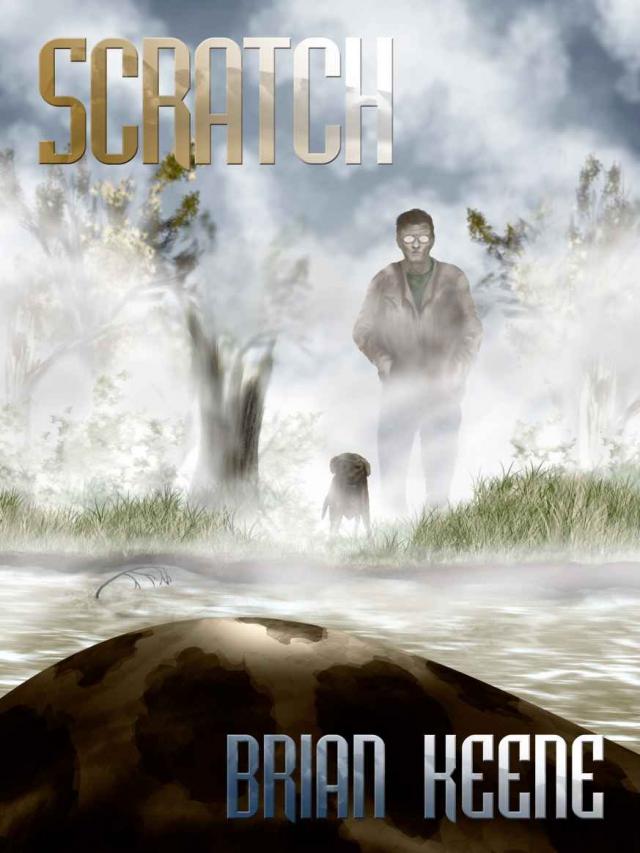
Cover image and design copyright © 2012 Russell Dickerson
Ebook design by Robert Swartwood
Scratch was previously published as a limited edition hardcover from Cemetery Dance.
“Halves” was previously published as a limited edition chapbook from White Noise Press.
This is a work of fiction. Names, characters, places and incidents are either products of the author’s imagination or used fictitiously. Any resemblance to actual events, locales, or persons, living or dead, is entirely coincidental. All rights reserved. No part of this publication can be reproduced or transmitted in any form or by any means, electronic or mechanical, without permission in writing from Brian Keene.


